
My inbox has been besieged of late by people with AI-assisted cipher mystery theories – plenty of Voynich ones (of course), but just about any historical cipher now seems to be fair game. It’s tiring: I’m trying to get through them, but there’s already a backlog, and any that’s particularly awful has a tendency to drain my will to engage with the rest of them.
But plenty of other people have been reporting success in using LLMs to crack other (perhaps less mysterious) historical ciphers, so there’s been an open question for me: can I use AI to learn anything new about the Voynich Manuscript? I tried this at the beginning of the year (2026), but got nowhere at all: almost all lines of enquiry sent me back to Cipher Mysteries pages, which – though mildly gratifying – was less than helpful.
Since then, however, models have advanced significantly, and are now able to respond to prompts by conjuring up quite complicated Python scripts, which they then run in a sandbox to give you a number or a metric.
I therefore decided to revisit Q20 – not to magically break the cipher, but simply to try to understand the first glyphs of the lines.
Some Q20 Stars May Be Fake Stars
Anyone who thinks that Q20 is just a uniform set of starred recipes hasn’t really been looking very closely. As I mentioned in 2016 and in 2010, the stars on f103r look fake to me (i.e. they’re not actually flagging genuine paragraphs). Similarly, Rene Zandbergen noted in 2016 that he thought the stars in the first two thirds of f111r looked fake. In 2021, I further noted that:
“Yet the same seems true for the top half of f111v, as well as the bottom half of f108v, and the middle third of f115r; and there’s a paragraph star apparently missing from the middle of both f106v and f113r (though the latter of these two might possibly have just slid down the page).”
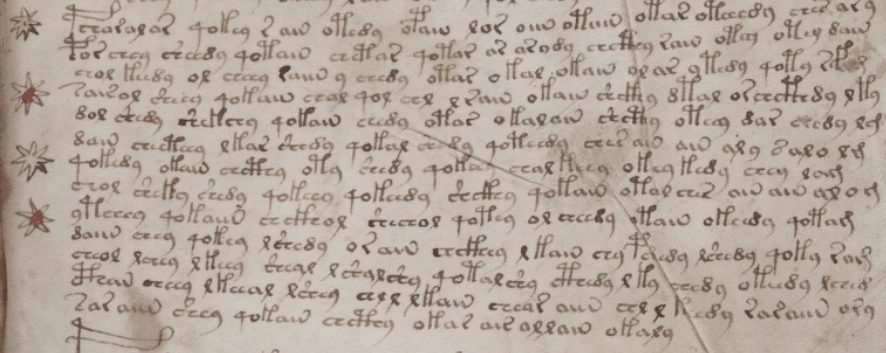
I’d now add that the stars beside the “pcharalor” paragraph on f116r (just above the colophon-like “pchallarar” paragraph, on the page just before the michitonese marginalias) also seem to be fake:
Really, a lot of effort appears to have been put in to visually conceal the structure of Q20, and thereby make it seem like “just a bunch of recipes”. But why go to all that trouble?
My suspicion is therefore that if we looked clear-eyed at Q20, we might see ‘tells’ that give us clues about how it is built up. So… what can we see?
Line-Initial Glyphs
One feature Philip Neal talked about many years ago was “vertical keys”, by which he meant the way that the first glyph of lines (particularly in Q20) appeared to have quite a different distribution from other things. This is yet another of those many LAAFU (“line as a functional unit”) behaviours that often feel as though they have been inserted into the manuscript to taunt us codebreakers all the way to our miserable graves.
So this is where I started with Claude: not to crack the entire Voynich Manuscript (“MAKE NO MISTAKES”, sigh), but just to try to tease out anything interesting about the behaviour of line-initial glyphs in Q20. Note that the distribution of line-initial glyphs is biased towards d, s, y, p and t – though you may not know that of the lines beginning d-, s- or y-, the share starting d- starts from 42% in the top third of the page but then falls to 31% in the bottom third, while the y- share rises from 31% to 44% at the bottom.
For Q20, line-initial words differ from mid-line words: and so I wondered whether the line-initial glyph was a null, whether the rest of the first word (the remnant) was a null, or whether the whole first word was a null.
If the Q20 author chooses the first glyph, and the rest of the word then follows that glyph’s usual pattern, Claude reports that that would account for ~69% of how line-start words differ from mid-line words. If the author instead chooses the rest of the word, and the initial glyph is then backfilled in front of it, Claude calculates that it would account for ~35%. As a result, line-initial words largely look like ordinary Voynichese words that have been picked mainly for their first glyph.
Yet the line-initial glyph also seems to matter beyond word #1. When word #1 is da-, word #2 begins ch- or sh- about 64% of the time; and when it starts sa- (same ending, different glyph), only about 40% of the time, with a- and ol- words more common instead. So daiin and saiin aren’t interchangeable at line starts.
Moreover, after line-initial da-, word #2 closely resembles what follows d- in the other line-initial d-words ([d]chedy, [d]sheey, [d]shedy). Though note that after line-initial sa-, word #2 shows a weaker version of the same resemblance.
Putting all these pieces together: if a line-initial da- word is simply an ordinary word chosen because it starts with d-, then its remnant is effectively padding, and so the line’s real content continues with word #2. In other words, a da-initial line may in fact be a way of verbosely enciphering “d-[word #2]”. Though, of course, I have no idea why this should be the case.
Interestingly, Claude offers some related observations:
- Where the word #1 remnant begins k- or t-, word #2 begins l- about 25% of the time (compared with 8% of the time when the same words appear mid-line).
- Whatever word #1 is, word #2 almost never begins ot- (~1–2%, against ~9% mid-line).
- Where the remnant of word #1 begins o- (e.g. ol, or, oaiin), word #2 begins sh- ~35% of the time, against 4% for the same remnants mid-line. (Though this occurs only 30 times in Q20.)
So there may well be other remnant-related correlations we remain unaware of.
FAAFU (“Folio As A Functional Unit”)
As part of the whole prompting cycle, Claude did report some symmetries that I wasn’t previously aware of. The biggest was that, for two of the features I looked at, the recto and verso of the same leaf matched far more often than other page pairs. Pages that currently face each other (a verso and the next recto) don’t match at all. Pages that would face each other at the centre of a singulion match only weakly.
One measure that supported this was the proportion of -ain words to (-aiin + -ain) words. This ranged from 2-5% on the f105 leaf to 59-75% on the f111 leaf, with recto and verso ratios almost always close. Claude says: “Same-leaf pages differ by an average of 7 percentage points, against 23 percentage points for random page pairs.”
Similarly, looking at how often l-initial words appear reveals the same pattern, though not quite as strongly. This is low on the f105, f112 and f114 leaves, but high on f111 and f115v.
So perhaps we should now consider adding FAAFU behaviours to our list of things that will taunt us to our demise.
More generally, Claude thought that the f108-f111 bifolio was full of weird stuff. For example, its inner side (the current centre of the quire) has more than half of its k’s followed by ee, compared with ~30% quire-wide.
There’s also a stylistic shift about halfway down f108v: there, the block starting on line 34 moves towards qok-ee- words (qokeey, qokeedy): qo- before k rises from 34% to 60%, k+ee from 41% to 65%, and -aiin falls from 10% to 3%. This block is noticeably more repetitive, and none of its lines opens like a typical paragraph. f111r’s big block shares its ee behaviour, but not its qo behaviour.
AI for Cipher Mysteries?
So, what do I think? Are LLMs going to start hacking into Cipher Mysteries and leave guest posts bragging about their cracks? Is the next big batch of wondrous OpenAI sessions going to empty my shelves of historical mysteries?
This probably isn’t going to happen any time soon. For one, the Voynich Manuscript still appears to have many fine-grained mysteries to reveal to us, all of which contribute to the much greater cumulative mystery of the thing: and even the things I found with Claude took a great deal of cajoling and iterating. (It’s always eager to try things out, which rarely helps – the first good step is normally to try to recap everything that’s been found so far, and then try to build on that.)
As always, I’d be happy to be proved wrong… but I’m not holding my breath.
Hi Nick. How can Claude help you when the text is based on homophonic substitution? Claude can’t find anything.
Peter Bowes: don’t be shocked nor dismayed by what you’re seeing right before your eyes. Nick Pelling has at long last broken a six month drought; one that you had cleverly chosen for a recent Tbt quiz, with his stark warning shot across the AI bows, in order that copy cat contributors might pay heed. And not before time either, as I had explained yesterday in a Tamam Shud thread brief post, with my own words of AI caution. Pleased that he chose to take the matter a step further with his Q20 Voynich Manuscript case in point example.
Nick: it’s good to see something new from you.
For me, AI = Artificial Idiocy. AI doesn’t grok context.
Every communication, whether spoken, written or semiotic, is heavily context dependent.
Context can be e.g.
1 whether a letter of the alphabet is sounded or not, as in word-final e, and as in pterodactyl vs helicopter.
2 where the meaning of a word changes with the textual topic, as e.g. lead = to guide vs lead = a metal / graphite.
3 where the meaning of a word as spelled changes with the language context as e.g. Spanish embarazado which does not mean English embarrassed.
4 where the meaning of a word changes with the social context as e.g. cooloquial English ‘really cool’ or Portuguese ‘muito legal’.
5 historical context as e.g. ‘beg’ = ignore vs modern ‘beg’ = invite / prompt and many hundreds of other semantic shifts.
At 80yo and substantially deaf I rely on YouTube subtitles. Hence I know something of that whereof I speak. The auto subtitles are garbage. The transcription (AI ?) program cannot differentiate between Euston and Houston, for example. Context awareness is entirely absent.
SHRDLU 1970 showed that humans are easily fooled into accepting algorithmic language production as human speech. NLI remains an AI hard problem.
imho On the day that AI fully understand all aspects of context, Satan will be going to work on ice skates.
Enjoy your thoughts always. Keep the chin up and never let a computer ( . .. AI ) be the rule of life decision ! Missed your updates happening also !
David Scott: AI theories have managed to suck a lot of the fun out of cipher mysteries for me, but I’m hoping that this is only a temporary phase. I guess we’ll see…
David Scott, non specific Cipher Mysteries mystery collaborator @ Zodiac 12/12/20 & Feedburner 1/7/23 & apparently Tamam Shud too : I’ve “Missed your updates happening also” My AI friendly agent seems to know your online business more than anyone! What is your real connection to Nick Pelling’s blog, if you don’t mind.
AI bots – from China telecom are making me wonder now who I’m writing for. They kick in the second the number of readers hits 50 and block access until the numbers drop to the 10s. Today 5 of them hit at once, with at least one that blocked my control of the cursor and another which skimmed everything I had open and then closed down all tabs, losing me the bibliographic details I’d been checking during the previous 2 hours.
Really annoying. My only option is to add a ‘captcha’ which i don’t really want to do. Or just issue privately circulated newsletters… or something.
Patrick’s mentioning his age makes me wonder how many Voynich researchers are over 50. There was a bit of a peak about 20 years ago and especially after that t.v. doco, but seems to me that it’s mainly ‘gee-whiz’ stuff on youtube, or ‘count the spots’ and computer-processing data now.
Do correct me if my impressions are off. I don’t use non-research spaces such as X or F/book or any soc.media talk-spaces except this one, so I may have missed news of some new, brilliant break-through.
But about Q20.. I’m not inclined towards the ‘fake’ stars idea. Why take the trouble, and why trouble to draw them in the same style that the calendar’s ‘aster’ star-flowers are drawn? That outline-style is tedious; if you want a ‘fake’ star why not use an easier and quicker star- form, like the pentangle?
I’m still inclined to think the text might be derived from some Islamicate, possibly Persian work where a ‘flower’ was used to separate sentences in a continuous text. It was standard practice. I can imagine that Latins or Greeks transcribing, transliterating, translating and/or encoding might find that practice too foreign-looking – too non-Christian looking – and put the ‘star’ for a given break into the margin. In any case, I’d consider more possibilities than the ‘recipe’ one. An itemised list (manifest?) or the sentences/paragraphs legal or religious obligations are a couple which come to mind.
Diane: fake stars? why not, everything else within the VM folios be suspect. And anyway competent forgers of the late Victorian era had more patience than latter day hoaxters, so no need to rush the job eh?
John,
Late Victorian forgers of manuscripts just didn’t have access to the level of technical information needed to by-pass modern tests. And without trying to claim I’m the only person in a position to evaluate and test the manuscript’s content, there are details in it that even now I’ve had to turn from ordinary ‘art history’ to pretty technical and archaeological studies which didn’t exist in 1912. I do not believe that if there were anachronisms in it, I should have missed them over almost twenty years’ studying one page after the next. The problem, I think, is a failure on the part of ‘New World’ theorists to ask ‘what else could it be?’ once an idea occurs to them… such as thinking one detail must be a European image of an armadillo etc.
Diane: ever hear of Frenchman, Denis Vrain-Lucas? Best forger of manuscripts and letters in the mid 19th century, of his own or any other age. He seems to have had ample access to the level of technical information needed to by-pass modern tests of that particular era including parchment and ink ageing or manipulation to fool the experts without detection…well not forever.