
It’s an oldie, but a goodie: first published in 1979, Wilfrid Blunt and Sandra Raphael’s “The Illustrated Herbal” (particularly the revised 1994 edition) is a must-buy first read for any Voynich Manuscript would-be herbal decipherer – if only to make plain by how much its herbal pages differ from other contemporary herbals.

Of course, Blunt has sneaked a few pictures from the VMs in there (pp. 88-91); and though he cites Alfred Werner’s (1963) observation that one page in the water section is like “a plumber’s dream“, he quickly cautions that “…’Heath Robinson nightmare’ might seem more appropriate” (which is fair enough). But as for commenting on the plants themselves, Blunt is content to pass them by at some speed, in much the same way that Eric Sams fled from the ciphertext. You’ll just have to find your own answers, I guess.

What did I learn? A new way of looking at plants began to emerge from around 1380, which a handful of artists were plugged into – but which most plainly weren’t. For example, even Giotto wasn’t au fait with it (though he “painted birds and other animals with a tolerable naturalism, [he] still made trees like outsize herbs”, p.57), but Leonardo (circa 1500) certainly was (and I would add Van Eyck too). As far as herbals go, if you look at Rinio’s Liber de Simplicibus (1419) [which John Ruskin adored], or even Serapion the Younger’s Herbolario volgare (better known as the Carrara herbal, MS Egerton 2020) (1390-1400), I think there’s something ‘graphic’ about the rendering, that we might today recognise as a “draughtsman-like aesthetic”. But far, far beneath the soaring flights of these stunning, draw-what-you-see masterpieces, the pedestrian copy-what-you-know world of medieval herbals stumbled on regardless.
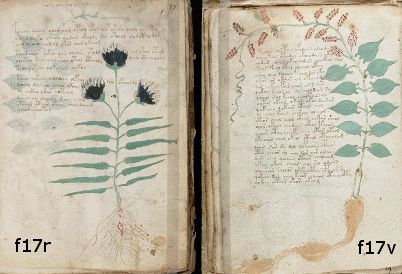
Voynich Manuscript f17r and f17v, side-by-side
Medieval and modern, on the front and back of the same folio!

In the big scheme of things, I would say that what we see in the Voynich herbal pages is annoying because it fails to fit in either of these two easy pigeonholes – neither the high flyers nor the low achievers. And so the VMs actually has a chasm on each side: and because it contains occasional flashes of both medievalism and modernity, it – doubly annoyingly – lets people read either (or indeed both!) of those into what they see. Yet in order for those flashes of modernity to be present at all, it has to postdate 1380, and must have had an author who was at least aware of both levels: while its overall drawing style matches 15th century stylistic conventions far, far more closely than it does 16th century ones. But there you go.

Blunt and Raphael’s work is built on two lifetimes’ worth of herbal scholarship and reflection: and, nicely, is happy to adopt a light tone when it suits the needs of the passage. This seems to happen particularly when quoting Charles Singer from the 1920s, such as Singer’s description of the Leiden manuscript as “a futile work, with its unrecognisable figures and incomprehensible vocabulary” (the VMs isn’t completely alone, then).

At the end of reading “The Illustrated Herbal”, I came away with my head buzzing with stuff, but none it about where the VMs’ herbals came from – Blunt’s Wittgensteinian “if you can’t say anything useful, stay silent” position on the VMs’ plants has a lot to commend it. No, what I was most inspired by was his discussion of the transmission of ideas about herbals during the 16th century: but I’ll have to return to that in another post (shortly)…
Peter Marshall’s (2006) “The Mercurial Emperor: The Magic Circle of Rudolf II in Renaissance Prague” takes a sideways look at everyone’s favourite mad Holy Roman Emperor, by using those around him as a kind of slightly wonky mirror. The choice of who makes the cut is a bit arbitrary in places: John Dee (who never came close to gaining Rudolf’s favour) gets rather more coverage than I think justified, however much some Voynicheros happen to like him. 😉

By using the Imperial court to cast light on the man in the middle, it is reminiscent (and perhaps consciously so?) of John Christanson’s “On Tycho’s Island”, which does much the same thing for Tycho Brahe (who features here too, of course).

Even though Marshall does sometimes feel compelled to thicken up his text with Wikipedificatory asides, overall you can’t help but enjoy the ride – it’s a basically good book. What you end up with is a feeling for Rudolf’s overall character arc, from his ultra-stiff Spanish upbringing, through the alchemical / astronomical / allegorical golden years, to the slow-motion showdown with his bluff soldier brother Matthias (which Rudolf lost, if you didn’t already know).

For me, the biggest takeaway I got from the book came from the raking light it cast onto Rudolf’s relationship with art. His collection of paintings was not, as Warburgian historians formerly liked to believe, imbued with Neoplatonist symbolic power, their artists digging deep into the cultural psyche to tease out deeper archetypes from myth and legend, which only heroic modern ‘symbologists’ (*ack* *spit*) could ever decode. Oh, no: it’s far worse than that; and perhaps worse even than Charles Hope’s art historical cynicism would put it. I think Rudolf’s all-star proto-Mannerist painters spent their time constructing his Imperial Internet pr0n browser: the vision that is conjured up for me is of them feverishly thumbing through their emblem books (etc) finding stories that prominently featured young women, and then ‘artfully’ arranging them on the canvas for maximum fleshly exposure. Shame on me for even thinking it, but ultimately Rudolf’s gallery reeks more of “Beavis and Butthead Win The Lotto” than anything else. Uh huh, huh. *sigh*

But I digress. 🙂

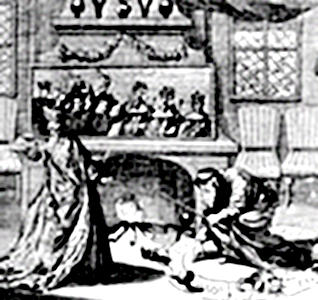
Marshall’s book did have one complete laugh-out-loud moment for me, which made my wife chuckle too (no mean feat). The engraving on p.151 depicts Nostradamus in a magic circle, conjuring up a procession of future kings of France for Catherine de Medicis in a “magic mirror” (not much to do with Rudolf II, but a fun picture all the same). I looked at it and thought – that’s not a mirror, that’s a bloody big plasma TV he’s got there. But perhaps you disagree?

Nostradamus showing off his widescreen TV to the Queen of France

Enjoy! 😉

Are you an historian with an enciphered document you want to read? If so, here’s a link to an article you really ought to have a look at: “Cryptanalysis and Historical Research” by Eric Sams, from Archivaria 21 (1985-1986) [it’s actually an extended version of two earlier articles he wrote for the TLS in 1977 and 1980].

There’s tons of good stuff in Sams’ article, such as a mention of the table of early shorthands in Isaac Pitman’s book “The History of Shorthand” (which I saw in Leeds University’s Brotherton Collection): this table really ought to be on the web somewhere (please let me know if you happen to find a copy). Incidentally, The Shorthand Place website has a fantastic list of shorthand collections in UK libraries.

But I know what you’re thinking at this point: “What does Sams think of the Voynich Manuscript?” And the answer is, well, not an awful lot:-

“Of course some archives are likely to remain dark and impenetrable. William Friedman, one of the world’s greatest cryptanalysts, spent many a fruitless hour on the Voynich manuscript, attributed to Roger Bacon, which is fluently written in a natural-looking yet wholly unintelligible language.”

AKA, “if it looks tricky, don’t even go there”. But wait: Sams isn’t finished yet…

“The British Library […] also owns an original volume of an equally obscure manuscript which begins by saying in plain English that no one will ever unravel the meaning of what follows.”

But… which manuscript would that be, Eric? Unfortunately, Sams – the teasing swine! – fails to say. (Please email me if you do know!) Flicking through the British Library’s manuscript catalogue, the best candidate appears to be “The Subtelty of Witches” by Ben Ezra Aseph (1657) [British Library MS. Add. 10035], written entirely in cipher… might that be it? Also: BL Ms Add 32305 contains 39 folios of “unidentified cipher keys”: which sounds like a lot of fun. 😉 But I digress! Sams finishes his discussion thus:-

So be it; many tracks lead into such caves. but none ever come out. The true treasure-chests are much more likely to be those which clearly once had real keys, later lost or mislaid. 

Well… speaking as a long-term denizen of the Voynich Manuscript cave, I have to admit that Sams might just have a point here. But no sense of romance, damnit! 🙂

PS: fans of Sams can find a list of his cryptological papers here.

As I mentioned recently, I’m working my way through James E. Morrison’s book “The Astrolabe”: seeing so many astrolabes at the Museum of the History of Science in Oxford was good fun, but I still want to get all the maths and celestial mechanics straight in my head – I’m never really happy until I get Art and Science in some kind of balance. Curiously, I worked for a camera company (/*you know who you are*/) not so long ago where stereographic projection (as used in astrolabes) is central to its business: isn’t it strange by how little maths has changed over the millennia?

But before the astrolabe, there was a set of objects known as anaphoric clocks (as mentioned by Vitruvius, De Architectura, Book IX, Chap. 8, 8-15): the Tower of the Winds in Athens is generally believed to have had one of these. These are deceptively simple objects, comprising a wire framework top layer (known as a “spider”) to represent the hours of the day, and a backlayer containing both a stereographic projection of the night sky and a circle of peg holes marking the sun’s position as it moves through the zodiacal year.  (All basically as per Morrison, “The Astrolabe”, pp. 33-34).

And now Kansas City is host to a brand new (and really quite funky) anaphoric clock, thanks to local artist Laura DeAngelis (with help from Peregrine Honig), as well as the advice and calculations of Jim “Mr Astrolabe” Morrison himself. If you happen to be in Kansas City unexpectedly (for example, if you click your heels, Dorothy), why not have a look for yourself? The anaphoric clock is in the Oppenstein Brothers Memorial Park, and I think it’s just fabulous (but I would, wouldn’t I?)