Before I begin: I just stumbled upon a bot-generated webpage that claimed to be “A discussion of the geography, accuracy and geometric salesman relating to the 14C farrago of the Voynich“. Who’d have thought random text could be so splendidly insightful?

Irena Hanzíková

Anyway… might Irena Hanzíková be our Voynich theorist of the day? A recent piece in Novinky.cz (the highest-traffic Czech news-site, and the online face of Czech newspaper Právo) has a nice picture of her:

irena-hanzikova-with-voynich-manuscript-cropped

The Voynich Manuscript is, she says, nothing less than “o knihu života” (the book of life), and that “Obsah bude pro všechny překvapením” (the content will surprise us all).

But the article does (thankfully) give us a short snippet of her transcription / decryption of folio 49 (it doesn’t say recto or verso) to keep us going while she gets the rest countersigned by a notary: apparently it says “Vedle cti doutná zlomyslnost, prospěch má sestru zradu, cílem je poznat svět, přesto svítit do tmy” (and, in case you hadn’t guessed, it is written in Old Czech).

Giuseppe Bianchi

Of course, Hanzíková has plenty of competition: such as Giuseppe Bianchi, a surveyor from Arquata Scrivia in North-West Italy, whose April 2016 article in La Stampa describes his wondrous Voynich microwriting theory.

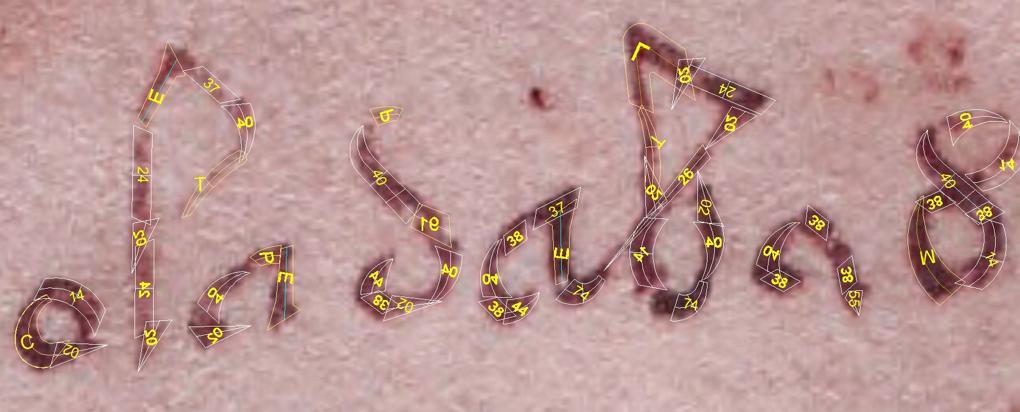
He believes the key to understanding the Voynich lies in f1r (the first page) and f116v (the last page), because the whole manuscript is sort of an experiment in “proto-typography” – forming letters with (terrifically tiny) stencils, where each stencil is equivalent to a particular code. Here’s how the second word of the (in)famous “michiton oladabas” breaks down into stencil presses, which is (I have to say) a lot like an odd cross between William Romaine Newbold’s supposed microwriting and the Phaistos Disk’s shape-stamping:

oladaba-kvfg-u1070913399848i8-1024x576lastampa-it

There’s plenty more on YouTube, if microstamping Voynich theories are your bag.

Glen Russum

Enthusiastic smoker Glen Russum has his own Voynich theory to fill his YouTube video with (for example)

I want for Yous to do most of the paying Sam Can Not
be doing it without Help o what I am saying to Help
I think I am wanting all 8 to Pay His and Hers, and
she also. Not I, Sam They I’m Not going to Pay-
not so- not for all 8 of Us! Have Mercy! Please woMen
Do not be so cruelly cruel. …. (do) Care

The first YouTube commenter calls this “Just ridiculous“: but having seen plenty of genuinely ridiculous Voynich theories, I’d be hard-pressed to say whether this has even managed to attain ridiculousness yet. I guess you’ll have to make up your own mind.

Volder Z

“Volder Z”, by way of comparison, is trying to carve out the perilously narrow linguistic furrow most famously ploughed by Stephen Bax’s ard. Volder takes some bits out of Bax’s box while discarding others; rules out most European languages; then moves to his own brand of “modified Syriac” (i.e. start with Syriac but twiddle with ~50% of each indiviudal letter, even though Syriac was written right-to-left *sigh*); and tries to logically deduce the gallows pronunciation in terms of aspirative plosives.

Of course, there are the inevitable problems (he thinks that EVA “i”, “v” and “q” don’t have sounds), and Volder has an entire second video (which I lost the will to watch after only a few minutes, but perhaps you will fare better). But the short version [spoiler alert] is that he thinks it is a super-early Romany language.

There’s a kind of relentless Mormon logic to Volder’s entire linguistic edifice that Bax utterly shares: that just because you can apply a certain frame of reference to a thing, not only should you do it, but that doing so guarantees you a good result.

And the rest…

I could go on (e.g. Karin Marie Olt, who was shown the solution by twins “Lisa and Leonardo” in her dream, now has a Facebook page and has published her own book, etc), but that’s not really the point.

For me, the single biggest reason why I haven’t covered these kinds of Voynich theories here for such a long time is that they – and even stuff like the bot text I started this page with – all merge into a single thing for me.

The way I see the Voynich Manuscript – as a series of micro-stories, all told by the manuscript’s internal evidence, but not as yet gelling into a complete macro-story – is so diametrically opposite to these Voynich theorists that it’s hard to bridge the gap between them. Asking which is the Voynich theorist of the day, week, month, year or decade would be missing the point: I don’t really want any of them, sorry. 🙁

There are two big problems with the Voynich Manuscript handwriting: (1) it doesn’t flow like normal handwriting; and (2) there are apparently a number of different “hands” in play.

The first researcher to properly foreground the idea of different “Voynich hands” was the US WWII codebreaker Prescott Currier: he noted not only that there were different types of handwriting (which he called “Hand 1”, and “Hand 2”), but also different types of contents, to the point that he grudgingly dubbed them different ‘languages’ (e.g. “Currier A” and “Currier B”, though it should be born in mind that his angle on them was overtly statistical/cryptanalytical rather than linguistic).

Rene Zandbergen has long written about numerous issues that arise from Currier’s A/B insights, as well as with the limits of what you can conclude from them (e.g. here): generally, it is more sensible to talk of Herbal-A, Herbal-B, Pharma-A, Bio-B, etc, because the differences between A and B taper and lurch around rather than abruptly switch.

What emerges from this is a far more nuanced and subtle picture than, say, Gordon Rugg ever assumed, as evidenced in particular by Mary D’Imperio’s interesting paper on cluster analysis (declassified in 2002).

Hand 1 vs Hand 2

But the same kind of thing turns out to be true of Currier’s initial Hand 1 / Hand 2 dichotomy: for when you look a little more closely at the pages, you find that there could easily be several different hands in play.

Certainly, few would disagree that there appears to be a broad division to be made between large-hand A pages (such as f8v, the last page of the first quire)…

hand-1-clip

…and tiny-hand B pages (such as f33r, the first page of Quire 5)…

hand-2-clip

It is certainly conceivable that Hand 1 and Hand 2 were both written by the same person (say, using different types of quill, or with different types of content, etc etc): moreover, some researchers (such as Sergi Ridaura and others) have specifically asserted that this is the case.

Yet the more that I have tried to work with the Voynich Manuscript’s pages as 15th century palaeographical artefacts, the less comfortable I have become with this suggestion. There are similarities between Hand 1 and Hand 2, for sure: but those similarities also sit at broadly the same kind of level you would expect to see from different scribes working in the same town, or taught by the same teacher. Further, I’d argue that there is no palaeographic ‘tell’ to be seen that links 1 with 2 in a definitive way: and that’s precisely the kind of thing you’d need to properly form the logical core of a “Hand 1 == Hand 2” argument.

More Than Two Hands?

Even though Currier started from this two-hand viewpoint (and was also not working with anywhere near as good a set of images as we now have), he eventually found himself pushed to a radical conclusion:

Summarizing, we have, in the herbal section, two “languages” which I call “Herbal A and B,” and in the pharmaceutical section, two large samples, one in one “language” and one in the other, but in new and different hands. Now the fact of different “languages” and different hands should encourage us to go on and try to discover whether there were in fact only two different hands, or whether there may have been more. A closer examination of many sections of the manuscript revealed to me that there were not only two different hands; there were, in fact, only two “languages,” but perhaps as many as eight or a dozen different identifiable hands. Some of these distinctions may be illusory, but in the majority of cases I feel that they are valid. Particularly in the pharmaceutical section, where the first ten folios are in a hand different from the middle six pages, I cannot say with any degree of confidence that the last ten pages are in fact in the same hand as the first ten.

Taken all together, it looks to me as if there were an absolute minimum of four different hands in the pharmaceutical section. I don’t know whether they are different than those two which I previously mentioned as being in the herbal section, but they are certainly different from each other. So there are either four or six hands altogether at this point. The final section of the manuscript contains only one folio which is obviously in a different hand than all the rest, and a count of the material in that one folio supports this; it is different, markedly different. I’m also positive it’s different from anything I had seen before. So now we have a total of something like five or six to seven or eight different identifiable hands in the manuscript. This gives us a total of two “languages” and six to eight scribes (copyists, encipherers, call them what you will).

So, might Captain Currier have been right about there having been so many contributing hands? Surprisingly, it’s not something that has been satisfactorily dealt with by palaeographers at any time in the last century. If you thought the silence following Mary D’Imperio’s paper was bad, the pin-drop-library-quiet surrounding Voynich palaeography is arguably even worse.

But perhaps we’ll start putting that right before too long…

Voynich Manuscript handwriting

Finally, the palaeographic problem with Voynich Manuscript handwriting is that it does not flow – for the most part, it’s not “joined-up writing”, as British children are taught to call cursive handwriting, but printed out, one letter (or short block of letters) at a time.

The reason I call this problematic is that this reduces our ability to do satisfactory palaeographical matching between Voynichese and other texts, simply because almost all other texts of the right kind of period are cursive. (So when we do comparisons between Voynichese and other texts, we are immediately at a disadvantage, because they are different kinds of things.)

The big exception to this sweeping generalization is, of course, humanist handwriting, which survives in numerous top-end Quattrocento examples much loved by palaeographers. While what we see in the Voynich Manuscript is most definitely not humanist handwriting, there is a strong case to be made that it is a “humanistic hand” – by which I mean something that borrows from the letter formation and ductus of both pure humanist hands and is yet close to more straightforward cursive mercantile hands of the time.

But a discussion of that will have to wait for a further post…

A little while back, the Yale’s Beinecke Rare Book & Manuscript Library announced that it would be allowing a specialist Spanish publishing house called Siloe to produce a short-run facsimile edition of the Voynich Manuscript.

The story was covered in El Pais back in December 2015, months before Siloe’s people had set their painstaking 18-month production process in motion. (Annoyingly, the second illustration that El Pais included was of a modern reinterpretation of a Voynich Manuscript drawing, *sigh*.) But even then, Siloe’s owners could clearly see the financial upside of the project:

“What really excited us about it was that it is one of the most requested books in the world for exhibitions, so it’s much simpler for an institution like the Beinecke Library, rather than having to loan the codex out all the time, to be able say that there is an exact replica that a Spanish publisher has printed that you can use. This was a good argument for persuading them to give us the project.”

In fact, few people outside of academia or museums even know properly what a facsimile edition is – it’s a copy of a book (usually a rare manuscript) that reproduces the original’s physical state as closely as practical. That is, it is not so much a printed set of scans of the original book’s pages as a brave attempt to reproduce the original object’s overall physicality – its page feel, page weight, waterstains, holes, stitches, binding stations, and all.

As you can imagine, this bravery takes a great deal of time and effort to achieve, not only in terms of the actual printing (which is extremely hard for normal pages, but the Voynich Manuscript also has a number of unusually complicated fold-out pages to deal with), but also in terms of things like getting the basic shape, texture and feel of the pages right, and even scanning the pages in a completely different way from normal. It’s a big, tough old job, however you look at it.

£6000 and up

In due course, the plan is for Siloe to place 898 facsimiles of the Voynich Manuscript on sale for around £6000 each: which, if they sold them all, would net them several million euros. All of which is surely enough to make a crypto guy or gal struggling away in their research garret wonder whether he or she is in the right bloody business. 🙂

But all the same, £6000 is a lot of money for a book, however much hard work has gone into making it. So apart from a small handful of (oxymoronic) cash-rich museums or libraries, who exactly would be ponying up their painfully-amassed cash for one of these improbably splendid facsimiles?

Well, it’s fairly hard to say. The Beinecke itself would want one to palm Voynich tourists off with: but it would be a remarkably inept set of negotiations that didn’t allocate at least one of the copies as complimentary. Siloe say that they have not far from “300” clients already eagerly splashing their cash for a copy: but in the ever-bullish world of press releases, it’s hard to be completely trusting of what any publisher asserts about pre-sales.

Even so, I’d personally be surprised if they had pre-sold a lot more than a hundred up until last week: which was when the all-wise Goddess of PR made them a gift they could not refuse…

The AFP Story

Two weeks ago, I was contacted by Madrid-based AFP journalist Marianne Barriaux, who was about to go to Burgos to interview people at the Siloe publishing house about the Voynich facsimile project, asking me if I might be available for a phone interview on the subject. Three days later, she emailed back to say not to worry, she’d since found Rene Zandbergen’s site and so now had no need to speak with me. Which was nice. 🙂

So really, it wasn’t a huge surprise to me that when the AFP story broke a couple of days ago, it was quickly picked up by numerous newspapers – Guardian, Daily Mail, Telegraph, Washington Post and so forth.

What did AFP do right in August 2016 that El Pais did wrong in Dec 2015? August is renowned in the UK press as the “Silly Season”, when the paucity of content (and a lack of journalists not on holiday) can lead B- stories to get trumpeted as if they were A+ stories… and sadly, this is what seems to have happened here. Timing is everything!

Still, the AFP news story is probably the best thing that could have happened to Siloe: chances are that they’ve had a load more pre-orders arrive over the last weekend. Break open another bottle of cava, chaps: happy days.

BBC World Service Newshour

For a 3-minute audio version of my take on the whole story, I was interviewed last night by Julian Marshall for the BBC World Service’s Newshour programme.

The point I tried to make (and that managed to somehow survive the edit) was simply that the Beinecke wasn’t making this Siloe facsimile available to encourage amateur codebreakers to take on the challenge of cracking Voynichese: really, it had done that extremely effectively back in 2004 when it had released its first set of high-ish resolution scans of the Voynich Manuscript’s pages. One might argue, from the continuous attention from the whole crackpot spectrum the Beinecke has had ever since, it was wildly successful in that regard. Success isn’t always what you want it to be, it would seem. 😐

Yet the Beinecke, I believe, would now dearly like to wrest control of the Voynich away from the nutters, and instead hand it over to academics: and so the real point of allowing top-end facsimiles to be made, I would argue, is that its curators want to legitimize the Voynich Manuscript in the eyes of academics as a genuinely interesting historical artefact, one well worthy of study and close analysis (even if we still can’t read a word of it).

However, up until now, the Voynich has been something far closer to Kryptonite for those of Academe who dare to step up to the line: its quicksand of uncertainty sucks in and annihilates reputations, not makes them. And so – sadly – it is hard not to conclude that it will probably be a very long time before the crackpot contingent leave the Beinecke and its forlorn manuscript behind… a very long time indeed.

But What About *The Other* Facsimile?

The first sort-of-but-not-really-a-facsimile edition (i.e. just a set of colour images) was published by Jean-Claude Gawsewitch in 2005 (I always bring my now rather tatty-from-overuse Gawsewitch to Voynich pub meets and talks), though now there are a whole load of similar books, and of wildly varying quality. But if you want to see the best quality images, download them for yourself from the Beinecke’s website.

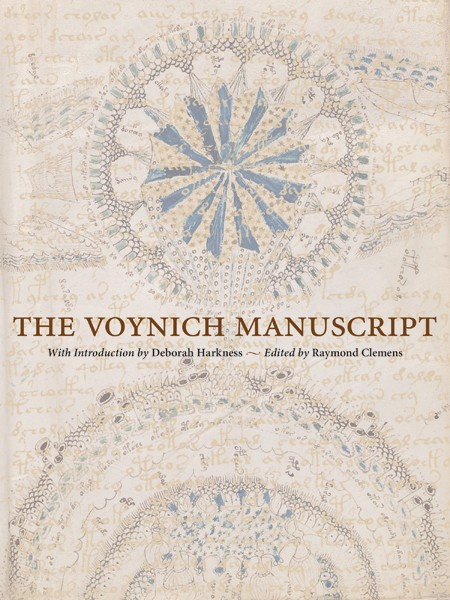
But lost in all the painstaking mire of Siloe details is the fact that the Beinecke has also produced its own mid-market coffee-table-style photographic facsimile-stylee reproduction, and will be publishing “The Voynich Manuscript” on 6th December 2016, just in time for Santa Claus to get some stock in for your stockings (or alternatively, Yale Books will happily take your £35 pre-orders now, so feel free to step right up, Good Ladies and Gentlefolk of the Interweb).

The publisher’s blurb for this (other) Voynich Manuscript facsimile says:

The essays that accompany the manuscript explain what we have learned about this work-from alchemical, cryptographic, forensic, and historical perspectives – but they provide few definitive answers. Instead, as New York Times best-selling author Deborah Harkness says in her introduction, the book “invites the reader to join us at the heart of the mystery.”

The-Voynich-Manuscript

So fear not! Even if your book budget won’t stretch (as mine certainly won’t) to a Siloe-style Voynich Manuscript facsimile, Yale Press’s coffee-table sort-of-facsimile will be far less likely to break your bank.

For me, it’s probably time to replace my ten-year-old Gawsewitch: the only downside is that I’m likely to have to grit my teeth in sharp disagreement with at least half of the essays at the front… but you knew that already. 😉

I grabbed a long-overdue day at the British Library yesterday. Apart from looking at Indian Ocean French pirate books (much more on which in future posts), I patiently worked my way through several thousand pages of the BL’s palaeography dating source books (most of which are on open shelves in the far end of the Manuscripts Reading Room, shelfmark MSS411.7), as I had intended to do back in 2009.

There were plenty of familiar authors’ names to keep me virtually company there – Charles Burnett, Malcolm Parkes, and Andrew Watson, to name but three – but in the end, it was just a matter of picking a date range (I chose 1400 to 1550) and ploughing through each book in turn to see what you find.

Palaeography dating books contain a long succession of images of manuscript pages (where the date of each image is known), usually arranged by date (though some have a miscellaneous section at the end containing images of handwritten pages whose date isn’t known exactly). Though some images have clearly been cherry-picked for their interesting content (e.g. nice marginal illustrations, ciphers, notable layouts, etc), there is rarely any more organization: the contents of the pages are a function not of any particular style but of the manuscripts the archives happens to have in them in that date range.

I went through the Swiss archives book set, the Austrian archives book set, and several of the 20+-volume Italian archives before running out of time. As you’d expect, much less than 1% was of specific interest to Voynich Manuscript researchers, but… I did find at least one thing that may well be worth looking more closely at.

Basel. Univ. Bibl. A X 132

In its section on Universitätsbibliothek Basel‘s manuscripts, Paul Oskar Kristeller’s “Iter Italicum” vol.5 says:

“A X 132. Steinmann, pp. 419, 457, 548. misc XV. Joh. Gualensis O.F.M., breviloquium philosophorum de virtutibus antiquorum principum (f.83). Vocabularius hebraico-latinus (202). Vocabularius graeco-latinus (220).”

Kristeller’s reference to (Martin) Steinmann appears to be to “Die Handschriften der Universitätsbibliothek Basel, Register zu den Abteilungen A I – A XI und O”, Basel, 1982: unfortunately, I ran out of time so didn’t get a chance to see this. But I did find the 1907 listing for the manuscript in Die Handschriften der Oeffentlichen Bibliothek der Universität Basel : Erste Abteilung : Die deutschen Handschriften : Erster Band : BASEL 1907″:

244 A. X. 132.
9. Johannes Gallensis, Breviloquium de virtutibus antiquorum principum et philosophorum.
Vgl. Histoire litter. de la France, T. 25, p. 182. Der Name des Verfassers findet sich in unserer IIs. im alten Inhaltsverzeichnis: a Johanni Gallensi editum.
Bl. 83v: Breuiloquium de virtutibus principum antiquorum et philosophorum. Quoniam misericordia et veritas custodiunt regem…
Bl. 101r Schi.: vbi vis permanere ego vita. Amen.
Completus est libellus de virtutibus principum et philosophorum Anno | a nativitate domini 1465 tercia die mensis septembris que | fuit dies martis
.

Hence the date that this section of the manuscript was completed was “3rd September 1465”.

And there is a mention in the handschriftencensus page to “Katalog der datierten Handschriften in der Schweiz in lateinischer Schrift vom Anfang des Mittelalters bis 1550, Bd. 1: Die Handschriften der Bibliotheken von Aarau, Appenzell und Basel, Text- und Abbildungsband”, Dietikon-Zürich 1977, S. 110, by Beat Matthias von Scarpatetti, which is where I found it.

It’s listed on Google Books: the text description of A X 132 is in section 296 of the “Text-” half of volume 1, while the handwriting is reproduced in Abb. 463 of the “Abbildungs-” half of volume 1.

Breviloquium de virtutibus antiquorum

Incidentally, Johannes Gallensis is one of the names that the thirteenth century Franciscan theologian John of Wales” was known by. His “Breviloquium de virtutibus antiquorum…” was a well-copied work: at least fifty copies are listed here, and there may well be many others.

But sadly…

Even though the handwriting we’re interested in runs from fol. 83r through to fol. 101r of Basel Univ. Bibl. A X 132, there are no images of this that I could find online at all, not even on the e-codices database doesn’t have a copy of in it.

And (worse) my mobile phone ran out of battery taking photos of pirate treasure books before I got this far. So all I can do for the moment is tell you about it rather than show it to you. But I thought you’d like to know anyway…

So: if anyone has access to a copy of “Katalog der datierten Handschriften in der Schweiz in lateinischer Schrift vom Anfang des Mittelalters bis 1550, Bd. 1: Die Handschriften der Bibliotheken von Aarau, Appenzell und Basel, Text- und Abbildungsband”, could I ask them to scan in a copy of Abb. 463 and email it to me? I’ll post it here as soon as I can, thanks very much!

Back in February 2016, I posted about a possible “block paradigm” match for the Voynich zodiac section – using a separate text uncovered by secondary research as a close match to the plaintext, and trying to work forward to the ciphertext, rather than blindly backwards from the ciphertext (as normal).

The match I proposed was with Andalò di Negro’s “introductorium ad iudicia astrologie”, a little-known fourteenth century text mentioned by Thorndike that covered per-degree judicial astrology. I tried hard to find a match between the tables in Andalò’s work and the poses of the nymphs in the Voynich zodiac section: but ultimately wasn’t able to. It might be there, it might not: I don’t know either way.

It was a disappointment: but not the end of the road by a long way…

The Paris 7272 Cipher

One of the two extant manuscripts of Andalò di Negro’s Introductorium is BNF Cod. Fonds Latin 7272: interestingly, as I noted back in 2009 when I saw its zodiac images in the Warburg’s photographic archive, this has some shorthand-like marginalia that had never been decrypted.

When I finally managed to get good images of these marginalia and posted about them, it didn’t take long before Marco Ponzi cleverly managed to crack the core of the cipher.

Once decrypted, these marginalia revealed the – apparently top secret – names of the spirits governing each zodiac sign, e.g.:

Aries: NOMEN ARIETIS SOLICET ANGELUS EIUS (EST) “SORON”
Taurus: NOMEN ANGELUS TAURA (EST) “TOION”
Gemini: NOMEN ANGELUS JEMINORUM (EST) “SAISIACIN” “GADLIO[N]I”
Cancer: NOMEN ANGELUS CANCRI (EST) “BARAM”
Leo: NOMEN ANGELUS LEONIS (EST) “COLIN”

The complete set of spirit names for the twelve signs is then revealed to be:

– IN?TIUS
– SORON TOION
– GADLION SAISIACIN
– BARAM COLIN
– MIMIN SUDRAM
– TEDUO GORO(?)
– UDABUL DOLI?IT

What I didn’t point out at the time is that because “GADLION SAISIACIN” would appears to be a single spirit name (that for Gemini), then “IN?TIUS” would appear to be the spirit name for Pisces. Hence Pisces would seem to be the first in the list.

And – I almost need not say, but I’m contractually obliged to – the Voynich Manuscript’s list of zodiac signs begins (slightly unusually) with Pisces. Which gives a small amount of support to the idea that these two documents may both be drawing in some way from the same well. It’s not a big thing, but I thought I ought to mention it regardless. 🙂

Voynich Pisces

Aside from the looking for a block match with the thirty posed per-degree nymphs corresponding to each sign, there’s another possible block match on the same page: with the text on each circular ring.

This doesn’t amount to a great deal of additional text for each sign: but given that something is definitely there, a similarly-sized piece of text associated with the original per-degree table for that sign might conceivably get us close to the original (unenciphered) plaintext for those rings.

In the case of the Voynich Pisces page (f70v2), the three rings of text (in EVA) are as follows:

(R3) Outer ring, clockwise from 11:30 (as per the interlinear transcription) [~43 words]:
okcheo.dar.otey.ykeey.tchy.otsheo.oteotey.shey.sheckh.opcheoldair.dateey.sal.ody.choteey.chocthedy.oteoteotsho.yteos.alain.sheodaly.ckho.aiin.cholkal.chotear.oteody.cholaiin.oteeey.al.ol.sheeor.okey.choldy.otees.chor.ol.ar.otoaiin.oteeody.sor.todaiin.chokain.otalal.otcham.

(R2) Middle ring, clockwise from 11:15 [~32 words]:
chedaiin.oteey.dair.shchey.daiin.chalaly.oteody.chotol.chedy.oteotey.oteeeor.ar.alody.daiir.oteedar.otchy.teey.dalal.cheoltey.oteedy.sheeteey.*.ykeeol.ykeeor.shey.ykear.araralor.daimamdy.otar.am.aral.otar*

(R1) Inner ring, clockwise from 09:00 [~20 words]:
otaldaly.oteoal.dalaildy.otaiin.ar.oteey.shal.o.qoteeal.ar.al.otaiin.al.teodaiin.oteey.cthey.oteeor.oteor.aiin.daim.

Note that this is my own reading of these lines, which is slightly different to other researchers’ readings. But that’s fairly immaterial here, because we’re looking for word-level matches with a parallel text: and remember that we have no evidence of any encipherer systematically hiding word divisions in a ciphertext until the early sixteenth century, some decades after the Voynich Manuscript was made.

The question now becomes: is there a similar-sized block of text for Pisces in Andalò di Negro’s “introductorium ad iudicia astrologie”? And if so, what happens if we try to make a block paradigm-style “block match” between it and the text in the Voynich Manuscript’s Pisces rings?

Zodiac Texts

It just so happens that there is such a text. In fact, I posted the complete set from the two extant Introductorium manuscripts on the Cipher Foundation website earlier in the year.

In the London manuscript, the Pisces text block looks like this:

andalo-pisces-text

In the Paris manuscript, the Pisces text block looks like this (with one extra sentence):

paris-pisces

This is roughly half the number of words of the Voynich Pisces ring texts: but once again, there’s a further short piece of useful text attached to the tables that (I expect) would also need to be carried across:

7272-pisces-table

Most of the text in the table is formulaic (i.e. common to all twelve zodiac tables), but some lines (specifically the top three lines of text) seem to be largely specific to Pisces.

I suspect that if you add these two half-blocks together, you would get close to the same number of words that the Pisces rings contain. Might there be a match of some sort in there? Very possibly, I’d say. So perhaps this may yet prove to be a practical start towards a decryption of this page, let’s keep our fingers crossed, eh?

And My Conclusion?

Well… sadly, I don’t have a conclusion yet. I’ve posted this as a set of work-in-progress notes for myself, and as a broad guide to the kind of approach I believe stands a good chance of cracking the Voynich Manuscript (in time) for others, rather than as a decryption as such.

But perhaps any passing Latinists will be so kind as to parse the handwriting and expand out the late medieval abbreviations, I’m sure that would be a very great help for anyone who would like to try to make a forward (block) match for this page. Thanks!

Since the Voynich Manuscript surfaced in about 1912, many of the best-known codebreaking experts have studied its writing (‘Voynichese’) in depth. Of them, many have concluded that it was written using a cipher system that was (a) stronger than a simple (monoalphabetic) substitution cipher, yet (b) mathematically weaker than a polyalphabetic cipher.

If the University of Arizona’s 2009 radiocarbon dating of the Voynich Manuscript’s vellum (which points to the first half of the fifteenth century) is correct, the most likely reason for (b) becomes blindingly obvious: polyalphabetic ciphers (such as those of Leon Battista Alberti, Abbot Trithemius, and Vigenère) hadn’t yet been invented.

So, does that mean that all pre-polyalphabetic ciphers were easy? Errm… nope. In fact: not even close.

Fourteenth Century Cryptography

Even though Gabriele de Lavinde’s 1379 collection of Vatican ciphers were, at heart, simple (monoalphabetic) ciphers, many also included “nulls” (special cipher shapes that code for nothing at all, and were added into ciphertexts specifically to try to misdirect codebreakers). In the hands of a tricksy encipherer, this can already become not at all straightforward to crack.

Even the very clever CryptoCrack doesn’t have a tool for predicting / identifying nulls in a given ciphertext: and it turns out (I believe) that this is a significantly harder technical challenge than you might think.

Moreover, many of the ciphers in Gabriel de Lavinde’s cipher ledger also contained a nomenclator: this was a list of typically a dozen-or-so shapes enciphering entire words, like a cross between a cipher and a code. (Broadly speaking, a ‘cipher’ enciphers a message a letter at a time, while a ‘code’ encodes a message a word at a time: so nomenclators blur the line between the two).

However, it’s far from clear (to me at least) whether nomenclators were added in the 14th century for security, speed or brevity. I suspect that to insist that it was just a matter of security would be to project principles of Schneieresque computer science onto the codemakers and codebreakers of the 1300s: the true answer would be some vague (and probably unworked-out) combination of all three.

Fifteenth Century Cryptography

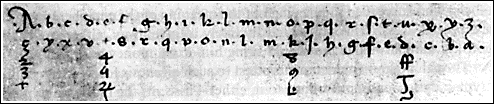
At the beginning of the 15th century, however, things started to shift (slightly) in the world of codemaking. 1401 was when a secretary at the Duchy of Mantua produced the following cipher alphabet for corresponding with Simeone de Crema:

crema-1401

Now, in many ways, this is a particularly stupid cipher alphabet, because the top (core) line maps each character in the alphabet to its reversed-alphabet equivalent (i.e. ABCDE –> ZYXUT and vice versa). Yet what is simultaneously clever about it is that it allocates multiple shapes to each of the five vowels.

To be honest, I think it would be a bit of a stretch to infer from this (as David Kahn tries to) that the notion of defending against frequency analysis-based attacks must necessarily have been entering cryptographers’ minds as early as 1401. Rather, it seems many times more likely to me that this trick (now known as “homophonic substitution”) was originally devised for a far more mundane reason: to make it harder for codebreakers to tell which letters are vowels and which are consonants.

Fast forward to the middle of the fifteenth century (probably circa 1450-1455), and we can still see the same palette of tricks in action in the following (undated) cipher alphabet in the Tranchedino cipher ledger from Milan:

milanese-cipher-part-1

Apart from not using the same alphabet backwards as the base cipher alphabet, it would seem that not much has changed since 1401: the vowels are still obfuscated with multiple homophonic alternatives (though with only three different shapes per vowel here, rather than the four shapes per vowel used half a century before).

The more observant among you will also notice that the (formerly Tironian) shorthand abbreviation ‘9’ gets its own cipher shape, as does ℞ (i.e. Rx, if your prehistoric browser can’t render Unicode character ‘U+211E’).

However, the later cipher alphabet also has special cipher shapes for doubled letters, a few other common shorthand abbreviations (p, etc), and a few more nulls than before:

milanese-cipher-part-2

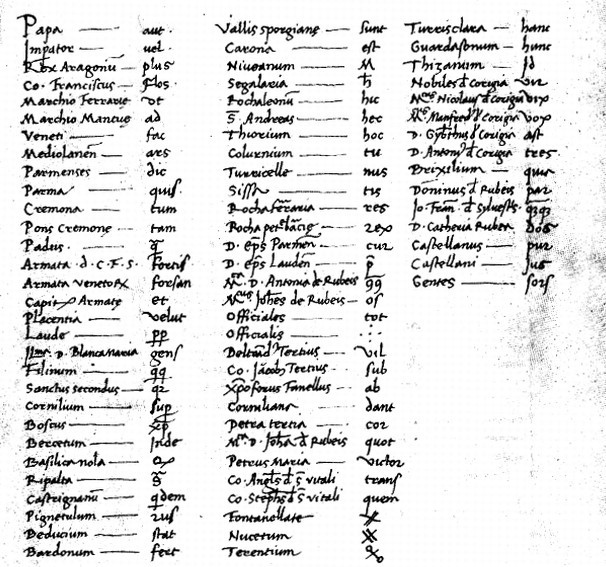
The nomenclator is noticeably beefed up, with this particular cipher boasting more than eighty special entries:

milanese-cipher-part-3

Another Mantuan Cipher (1450)

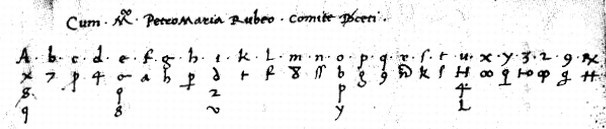
Given that the 1401 cipher was from the Duchy of Mantua, it’s interesting to have a look at a Mantuan ducal cipher from 1450 in the Tranchedino ledger. This now has two homophonic shapes per consonant (except for x, z, and the ‘9’ shorthand shape), and three homophonic shapes per vowel:

mantua-cipher-part-1

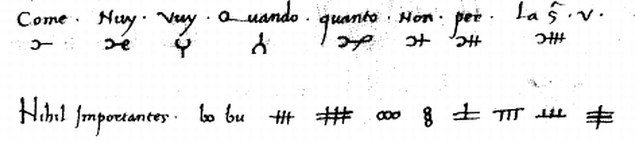
It then has a mini-codebook of common words (Come, Quando, Quanto, Non, etc) and some nulls:

mantua-cipher-part-2

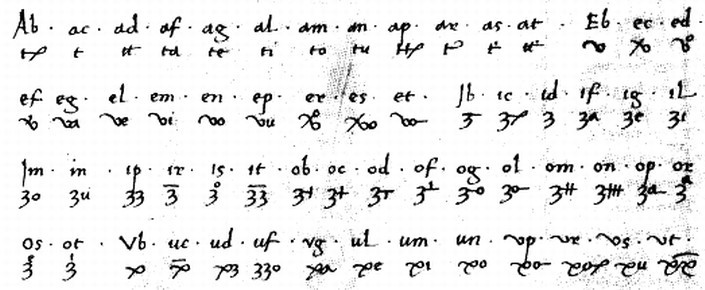
Interestingly, this is followed by an entirely new section, with arbitrary shapes standing in for a whole load of syllable groups (ab, ac, ad, af, ag, etc):

mantua-cipher-part-3

Finally, the page finishes up with roughly the same (small) size of nomenclator as had been in use in Mantua half a century previously:

mantua-cipher-part-4

So, You Call This “Progress”?

There is a long-standing (and widespread) tendency among writers on cryptography to present the development of ciphers in the fifteenth century as a kind of prototype of the modern arms race.

It’s perfectly true that, as the number of parties enciphering messages grew (along with the first flush of modern diplomacy) in the mid-15th century (many historians quite reasonably date this to the 1454 Treaty of Lodi), so too did the number of people who became experienced at cracking them.

However, there seems to me to be no evidence suggesting any kind of awareness of frequency analysis in the West in the fifteenth century. While Leon Battista Alberti’s short book on ciphers (“De Cifris”, 1466/1467) did cover this very well, he appears to have devised the abstract principles himself: and the contents of his book seem never to have been shared with anyone outside the Vatican. Similarly, al-Qalqashandi’s (1412) Arabic encyclopaedia entry on frequency analysis (mentioned in Kahn) appears never to have been transmitted to the West.

Don’t get me wrong, cryptology and cryptography both genuinely advanced in the sixteenth century: but in the fifteenth century, code-breaking had no mechanisms, no abstract methodology to work from: and fifteenth century code-making relied, by and large, on exactly the palette of tricks that were in place by 1450 or so. The only noticeable difference was that of scale: more homophones, more syllables, more nulls, and bigger nomenclators.

What, Then, Of The Voynich Manuscript?

In almost all practical senses, I think it’s fair to note that the Voynich Manuscript stands outside the cipher-making traditions you can see embodied in the cipher alphabets described above. It would seem to have too few cipher shapes to be using homophonic cipher tricks, doubled letters, a nomenclator of commons words, or even nulls.

And yet it dates to this precise period: and – arguably the most telling cryptanalytical feature of all – there is still no modern-day consensus as to which shapes are vowels and which are consonants. Even now, the letters that resemble ‘a’, ‘e’ (sort of), ‘i’, and ‘o’ continue to convince people seeing the Voynich Manuscript with fresh eyes that they ‘must’ not only look like vowels, but ‘must’ also be vowels. However, the closer you look at these, the unlikelier and wobblier this conclusion gets.

So, here’s your paradox for the day: even though the Voynich Manuscript is almost certainly not using the homophonic trick of using multiple letters for each of the vowels that was in use as early as 1401, it very much seems that its author devised or adapted an alternative way of concealing the plaintext’s vowels, i.e. of answering the same basic cryptographic ‘problematique’.

But how did it do that?

I recently found this page from last year (2015) on Quire 13 (Q13) of the Voynich Manuscript, where the writer asks if anyone knows how the late Glen Claston got to his (2009) idea that the quire was originally written in two halves.

I still have the emails Tim sent me (both dated 7th March 2009), so I thought it would be nice to share them here (only very lightly edited)…

Glen Claston on Quire 13 (Part 1)

[Block quotes here are from my reply to him]

Basic VMS rule – “Major topics always start with a page of text – okay, at least almost always, except when they don’t”.

76r is the only full page of text, so it should be the beginning.
76v is medical, and there is only one other medical bifolio to line up with.
80r – medical, and when placed against 76v, the little guy pitching star dust at the top right of 76v works with the line of women on 80r.
80v- the last purely medical page, so all medical pages are now in order with the text page first.

This leaves 79r/v and 83r/83v on the back of this section with the topic of Galenic humors/astral fluxes. The only bifolio that fits in between these that of 77r/77v/82r/82v. Put in that order we transition from medical to biological to Galenic humors.

Per John Grove, 78v and 81r are the center of the quire, identified by the connected drawing across the pages. I agree with that assessment, but the only problem here is that the two remaining bifolios do not deal with topics related to the other three bifolios, and therefore appear to form a separate quire. This has nothing to do with the order of binding, it has everything to do with the flow of connected thought coming from a rational mind.

By my judgment, two sections were originally composed, set completely apart from another, and later interleaved. I would have to call them Q13a and Q13b. Here is the order:

Q13a – medical – biological – Galenic

76r/76v – bifolio 2 > medical
80r/80v – bifolio 5 – flipped > medical
77r/77v – bifolio 3 > biological
82r/82v – bifolio 3 > Galenic
79r/79v – bifolio 5 – flipped > Galenic
83r/83v -bifolio 2 > Galenic

Q13b – Balneological

84r/84v – bifolio 1 – flipped > balneological
78r/78v – bifolio 4 > balneological
81r/81v – bifolio 4 > balneological
75r/75v – bifolio 1 – flipped > balneological

There are a couple clues that say Q13b was written after Q13a, but I’d have to do some research to make this claim firm. A scatter plot of these pages from my transcription would be desirable to see if the text separates along the same lines as the visuals do.

Anyway, I’ll look at it a bit more, but spending a few minutes on it and refreshing my memory, this is where I sit on the nature of Q13.

Glen Claston on Quire 13 (Part 2)

Thanks for the notes on Q13. First thing is that I completely agree there is definitely a difference in kind between Q13a and Q13b. For a start, Q13a has nymphs doing weird stuff in just about every margin (apart from the text-only page), while Q13b just has nymphs in bath-type scenarios.

In short, Q13b does indeed look like a two-bifolio bath quire, while Q13a looks like a three-bifolio weird-stuff-with-pipes quire (not sure if I can quite get all the way to “medical” from where I currently am, but we’re motoring in the same kind of direction). So, good call, very well done! 🙂

As far as the page order goes, Q13b seems locked down, so we can put that to one side for now. For Q13a, f76r looks to me like the first page as well (as it would), so I’m very cool with that: but what of the final two bifolios?

You suggest that f76v faced f80r because of the top-right man apparently throwing stuff over to the people at the top of f80r, and that that would place f76v, f80r, f80v (three similar “medical” pages) in order in a block. Conversely, I suggested that f76v faced f77r because of the wiggly lines in both drawings (Curse p.64); because that would make the “rainbows” on f82v face the similarly arched pipe on f83r; and because they are currently adjacent (though that’s by far the weakest of the three reasons, admittedly).

But actually, I’m pretty comfortable with both orderings, because I suspect we’re pretty much bumped right up against the limits of what it is possible to infer from these drawings (in the absence of further evidence). All the same, splitting Q13 into /a and /b does make it very easy to narrow down what to go looking for in the codicology (basically, contact transfer from the very earliest layers of ink and paint) that might support or refute these basic ideas.

Incidentally, looking at f83v as the back page of Q13a does make me wonder whether this was quire X of the manuscript, as the big (and rather incongruous) drawing 1/4 of the way down does happen to have a giant ‘X’ visually embedded in its design. Just a thought! 🙂

I sort of anticipated your comment that you can’t tell medical from anything else at this point, I know I didn’t bring you up to speed on how and why I’m making such distinctions. It’s really a rather lengthy presentation of evidentiary procedure, something I’m having to write up in bits and pieces because I hate concentrating on it too long. Basically it started with looking at drawings such as the “four seasons”, or the “four winds” drawing on f86v3, and realizing that there is an underlying methodology of symbolism to the drawings that opens doors to the other drawings. For instance, if I were to ask a modern to draw a cloud, we’d probably all now draw a cloud similarly, since we all know the standard representation. But this guy didn’t have many standard guidelines that I can find. The four winds were commonly depicted as bellows, and the basic bellows structure is evident here as well, but the bellows are also drawn as cloud-like structures. The winds are evident and can be discerned, with the warm southern wind, the icy northern wind, and the eastern and western winds that bring snow and rain. So we can then determine what a cloud looks like in this guy’s mind, and what a bellows or strong gust/influence looks like. We know what ice looks like, we know what rain looks like.

The next part, and the lengthy part, was going back to Galenic books and matching the symbolism in the writings to the symbolism of the drawings. It’s just one of those things that when you start to nail one thing down, another and another follows, until you can finally understand the imagery to some degree. I never had much use for art appreciation classes, and I don’t think they were meant to do this kind of forensic discovery, but I think this is along those lines.

The three “medical” pages I’m keeping together all have medical instrumentation and treatments depicted in the drawings, with the same color scheme and sometimes multiple examples of the same device, so these clearly stay together as one single line of thinking. There’s the fumary treatment and syringe (douche bladder) on 76v, on 80r the suppository tool, the tweezers, the herb balls (or pessaries), and that ring thing I’ve been asking about, which I’m doing research on right now and think may also be an early vaginal pessary. The last purely medical page, 80v, has the syringe, the ring and at least two examples of aromatic baths. This page also has a drawing of some kind of hair or scalp treatment. These three pages are very heavily medical in their imagery, and since they are all on the same topic of treatments, they should be together.

The biologicals aren’t really about human biology, they represent the Galenic medicine view of the influences of humors on the internal organs. The artist depicts humors differently from astral influences, and astral influences differently from meteorological influences. Smoke is drawn differently from a cloud, and astrological bellows (forces) are drawn differently from wind bellows. This works not just for one drawing but across the spectrum of drawings, which I really like. If I were to write about this on the list it would go unheeded, but only in understanding the nature of the representations made by the author can one understand what he’s drawing, and once that level of understanding is reached, this all starts to have parallels in other medical writings, when no other approach finds enough parallels to be credible. But then again, had I actually started out with some degree in medieval codicology or something like Panovsky had, it wouldn’t have taken nearly this long to reach conclusions he’d already reached through brief examination, eh? 🙂

As another aside, looking at f84r and f75v as the outer two pages of Q13b, I don’t really get any kind of outer-side-of-the-quire feel from them. So I strongly suspect that there was once an additional outer bifolio to this (otherwise very small) quire which has got lost along the way.

Yes, it does seem to be incomplete.

Additionally, seeing Q13 as having been formed by merging two smaller quires would perhaps help explain another odd thing. If the two pharma wide bifolios (Q15’s f88-f89 and Q19’s f100-f101) originally sat side-by-side (100-101-88-89, as per the apparent progression of the jars), then that would be another example of two small quires sitting adjacent to each other, but having subsequently been turned into conventional nested quires in order to be bound.

My suspicion there is that the absence of original quire numbers on Q19 and Q20 could simply be because (a) as the final quire, Q20 was never actually numbered, and (b) when the quire numbers were first added, there might well not have been a Q19 at all – the bifolios in Q19 might well have been bound up inside other quires completely.

I think the next section I need to re-examine for my notes is the pharmaceutical section. I too have some unanswered questions about this section.

If you look at all the different handwritings used for the quire numbers (Curse p.17 is quite handy for this), do you get any kind of feeling that bifolios were on the move both before, during, and after the quire numbers were added?

Ah yes, well it just so happens that I’ve had your book handy just for such discussions. See, I’m not entirely ignoring you! 🙂

Basic differences of opinion, Q5 comes out in Jon Grove’s filter has having the same black ink component as that of Q6, when what you call Quire Hand 1 has no black ink component. Q19 and Q20 are definitely afterthoughts of someone, but because of ink and hand differences, we are in agreement that the quire marks are not all in the same hand. Some are probably added by binders in the same style, and I think I can probably match up the quire marks of this nature with the ink and hand of the particular binder. As we’ve seen with Q8 though, the quire marks (at least some of them) existed before the foliation, so this makes me think that the basic order was established before the two major binding sessions. I *think* (suspect without evidence) that the first three quire marks may be from the author himself, placed there in the first three herbal quires before the herbal-b’s were added, and no other quire marks are his, they were added by binders because the first three quires had quire marks, and the addition would have added a look of consistency to the bound book. I’ve always been of the opinion that if it was bound at all while in possession of the author, this would have been one of those loose bindings so common to workbooks, and nothing at all permanent. Just a thought. Speaking of quire marks, what scenario did you come up with to explain Q5 extended to Q3? It’s probably in your books somewhere, but please refresh my memory.

I think you understand what lies beneath that drives my quest for knowledge, I think you share this. I get so frustrated with people who say “we can’t know”, and usually invoke this phrase in defense of their own positions. I don’t think we can know everything, even after the book is read, since I think we both know there are substantial missing parts that will never be discovered. I think however that careful, educated examination and a rational approach can yield enough information that what we don’t know will be little.

Yes, a positively huge thank you to the London Fortean Society for having me along for one of their evenings. I had a lot of fun covering the Voynich Manuscript and I hope the 100-strong audience managed to walk away with a reasonable feel for what I find entertaining, intriguing and frustrating about it.

What I particularly appreciated was that when (during the Q-and-A section) anyone right at the back asked a question, the entire room went pin-drop quiet so that everyone could hear what was being said. That’s exactly the kind of audience every speaker would like to have. And the questions were really good too!

Oddly enough, I’d never given a talk on the Voynich Manuscript to non-specialists before, so the evening also offered me a nice opportunity to cover a lot of material that I’d thought about over the years but hadn’t really found a way of presenting in Cipher Mysteries.

At the same time, I did deliberately steer well away from Voynich theories (and indeed from almost all Voynich theorists): and noted that as time has gone by, my interest in (and desire to try to answer) any historical question that involves the word “why” has ended up so close to zero that you’d need Roger Bacon’s non-existent microscope to tell the two apart. (Frankly, I find trying to work out what genuinely happened more than difficult enough for me.)

As a salutory tale of what happens when Voynich theories go really bad, all I can really do is point to Dan Burisch and his wonderfully recursive timelines, catastrophes, J-Rods, DNA inventions, etc – here, here, here, and finally here.

Back in the present, the big problem I’m facing is that history tells us that a typical Voynich researcher will study the manuscript for twenty years before being stopped, either by choice (has this ever happened?) or by being forcibly raised to that nymphily balneological structure in the sky. No wonder I’m feeling an increasing sense of urgency, given that it would seem I now only have about four years left to crack it. (And as for Rene Zandbergen, he must be made of awesomely stern stuff, methinks.)

Oh well, all I can do is hope that I’ll be able to come back to the LFS for an update lecture in less than four years with some good news. Fingers crossed! 🙂

I’ve blogged before about the Voynich Manuscript talk I’ll be giving to the London Fortean Society this coming Thursday, but I need to make sure that anyone going realises that the venue has changed.

The new venue is The Pipeline, 94 Middlesex Street, London E1 7EZ, which is located in the City-style Bermuda Triangle of Liverpool Street, Aldgate, and Aldgate East; the last of which three always made one of my grandfathers laugh his head off: he’d once heard a Cockney bus conductor say “Aldgit East, all git aht“.

As to the contents of the talk… anyone expecting a regurgitatory recap of what you read in Wikipedia will (I sincerely hope!) be sadly disappointed, because I plan to cover a great deal of stuff to do with the Voynich Manuscript that you wouldn’t find there, or in fact hardly anywhere on the web. Such as the real deal with Voynich theories, for which I produced a special commemorative meme:

my-theory-is-too-big-for-your-tiny-brain

Anyhoo, I’m looking forward to the evening, and (barring any disasters) it should be fun. Very reasonably priced and timed (7.30pm for an 8pm start, £4/£2 concs), and I hope to see some of you there! 🙂

Statistical and cryptanalytical analyses tend to assume that ciphers will fit one of a small number of well-known and well-researched pigeonholes (e.g. Vigenère, autokey, etc). Unfortunately, this kind of “backwards attack” can often be stopped dead if the encipherer includes one or more additional steps sideways, unless the backwards attacker happens to be cunning or lucky enough to reconstruct those tiny steps.

But as they knew in Bletchley Park, it is sometimes possible to “forwards attack” cryptograms. There, a “crib” was the name BP codebreakers used to describe where you already had the plaintext, typically obtained by decrypting the same message enciphered using a different cipher system: having this would help the code-breakers reconstruct daily settings for the second cipher etc. Just so you know, this is precisely why you should never forward a received (and deciphered) message word-for-word using a different cipher, a lesson many WW2 code bureaux stubbornly failed to learn.

Similarly, the idea behind my “block paradigm” methodology is that if we can use secondary historical clues to determine the plaintext from which a given section of ciphertext was derived, we stand a reasonably good chance (I think) of reconstructing the cipher forwards from there. You can therefore think of it as a high-level “historical crib”, where the plaintext is reconstructed via in-depth research rather than by breaking a parallel cipher.

At the very least, this whole process could very possibly yield a completely different class of problem to solve, which in the case of the Voynich Manuscript shouldn’t be a bad thing, given that a century’s worth of backwards attacks has been largely unproductive. 🙁

But what might the plaintext for the Voynich zodiac look like? Would we even recognize it if we had it in front of us?

The Voynich zodiac section

In the same way that many people have long suspected that the Voynich Manuscript’s “Herbal” section(s) probably contains plant and/or remedy descriptions (albeit secret, valuable or unexpected ones), there has long been a strong – yet untested – historical hypothesis about what the Voynich zodiac section might well contain, which is simply this: per-degree astrology. This is because each sign seems to be divided into 30 elements (29 in the case of Pisces, though this may possibly have simply been a slip of the quill), and there are 30 degrees in each zodiac sign (i.e. 12 x 30 = 360).

The modern history of per-degree astrology is something I covered here before: it moved back from Marc Edmund Jones (1925) to the nineteenth century astrologers “Charubel” (who claimed he channelled his per-degree symbols) and “Sephariel” (who claimed that he copied his from “La Volasfera”, supposedly a Renaissance book by Antonio Borelli / Bonelli [did he mean Guido Bonatti?], but this has never turned up).

It’s often written that Western medieval per-degree astrology arrived from Arabic sources via Pietro d’Abano (while he was in Spain during the 13th century). Heidelberg has a 15th century German translation of his work in MS Cod. Pal. Germ. 832 (“Regensburg, nach 1491”), which Rene Zandbergen mentioned in a comment here back in 2009. (If you look at fol. 36r onwards, you can see a few lines of text for each of the thirty degrees in each of the signs in turn, along with some rather jaunty miniatures.)

Prior to the Arabs, you can doubtless trace all this back to the original Indian sources (Diane O’Donovan pointed to the encyclopaedia-sized “Brihat-Samhita” by Varahamihira), but taking things back that far falls way beyond my paygrade, so I’m not going to attempt it in this post. 🙂

However, if you take the time to read Chapter XII of volume III of Lynn Thorndike’s “History of Magic and Experimental Science”, you’ll see that another medieval writer famously wrote on per-degree judicial astrology: and this is where my search began.

Andalò di Negro

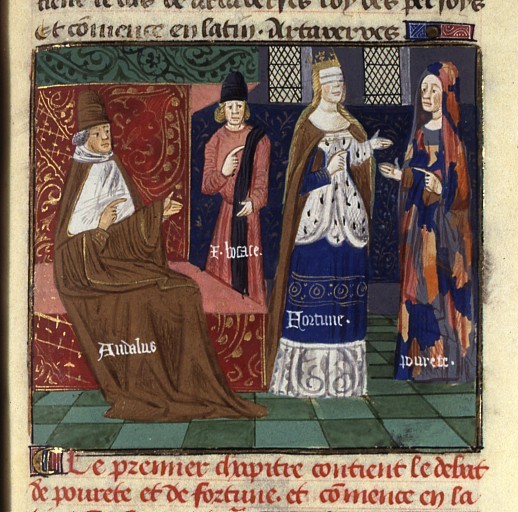
Andalò di Negro (fl. first half of the 14th century) was a noble from Genoa. Boccaccio, who he famously taught “in the movements of the stars”, noted that “since [Andalò] had traversed nearly the whole world, and had profited by experience under every clime and every horizon, he knew as an eye-witness what we learn from hearsay” (De genealogia deorum, XV, 6, quoted in Thorndike, p.195).

andalo-and-boccaccio

One of Andalò’s works (“introductorium ad iudicia astrologie”) that discussed per-degree judidicial astrology was of particular interest to me. So, back in 2009, I managed to get some working photocopies of it courtesy of the Warburg Institute’s Photographic Collection: these were of the two known documents listed further below.

Interestingly (and unlike the Pietro d’Abano-derived Heidelberg manuscript), the key feature that seems to oddly parallel what we see in the Voynich Manuscript’s zodiac section is that these two documents contain only a small amount of data per degree (though admittedly arranged in columns of a table rather than in the form of nymphs, stars and labels).

The first document is at the British Library: I managed to get a look at this in person, kindly thanks (if I recall correctly) to a letter of introduction from Dr David Juste, who was then a historian of astrology at the Warburg Institute. One unusual feature was that a few key parts of the tables were highlighted in different colours, something that wasn’t at all apparent from the black-and-white photographs taken for the Warburg in the (I guess) 1920s or 1930s. (Sadly, the colour notes I took at the time have long since disappeared).

* BL Add. MS 23770 (BL: “14th century”, Warburg: “circa 1350”)
http://searcharchives.bl.uk/IAMS_VU2:IAMS032-002097417 – “Letter of introduction required to view this manuscript
1. “INTRODUCTORIUS ad iudicia astrologie co[m]positus ab A[n]dalo de Nigro de Janua;” with paintings of the signs of the Zodiac, the planetary Gods, etc., ff. 1-44.
Aries (8r), Taurus (9v), Gemini (11r), Cancer (12v)
Leo (13v), Virgo (15r), Libra (16v), Scorpio (17v)
Sagittarius (18v), Capricorn (19v), Aquarius (20v), Pisces (21v)
You can see monochrome thumbnails of these twelve images on the Warburg Institute’s Photographic Collection.

In the case of the second document, since 2009 Cod. Fonds 7272 has been placed online and made downloadable by BNF. As a result, I can include links directly into the Gallica pages for you (which is nice).

* BNF Cod. Fonds Latin 7272
http://gallica.bnf.fr/ark:/12148/btv1b8452771j
Aries (112r), Taurus (114r), Gemini (115v), Cancer (116v)
Leo (118v), Virgo (119v), Libra (121r), Scorpio (122v)
Sagittarius (124v), Capricorn (126r), Aquarius (127v), Pisces (129r)

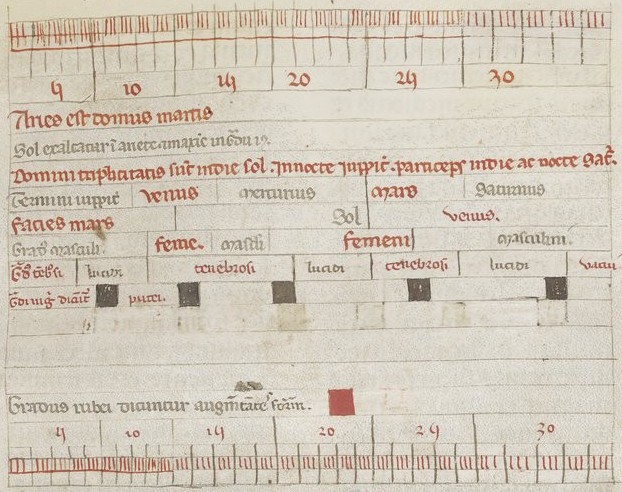
Here is the Aries table as it appears in BNF Cod. Fonds Latin 7272, courtesy of Bibliothèque nationale de France via Gallica:

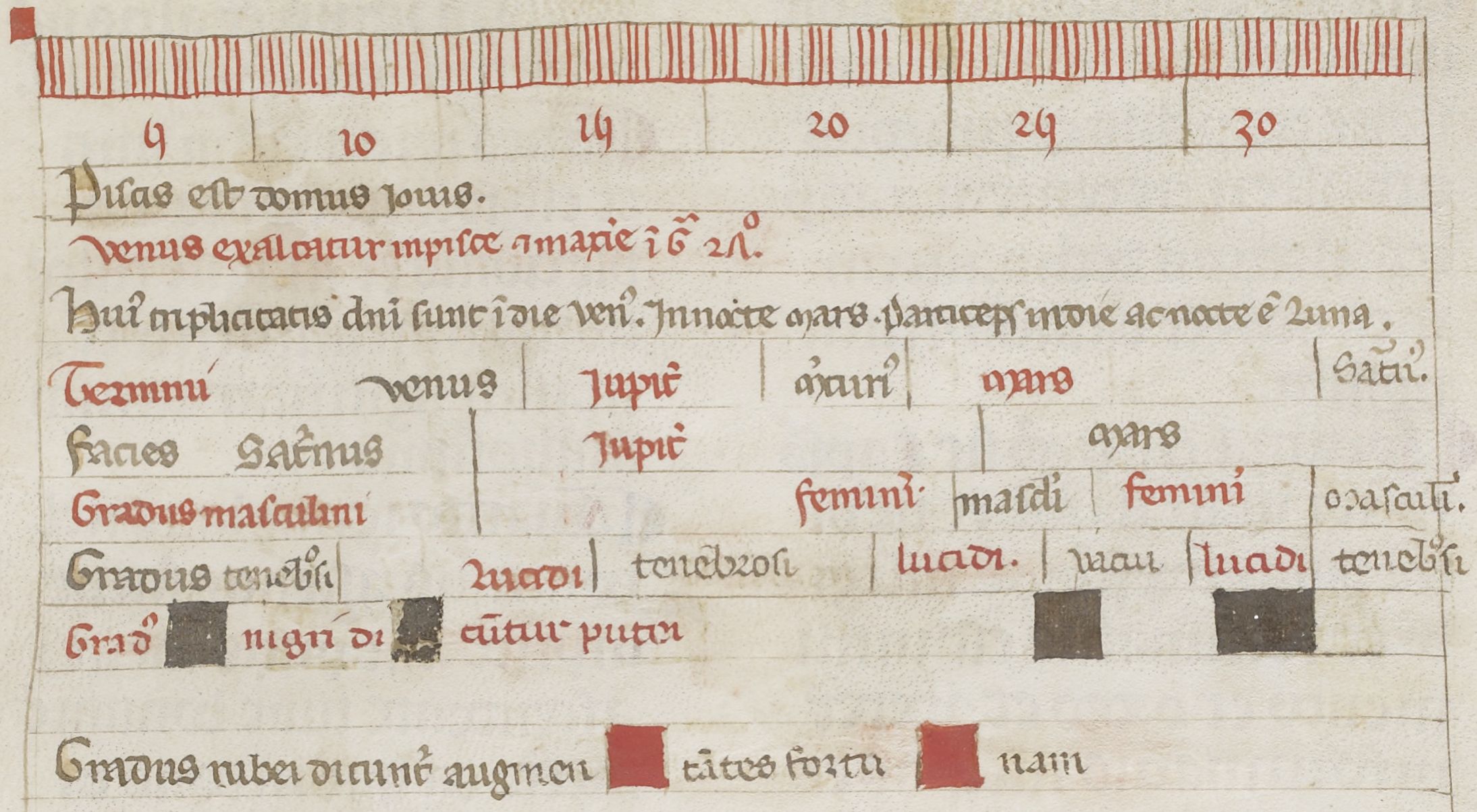
7272-Aries-table

By way of a guide, fol. 22v of BL Add. MS 23770 explains (says Thorndike, p.192 n.5) Andalò di Negro’s “fivefold distinction of degrees within the signs: 1, masculine or feminine; 2, lucidus, tenebrosus, fumosi, or vacui; 3. putei; 4. azamena (like the putei, to be avoided); 5, augmentates fortunam.”

However, I have to mention at this point that according to Boncompagni’s (1875) “Un Catalogo dei Lavori di Andalò di Negro” (an offprint taken from “Bullettino di Bibliographia e di Storia delle Scienze, Matematiche E Fisiche”, Tomo VII – Luglio 1874, and for an original of which I paid a load of money several years ago but which is now available print-on-demand from Kessinger *sigh*), there might possibly be a third copy still floating around.

Boncompagni (pp.54-55) mentions that an 1834 alphabetical index of the Biblioteca Altieri di Roma published by Federico Blume lists: “de Nigro, Andali de Ianua, Introductorium ad iudicia astrologiae, Fogl. membr. V.E.5”. Moreover, Emilio Altieri’s index to the Biblioteca Altieri (car. 11a, recto, lin.2) reads: “Andalus de Nigro de Janua, de Astrologia, Pil. 13, Lett. A. Numo. 5”. Yet according to a 1690 index, “Il detto Altieri non possiede ora alcun esemplare manoscritto d’alcun lavoro di Andalo di Negro“, so it seems that it had already disappeared by then.

That sums up the known versions of this work tolerably well: but what might these tell us about the Voynich zodiac? Obviously, that’s a good question something I’ll have to leave for a follow-on post…