I was reading about Hallermann–Streiff syndrome this morning, and was a little surprised by the huge gap between Aubry (who first discussed elements of it in 1893, though only partially and in the context of congenital alopecia) and Hallermann (1948) and Streiff (1950) (after both of whom the syndrome was named).

And so I went a-looking, to see what I could find. I searched Hathitrust for “congenital alopecia”, ordered the results by date, and was so amazed by the first result (and also by the fact that it wasn’t visible on the Internet) that I decided to turn it into a webpage.

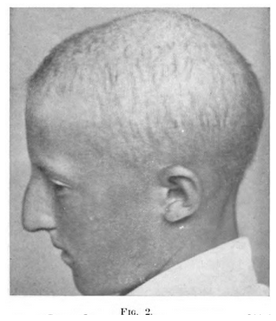
So, here’s the link to my typed-up version of “Congenital Alopecia as an Expression of Atavism” by James Nevins Hyde, M.D. (1908).

Of course, 1908 was far too early for Hyde to have a modern-feeling ‘syndrome’ framework to place his observations inside. But, to be fair, I think he did as well as he could: the places where he reverts to atavism or to reversion to lower mammalian or amphibious types feel almost like dated science fiction to our modern syndrome-attuned ears.

So maybe dismissing all physicians of that era would be somewhat unfair: Hyde did the best he could to capture, cross-reference and consider the condition, with clear and careful photographs that are useful even now. And maybe the websites discussing the history of HSS should mention Hyde’s contribution?

Having just posted about Project NEPA (and now reading Alex Wellerstein’s fantastic “Restricted Data”), something clicked in the back of my head about Nick Redfern’s source “Black Widow” (in his book “Body Snatchers in the Desert”).

According to Redfern, she claimed that “[she] met a lot of the NEPA and ANP people at Oak Ridge...”. But Project NEPA started as part of the Manhattan Engineer District (under General Leslie Groves), and then control moved to the Armed Forces Special Weapon Project (again, under General Groves), and then to the Power Branch at AFWSP (under Donald Keirn), and then eventually to the AEC Division of Reactor Development (on 01 Feb 1949, the day after General Groves retired – which was probably no coincidence).

All through that process, the highest security rules applied: so Project NEPA really wasn’t something you could talk about idly over the watercooler, at Oak Ridge or indeed anywhere else. All of which means – I’m pretty sure – that the “Black Widow” can only have been working directly on Project NEPA. Which in turn made me think of…

“In the Atomic City”

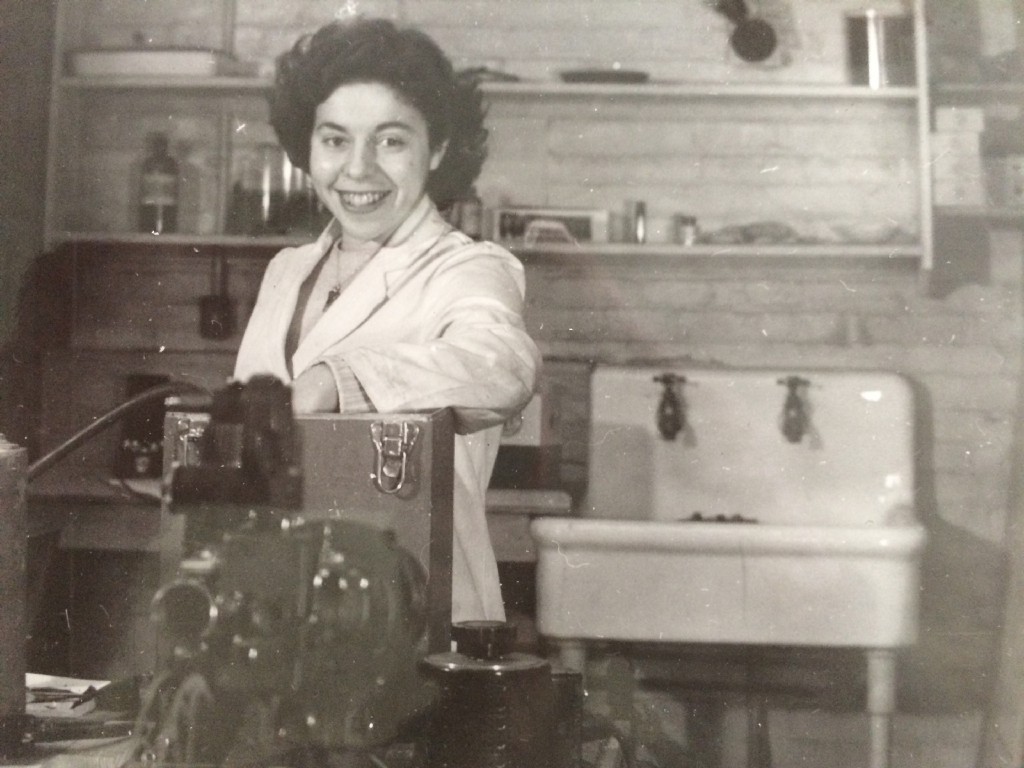
Here’s Millicent Dillon’s account of being a young female graduate physicist working in “Atomic City” on Project NEPA in 1947. Dillon (nee Gerson) moved from being a physicist to being a writer a little later in life, and for me her writing has a nice, reflective tone that’s easy to read (but is hard to do). Other people have commented on the ‘precision’ of her writing, as though it springs from her time as a technical writer in Project NEPA’s Information and Handbook department. But precision can be learnt: emotional honesty takes proper talent.

(Nice picture from this interview here with her in The Awl.)

Might she have been Nick Redfern’s secret source? It’s entirely possible, and as Dillon (sadly) died in January 2025, perhaps Nick R will tell us at some point. (Go on, Nick!)

She actually spent some time writing her memoirs (“In the Atomic City” was effectively an extract published in The Believer magazine). These were to be called “The Absolute Elsewhere”, but there’s no obvious sign that they were ever printed. But goshdarn, I really wanted to read them.

So I then found that her papers (19.32 linear feet!) had been donated to the Harry Ransom Center at the University of Texas (MS-01167). However, their date range is marked up as “1905-2002”, which feels as though “The Absolute Elsewhere” was probably retained by her family. So maybe we will see this published someday. (If so, please leave a comment here, I’ll be the first to buy it!)

Incidentally, her “Atomic City” article mentioned a book called “Race to Oblivion” by Herbert York, which you can borrow via archive.org. In fact, more or less all the people from this period or Project NEPA seem to have written their memoirs, which (to be honest) all seem to say little or nothing about the important stuff. It will be interesting to see how genuinely honest Dillon’s memoirs will turn out to be.

The May 1947 test (that failed)

In Nick Redfern’s book, the Black Widow mentions “that there were, I think, three classified balloon flights in May, June, and July 1947 and at least two were disasters. […] Sometimes there would be experimental shielding in a radiation experiment and the people would be separated – some having shielding, pressurisation, and some not, depending on the experiment.” (Body Snatchers, p. 9)

Back when I first read this, it made no sense to me at all. The weight of radioactive shielding would be just colossal, far greater than any balloon of this period could manage. Really, any experiment with this kind of shielding would need to go up in a meaty, chunky ol’ aircraft. And surely any plane with Project NEPA would have gone up much later than 1947? So I didn’t really see at all how this could have worked.

However, I recently found out about Project Chickenpox, MX-886. This was a project that General Groves helped kick off in October 1946 to make airborne atomic assembly laboratories. The basic idea was to kit out some C-97 aircraft with the necessary laboratory materials so that an atomic bomb could be assembled while in flight to its target (i.e. rather than having to wait for one to be assembled on the ground before loading it onto the plane). This is described in General Groves’ secret correspondence files (microfilm M1109), which you can buy online: and also in the AFSWP first year history (section 4.6.4 (e)).

Connecting the dots

Until today, I didn’t see how any of these individual points of data might be connected. But then I learned that one of the three C-97 planes owned by AFSWP crashed on 22nd May 1947. Here’s the report from the Prescott Evening Courier of the same day:

5 KILLED IN PLANE CRASH

Dayton, O., May 22 (/P) – Five persons were killed and two others were injured today when a four-engined army transport plane from Wright field crashed and exploded in a field about four miles east of Dayton.

Names of the dead were withheld pending notification of relatives.

A witness said the plane appeared to be in trouble as it swooped low. Seconds later, the plane tilted on its side and plowed into a ditch, then hurtled into a wheat stubble field.

An explosion turned the plane into a mass of flames.

Wright field officials said the plane, containing military personnel, was on a routine test flight.

The plane, a C-97, was the military version of the Boeing stratocruiser – a giant ship capable of carrying scores of troops or tons of cargo.

Wright field officers said they believed the plans stalled as it approached Wright field for a landing.

The injured personnel, whose names and conditions also were withheld were thrown clear of the plane.

They are at Patterson field hospital.

Might this – a secret C-97, easily able to lift a Project NEPA nuclear reactor and shielding into the air – have been one of the tests that failed disastrously?

I’ve been trying for a while to find a reliable insider account of the early days of Project NEPA. Helpfully, I found two accounts of Project NEPA written by Lt. Col. Clyde D. Gasser, the Air Force Engineering Officer for project NEPA in Spring 1947. Incidentally, his 1990 obituary is here, and I also found a page collecting together his thoughts on UFOs (spoiler: he thought they were Russian).

Gasser reported to (later Major General) Donald J. Keirn, the Chief of the Power Plant Laboratory at Wright Field. Keirn had previously been liaison officer to the Manhattan Project, but in May 1947 was appointed special assistant to the director of the Division of Military Application, Atomic Energy Commission (Brig. Gen. James McCormack, Jr.).

Gasser’s first account was a report on NEPA dated 30th May 1947, which – to be frank – was a load of stakeholder-facing success theatre. (Though to be fair, it does have a lot of useful details that help stitch NEPA into the broader military/AEC fabric.) The second Gasser account, however, seems to have been written during the 1960s, and tells much more of the story behind the project. Though this second account has, especially towards the end, a reek of ideological indoctrination and denial (i.e. ‘sure, the project failed, but history will prove us right‘), it is at least accessible and direct about what happened.

I also found Chapter 4 of “Race to Oblivion: A Participant’s View of the Arms Race” (1970) by Herbert F. York fairly useful, along with Lee Hite’s “Giving Wings to the Atom“.

The origins of NEPA

During WWII, the notion of nuclear powered aircraft seems to have been ‘in the air’: Enrico Fermi discussed it in 1941, and (then-Colonel) Donald Keirn certainly seems to have talked about it too. But neither of them had the political muscle to turn it into any kind of scientific R&D programme.

Project NEPA seems to have stemmed from a ‘meeting of minds’ between Army Air Force General H. H. “Hap” Arnold and much-lauded physicist Theodore von Kármán. Back then, every senior figure in the US figure was haunted by the spectre of what had happened at Pearl Harbor: they were therefore alert to any possible technology that offered them the chance to not be caught out again. So at that precise moment, von Kármán’s optimistic gloss on possible technologies was exactly what the General wanted to hear.

Arnold therefore set up a Scientific Advisory Group of the US Air Force (later the Scientific Advisory Board) headed by von Kármán. This yielded a series of short works describing the scientific state of the art in various fields relevant to the Air Force, ranging from guided missiles to aviation medicine: “Where We Stand” (von Kármán’s initial report) and “Toward New Horizons” (“Science, the Key to Air Supremacy“).

But of all of these, it was the chapter on nuclear powered aircraft (“Possibility of Atomic Fuels for Aircraft Propulsion of Power Plants” by Hsue-Shen Tsien) that seems to have captured the imaginations of Hap Arnold and his Air Force planners. For the Cold War with the Soviet Union that they could all see just starting, they came to believe that nuclear aircraft – though technologically challenging – would give the US Air Force numerous structural (and very hard to challenge) strategic advantages:

  • Super-high altitude (because the thin upper air would not limit nuclear power efficiency)
    • Too high to be intercepted by conventional aircraft
  • Super-long endurance (missions could spend days if not weeks in the air)
  • No need to manage a global set of airfields for their (conventional range) bombers to launch from

Remember that the dangers of nuclear fallout weren’t properly understood back then; and though ICBMs had been proposed, the conventional wisdom was that such missiles would be many decades away, and even then would have highly uncertain reliability or precision. For the Air Force planners peering into the future, the only decisive theatre of war they could foresee had bombers and nuclear bombs. And so nuclear aircraft seemed to them to be a logical next step (albeit a monumentally large one).

NEPA, 1946-1947

At this point, Colonel Keirn – who is essentially the hero of Gasser’s account – took the whole idea to General Leslie Groves at the Manhattan Engineering District (basically, what was left of the Manhattan Project after the war), and started to talk about it. However, the Air Force hadn’t been part of the development of the atomic bomb, and so didn’t really have sufficient technical expertise. But at this point, Fairchild Engine and Airplane Company stepped forward: and they were really, really interested in designing and building nuclear-powered aircraft. And that’s basically where it all actually started.

The initial AAF letter of intent by General Spaatz and Maj. Gen. Leslie Groves on 28th May 1946, committing $200,000 to the project (of course, this rapidly increased). Early funding for the project came from the Air Force Research and Development section, with the AEC contributing to the budget from 1949 onwards. For the first fiscal year (1946), funding was $1.3m: by 1951, this had steadily grown to $8.3m. (York p.61)

Then on 15th July 1946, the project moved into a suite of rooms in Raleigh Hotel on West 72nd St. New York City. This was briskly followed on 4th September 1946 by a move to the AEC Administrative Building in Oak Ridge (which at the time was still Clinton Laboratories): and then on 24th September 1946 onwards to Oak Ridge’s S-50 Area near the K-25 Power Plant. (Hite p.3)

This was all happening while the Manhattan Engineering District was approaching the end of 1946, at which point it was handing over some (but not all) of the atomic reins to the newly-formed civilian Atomic Energy Commission. So in February 1947, control of NEPA moved to AEC Subcommittee of the Joint Research & Development Branch (known as the JRDB).

Secrecy and Control

How was the AEC – a civilian body – able to take control of a top secret military project in February 1947? When you put it like that, it doesn’t really make sense.

My understanding is that what really happened is that because the AEC had control of key parts of atomic research (as well as the equipment and the raw materials, such as uranium), they took notional control of the project. However, military control of the project stayed with General Groves (albeit invisibly) as he sidestepped from the Manhattan Engineering District to the newly-formed Armed Forces Special Weapons Project.

The AFSWP was a joint military organisation (i.e. Army, Navy, and Air Force) that officially started on 29th January 1947. It started its life in the former offices of the Manhattan Project (the fifth floor of Washington’s New War Department Building), but on 15 April 1947 it moved to the Pentagon, where it sprawled and sprawled as it grew.

This speaks to what I dislike about the way Project NEPA is almost always presented: that the entire layer of military control via AFSWP is essentially absent. Metaphorically, if the AEC owned the NEPA house, Groves and the AFSWP had the keys (and had installed all the locks too). And I’ve read elsewhere that on anything to with secret stuff, the rest of the AEC Commissioners normally deferred to former Navy Admiral Lewis Strauss, because of his high security clearance. (Though note that Strauss had never seen action, his war was spent in the USNR working for the Bureau of Ordnance.)

Once this whole picture is reframed with AFSWP in its correct place, NEPA looks far less like a post-war experiment in civilian control and far more like a continuation of Manhattan Project secrecy culture by the back door. I just wish that even one of the 50+ articles and books I’ve read about Project NEPA had bothered to point this out. But now you know.

My search for scientific balloon history 1945-1949 has just taken a sharp turn to one side. I’ve managed to locate a folder in the Air Force Historical Research Agency at Maxwell AFB in Montgomery, Alabama that has (or, at least, in 1986 had) information about some super-early scientific balloon stuff that might possibly be what I’ve been chasing after for a while now.

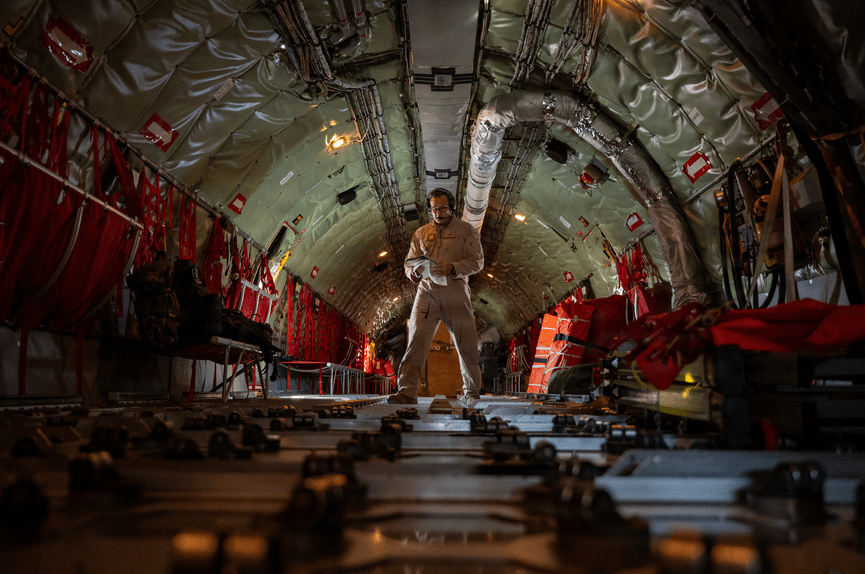
(Just so you know, this is the inside of a KC-135 Stratotanker at Maxwell AFB.)

But – Lawdy, Lawdy – finding an independent researcher in Alabama happy to go onto a military site isn’t proving easy at all. I know, it’s only a single folder, so it’s barely even a day gig, which isn’t much. But when you have nothing, even a small something can be a huge deal. It eez what it eez.

So… does anyone here happen to know someone who might fit the bill? Or have any suggestions as to how to find someone who might fit the bill? Thanks!

[*] Well, a bit of it, anyway.

Over the last weeks, my Cipher Mysteries inbox has been inundated with AI-generated theories. But – and with my apologies to the genuine cipher theories that also landed there, which I promise I will get back to – I’ve instead been focused on the Voynich Manuscript. Or, more specifically, on a single line of its text.

And I think I can read it.

The f17r marginalia

Back in 2006, I was hugely fortunate to be allowed by the Beinecke Rare Book & Manuscript Library’s curators to spend a few days working with the Voynich Manuscript. One of the highlights of that trip came when I borrowed their UV blacklamp to examine the tiny marginalia at the top of page f17r.

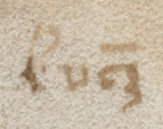
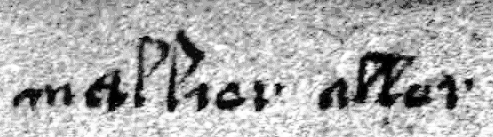
To my huge surprise back then, what the UV light made visible at the end of that line was some Voynichese text. Later on, another group did some multispectral scans of f17r, so here’s what they saw (“Voynich_17r_WBUVUVP_019_F”, auto-equalised in Gimp):

Why was all this important? Because it strongly suggested that there was some kind of direct link between (one of) the marginalia people and the curious Voynichese writing itself. (And also that the Voynichese letters on the final page (f116v) were probably not coincidental). For me, this all suggested that understanding the Voynich Manuscript’s marginalia might not only tell us something about a later owner of the manuscript, it might also tell us about its creator(s).

So the marginalia are a big deal to me. And if you’re interested in the Voynich Manuscript, they really should be a big deal to you too.

Theories about the f17r marginalia

So, what does it say, what does it say? Poundstone thought that the first word might refer to herbal writer Pierandrea Mattioli (1501-1577): Brumbaugh similarly thought it might refer to Mathias de l’Obel (1538-1616). But these both feel quite wrong, because the cursive gothic handwriting is typical of the (mid-)15th century, not of the 16th century.

Since then, there have been plenty of partial readings of the f17r marginalia, most of which seem – possibly emboldened by the apparent fragments of German writing on f116v – to be German-ish. But though such readings typically start promisingly, they quickly fall to pieces when you look more closely.

A special mention here to two good attempts:

For “The Curse of the Voynich” (2006), I had my own proposed reading (on pp. 24-25), but I’ll come back to that in a minute. Still, the important thing I noted was that the second letter of the first word appeared to have been emended: and so consequently the first word actually seemed to have originally been “meilhor“.

The mysterious third word

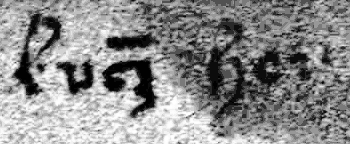
Also back in 2006, I wondered if the third word might be “lutz” (the Occitan word for “light”). Yet that (and almost all the other theories about how to read this word) failed to explain why there was a macron (overbar) over the end part of that word. In 14th-15th century texts, the macron was widely used as a way of inserting a missing ‘n’. So… why on earth was there a macron over this word?

Back in 2017, Helmut Winkler posted this on Voynich Ninja:

I think there are several more ways to read the “lucz”,  e.g. lucem or lucet, but in this contextI I would suggest  luc[ea]m her[bam], one of the Alchemical Herbs

Now fast forward to a July 2025 comment by Marco Ponzi, mentioning some text from Fribourg MS L.52 (f.8v): “oleum lucet, balsamum redolet” (and I have a ton to say about L.52 on another day):

Marco then noted:

For the third word in the Voynich f17r marginalia, assuming that the text is Latin (very doubtful) and that the initial [letter] is ‘L’, a possible reading could maybe be “lucent” (where the macron stands for the missing ‘n’) – “they shine”, third person plural.

You can’t fault Marco’s logic here: even though adding the macron would ‘nasalise’ lucet into lucent, it overall does not look like Latin. So… how can we resolve all this?

Reading f17r marginalia (finally)

The reason I’ve ground through all the above (giving credit to everyone who helped with all the steps along the way) is that the final reading didn’t just magically pop into my head. I started looking at this properly in 2005-2006, so it has taken nearly twenty years to get to (what I believe to be) the end line.

When writing Curse, my tentative reading of this marginalia was that this was Occitan, and that it began:

  • meilhor aller lutz [kou?]…

…which was close, but no cigar. With the benefit of all the above, I am now pretty sure that it is Occitan, and that it reads (using a Latin abbreviation style to render the Occitan “lucent”):

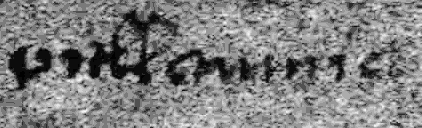
  • meilhor aller lucent ben balsamina [….]

Or, one multispectral block at a time:

meilhor aller

luc[ent] ben

balsamina

Balsamia / Balsamina

If you look at Wellcome MS.626 (Livres des simples médecines), you can easily find (because it’s arranged alphabetically) balsamia [balsam] on folio xxix:

To be precise, this is talking about the original (and mythical, almost unobtainium-like) balsam from the East, a plant known not to anyone by actual experience. So this is reporting – medieval herbal-style – on a plant without flowers yielding a kind of resin, and the artist is just guessing at what it might look like. It’s really not a literal drawing of a tree.

And yet a century later, Leonhart Fuchs in his 1542 Hist. Stirpium was using the word ‘balsamines’: “Duo Balsamines genera damus“, and the word balsamine was being used in French in 1545 to mean “balsam-like”. So even though this isn’t “balsamina” in its modern sense (e.g. impatiens balsamina), it is a word that is specifically being used to evoke balsam-like qualities.

And I think the word we’re seeing at the top of f17r is “balsamina”.

Occitan marginalia. Really? Really.

So, my argument here is that the marginalia at the top of Voynich manuacript page f17r is written in Occitan. And guess what? Back in 2006, I argued long and hard that the Voynich zodiac roundel month names (which also appear to be marginalia) were also in Occitan. So this should, in theory, be the least surprising marginalia language identification ever.

And yet I already hear every single Voynich Ninja commenter disagreeing. Pffft. It is what it is. It’s Occitan.

If the Voynich Manuscript was written by people who appear to have been writing natively in Occitan, the first thing we should now be doing is looking at every single Occitan herbal-related manuscript from the period, such as BNCF Manuscript Palatino 586. Roll with it for a change.

As I noted last year, it’s well documented that the round-ended capsule-shaped metal stratospheric gondola designed by Charles Burgess and Tex Settle (referred to as “The Flying Coffin”) was approved by Rear Admiral Moffett, who died in April 1933 (on the US Navy airship USS Akron). It’s also known that it was constructed in the Naval Aircraft Factory in the Philadelphia Navy Yard, but never flown.

And really, you have to admit that witness descriptions of the 1947 Roswell Incident capsule – also a round-ended thin-skinned capsule-shaped hollow metal ‘thing’ – do sound extraordinarily similar. The only obvious difference (from what little we know of both) is the size, with the Roswell capsule being described as slightly larger (but not really by very much).

But even so, might the two have been the same thing? Was it the Flying Coffin that was found in Roswell? It’s a question I’ve been trying to resolve for a few years now. And I think I’ve now found an answer, but in a place I never expected…

Aluminium Alloys

Pure aluminium is nicely malleable – hammers and a buck, and you’re basically there. So if you were making a round-ended capsule (i.e. one with no stress concentration points), it would be easy in a factory to shape the aluminium gores into their desired final shape.

George Melies "A Trip To The Moon". Factory workers hammer a rocket into shape.

Auguste Piccard insisted on using pure aluminium for his gondolas, because (as I recall) he wanted to avoid stress failures while high up in the stratosphere. Which, to be fair, in the 1930s was entirely reasonable. But more generally, to prospective stratospheric gondola makers, pure aluminium isn’t really as strong as you’d like. Resisting the pressure difference in the stratosphere would mean a pure aluminium gondola would need to be quite thick – and quite heavy.

Yet at the same time, even by 1933 there was moderate knowledge of aluminium alloys. Duralumin was an Al–Cu–Mg alloy that had been invented in 1909: it included a thin aluminium “top coat”, to help cope with weathering. Yet even though Duralumin was widely used in aeronatical engineering (Zeppelins, airships, even the USS Akron, though it was a storm that brought that down), 1933-era engineers were still wary of its potential for stress fractures. But if not that, then what?

Looking at the range of aluminium alloys known in 1933, what looks to my eyes a safe middle ground (between pure aluminium and Duralumin) for stratospheric gondolas would have been an aluminium alloy formed of aluminium with ~1% manganese. (Less than 0.7% manganese doesn’t really gain strength, while more than 1.5% manganese and becomes more brittle.) While not as strong as Duralumin, aluminium with ~1% manganese would be nearly as malleable as aluminium, but significantly stronger.

Even in 1933, a top supplier like Alcoa could give you access to pretty good aluminium (if not particularly pure compared to modern day materials), and with whatever extra stuff you wanted mixed in. So, the Flying Coffin could have been (and I believe indeed probably was) made of an aluminium alloy, though rather than Duralumin I would guess Al + 1% Mn. And that was pretty damn impressive stuff.

Welding in 1933 and 1947

Impressive… except that aluminium alloy was only a part of the story. In 1933, the only real way to join gores (curved panels) together was with oxy-acetylene welding. And oxy-welded seams were – even in the hands of top welders – not great, not great at all. The poor seam quality meant that you had to use much thicker panels that you would like, to be defensive against leaky, cracky, achey-breaky seams.

That in turn would pretty much double the weight of the capsule, whichever type of aluminium you used. And so what I think we can predict about Settle and Burgess’ Flying Coffin is that:

  • it was a bit of chunky boi
  • it would have had visible, fairly ugly seams
  • it would have felt basically industrial, not futuristic

However, fast forward to 1946-1947, and metal assembly had been revolutionised by TIG (Tungsten Insert Gas) welding. (It’s known as WIG in Europe, because Tungsten was also known as “Wolfram”.) This was developed in 1941-1942, so would not have been available to Settle and Burgess in 1933.

TIG welding was a world away from oxy-acetylene welding. All of a sudden, beautiful clean (and non-leaking) seams were possible, and even the norm. And this in turn meant that thinner sheets of aluminium alloy could be used, with the seams neatly sealed and then polished and brushed.

So the question really is: do you think the Roswell capsule would have evoked shock and awe if it had been constructed using 1933’s thicker aluminium alloy and oxy-acetylene welding? Or would 1947’s shiny (and – literally – seamless) lightweight capsule have given everyone who looked at it a wobbly feeling of glimpsing an unknown, alien future?

My own conclusion is that it was probably not the Flying Coffin, but a TIG-welded post-WWII round-ended aluminium alloy capsule. And if that’s correct, whoever stumbled across it in the middle of nowhere north of Roswell might easily – absent a genuine explanation – end up jibbering for years.

The Shock of the Really New

Arthur C. Clarke’s famous adage “Any sufficiently advanced technology is indistinguishable from magic” was something he write in “Profiles of the future; an inquiry into the limits of the possible” as a footnoted aside. I suspect Clarke wanted his aphorism to play to the sci-fi gallery, to the readerly desire for curiosity.

But if I’m right, the evidence from Roswell hints at something slightly different (and I don’t intend this as a snowclone at all). Rather: it suggests that any sufficiently advanced technology is first and foremost a shock, one powerful enough to disrupt your ability to make sense of it.

In the real world of 1947, the US Army was presented with what must surely have seemed like Clarke’s “sufficiently advanced technology”, and the reverberations of that shock plus the long chain of tragic misunderstandings it triggered – are still very much with us, nearly 80 years later.

For decades, Roswell researchers have tried to gain access to Project Mogul documents. Most famously, UFO skeptic Robert Todd submitted numerous FOIA requests during the 1980s and 1990s to try to access some of them. According to the McAndrew US Air Force report, it was Todd’s efforts that ultimately led to the Project Mogul account of the Roswell Incident emerging (or ‘being constructed’, depending on your point of view), mostly by… looking at his FOIA requests. And if that sounds a bit useless, it’s because it is.

Still, where are all the Project Mogul documents?

The Roswell Report

The Roswell Report contained large sections of Project Mogul-related text (albeit carefully curated):

  • New York University, Constant Level Balloons, Final Report, March 1, 1951
  • New York University, Constant Level Balloons, Section 1, General, November 15, 1949
  • New York University, Constant Level Balloons, Section 2, Operations, January 31, 1949
  • New York University, Constant Level Balloons, Section 3 , Summary of Flights, July 15, 1949
  • New York University, Progress Report No. 6, Constant Level Balloon, Section 11, June 1947
  • New York University, Special Report No. 1, Constant Level Balloon, May 1947
  • New York University, Progress Report [No. 7], Constant Level Balloon, Section 11, July 1947
  • New York University, Progress Report No. 4, Radio Transmitting, Receiving and Recording Systemfor Constant Level Balloon, [Section I], April 2, 1947

To be clear, these were taken from reports on the contract portion of the project that was carried out by the group at New York University. And there’s no obvious sign to me that those reports themselves have ever been made public, or indeed any document relating to the project (as opposed to just the contract), which was top secret.

Request for Lt. H. F. Smith (USNR)

Incidentally, while once again grinding my way through these sections of the Roswell Report, I noticed a short report of a meeting on p. 807 that I’d previously overlooked re. Harris F. Smith:

  • 6/25/47
  • Mr. Gordon Vaeth, Commander G. W. Hoover, J. R. Smith, C. B. Moore
  • Sands Point Office of Naval Research, Port Washington, L. I., N. Y.
  • Request for clearance on General Mills Balloons. Request for Lt. H. F. Smith (USNR) to accompany project to Alamogordo.
  • Granted.

References in a Holloman AFB document

I found a separate (non-classified) https://apps.dtic.mil/sti/tr/pdf/ADA323109.pdf Holloman AFB balloon history document that referred to the NYU project reports, along with monthly Guided Missile group progress reports (which were from Holloman AFB itself):

  • Research Division, College of Engineering, New York University, Technical Report No. 1 (New York, 1 April 1948)
  • Research Division, College of Engineering, New York University, Technical Report No, 93.03. Constant Level Balloons Final Report (New York, 1 March 1951)
  • Progress Summary Report on U.S.A.F Guided Missile Test Activities (HAFB, published monthly 1 November 1947-1 June 1950)
    • Progress Summary Report, 1 August 1948
    • Progress Summary Report, 1 October 1948
    • Progress Summary Report, 1 March 1949
    • Progress Summary Report, 1 May 1949
    • Progress Summary Report, 1 May 1950

According to DTIC document ADA375116, Maxwell AFB apparently has at least some of the HAFB monthly Progress Summary Reports on microfilm. So I submitted a request to the Air Force Historical Research Agency at Maxwell AFB to ask them what they have, and whether it is declassified / accessible etc.

Robert Todd’s “Cowflop Quarterly”

Back in 1995-1997, UFO skeptic Robert Todd (who died in 2007) published parts of his research via a newsletter he called “The Cowflop Quarterly” (“Reporting on Ufological Frauds and Fantasies“). I’m guessing the one time he called it “KowPflop Quarterly” was some kind of not-very-subtle dig at Roswell researcher Karl Pflock.

Very helpfully, though, Todd explained (on p.3 of The Cowflop Quarterly No.4) how Project Mogul connected to other projects:

A search using the code name “Mogul” would be worthless, especially since the name was later changed to “Rockfish”. For reasons too complicated to explain here, Project Mogul also was known as, or became a part of, Project MX-968, which itself was a part of the much larger Project “Whitesmith”, which was later changed to Project “Bequeath”, which was later changed to Project “Centering”, which was still later changed to Project “Cottonseed”. During the Operation “Sandstone” A-bomb tests in the Pacific in 1948, Operation “Fitzwilliam” was formed to test various methods of detecting nuclear explosions at long range. The Project Mogul portion of Operation “Fitzwilliam” was known as Project “Blackheart”.

I bet you’re glad that’s clear now!

Yet Todd also cautions that “[he] spent five years looking for the Project Mogul project files, without success” (on p.4 of The Cowflop Quarterly No. 4).

Additionally, in The Cowflop Quarterly No. 5, Todd mentions (pp. 2-3) two interesting sounding files of AMC correspondence out of a 36-box-large load of files retired to the National Archives:

  • 000- Flying Discs- “Sign”, “Grudge”
    • 1947-1950
  • MX-1011 – “ROCKFISH”, “MOGUL” Projects
    • Acoustical Research (1946 thru 1950)

These files were supposed to be retained, but (p.3) “[were] destroyed during [a] disastrous fire in July 1973” at the National Personnel Records Center, St Louis, Missouri. But all the same, that suggests another AMC project number (MX-1011).

Some quick thoughts…

The Project Mogul documents seem to be caught in a peculiarly American tangle. The reports produced under the NYU contract (which I think was confidential rather than secret) have been indirectly released via the Air Force’s “Roswell Report” but not declassified. So, unless you know better, these documents don’t appear in DTIC or anywhere else, apart from the Roswell Report excerpts. Similarly, even though Project Mogul itself was an Air Materiel Command project, it doesn’t appear to have been declassified at all.

All the same, the two MX- references that Robert Todd dug up (MX-968 and MX-1011) can be cross-referenced using modern search engines, with surprising results…

Project MX-968 and Project MX-1011

First, the easy one. MX-1011 was (according to this site) “Aerojet General X-8 Aerobee research rocket”. The Aerojet General X-8 rocket was ordered by the US Army Air Force for high-altitude research as part of Project MX-1011: this was used at Holloman AFB for many of the space biology launches I discussed a few days ago. So it seems as though the reference on the outside of the AMC correspondence file may not have been correct.

We’re onto more solid ground with MX-968, though. According to this MX designation website, MX-968 was “[Project] “Cottonseed” (unidentified project; Power Plant Lab requirement)“, which is – according to Robert Todd – the name that Project Mogul ultimately morphed into. Note that “Power Plant Lab” was the section of Wright Air Development Center at Wright-Patterson AFB that designed engines specifically for planes, so this is probably a sign more of what the project later became than what it originally was.

A much more direct reference describing what MX-968 actually was appears in this DTIC file, pp. 45-46:

Although this approach [Project Mogul] did not prove fruitful, the newly-established Geophysics Research Directorate at Watson Laboratories started a follow up program, MSX-968 [sic], early in 1948 to explore radiological, acoustic, and seismic techniques for long-range detection. Work on the radiological technique, originating under a Watson Labs contract with Tracerlab, Inc. in Cambridge, MA, developed airborne measurements of post-nuclear particles that diffused through the atmosphere. It led to a successful identification of the first Russian nuclear explosion in 1949.

Footnote 89 (pp. 70-71) is also very revealing:

Memo from Capt Albert Trakowski to AFOAT-1, subj: Mogul and MSX-968, 10 December 1948, Geophysics Directorate History File, Hanscom AFB, MA. For these programs, which originally were classified Top Secret, see Charles A. Ziegler and David Jacobson, Spying without Spies: Origins of America’s Secret Nuclear Surveillance System (Westport, CO: Praeger, 1995), esp. chs. 3-7. Also Bates, Gaskell, and Rice, Geophysics. 87-88. As the memo above indicates, the Tracerlab contract was transferred from Watson Labs to AFOAT-1 later in 1948.

(In case you’ve forgotten my post from a few days ago, AFOAT-1 was where Walt Singlevich worked: the Air Force Office of the Assistant Deputy Chief of Staff for Atomic Energy, Section 1. This was later renamed the Air Force Technical Applications Centre (AFTAC). There’s also an excellent CIA history of AFOAT-1 and the detection of JOE-1 online.)

Unfortunately, Ziegler’s “Spying without Spies” is currently £70+ on bookfinder (ouch), so I guess I’ll have to park that purchase for the moment. But it seems like it could be a helpful book: Trakowski did say (Roswell Report, p.198, and then much the same on p.258):

Charles Ziegler was working on the history of nuclear weapons detection capability. He had some letters/papers that I did not have such as the letters the Gen Spaatz directed the establishment of project Mogul.

Putting all these pieces together (finally)

All in all, I think this helps us read the few references in the Roswell Report reasonably well. For example, Roswell Report p.198, Albert Trakowski witness statement:

  • “Through 1949, I [Trakowski] was the director of both MX968 and Mogul.”

Roswell Report p.224, interview with Charles Moore:

  • A: [Moore] At [Tracerlab], have you come across Charlie Ziegler at Brandeis?
  • Q: No.
  • A: [Moore] He worked for [Tracerlab, Inc] and is just bringing out a book on the early detection system.
  • Q: That was Project Center. MX-968.
  • A: [Moore] There was another one that followed on this to measure krypton. It was called Grab Bag in our lexicon.
  • Q: Did you ever hear of the project Bequeath?
  • A: [Moore] No. Being a civilian and outside, I was more knowledgeable, essentially, of the intent and what was required rather than the project names.

Roswell Report p. 260, interview with Col Trakowski:

  • Q: Until ’49, were you still on Project MOGUL?
  • A: [Trakowski] Yes, indeed. And Project MX-968.

So the big picture seems to be that Project MX-968 was actually Project Center (which might be a McAndrew transcription mishearing for “Project Centering”, as per Robert Todd), which was the follow-on project launched in 1948 to achieve by different means what Project Mogul had proved unable to do.

Even though I still don’t know what Project Bequeath or Project Whitesmith was (though web scraped data implies that the latter is discussed in “Spying without Spies”), I think it’s likely that Mogul became Rockfish, and in turn became Cottonseed.

I keep mentioning Project NEPA here, but it’s not exactly well known. So, for a bit of fun I thought I’d draw out the lines connecting it with the Fallout game series’ Vault Boy mascot.

As you might guess, this whole story arc hasn’t really got a happy ending.

From the Manhattan Project to the AEC

The Manhattan Project was the top secret WWII US programme to develop nuclear weapons of war. Even though the work was spread across a large number of geographically dispersed sites, the technology goal was achieved using a tightly managed, highly compartmentalised wartime secrecy culture. Ideologically-driven administrators (in particular Major-General Leslie Groves) did what it took – and in an often direct and unaccountable way – to get the job done.

The period 1945-1947 saw (as I’ve discussed elsewhere) the US transition from this wartime secrecy silo state to a peacetime secrecy silo state. The National Security Act of 1947 took the set of practices that had evolved out of wartime secrecy silos and embodied them both in legislation and in bodies such as the CIA. So… where did all that Manhattan Project know-how go next?

The Manhattan Project’s civilian successor body was the Atomic Energy Commission, which had a chairman and five commissioners. Right from the start, AEC Commissioner Lewis Strauss often acted as a dissenting voice (e.g. being outvoted 4-1 on information security matters). Strauss believed completely that a Cold War had already started, and that the US should actively try to detect Soviet nuclear blasts (which led to Project Mogul and its successor projects).

Strauss was what you might call an “atomic maximalist”: he vigorously backed a large number of ambitious nuclear-based programmes, albeit typically by kicking the feasibility can far, far down the road. He believed that electricity generated by nuclear energy would become “too cheap to meter” (he actively backed the first US nuclear power station in Pennsylvania in 1957), and that nuclear ships and aircraft were not just possible but desirable. At the same time, he largely dismissed talk of nuclear contamination, such as after the 1954 Castle Bravo nuclear test.

But hold on… nuclear aircraft, really?

Project NEPA

Initiated on 28th May 1946, Project NEPA was bold and audacious, if somewhat hallucinatory: it was like a post-war hi-tech programme designed by ChatGPT. Yet despite being one of the most massive tech efforts of the period, it has been somewhat airbrushed out of history: on Wikipedia, it gets no more than half a paragraph in the page devoted to its successor project ANP.

Militarily, Project NEPA was initially driven by the US Army’s Air Materiel Command, and framed by the emerging Cold War. The plan was to build nuclear-powered bombers capable of flying across continents (or even circling high over enemy continents for days or weeks) without ever refueling, all the while keeping the crew safe from radiation. The planners believed that this would give the US a permanent nuclear advantage.

But where did it come from? Surprisingly, Bernard J. Snyder’s (1996) bibliography traces the core idea right back to H. G. Wells’ (1914) “The World Set Free – A Story of Mankind“, where the author describes the (future) skies of 1943 as being filled by thousands of atomic-powered planes “humming softly”.

Back in the real world, a 1945 study (“Where We Stand”) by renowned aeronautical engineer and physicist Theodore von Kármán (commissioned by Air Materiel Command) was upbeat about nuclear aircraft. This was used by AMC to pressure Major-General Leslie Groves into creating Project NEPA. Brant Sponberg’s (1995) “Means Without an End” article noted that this got approved even though Vannevar Bush, James Conant and Robert Oppenheimer were all skeptical about the idea of nuclear aircraft.

And so Project NEPA started with a feasibility study carried out by Fairchild Engine and Airplane Corp., in space provided by the AEC at the Oak Ridge National Laboratory (ORNL) in Tennessee, and with the first project funding in May 1947. A 1948 project review (the Lexington Report) concluded that it was basically sound, but would require 10-15 years and a billion dollars. And so a billion dollars was indeed spent on the dream, before it was finally cancelled in 1961 by President Kennedy.

In reality, NEPA was a ‘triumph’ of secrecy over realism, of ambition over accountability, and futurism over physics. Classified reports circulated without scrutiny, technical hurdles were treated as footnotes, and the engineers tasked with shielding, propulsion, and crash safety were constantly outflanked by administrative optimism. The program consumed massive sums of money, intellectual energy, and political capital, all in service of a vision that, by its own physics, was doomed from the start.

Honestly, Project NEPA wasn’t just big ticket technical misadventure; it was a towering monument to how not to do state-backed big science.

But what if it had succeeded?

The Fallout Universe

For the Fallout videogame series, the developers were aiming for a vibe inspired by A Canticle for Leibowitz (1959), a post-apocalyptic sci-fi story by Walter M. Miller Jr. In the book, the titular Isaac Edward Leibowitz creates a monastic order in New Mexico to preserve human knowledge following the “Flame Deluge” (nuclear war). Six centuries later, Leibowitz’s 20th century notes are found in a fallout shelter, where they are considered ‘holy relics’: and so forth.

For me, though, Fallout’s “Vault Boy” who grins at you bright-eyed from a pip-boy screen is like the cheerful ghost of Project NEPA. He embodies all the hubris, spin, technological impossibility, madness, lies, and deception: he embodies the stupid political dream of 1945-1947 that, somehow, physics was wrong and their whole anticommunist Cold War ideology was right. He is AEC Commissioner Lewis Strauss’ poster boy for the nuclear reactor in every home, the cheerily polished technological turd.

I mean, thousands of nuclear reactors “humming softly” in the sky, what could possibly go wrong?

As per my last post, I’ve been trying to dig up all the Project Mogul reports to get a more detailed (and less curated) look not only at how it worked, but also at how it interworked (e.g. with Project Helios, etc). These appear to be in the unhelpful state where they have been declassified but not digitised or indexed. Anyway, I at least now have a long list of reports that I know I don’t have, so maybe this is progress.

Holloman AFB

I did find a helpful cache of documents on the Defense Technical Information Center (DTIC). For researchers with a suitable clearance (including “select [but unnamed] academic institutions“), this provides close to five million records, of which a million or so are accessible to the rest of us.

As far as balloon-related documents go, there are a good number from Holloman SFB there, many written by (or with sections written by) Duke Gildenberg. For example, “Contributions of balloon operations to Research and Development at the Air Force Missile Development Center Holloman Air Force Base, N. Mex 1947 – 1958” covers the early development of balloon launches at Holloman AFB. This mentions (on p.108) that “After visiting Holloman Air Force Base for the first time with a New York University balloon team in 1948, [Duke Gildenberg] joined the Balloon Branch itself on a permanent basis in 1951.” This confirmed my suspicion that Gildenberg wasn’t with the NYU team in New Mexico in 1947.

But the most interesting document I’ve found so far is this: “The beginnings of research in space biology at the Air Force Missile Development Center Holloman Air Force Base, New Mexico 1946 – 1952“. This gives a history of the first various space biology experiments they tried to carry out using balloons, which I haven’t seen covered in other space biology references. So I thought I’d summarise them here.

Early Space Biology at Holloman AFB

  • 17 December 1946 – National Institute of Health
    • Fungus spores (though the lucite containers containing them were never recovered)
  • 1947
    • Fruit flies carried up to 106 miles (was this a typo?)
  • 18 June 1948 – Albert(I) Project – Wright-Patterson Aero Medical Lab
    • Anaesthetised rhesus monkey (“Albert”)
    • Probably died before V-2 launch
  • 14 June 1949 – Albert(II) Project – Wright-Patterson Aero Medical Lab
    • Anaesthetised rhesus monkey carried up to ~83 miles
    • Died on impact (on return to earth), after parachute failure
  • ???? – Albert(III) – Wright-Patterson Aero Medical Lab
    • Anaesthetised rhesus monkey
    • Early V-2 rocket failure
  • 1950
    • Unanaesthetised mouse on a V-2
    • Died on impact
  • 29 August 1950 – Wright-Patterson Aero Medical Lab
    • 1st of the balloon flights for the Aero Medical Lab” (Wikipedia)
  • 28 September 1950 – Project MX-1450R, “Physiology of Rocket Flight”
    • Eight white mice carried to 97,000 feet on a balloon
    • “[This and] other balloon experiments in the same series were primarily intended to determine the effects of cosmic rays upon biological specimens
  • 18 April 1951
    • Rhesus monkey in an Aerobee rocket
    • Died on impact (after parachute failure)
  • 20 September 1951
    • Rhesus monkey, nine mice, plus two other mice in a drum
    • Even though the parachute worked OK, the monkey and two mice died two hours after impact (probably from the heat of the midday New Mexico sun, after the retrieval was delayed slightly)
  • 21 May 1951
    • Two monkeys and two mice, carried up to 36 miles on an Aerobee rocket
    • All animals survived, both monkeys were then given to the National Zoological Park of the Smithsonian Institution in Washington D.C.

Holloman – Frontier of the Future

Incidentally, film of the “two mice in a drum” from the 20th September 1951 flight can be seen edited into the following film at 2:43, which also includes reasonably well-made footage of a lot of things I’ve been describing here – balloons, Project Manhigh, etc – along with a detailed description of Holloman AFB:

Introducing Project MX-1450

As Cipher Mysteries readers probably know (or at least those few who read my Roswell-related posts), I’ve been searching for a while for a human physiology project from 1945-1950 focused on the effects of cosmic rays on human physiology. So, what then of the Project “MX-1450R” mentioned above?

MX stood for “Materiel, Experimental” (an early R&D project numbering system used by the U.S. Army Air Corps, then U.S. Army Air Forces, and early U.S. Air Force), where “Materiel” referred to Air Materiel Command. For example, Project Moby Dick (that Duke Gildenberg worked on) was actually “Project MX-1498”. There’s a list of MX projects here, that says MX-1450 was from Wright Field AeroMedical Laboratory, and involved “Research into the physiology of rocket flight (high-altitude animal experiments using ballons and rockets)”. Similarly, another MX project listing describes it as: “Wright Field, high altitude balloon and rocket tests with animals on board“.

A balloon launch listing (presumably supplied to Project Blue Book by Holloman AFB) shows lots of MX-1450 flights from 29th August 1950 onwards. These are interleaved with MX-1277 (“Fundamental properties of the atmosphere”), MX-1011 (“Aerojet”), MX-1498 (“Project Moby Dick”), MX-1594 (“Project Gopher”), and “AFCRC” (which I expect was Air Force Cambridge Research Center, i.e. Cambridge Massachusetts).

Furthermore, while MX-1450 was the name of the overall funded project, it seems that the “-R” suffix would have indicated a specific subpart of the project. The first “MX-1450-R” balloon launch in the Holloman Blue Book listing is 12th February 1953, but flights before that were just marked up as “MX-1450”. These start right after Holloman AFB began keeping systematic records in summer 1950, so were probably flying General Mills and Winzen Research polyethylene balloons even before then.

So… might MX-1450 be the missing cosmic ray biophysiology programme I’ve been hoping to find?

MX-1450B in the Roswell Report

The Roswell Report” mentioned “MX-1450B” in three places, but only in respect of the much later (anthropomorphic test dummies) Roswell cover story. Firstly the footnote 44 on p.129:

High Altitude Balloon Dummy Drops Part I, and High Altitude Balloon Dummy Drops Part II, and Holloman Air Development Center, Weekly Test Status Reports, Project MX-1450B (Manned Balloon), National Archives and Records Administration, National Personnel Records Center, St. Louis, MO, Accession No. 342-62A-A-641, box 115/248, folder; R-695-61D, “High Altitude Escape Studies, Gen B-l, Manned Balloon Flights.”

Footnote 152 on p. 136 says:

Memorandum, subject: Balloon Tracking and Recovery Equipment, ad., National Archives and Records Administration, National Personnel Records Center, St. Louis, Mo., Accession No. 342-67B-2133, box 65/249, file 2, “Biophysics Branch-Escape Section, High Altitude Escape Studies, 7218-71719,” and High Altitude Balloon Dummy Drops, Part 1,17, and “Weekly Test Status Report on Project 7218, Manned Balloon Flights, (MX-1450B)”, for Week Ending 28 February 1955, National Archives and Records Administration, National Personnel Records Center, St. Louis, Mo., Accession No. 342-66A-181, Box 14/18.

And finally, the bibliography on p.223:

Holloman Air Development Center, Weekly Test Status Reports, Project MX-1450B/7218 (HIGH DIVE), June 1954 to January 1956. ADA323823

The Missing Project

Of course, you have to ask the basic question: if Project MX-1450 ran from at least as early as 1950 and to much later in the decade, and was an Air Materiel Command Experimental R&D project, why do my searches of DTIC and NARA for it all return, ummm, nada?

With DTIC, it’s entirely possible that MX-1450 hasn’t been declassified: and so I can only ask any Cipher Mysteries readers who just happen to have access to the full (five million document) DTIC archive to – please! – search there for MX-1450 on my behalf. There may be tons of files or nothing, I don’t know.

But really: when did Project MX-1450 start? Who funded it? Has it been declassified? Where are all its documents? Who were its principals? Was it run out of Wright Field’s Aero Medical Labs? Even though I have a lot of questions, hopefully they will prove specific enough to answer…

I put the following diagram together to make it easy to see how I think the various pieces of balloon technology fitted together. The “Project -X-” is, of course, a placeholder for the (still unnamed) project or operation that ended up (thanks to the magic of plausible deniability) at Roswell in 1947.

There are numerous links between Project Helios and Project Mogul:

  • Albert Crary’s journal in February mentions that the Mogul administrators were interested in Project Helios’ June launch (Project Helios planned to make its first manned balloon long on 21st June 1947)
  • We see Lt. Harris F. Smith arriving with the NYU team at the launch site as part of the project’s Alamogordo Phase II (28th June 1947 – 8th July 1947)
  • Some of the Project Mogul balloons used a Helios cluster balloon configuration
  • According to Stratocat’s list of 1947 stratospheric balloons, there was a Project Mogul balloon launch on 5th August 1947 from NAS Lakehurst (which landed in Smyrna, Delaware)

One of the things I’m therefore now trying to get a hold of is all the Project Mogul technical reports and progress reports, which I believe have all been declassified. The McAndrew report presented a curated summary of those reports, but I would expect that many of the things that particularly interest me would have flown over McAndrew’s head (if you’ll forgive the pun).