The Voynich Manuscript is a dismal reality TV channel, where every participant’s ten minutes of fame segues quickly into an eternity of opprobrium: few people dipping their feet into its toxic slurry get to keep all their toes for very long. I’m sorry to have to say such a thing, but as the modern philosophers Run and DMC put it, “it’s like that, and that’s the way it is“.

All of which is a long-winded way of saying that, somewhat surprisingly (at least to me), Gordon Rugg has this week returned to the Voynich’s rancid riverside with a fresh supply of podalic digits for dunking. But this time around he’s appropriating its mysteries not to promote the claimed benefits of his “Verifier Method” (a meme which seems not to have taken root), but to promote his newly-patented toy for 2013, that he somewhat grandly calls the Search Visualizer (rather as if he’s inventing a whole new field).

Yet unless I’ve misunderstood it significantly, all the Search Visualizer actually does is:
* draw a rectangle representing an input document
* draw dots on it wherever one of a user-defined set of syllables or words appears, with each dot a different colour.
Thus a SV user can, for example, map out that ‘witch’ and ‘sleep’ appear in different clusters within Macbeth. So far, so facile.

Nonetheless, I (perhaps) hear you ask eagerly, what can the Search Visualizer teach us about – dan dan darrrr – the Voynich Manuscript? Unsurprisingly (given the amount of exposure his Voynich claims gave the Verifier Method all those years ago), that’s the subject of this week’s blog post from him.

Having used SV to draw a lot of diagrams of (in the EVA transcription) “daiin”, “qo”, “dy”, and “ol”, Rugg concludes from the “banding” (basically, section structure) visible in those diagrams that…

It’s completely inconsistent with the theory that Voynichese is a single unidentified language, or with the theory that Voynichese consists of two dialects of a single unidentified language.

If we’re looking at dialects, then there are at least six of them, and some appear to be more different from each other than English is from German, at least on the preliminary results from my work so far (I looked at other German texts, and saw the same distribution patterns as in the book example above).

If we’re looking at a coded text, then there appear to be at least half a dozen different versions of the code, or at least half a dozen different codes producing similar but not identical types of text.

Of course, the main person who failed to grasp that the whole Currier-A-&-B-languages things wasn’t anything like a binary either-or (despite Rene & I telling him several times, as I recall) was, errrm, Gordon Rugg himself. So this is, unusually, a straw man argument where the straw man is the researcher himself (but 9 years in the past).

Anyway, even though his “Verifier Method” (in my opinion) falls well short of David Hackett Fisher’s splendid book “Historians’ Fallacies”, let’s apply it to the Search Visualizer:-

1. Accumulate knowledge of a discipline through interviews and reading.

I’ve read the article and most of his website, too. I’m an IT professional and a computer scientist. I can see what he’s doing: rectangles and coloured dots.

2. Determine whether critical expertise has yet to be applied in the field.

As far as the Voynich Manuscript goes, I don’t see any reference to:-
* codicology (though he’s added an addendum noting that the order of the pages may be wrong in “some cases”, this clearly isn’t reflected in his conclusions, which are almost entirely about the whole “banding” and “sub-banding” thing)
* Prescott Currier’s famous analysis (A pages, B pages, but plenty of intermediate ‘dialects’ too) isn’t mentioned once. That’s right, not once. Anywhere.
* statistical analyses carried out by researchers other than Gordon Rugg or his students.

Sorry, but that seems like a very uncritical, self-contained way of working.

I would add that I don’t see a lot of critical expertise being applied to historical cryptography: what instead appears seems to be a partial rendering of the history to support previously held positions.

3. Look for bias and mistakenly held assumptions in the research.

There’s plenty of bias towards his grille method, as well as naysaying against mainstream historical cryptography (which, let’s remember, he is trying to rewrite to support his particular story).

There’s also bias towards his 16th century dating in the face of fairly rock-solid scientific, art history, codicological, and palaeographic dating to the start/middle of the 15th century, which doesn’t really appear in his presentation.

4.Analyze jargon to uncover differing definitions of key terms.

What Rugg calls “Search Visualization” (drawing a rectangle of coloured dots) surely seems rather a low-grade kind of search. The point about “search” (in the Google sense) is surely that it finds things you didn’t previously know about and includes filters that promote relevance: whereas feeding pre-determined syllables and drawing coloured dots in a rectangle is only barely pattern-matching, and only barely visualization.

5. Check for classic mistakes using human-error tools.

* Using an outdated transcription
* Not filtering out all the embedded comments (is there a better explanation for this than sheer laziness?)
* Relying on computer science alone without integrating genuine historical research
* Arguing from possibility rather from probability or fact
* Not responding to criticism from actual domain experts

6. Follow the errors as they ripple through underlying assumptions.

(Too boring to do if so many mistakes have been identified in steps 1-5.)

7. Suggest new avenues for research that emerge from steps one through six.

Surely a proper academic would be building a tool that would find telling letter clusters for you from an input text, using Hidden Markov Models and all kinds of proper statistical mechanisms? Shouldn’t something like the Search Visualizer be about finding things you don’t already know about, and only then helping you visualize them?

All in all, I find it extraordinarily hard not to get cross about this, because Rugg seems to be exactly reprising what he did all those years ago, once again at the cost of the whole research area. And once again, his driving force appears to be “ask not what you can do for the Voynich Manuscript, ask what it can do for you.” Sad, very sad.
I think it’s fair to say that even though the French love books in general, there’s one category in particular they adore – anything revealing the long-lost secrets of the Knights Templar. To a relative outsider (such as me), the 1309 suppression of Les Templiers by the French king comes across as a wound to the national psyche that has required a mile-high Band-aid of literary retribution to attempt to heal.

Of course, the not-so-subtle questions that pretty much everyone actually wants answered are:
(a) “where was the Templar treasure hidden?“, and
(b) “can I have some of it?

Admittedly, there is a fairly strong case to be made that by 1309 the Templars were probably close to bankrupt. Following the Seventh Crusade (1248-1254), there was effectively no Jerusalem for pilgrims to go on pilgrimage to: and so the whole raison d’etre for the Knights Templar (i.e. protecting pilgrims) had basically vanished. Hence Templar historians I’ve talked with believe that, after 1254, the Order pretty much ‘withered on the vine’, not really taking any new recruits. By 1309, it was an old man’s order, and I suspect its cash reserves had dwindled to close to nothing.

All the same, the romance of secret caches of gold- and jewel-filled barrels remains: and so French armchair treasure-hunters continue to wave their virtual metal detectors over the scantiest morsels of Templar-related texts, hoping that this might just uncover the ultimate secret history haul. Really, Rudy Cambier’s biggest insult against this établissement is his idea that the Templars might deign to bury their precious cargo in Hainaut of all places – when of course, it could only genuinely have be buried in La France! (And let’s not wake up the Sinclair and Oak Island factions here, OK? *sigh*)

Compiling a list of hopeful French Templier-trésor authors would consume decades of anyone’s life: but there’s one whose cycle helmet, in my opinion, is several wheels ahead of the pack. For me the maillot jaune of Templar authors is Alfred Weysen, author of (1972) “L’Île des Veilleurs” (The Island of the Watchers).

Unfortunately, second-hand copies of this are £60+, and the best modern treatment of the same evidence seems to be Paul Amoros, Richard Buadès et Thierry-Emmanuel Garnier’s (2007) “L’Île des Veilleurs, Contre-Enquête sur le Mystère du Verdon et le Trésor de l’Ordre du Temple”, which is currently being reissued (but copies of this also go for £60+). For the moment, these remain only for researchers with particularly deep pockets.

The rest of us will have to make do with this nice French website dedicated to the whole “L’Île des Veilleurs” enigma, which I’ll briefly summarize.

“The Isle of the Watchers” denotes a 66 square kilometre area in Provence, bounded by the towns of Castellane, Le Bourguet, Jabron, Trigance, Soleils and Taloire, and containing Veydon; and by the D252 road to the east and the D955 to the west. The term was coined by Alfred Weysen, though the claim linking the area to Templar treasure first appeared in print in Robert Charroux’s (1962) “Trésors du Monde: Enterrés, Emmurés, Engloutis” [Éditions J’ai Lu].

All the same, Weysen’s book goes far beyond this, by linking all manner of local sites with Templars and other historical narratives. He asserts:
* that Veydon was the subject of Goethe’s 1795 story Das Märchen (Le Conte), or The Green Snake, with Goethe’s having previously been initiated into a centuries-spanning secret society (naturally).
* that a passage connecting La Baume Jardin (The Hermit Cave) to another cave beneath the chapel of St. Trophimus, a Templar church located (unusually) on the side of a mountain.
* that numerous authors support the notion that this area hold Templar treasure.
* that his argument is undoubtedly correct because of various numerological justifications etc etc.

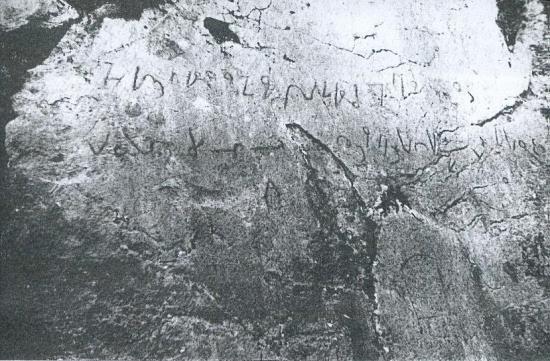
Personally, I have no great interest in unearthing the fabulous wealth of the Templar hoard: anyway, it’ll already take me the rest of my lifetime to spend my share of the Beale treasure. (Ha! As if!) But what does interest me is that Weysen discusses what seems to be a genuine cipher mystery, somewhere in the gorges by Jabron (much loved by canoeists), though it would be somewhat… premature for us to agree that it’s a Templar message just yet, let’s say. And I found a passable picture of the cryptogram here:

jabron-cryptogram

What message do these scratchy glyphs hold? Weysen believed that he was able to decrypt them, and that they said…

Salut! Tu es ici dans les terres de la Vraie Croix. Céleste dominant l’éternité, baille aux languissants la clarté.

Well… I’m going to stick my neck out and say that I don’t think this makes a great deal of sense. But if we can get a better picture of this to work with, I reckon we probably can decrypt it between us…

…Is anyone here going on holiday in Provence this summer who would like to take up this challenge? Just asking! 🙂

Having recently written up the Moustier Cryptograms here (thanks to a declassified issue of the NSA’s in-house “Cryptolog” magazine), I bought a copy of Rudy Cambier’s (2002) book “Nostradamus and the Lost Templar Legacy“, simply because it appeared to contain just about the only thing written about Moustier in the last 40 years.

Initially, Cambier speculated that the cryptogram’s ten pairs of lines of scrambled text contained a somehow-obfuscated version of the Ten Commandments. But given that “the [two] Tablets abound with consonants” (p.132), he dropped that notion and instead hypothesized that the original author “might not have provided the vowels – through a well-known cryptographic expedient” (p.132), i.e. an abjad. Cambier then tells us that this hunch “actually appeared to be the case, and this is what may be considered quite a stroke of luck“, and that he decrypted them on that basis “on three winter evenings in December 1995, with a little effort and a little skill” (p.130).

But what does it say? He claims that the tables “indicate […] to the long-awaited one, to him who will be capable of deciphering them, the secret place where the [Knights Templar] belongings lie hidden” (p.130). Annoyingly, though, Cambier goes on to say that anyone interested in understanding how his lengthy argument goes should instead refer to the article by François Descy in “Le Courrier de l’Escaut” that ably summarizes it.

And therein lies a problem, in that there doesn’t seem to be a copy of this article online. On Le Courrier de l’Escaut’s website, it says that the paper has been following Cambier’s theories for many years, and that its first article covering them appeared on “le 11 février 1998”, but I don’t know whether or not that is the particular article to which Cambier is referring. I’ll try to get a copy, see what it says…

Anyway, according to local historian Jean Connart, work was undertaken on Moustier Church in June 1838 “in accordance with the plans of Philibert Pluvinage and Pierre Joseph Lemaitre”. But who were these two men, exactly?

I turns out that Philibert Pluvinage (b. 1770) was a lay clerk at Moustier Church and also Moustier Philharmonic Orchestra’s first conductor (in 1811). The Tournai archives hold an 1810 document describing Pluvinage’s church-related duties. It’s not clear if he married Françoise Joseph Lepoutte (b. 9th January 1766 Moustier, d. 30th October 1842), for I suspect “Philibert Joseph Pluvinage” was actually his father.

There’s a little more detail on Pierre Joseph Lemaître to be had:
* born & baptised 31st March 1741 in Moustier, Hainaut, Belgium.
* married Catherine Joseph Dehors on 5th May 1779. They had 11 children.
* got a law degree & became a lawyer at the Supreme Council of Hainaut.
* succeeded his father as clerk of Moustier (1794-1807).
* succeeded Willaumez as Mayor of Moustier (1807-1818).
* died 12th November 1822 in Moustier.

Hence it would seem that the 1838 work on the Church was carried out according to plans in part drawn up by the Mayor of Moustier at least 15 years earlier. But without actually seeing those plans (which may well be in an archive somewhere, you never know), that’s just about all we can say for the moment.

So… now that I’ve had a few days to think about this new (to me) cipher mystery, what do I think?

For a start, I have to say that I don’t believe that the two altars look even remotely medieval. Rather, apart from the apparently amateurish quality of their inscriptions, I think they resemble the kind of 18th/19th century monstrosities I recall seeing in churches all over France. (But please correct me if you think I’m wrong!). From the pictures in Cambier’s book, the two altars look to have been made from exactly the same material, by exactly the same builders, and at exactly the same time: so I don’t really buy into the notion suggested by Jean Connart that the St Martin’s altar may have been brought in from elsewhere (and then duplicated for the other altar). So, the only workable explanation I can currently see is that the two side altars were made together in 1838 following the collapse of the church roof during rebuilding work.

And yet the overall mystery remains… why on earth would a church of that general date have cryptograms on its altars?

Having pondered this for a while, I think the explanation will most likely turn out to be that these are imperfect copies of a much older pair of cryptograms that were in Moustier for many years. In fact, they may be not so much cryptograms as badly faded inscriptions (say, from the churchyard?), somehow tied up with the history of the church or town. As such, I suspect that we may stand little chance of deciphering them without an earlier (& hopefully less degraded) copy of them to work with. Hence I believe the best place to search for them would be in the pre-1838 notebooks or sketchbooks of Belgian antiquaries. Someone must have seen a pair of enigmatic inscriptions and copied them down, surely?

Yet I also have to note one odd possibility. Rudy Cambier’s book is all about how he believes Michel Nostradamus was simply an opportunist who took a much older book written in the Picard language (e.g. from the Franco-Belgian border area in the North) and adapted the verses to his contemporary French (Nostradamus was from Provence in the South). And, curiously, “Moustier” is directly mentioned in Nostradamus’ Century I, verse 95:-

Devant moustier trouvé enfant besson,
D´heroic sang de moine & vetustique:
Son bruit par secte langue & puissance son,
Qu´on dira fort eslevé vopisque.

Here, “besson” is an old-fashioned word for “jumeau” – twin. So this would seem to be talking about twin things in front of Moustier. OK, it’s a bit of a long shot, but… might this be a fragmentary fossil of a reference to the (admittedly putative!) earlier twin pair of inscriptions that ended up being (badly) duplicated in Moustier Church’s side altars? I don’t know, it could well be no more than a coincidence but… it’s an interesting thought, right? 😉

Over the last few years I’ve read (and indeed reviewed) plenty of Voynich-themed novels, and indeed have several queued up here I’m trying to steal enough time to read (e.g. Linda Lafferty’s The Bloodletter’s Daughter, etc).

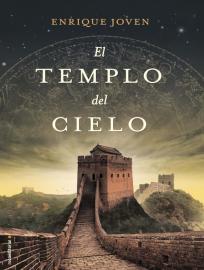
So my default answer to the question “does the world need another Voynich-themed novel?” is normally “no, sorry, I don’t honestly think it does“. Even so, I have to say I’m looking forward to the English version of one just released in Spanish by Enrique Joven (disclaimer – whom I collaborated with on a Spanish history-of-the-telescope article back in 2008).

El Templo del Cielo

His previous book (The Book of God and Physics“, I never did like that title) was a Voynich novel set in modern times, but his new book “El templo del cielo” (i.e. “The Temple of the Sky”, though doubtless his publishers will rename it “The Book of Noodles and Zodiacs”, *sigh*) is set in the early 17th century. Hence it’s kind of a “Voynich prequel”. Errrm… except if he writes a further Voynich novel set in the fifteenth century, when I guess it would become a “Voynich postprequel”. Or (more likely) “book two of the trilogy”. 🙂

In real (i.e. non-novel-writing) life, Enrique is a professional astronomer in Tenerife, and so likes to build his books around ideas that define the history of astronomy. So what’s nice here is that because he has his (historically real) team of Jesuit missionaries (supposedly) take the Voynich Manuscript with them to China (along with the 7000 volumes they did genuinely take), his story should foreground many interesting aspects of the ups and downs of that whole historical sequence. In fact, when I discussed this little-known history here back in 2010, Enrique left a comment outlining what his novel would be about. So we can’t say he didn’t warn us! 😉

PS: here’s a link to Enrique’s blog.

After many years of searching, I finally have a viable excuse reason to go to Belgium that doesn’t involve chocolate, waffles, mussels, chips, or beer. 🙂 And it’s all thanks to the National Security Agency…

I should explain. A few weeks ago, the NSA very generously declassified back issues of its in-house journal “Cryptolog” from August 1974 to Summer 1997 (though admittedly quite heavily redacted in places). Hence I’ve started working my way through them, looking (unsurprisingly) for any Cipher Mysteries stories that haven’t otherwise come to my attention. (Note that there are two Voynich-related snippets listed in the overall index, but these contain nothing obviously new or particularly surprising).

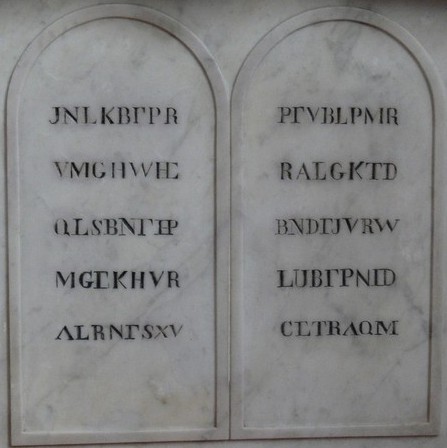
Hence the September 1974 issue of Cryptolog is where I found this particular story. It’s about a church in the Belgian town of Moustier which has a pair of rather curious cryptograms, which Professor Jean Connart (who was writing a history of Moustier), “has been trying since 1961 to discover the meaning” of. Without success, of course.

The first cryptogram is on the church’s St Martin’s Altar (photo by Koen Van de moortel)…

Moustier Church, St Martin's Altar

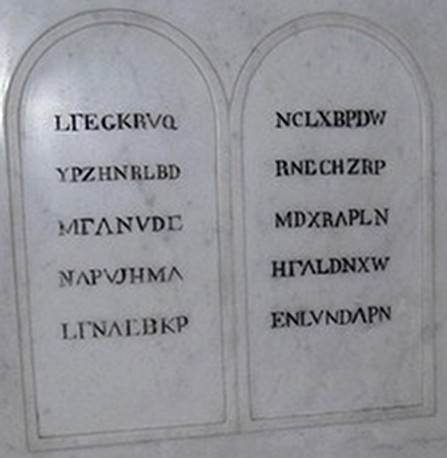
…and the second is on its Virgin’s Altar (photo also by Koen Van de moortel, but scaled up and sharpened by me)…

Moustier Church, Virgin's Altar

What’s nice is that the Cryptolog pages answer many of the questions you’d have asked about Moustier Church if you’d had the chance:

According to parish records, the church at Moustier was in such dilapidated condition about 1836 that repairs were needed to/prevent total ruin of the building. In addition, the winds of November 1836 had taken off part of the roof. In June 1838, some work was undertaken “in accordance with the plans of Philibert Pluvinage and Pierre Joseph Lemaitre. “A stonemason (un tailleur de pierre) received board and lodging for 18 days.” (Italics Prof. Connart’s)

In spite of these repairs, the church was (c.1840?) in such poor condition that part of it collapsed when the roof was raised. The contractors had to rebuild the choir and the side chapels (where the altars are) from the ground up.

There is a published report (Moulart, Basecles; Esquisse religieuse) that the ancient altar of St. Martin was sold or offered for sale at Basecles in 1843. Basecles, a Belgian town near the French border, contains the Church of St. Martin which dates from 1779 and is considered the best product of the Tournai School. Does the Moustier St. Martin’s altar come from Basecles? Were both it and the Virgin’s altar constructed in l843? Or does only the stonecutting date from that time? Answers to these questions could have a bearing on the date of the Moustier cryptograms and their underlying message.

Given that we have reasonable photos of these cryptograms (rather than the hand-drawn monochrome copies that appear in the Cryptolog pages) to work with, we’re arguably at an advantage over the NSA right from the start. And from that I can see that the letter carving is really rather… variable. The height of each row of letters seems inconsistent, with the vertical bars on the U in “LUBΓPNID” plainly different lengths; each row is 7, 8 or 9 characters long; there seems to be no obvious rationale as to whether individual characters have serifs or not; while some characters appear to be formed of merged pairs of letters, possibly accidentally (copying ciphers onto paper is hard, let alone onto stone) or deliberately (to squeeze them into a rectangle), it’s hard to tell.

Yet from the distinctive ‘R’ shape, and the closeness of the match between the materials and framing motif, I think it very likely that the two were carved by the same person at basically the same time.

If you want to take this on, here are my (provisional) transcriptions. I’ve transcribed the “Γ” character as ‘F’, the “Λ” character as “^”, and the composite “Γ-merged-with-L” character as “[“. And being in Belgium, you’ve got Flemish, French, German, and Latin (at least) to choose from as possible plaintext languages. Just be grateful that the dating seems to rule out Klingon. 😉

Moustier Church, St Martin’s Altar cryptogram

J N L K B F P R
V M G H W H[
Q L S B N F HP
M G [ K H V R
^ L R N F S X V

P F V B L P M R
R A [ G K T D
B N D F J V R W
L U B F P N I D
C [ T R ^ Q M

Moustier Church, Virgin’s Altar cryptogram

L F E G K R V Q
Y P Z H N R L B D
M F ^ N V D [
N ^ P V J H M ^
L F N ^ B K P

N C L X B P D W
R N [ C H Z R P
M D X R ^ P L N
H F ^ L D N X W
E N L V N D ^ P N

As far as the transcription goes, I’m far from sure about what’s going on here. I have a sneaking suspicion that part of the mystery might arise from a laziness in the carver, because “E” only appears in the Virgin’s Altar, while “[” appears twice as much in St Martin’s Altar. That is, might “[” simply be a lazy ‘E’, and “^” a lazy “A”? Or might “[” instead be a merged “L + Γ” pair?

As far as letter frequencies go (~27 unique shapes used):
16: N
12: P / L / R
10: F / ^ (note that I included the one instance of ‘A’ in the count for ‘^’)
9: V / D
8: B / H
7: M
6: [
5: K
4: W / X / G
3: J / C/ Q
2: Z / S / T/ E
1: I / Y / U

As far as the cryptanalysis goes, there are quite a few patterns:
3-grams: BFP (2 instances, both in the St Martin’s Altar cryptogram)
2-grams: R^ (4 instances), ^P, PN, ^L, PM (3 instances), plus 14 other 2-grams that repeat once.

PS: Koen Van de moortel describes the cryptograms as a “table with 700 year old secret code, referred to in the “Centuries” from Yves de Lessines, stolen and published by Nostradamus“. Basically, the story there is about a 14th century Cistercian monk called Yves de Lessines, whose book “Les Centuries” Rudy Cambier (of the University of Liège) recently claimed was reused by Nostradamus for his Prophecies. Cambier also claims in his book that “Les Centuries” also describes where the Knights Templar hid their treasure. Just so you know!

Just to let you know that Hungarian urban legend blogger Ivan Marinov emailed me an update on his search for the full story behind the 1926 Budapest crossword suicide case.

Ivan had, as promised, gone through the archives of various Hungarian police journals for 1926 (though the Rendőrségi Lapok-nak archive for the whole of 1926 turned out to be missing), but unfortunately without any great success. The only short article he did find was that (as I understand it) even though detectives had worked feverishly on the case for a month, they hadn’t been able to solve it: but the writer felt (somewhat downheartedly, it has to be said) that suicide had become so commonplace by then that it took attaching a crossword to one to make it noteworthy. And wasn’t it terribly sad that some people found it more interesting to make up a puzzle and die than to live?

However, this isn’t (quite) the end of the line: for example, it may well be that a Hungarian crossword history collector has a copy of this in a dusty file somewhere – or perhaps the Rendőrségi Lapok-nak 1926 archive will turn up in a completely different location. Hopefully we shall see! 🙂

Once upon a time in America, a child maths prodigy at Harvard (taught by famed logician W.V.O.Quine, no less!) volunteered as a guinea pig for Project MKULtra. This involved a long-term series of personality stress tests – specifically, experiments in torture, coercion, mind control and vivid psychological abuse. (All participants had codenames, I read that his was “LAWFUL”).

Less than a decade later, that same now-former child prodigy grew increasingly disenchanted with the industrial world; gave up his professorial post; dropped out of mainstream society, moving to a remote cabin outside Lincoln, Montana; and between 1978 and 1995 sent at least 16 mail bombs to universities and airlines. The FBI dubbed him “UNABOM” (“UNiversity & Airline BOMber”), but the media rechristened him the “Unabomber“. After getting his manifesto “Industrial Society and Its Future” published in The New York Times and The Washington Post (under threat of more bomb attacks), the Unabomber – Ted Kaczynski – was finally identified and arrested in 1996. Though he avoided the death penalty, he will remain in prison for the rest of his life.

What’s relevant for us is that Kaczynski filled his notebooks with a mixture of English, Spanish and a numeric cipher (as a maths professor, naturally he would use numbers to hide his secrets). Helpfully, investigators found the key to the cipher amongst his papers (many of which were later sold at auction), though this seems to have taken the FBI a whole decade to crack (yes, even with the key).

This was a story which Bruce Schneier picked up on in 2006 and then in early 2007, when he had been shown some (but far from all) cryptanalytical notes as to how Kaczynski’s complicated cipher system worked. On his blog, Schneier posted links to three pages he believed were original (and to two other pages he thought had probably been originated by an FBI cryptanalyst), though unfortunately all of these images have since disappeared from both the web and the Wayback Machine (while Schneier himself didn’t keep copies, he told me yesterday).

The only problem is that I don’t (yet) completely believe the story as reported is entirely correct – because the cryptography as described just doesn’t seem (to me) to link up with the ciphertexts in the way that it should.

Firstly, [which I found thanks to this 2003 Zodiac Killer forum page], the original Unabomber trial news reports described how “FBI cryptographer Michael Birch” used the notes that had been found in Kaczynski’s cabin to decipher his notebooks.

The diary, written in pencil on several hundred pages of notepaper and several inches thick, includes details of experiments with explosives. It was among 20,000 documents seized from Kaczynski’s tiny Montana shack.

The diary contents have not been made public, although Birch’s decoded version was given to the defense last year.

Sources familiar with the journal describe it as a sophisticated jumble of numbers, an intricate enigma wrapped in a riddle befitting a Harvard-trained mathematician described by one prospective juror as a “smart weirdo.”

Back in 2003, Douglas Oswell posted a grainy scan of a 42×52 cipher grid sheet that the FBI had released, where the top line seems to be “4 7 7 0 1 3 81 …”. This seems to have been taken from a book called “Harvard and the Unabomber” by Alston Chase. As I understand it, Chase included a list of numeric cipher key equivalents running from 0 (“for”) up to 89 (“delete”), all of which Oswell transcribed and placed online here. However, that numeric key does not seem to match up to the data in the grids, leading people to surmise (rightly) that there was at least one more enciphering / deciphering step involved.

I also found an image of a cipher grid codesheet that had been auctioned, where the top line is “… 7 54 4 2 13 1 72 11 7 36 18 1 5 6 4 12 15 29 27 30 29 47 8 37 75 8 45 41 19 2 21 13 34 2 …”. Though this has diagonal lines marked in (more on that later) and is at least 36 columns wide, the number sequences listed seem to me to employ a subtly different enciphering scheme to the image given by Alston Chase (though I might well be wrong).

Finally, the 2007 KPIX news report to which Bruce Schneier contributed (and which you can see on YouTube) describes a multi-stage horizontal, vertical, and diagonal “unscrambling sequence” (which could only ever work on numbers laid rigidly out on a grid), followed by a “marrying” and/or “merging” stage (combining pairs or groups numbers to yield more meaningful numbers). The report showed long non-gridded lists of numeric ciphers, such as…

73,32,51,91,62,59,33,13,15,11,57,31,7,…
33,82,30,76,31,53,42,35,6,24,51,61,1,75,…
16,41,95,87,91,55,62,51.
96,15,93,32,25,85,44,22,72,36,94,96,…
54,72,15,89,52,87,21,66,72,26,89,51,90,…

…and…

40,44,73,33,10,60,11,48,59,98,47,23,…
82,31,35,19,17,37,13,6,27,94,31,15,3,…
9,18,39,55,61,12,50,13,99,91,83,61,7,…
69,68,21,34,59,25,42,75,80,91,16,35,48,…
5,42,68,9,40,6,17,97,86,71,71,2,81,55,60,…
50,49,78,62,52,57,25,36,34,80,…
15,77,3,81,2,35,86,22,4,8,21,73,7,…
21,47,57,1,99,7,85,44,13,5,67,84,…
12,96,58,19,47,32,18,34,26,96,15,…
83,88,41,44,59,76,10,55,18,30,44,…

Yet only part of the back-end numeric cipher key is apparently given in the report:-

82 = SO
83 = ST
84 = TH
85 = THAT
86 = THE
87 = THERE
88 = THEN
89 = THIS
90 = TO
91 = TR
92 = UN
93 = UNDER
94 = UP
95 = WHAT
96 = WHEN
97 = WHERE
98 = WHO
99 = WH[Y?]

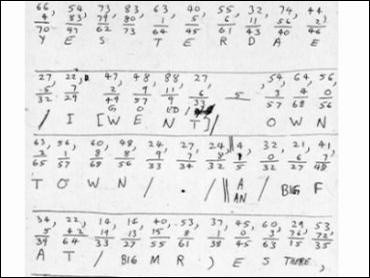
A worksheet was also released, that looks like this:-

Unabomber-cipher-worksheet

This pre-back-end-numeric-cipher calculations seem to involve adding pairs of numbers together (where if the tens column overflows into the hundreds column, that overflow gets added back into the tens column), and then using the final output pair of digits as an index into a table of letters or tokens similar (but not identical) to the one originally given by Alston Chase, i.e.
66 + 4 = 70 –> Y [Chase gives ‘X’]
54 + 83 = 137 –> 47 –> E [same as Chase]
73 + 79 = 152 –> 62 –> S [same as Chase]
83 + 80 = 163 –> 73 –> (null) [Chase gives ‘delete’ (‘null’?)]
63 + 1 = 64 –> T [same as Chase]
etc.

So, an open-and-shut case? Well… no, not really. Here’s what I don’t understand:-
* Why did the FBI say that it could read the cipher notebooks in 1996, when it then claimed to have cracked them only in 2006?
* Why does the numeric key given in Alston Chase’s book differ so radically from the one (82-99 only) shown by KPIX?
* Did Kaczynski use multiple numeric cipher keys?
* Why did the KPIX news report show lists of comma-delimited numbers as the contents of the notebooks if the method used to unscramble the sequences only worked on rigidly laid out cipher grids?
* Why was the numeric key given in Alston Chase’s book subtly different from the one used in the worked “YESTERDAE” example?

Don’t get me wrong, I’m really not doing anything like advocating Ted Kaczynski’s innocence or somehow endorsing his anti-industrial position etc. Rather, even though I’ve looked carefully at all the cryptographic evidence I’ve been able to find, I just don’t see how it’s supposed to hang together as a consistent piece of cryptological data.

Could it have been… that the original decryption involved not simply “learning how to apply the code to the defendant’s coded writings and the admission into evidence of [Birch’s] completed translation” (as claimed), but also having to infer the 100-letter numeric cipher alphabet that was perhaps not included in the “unscrambling sequence” notes? Could it be that the FBI was overanxious to paint a pre-trial picture convincing to jurors that what they had was ‘simply’ an an unambiguous “translation” rather than a (possibly interpretative) “decryption”?

This was, after all, really not long at all after FBI whistleblower Frederic Whitehurst had famously made his numerous allegations of forensic mishandling inside the FBI’s Laboratories, causing (for example) much of the explosive analyses done on the Unabomber case to be considered too unreliable to be used in court. If the ciphered journal was to be, as lead prosecutor Robert Cleary described it, “the backbone of the government’s case”, then there surely must have been internal political pressure for it to have been presented as if it were utterly rock solid evidence,

However, from the subtle difference between the numeric cipher given by Alston Chase and the one (implicitly) presented in the worksheet, I suspect that the FBI’s cryptanalysts didn’t manage to completely lock down the numeric cipher key list in 1996. Helpfully, Kaczynski seems to have made the decryption a little easier by using many letter keys in alphabetical order (a mistake people have made with numeric ciphers for centuries), and hence the decryption as presented to the jury was very probably extremely close to what Kaczynski had written. But if it wasn’t 100%, I don’t personally think it should have been presented as a “translation”.

So, if you’re like me, you’d now like to know a little more about the key to the Unabomber’s cipher journal that was found in his cabin. But given it’s the FBI (and many of the Unabomber records are locked for the next 50+ years), perhaps we won’t. Hopefully we shall see sooner than that… fingers crossed!

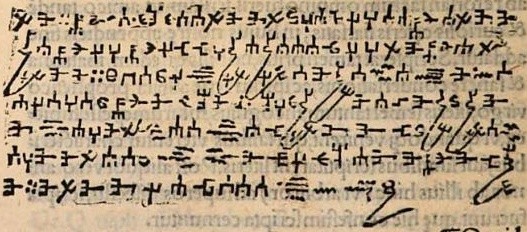
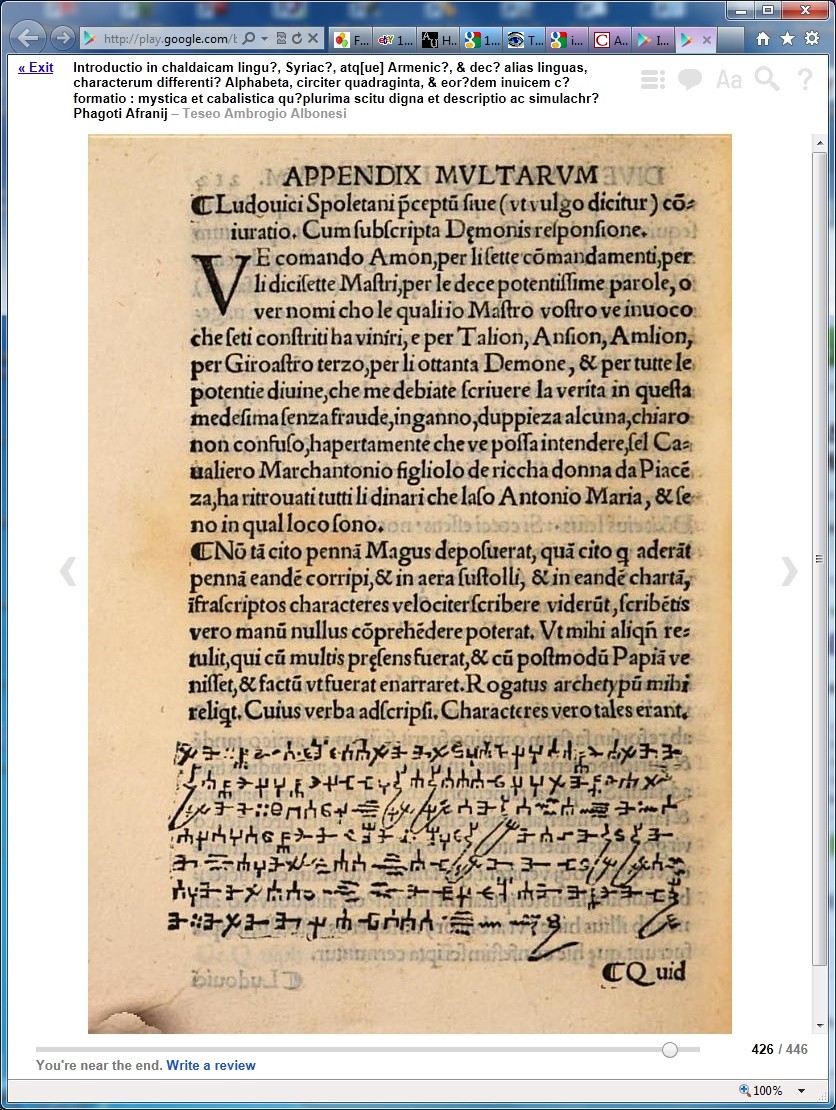
spoletani-cipher

A curious book called “The Devil in Britain and America” by John Ashton (1896) reproduced an image of some writing that…

is supposed to be the only specimen of Satanic cal[l]igraphy in existence and is taken from the ‘Introductio in Chaldaicam Linguam,’ etc., by Albonesi (Pavia, 1532). The author says that by the conjuration of Ludovico Spoletano the Devil was called up, and adjured to write a legible and clear answer to a question asked him. Some invisible power took the pen, which seemed suspended in the air, and rapidly wrote what is facsimiled. The writing was given to Albonesi (who, however, confesses that no one can decipher it), and his chief printer reproduced it very accurately.” (Preface, pp.v-vi)

This basic “Devil’s Handwriting” story has been reproduced & rehashed many times on the Internet: my thanks to the indefatigable Dave Oranchak for passing it my way last summer, when I used it as a slide for my London Rare Book School talk… (but then forgot to post it here, d’oh! Sorry!)

Though at first sight it all seems rather like an urban myth, it turns out that Albonesi’s book (with the catchy title “Introductio in Chaldaicam linguam, Syriacam atque Armenicam et decem alias linguas characterum differentium alphabeta circiter quadraginta et eorundem invicem conformatio“) is not only very real, but also (according to a book chapter by Daniel Stolzenberg) one of “the foundational texts of Oriental philology, as well as [one] of the earliest studies of comparative linguistics” (p.308). In fact, a copy recently sold at auction for $6899.

So… what was the Devil doing in Albonesi’s details, exactly? Well, it turns out that Albonesi (1469-1540) corresponded with the French linguist, astronomer, diplomat & cabalist Guillaume Postelon the subject of this and other magical or otherwise unusual alphabets” (p.308, note 21), and the story of Ludovic of Spoleto’s alleged encounter with the Devil seems to have arisen from there.

However, from my own crypto historian viewpoint, I have to say that Trithemius’ idea of hiding ciphers behind a demonological or necromantic facade was very much of the moment circa 1532: so I strongly suspect that what we’re looking at here is probably a cipher concealed behind a devilish story, rather than (say) some kind of quasi-moralistic hoax.

But can we crack it? Well… there are some problems. The best scan I have (at the top of the page, taken from the 1539 edition) isn’t of excellent quality, and it contains many similar-looking characters which could well be copying errors introduced when the book was prepared for printing. Hence transcribing this may not be quite as easy as many other ciphers you’ll see.

Still, it does largely resemble a “pitchfork-themed pigpen” cipher, and the cipher shapes look to have been consciously improvised around Devilish themes (pitchforks and bats?), so there may well be some kind of simple underlying symmetry to its letter/cipher organization that emerges once you get the hang of it. Plaintext is likely to be Latin or Italian, I guess. Unless it’s Adamic, Enochian, or the Green Language, of course, but I’m not holding my breath for any of those. 🙂

Guesses: it’s possible the “bats” are groups of “enciphered I” shapes (i.e. III or IIII, etc) while the ‘.’ is an enciphered U/V. The flourished pitchfork might encipher the full stop at the end of a sentence. Might the plaintext turn out to be nothing more than a joke making fun of Albonesi or Postel? Could be! Hopefully we shall see…

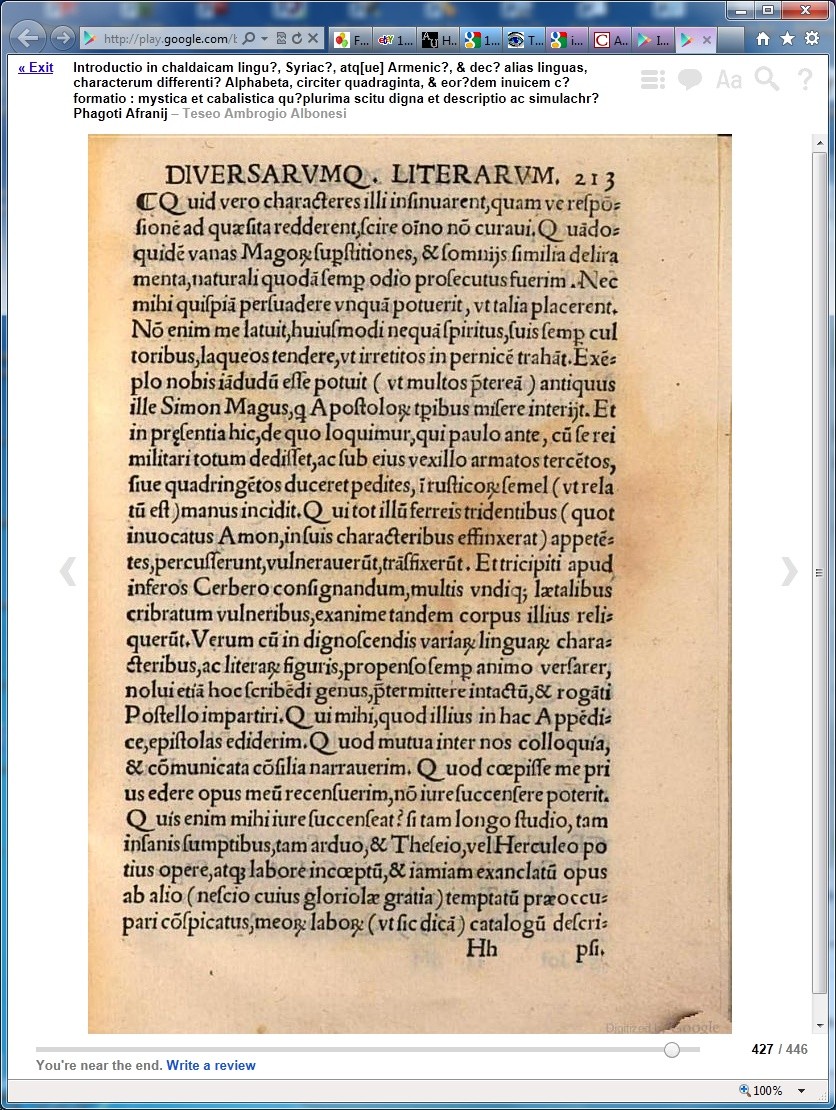
PS: I can’t now find the online copy of Albonesi’s book, but here are links to screengrabs of p.426 and p.427, in case you want to see the text surrounding it.

According to Stu Rutter’s latest raid on the National Archives, the Allies’ WW2 “Typex” cipher used a single five-letter indicator, placed both at the start and end of messages [so says WO 208/5109, anyway]: and so he concludes that Typex was very probably the system used by our wonderfully mysterious WW2 pigeon cipher. Having said that, I do wonder whether the first five plaintext letters will turn out to be “QQQQQ”, as I recall that many messages had this dummy text group added at the start to avoid stereotyped messages, even though it was itself an even more stereotypical sequence. Perhaps combining this with the ciphertext might let us work back to the rotor contents and settings… just a thought!

[Typex remains a great working hypothesis, though personally I’d still like to see how the Air Support Syllabic Cipher (War Office document BX 724) and Royal Engineer Syllabic Cipher (War Office document BX 724/RE) worked. But that’s another story!]

Intriguingly, GCHQ’s archives holds a Typex document which Stu would understandably like to get access to: and at last weekend’s Big Bang Science Fair at London’s ExCel venue (which my son thought was really fantastic), I was very pleasantly surprised to bump into the GCHQ Historian hard at work on the GCHQ stand, busily helping children encipher their own Enigma messages for Bletchley Park’s rebuilt Bombe to try to crack. He told me that GCHQ releases documents more according to security-related criteria than in response to Freedom of Information requests: and even though he would send us through the appropriate paperwork to fill out, we should necessarily be somewhat patient… it’s no secret that it’s not the fastest of processes (for example, they released the last Enigma file only last year). Fingers crossed that all goes through!

Incidentally, the Americans didn’t think Typex was properly fit for purpose, sniffily describing it as “nothing but a glorified German Enigma, with 5 rotors instead of 3 and with arrangements for printing” (NARA: RG 457 HCC Box 804 NR 2323, quoted in Ratcliff “Delusions of Intelligence”, p.167), while British cryptologists also saw flaws in Typex “as early as 1940”, though their recommendations as to how to work around them seem to have been acted upon (“Delusions”, p.179). Yet even though the Germans knew exactly how Typex worked, they had “abandoned work on it” prior to 1942, presumably because of its structural similarity to their own ‘unbreakable’ Enigma variants (“Delusions”, p.178 and p.202).

But here’s something to do with Typex that’s rather interesting (and more social history than overtly cryptographic) which I liked, and think you may well like too. 🙂

Having posted a few days ago on the British Army’s pervasive use of ciphers for pigeon messages, I was intrigued to read about the Army “cipher room” at Arundel Castle mentioned by Bill Button: and so decided to snoop around the web for further mentions of WW2 cipher rooms. The nicest things I dug up by far were three reminiscences made by Jessie Dunlop in 2004 (courtesy of her daughter Ann Wild) on the BBC’s “People’s War” website. Rather delightfully, these described her wartime cipher experiences, firstly at Low Grade Cipher School in Eccleston Square, secondly at High Grade Cipher School in Half Moon Lane, London, and then finally at SHAEF Supreme headquarters in an Underground tunnel between Goodge Street and Warren Street Station, at which time she met her future husband Jack.

Confusingly, she misremembered Typex as “xyco” (which is why these posts didn’t show up in web searches), but that’s entirely to be expected – it was a very long time ago, after all. In a follow-up comment from 2004, she further described how xyco / Typex was used:-

“I think it was modelled on the Enigma. It had several drums in the top with a lid to be lifted to reach these. The first one was static and was set each day with the beginning of the day’s code. The rest were also set each day but they revolved. A keyboard like a typewriter was below these and on this the message was typed in. It came out in groups of letters, I think. Sometimes we could add what was called a scrambler, an electrical gadget which we plugged in if the the message was top secret. This was indicated at the end of the message in the code.”

And so it would seem that in the pigeon cipher, we’re looking at
* an enciphered Army message (quite possibly in Typex);
* not sent during Operation Overlord (i.e. not on D-Day or shortly after); and
* not top secret (and hence not using any kind of scrambler).

This is really useful, because it probably means that Stu Rutter need not worry about scramblers or reflectors (I think): for if we are looking at a non-top-secret Typex message, it probably wasn’t using a scrambler. So as long as he has an accurate copy of the the contents and structure of the rotors and the way the Typex worked, who’s to say that Stu’s JavaScript simuator won’t be able to give us the answer? If so, it might arguably be the first Typex message ever decrypted by anyone… and how cool would that be? 😉

Incidentally, one great sanity check might be to ask the Royal Signals Museum in Blandford, Dorset if they could use their Typex machine to encipher some test messages with various rotor settings to validate Stu’s simulator. In return, perhaps they might like to have his simulator on display next to their machine, so that visitors can try it out for (virtually) real? That would be good for everyone, I think. 🙂

Anyway, here’s a question for you all: how can we find out if Jessie Dunlop – or indeed anyone else who worked on British Army High Grade Ciphers, whether in SHAEF or elsewhere – is still alive? Perhaps having her looking at our pigeon message might trigger some memories of how it all worked. Something to think about! 🙂

When “X. Lamb” unexpectedly announced that the “Tamam Shud” Unknown Man was a certain “H. C. Reynolds” (whose merchant seaman’s ID card she had), I’m sure that she was utterly convinced of the truth of what she was claiming, and that she believed it was simply a matter of time before evidence properly supporting it would emerge.

Indeed at first sight, it seemed both to me and others as though it ought to be fairly straightforward to test her claim. After all, we had a very specific data point to work with (admittedly surrounded by a whole load of media and online speculation, most of it unhelpful and distracting) – a name, a face, a date and a place of birth (Hobart, Tasmania).

Eventually, thanks mainly to solid work from Cheryl Bearden, we determined that this “H. C. Reynolds” was born in February 1900 and had the middle name Charles (which he clearly preferred to his as-yet-unknown first name “H[—–]”): and we were able to reconstruct his brief career as a merchant seaman working for the Union Steam Ship Company, the “Southern Octopus”. It was clear that this Reynolds was no fantasy, but a real flesh-and-blood person: and so, in theory, all we had to do was dig up a link between his maritime career and his life on land, and bingo – all his life would be spread before us.

Pursuing this fairly slender reed of a lead yet further, I managed to discover (from his employee records) his exact date of birth (8th February 1900): and, from the ever-useful “Log of Logs”, that ships’ logs for two of the three ships Reynolds worked on could be found in two different Australian archives. Very kindly, both Diane O’Donovan and John Kozak took the time to go and look at these two log books (one each), and found… nothing. Nada. Zero. And that, I strongly suspected at the time, was going to prove the end of the whole affair: for whatever reason, this H. Charles Reynolds seemed doggedly determined to stay just out of our archival reach. It felt hard not to conclude that we’d never be able to convincingly prove or refute X. Lamb’s assertion that he was the Unknown Man found mysteriously dead on Somerton Beach on 1st December 1948.

Frustratingly, it had been reported early on that a similarly-named-but-apparently-quite-different H. C. Reynolds (a “Horace Charles Reynolds”) had been born in Triabunna on Tasmania on 12th February 1900. But once we knew that “our” H. C. Reynolds had been born on a different day in the same month fifty or so miles away in Hobart, this was a fact that became pigeonholds in the ‘curiously coincidental but annoyingly unhelpful‘ category. And anyway, it was also reported that this particular Horace Charles Reynolds had been a poultry farmer, and that (when asked) his family didn’t believe that he had ever gone to Adelaide, let alone gone to sea. Oh well. 🙁

Step forward Debra Fasano: though a little late to the whole H. C. Reynolds party, she carved a path through the fuzz of uncertainty straight to an extremely reliable source – the “Tas BDM” (Tasmanian Births, Deaths, and Marriages) indexes on CD. And the entry she found there turned the whole story round:-

Tasmanian Federation Index 1900-1930 (CD)
Author: Macbeth Genealogical Services
Year: 2006
ISBN: 1920757082

Surname: REYNOLDS
Given name: Horace Charles
Event: Birth
Father: Edwin REYNOLDS
Mother: Mary Ann Matilda BAYLEY
Date: 8 Feb 1900
Sex: Male
Place: Davey Street, Hobart
Registration Number: 200

And with that, all the pieces finally start to fall into place. There weren’t two Horace Charles Reynolds-es born in or near Hobart in February 1900: there was, without much doubt, just the one. Debra adds:

“When looking for Horace’s birth I had a good search of the indexes and couldn’t find anyone else with a similar name, initials, or anything else that might be relevant. I am really strict about evidence and I do think that he is the person who was working as a Purser.”

As to when this Horace Charles Reynolds died, there’s a death notice in the Hobart Mercury (18 May 1953), which seems very probably the same man:-

REYNOLDS. -Suddenly, on May 16, 1953, at a private hospital, Hobart, Horace Charles Reynolds, late of Brookvale, New South Wales, aged 53 years. Private cremation.

We knew that our H. C. Reynolds was born in Hobart and got his first job in Hobart: and from this notice, it seems almost undeniable that Hobart was where he died too.

I say “almost”, because there are a few matters that remain half-open, not least of which is the matter of Reynolds’ family apparently denying that the photo was of him. I wonder, though: had someone seen a quite different Horace Reynolds from Wooroloo who died in 1954 (as per The West Australian Monday 15 March 1954 p 30) and put the two stories together? That particular Horace Reynolds was born 10th April 1903, was NX69883 in the 2nd AIF, and was a farmer married to Elizabeth. My guess is that he will turn out to be the “poultry farmer” mentioned very early on, someone quite different to the one we were actually looking for.

The Tasmanian Horace Charles Reynolds appears to have had no children: but if even if didn’t marry, it’s entirely possible that we could trace his immediate family right to the present day and perhaps ask them if we could find a photo of him – after all, 1953 wasn’t really so very long ago, was it?

Debra Fasano notes that Reynolds had two older brothers:
* Oswald Bayley Reynolds (b. ~1891) was a billing clerk who rose to become a senior bank administrator.
* Archibald Henry Reynolds (b. 1895) was (according to the 1930 and 1933 NSW electoral rolls) a clerk living in Carter Road at Brookvale in NSW.

I also noticed in Trove that Mrs Edwin Reynolds stepped down as Treasurer of her local Triabunna town committee in 1898, so it should perhaps come as no great surprise that Horace Charles Reynolds started out as an Assistant Purser, for he came from a veritable family of clerks. (Or do I mean “a fastidity of clerks”? I never can remember collective nouns).

Finally, Debra notes that a “Charles Reynolds” was also living in Carter Road in the 1930s, and working as (you guessed it) a clerk. Given that we know that our H. Charles Reynolds was already signing himself “Charles Reynolds” by 1919, and that the Horace Charles Reynolds who died in 1953 had been living in Brookvale, what are the odds that these are all pieces of the same cussedly consistent jigsaw? If there is a chink somewhere in this logical chain-mail armour, I have to say that I can’t currently see it.

Anyway, I’ve already been told off once this week for a ‘TL;DR’ (“Too Long; Didn’t Read”) post, so I’d better bring this to a close here. Perhaps someone will be able to use these details to ferret out a living relative of the various Reynolds brothers, and perhaps try to dig up a separate photograph of Horace Charles Reynolds to independently test this whole narrative. It would be nice to get proper closure on this, even if it isn’t quite the result some may have hoped for.

By the way, if you do decide to try to trace this all the way to the end, Debra suggests a number of surnames connected with the Reynolds family that may be of assistance:-

LESTER
VALENTINE
SHEA
SPENCER
FLETCHER
DENNE
ROLSTON
PAGE
TATE
MULLANE
LEVY
ALOMES
HARDY OR HARDING

Happy hunting! 😉