The story of what happened at Roswell is usually told in terms of two primary sites – the Foster Ranch site near Corona (where Mack Brazel and Dee Proctor found unearthly debris), and a site north of Roswell (where passing field archaeologists found a metallic ‘pod’ with four strange bodies, one still alive).

However, geographically between these two sites sits a third site, that Carey and Schmitt (in their “Witness to Roswell” book) call the “Dee Proctor site” or the “Dee Proctor body site”. By way of background, I’ve been looking for any additional sources on this (still somewhat mysterious) third site.

Hence I thought I’d summarise what I’ve found so far below. Which should pretty much double the amount of information on the Web. 😁

The Bluff

In 1947, Timothy William “Dee” Proctor (b. 07 Feb 1940, Corona, Lincoln County, NM) was just seven years old, and being paid 25 cents a day by Mack Brazel to ride along with him on the ranch for the summer. It was famously the two of them who found the first ‘crash’ site full of strange lightweight metallic debris.

But Dee seemed to have subsequently had a troubled life (described throughout Chapter 1 of “Children of Roswell”), keeping other things he had seen that fateful summer to himself. It wasn’t until 1994 that he drove his mother down rickety back roads to a specific bluff (“about 2.5 miles east of the Corona debris site”, WtR p.47), telling her “Here is where Mack found something else”. This was clearly The Big Secret (or at least part of it) that had been eating away at him for nearly fifty years.

What exactly was this “something else”? Carey and Schmitt say that this was “where several dead aliens were found who had been blown out of their crippled ship when it exploded” (CoR, Ch.1), though without giving a source. While Nick Redfern (via Anthony Bragalia in 2012) says that it was “body parts”, his source being a regretful retired intelligence agent (though unnamed).

But let’s not get too carried away, eh?

The Roswell Children

Other Roswell children claimed to have been to this “other location” (WtR, p.47): in 1998, Sidney “Jack” Wright said that he, Thomas Edington’s two sons and one of Truman Pierce’s daughters also saw what was there. None of these Roswell children has yet spoken of what they saw. But who exactly were they?

Sidney Jack Wright (b. 01 Jun 1934, d. 08 Aug 2019) was the son of Albert Sidney Wright and Celia Geneva (Clark) Wright: he was succeeded by his wife Wilene Wright of Odessa; his daughter Brenda Garvin (and husband Tim) of Waco, TX; and his son David Wright of Riverdale, CA. His memoirs are online (but with no mention of Roswell).

The Edington rancher family I have had no luck with. Any suggestions?

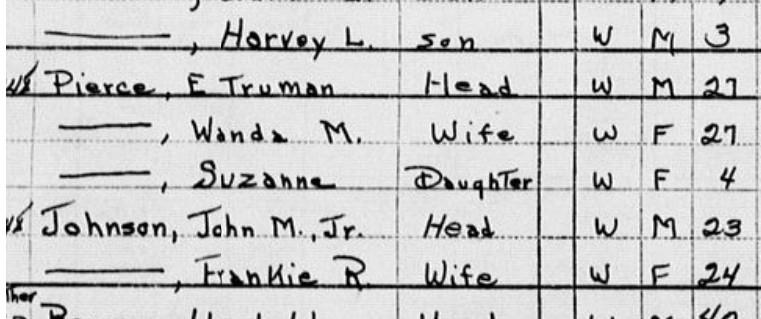
As far as the children (I’ve seen one son and four daughters reported on the Internet) of Edward Truman Pierce (1922-2001) and Wanda (McBride) Pierce (1922-1995) go: Suzanne “Suzie” Cox (nee Pierce) b. 12 Nov 1945, d. 25 Jan 2021, wouldn’t even have been two years old in August 1947, while Jean Hamill (husband Steve Hamill) and Joan Key (husband Collins Key) were even younger (I believe), so I’m possibly still missing a son and a daughter here, alas.

Oddly, the 1950 US Census only lists Truman (27), Wanda (27), and Suzanne (4).

Hines House & the Cattle Shed

Though it’s not completely clear, what seems to have happened next was that Mack Brazel took something (or maybe everything?) from this site to the cattle shed close to Hines House. (WtR p.50) Another account says that this was four feet by three feet by one feet, but the wires may be getting crossed here, it’s hard to say.

Given that Brazel later reportedly exclaimed “I should have buried that thing” (WtR p.80), my current guess is that that “that thing” was from the Dee Proctor site, and may possibly have been a bigger issue than the Foster Ranch site debris.

Carey and Schmitt report that Sheridan Cavitt went to the cattle shed (WtR p.206), but it’s not clear to me whether Jesse Marcel went there too.

What’s Missing Here?

Even though I’ve now read a ton of Roswell-related books etc, it still feels like I’m missing a ton of stuff. To me, it’s as though the key to the whole mystery is woven into the events that happened at this third site, but the accounts of it I’ve read are all fairly sketchy (at best).

Might Roswell researchers have over-focused on the two ‘glamorous’ sites (the Foster Ranch debris field and the ‘pod’ site), and not put the time and effort into the third site?

Or is there a huge bibliography on the third site I’m completely unaware of?

Not much news here, though I have finally managed to make contact with Charles Hansford Kendall’s family, who very kindly answered my questions about him. From what they told me, it now seems highly unlikely to me that Kendall was the Navy balloonist I’ve been seeking, so my search continues.

Robert Henry (“Bob”) Howe USNR

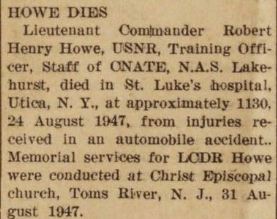
Kendall aside, the only other NAS Lakehurst Navy man I’ve found who died around the period of interest was Robert Henry Howe. The Princeton Alumni Weekly reported:

ROBERT H. HOWE ’23

It seems almost unbelievable that we are reporting the death of Bob Howe who was killed in an automobile crash August 24 [1947]. The accident happened near Utica, N.Y. while Bob with his wife and son, Richard, were on the way to the Adirondacks for their vacation.

Bob was commissioned in the Naval Air Corps in June 1942 as a lieutenant. He had served as a navigation instructor in Norfolk and at the time of his death was a Lt. Comdr. at Lakehurst, where he was instructing.

Prior to his entry into the service, he was in the jewelry and wholesale silver business. During the war his son, Robert H., Jr. died in the service when his Marine Corps plane crashed at Jacksonville, Florida.

Bob could be found at all reunions and those who were back last June will always remember his ready smile. Reunions just won’t seem the same without Bob and the class has lost a most loyal classmate.

He is survived by his widow, Priscilla M.; two sons, Charles M. and Richard B.; his father, Charles H.; a sister, Mrs Carol H. Newell; and his maternal grandmother, Mrs. Carrie W. Ostrander.

The class extends its sincere sympathy to the family in their great sorrow.

For the Class of 1923

H. GATES LLOYD, President

JOHN E. SPENCE, Secretary

If anyone has paywalled access to old newspaper sites, can I please ask if you would have a quick look to see if Howe’s death on 24th August 1947 was reported there? I looked on NYS Historic Newspapers (one of my favourite free newspaper sites), but it seemed to have nothing from Oneida County for that month, alas.

Dennis Gilliam, pressure suit historian

I’ve also found myself stymied looking for contact details for the pressure suit historian Dennis Gilliam. He used to work for “Orbital Outfitters” (surely a play on Urban Outfitters, right?), the spacesuit company whose contract with Elon Musk famously specified that the space suits should look “badass”.

I’d like to talk with Gilliam about the US Navy’s Strato Model 7 full pressure suit (designed by John D. Akerman at his Strato Equipment Company in Minneapolis). There’s a load of stuff in the John D. Akerman Collection at the University of Minneapolis, which I’m sure Gilliam will have gone through.

However, now that OO is defunct, Dennis Gilliam also seems to have disappeared from view. Can I please ask anyone with better online sleuthing skills than me to please try to find his contact details and pass them to me? Thanks!

I’ve been going through yet more of the (digitised) papers in the Smithsonian’s Captain George Henry Mills Collection, and have more to share about Captain Charles Kendall and NAS Lakehurst history.

The CNATE Succession

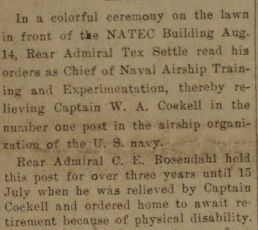
At the start of the period in question (1945-1950), the base commander at NAS Lakehurst was Vice Admiral Charles (‘Rosey’) Rosendahl. However, when ill health forced Rosendahl to retire early, the base was temporarily run by Captain William Arthur (‘Art’) Cockell, who then handed over to Rear Admiral Thomas (‘Tex’) Settle. Settle was in turn replaced by George (‘Shorty’) Mills, who held the post of CNATE to mid-1949.

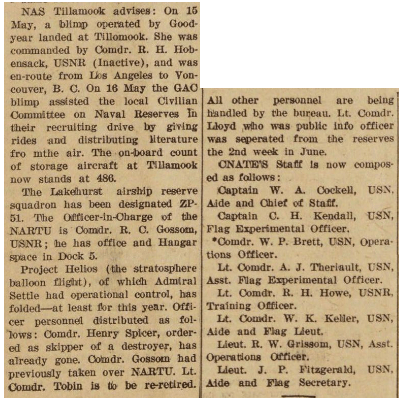
We can see much of this from a clipping from “The Bag Vet” (Number 1, Vol 1, 1st September 1946, p.1), an airship “News Sheet For All Vets of Blimpron 14”, which, along with all its where-are-they-now and would-you-like-a-job-flying-a-Howard-Hughes-blimp articles, also included airship-related news from various NAS bases such as Lakehurst:

(By way of explanation: a “blimpron” was a “blimp squadron”, Blimpron 14 was also known as “ZP-14”).

Captain Kendall updates

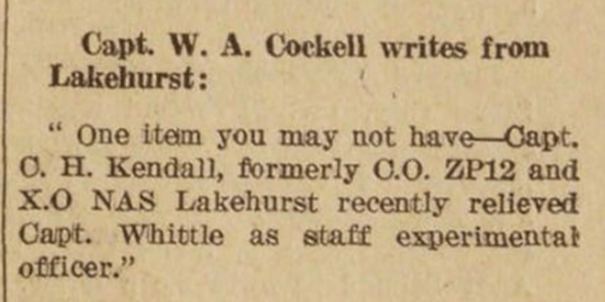
Even though Charles Kendall seems (unlike Rosendahl and Mills) not to have subscribed to The Bag Vet, a few news items relating to him do appear there. For example, in The Bag Vet, Jan 15th 1947:

Decoding the Navy acronyms, “C.O. ZP12” was “Commanding Officer of Blimpron ZP-12”: this was the blimp squadron that covering the Atlantic during WWII. “X.O” was “Executive Officer”, who was normally the Number Two on a given base. So it seems from this that Kendall started as Executive Officer under Tex Settle, but then became Experimental Officer at the start of 1947.

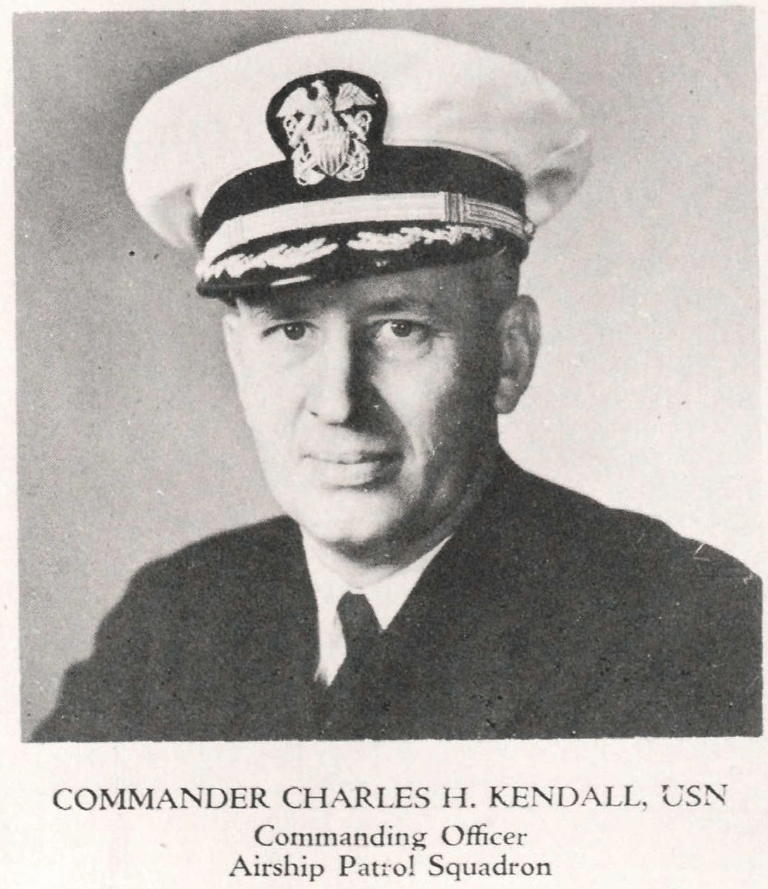
Incidentally, there’s a nice picture of Kendall as C.O. ZP-12 in “United States Naval Air Station Lakehurst New Jersey – A Photographic Essay”, a copy of which is in the George Mills Collection:

The Bag Vet (Vol. 1, Number 5, 1st Nov 1947) mentions the demise of Project Helios (note that Commander Henry Calvin Spicer Jr was for a while the designated pilot for Project Helios):

So, at some point in 1947, Captain Art Cockell was SDO NAS Lakehurst, Captain Charles Kendall was Experimental Officer, and Lt. Commander Alcide Theriault was Assistant Experimental Officer beneath Kendall. However, we can date this organisational change to before 24th August 1947, because that sadly was when Lt. Commander Howe (“Training Officer” above) died in an automobile accident:

Incidentally, in a US Navy context, a “Flag Officer” means a commissioned officer senior enough that they are entitled to fly a flag at the place they exercise their command. While this normally applies to rear admirals or higher, it can also apply to someone who has commanded a squadron of vessels. Yet in such cases, this normally only applies for up to a couple of years until a suitable promotion (normally to rear admiral) can be put in place.

So it would seem that in 1947, Captain Charles Hansford Kendall was very close to becoming an Admiral in the US Navy, a rank his older brother Henry Samuel Kendall had previously reached. It therefore seems likely to me that Kendall would have taken on the role of Experimental Officer at NAS Lakehurst only on a temporary basis: at that time, he was surely headed for a bigger role within the Navy before too long.

Where next in the archives?

While it has been helpful going through the (fully-digitised) George Mills Collection at the Smithsonian, and frustrating looking at the finding aid for its (entirely undigitised) J. Gordon Vaeth Collection (boo), it left me wondering if I was even looking in the right place.

I think it fair to say that George Mills was more of an administrator who liked LTA, while Vaeth was an airship enthusiast (if not actually a bit of an LTA history obsessive). But both of them were left firmly in the shade by Vice Admiral Charles Rosendahl: following his early retirement, Rosendahl seems to have spent the next 30-odd years writing constantly about airships – from the archives, there seem to be few newspapers or magazines or journals to which he didn’t submit pieces or articles concerning LTA.

And so it is that Charles Emery Rosendahl’s voluminous collection of LTA material at the Special Collections Department, Eugene McDermott Library (at the University of Texas at Dallas) has ended up, without much doubt, as the best place to look for answers to historical questions about airships and US Navy LTA history in general. This contains over 330 boxes of material: there’s a finding aid here.

Why is this so good? For example, whereas the George Mills Collection has a few cherry-picked issues of “The Airship” from NAS Lakehurst, the Rosendahl Collection holds (I believe) every issue from 1944 right through to 1958. Similarly, Rosendahl has Vol. 2 Number 6 of The Bag Vet (Mills only goes up to Number 5), along with a whole load of rare LTA newsletters that it would seem nobody else has ever heard of.

Even though I think I have already unpicked much of the raw history I was hoping to find, the answer to the thorny question of what actually happened to Charles Kendall still evades me. Yet there seems a good chance that the answer will be found in the Charles Rosendahl Collection, either in “The Airship” or The Bag Vet (Vol. 2 Number 6), if only I could find a way to look there…

A few days ago, I wondered whether I might find any clues to what happened to Captain Charles Hansford Kendall not when Rear Admiral Tex Settle was base commander of NAS Lakehurst (1946 – September 1947), but when Captain George Henry Mills was (October 1947 to June 1949). Helpfully, Captain Mills’ family made a substantial donation of his papers and notes to the Smithsonian Archives not too long ago: and – amazingly – almost all of the George H. Mills Collection is digitised and available online. So there is plenty to work with…

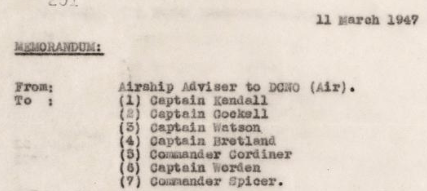
11th March 1947

There’s a brief mention of Captain Kendall here, in a memorandum from Tex Settle (it’s in one of the files holding correspondence between Mills and Settle):

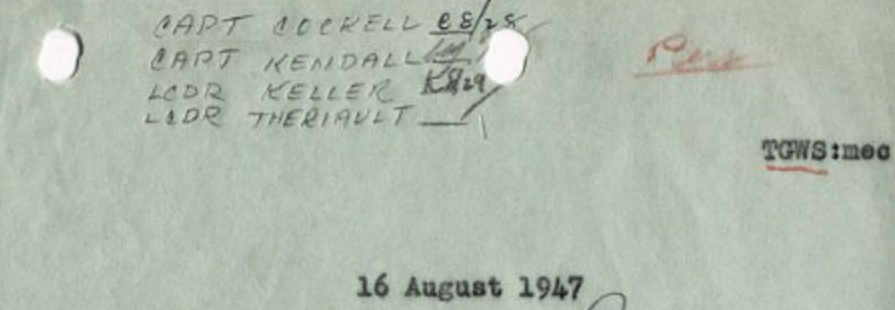
16th August 1947

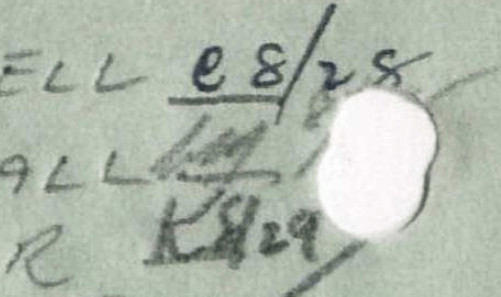
Close to the end of his time at NAS Lakehurst, Tex Settle sent out a fairly robust letter summarising the difficulties he had experienced as base commander. Kendall’s name was on a list of addressees, but unfortunately it’s not clear (to my eyes, at least) what was marked against his name:

I tried zooming in but it’s no clearer, the punched holes went straight through the interesting bit, alas:

10th October 1947 – Lakehurst Org Chart

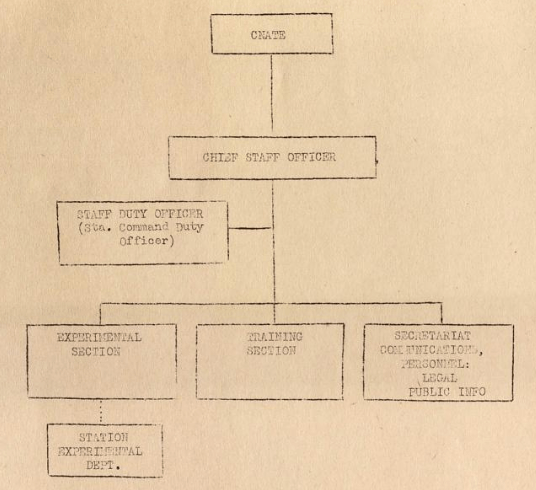
This organisational chart of the base dated 10th October 1947 was something I found interesting: this was in Memos – Naval Airship Training and Experimental Command (CNATE) personnel, 1947-1949. You can see that the Chief Staff Officer position (immediately below CNATE, the base commander) was a hugely important position (page 4):

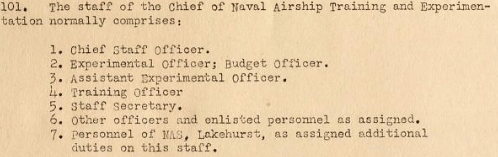
Page 2 includes a list of the major roles under CNATE at Lakehurst, including the Experimental Officer role (which was essentially head of the Experimental Section):

Oddly, Charles Kendall’s newspaper obituaries gave conflicting accounts of his position at Lakehurst: the Associated Press version was that he was Chief of Staff (CSO) to the base commander, while the reporter who talked to his widow noted that he was NAS Lakehurst’s Experimental Officer.

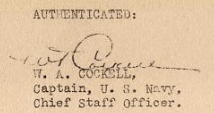
However, page 1 of the same document shows that it was Captain William Arthur (“Art”) Cockell who was the CSO as of October 1947:

November 1947 – List of Lakehurst Personnel

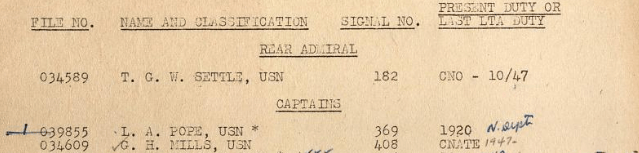
The following document gives a list of NAS Lakehurst personnel as of November 1947. This starts with RADM Tex Settle (who had just left), and you can see Captain George Mills as CNATE just below:

At the end of the section listing all the Captains, we see Captain Art Cockell and Captain Charles Kendall, who were both noted as being base Staff:

And yes, you can see that Captain Kendall’s entry was clearly marked as “SICK”.

January 1948 – Visitors to Base

A different series of document give CNATE News Memoranda, which are a lot like cut-down versions of NAS Lakehurst’s “The Airship” newsletter, but much more tightly focused on the NATEC part of Lakehurst, rather than its (numerically larger) training section.

Here we can see visitors such as airship designer C. P. Burgess coming over from BuAer visiting the base:

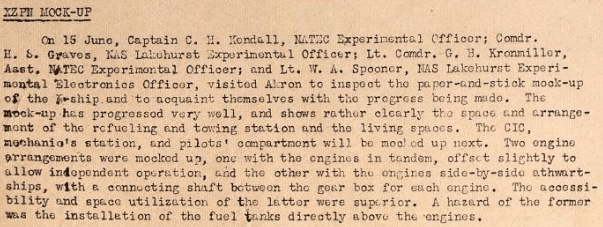
15th June 1948 – XZPN Design Visit

Here we get to see the first active mention of Charles Kendall I found from George Mills’ time as CNATE:

Hence it would seem that Associated Press (later) got it wrong: Kendall was not Lakehurst’s CSO, but NATEC’s Experimental Officer.

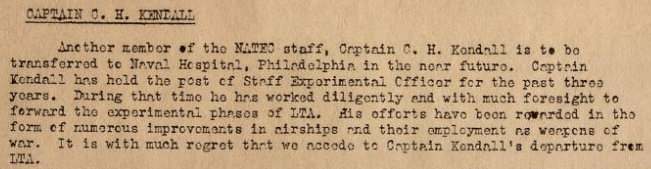
25th April 1949 – Naval Hospital, Philadelphia

This, alas, is the last mention I was able to find of Charles Kendall in the George Mills Collection, and signals Kendall’s impending transfer to the Naval Hospital in Philadelphia:

Because Captain George Mills left Lakehurst (and indeed retired from the Navy) in June 1949, the series of CNATE memoranda the Smithsonian has finishes just before Captain Kendall’s death (in the Naval Hospital) in August 1949. Hence – unless further CNATE memoranda appear – this report may also prove to be the end of the line for this particular archival trawl.

Can I ask for a little help? I turns out that my archive-related skills are as good as useless when it comes to locating the living: and I’d really like to contact members of the Kendall family to ask them about Captain Charles Hansford Kendall (1904-1949). I don’t know whether either of his two sons (Charles Hansford Kendall Jr and John Atterbury Kendall) are alive, but they or their children would be the first I’d like to ask.

I’m also interested in finding out more about Admiral Henry Samuel Kendall, CHK’s older brother: I wonder whether he was one of the people Commander George W. Hoover was talking about with “Project Durante“.

If anyone wants to contact me directly (e.g. for confidentiality about living people), please feel free to email me: I’m nickpelling at nickpelling dot com.

PS: Captain Charles Hansford Kendall’s obituary in the Washington Evening Star of 28th August 1949 noted that “[s]ince 1946 he had been chief of staff to the commander of the Lakehurst (N. J.) Naval Air Station”, which I’d point out isn’t quite the same as the role he had in his Associated Press obituary.

The Kendall Family Tree (incomplete!)

  • Henry Simon Kendall (16 November 1855 – 28 November 1935)
    married 26 Jun 1895 to Emily Carter Sclater (16 April 1865 – 16 March 1938)
    • Henry Samuel Kendall [Admiral] (19 April 1896 – 7 November 1963)
      married 31 December 1918 to Evelyn Leroy (b. 1895 to Oscor H Leroy & Janet Puroin)
      “In the early part of his career he had been a Naval aviator and also assigned to the Bureau of Aeronautics of the Navy Department in D.C.” [boydbooks]
    • Elizabeth Kendall (5 December 1897 – 5 March 1988)
      married 20 Mar 1919 to Dr/Dean Paul Stilwell McKibben (1886-1941)
      • Paul Stilwell McKibben (4 December 1919 – 21 May 2002)
        married 29 Jun 1946 to Susan Jane Boland
        • Barbara McKibben Varon
        • Bill McKibben
        • George McKibben
        • Paul McKibben
      • Richard Kendall McKibben (20 February 1921 – 2011)
        Married 23 September 1950 to Patricia Marie Luer
        • Dea McKibben
      • Elizabeth Thresher McKibben (28 November 1922)
      • John Hansford McKibben (28 August 1928 – 1999)
        Married 11 November 1957 to Costance Stephens (1933-)
    • Richard Carter “Carter” Kendall (20 March 1901 – 25 October 1962)
      married 13 April 1931 Margaret Elizabeth Williamson (1910 – 1972)
      • Margaret Emilie “Peggylee” Kendall (8 February 1932 – 2020)
        married Robert J. Fulmer (30 July 1931 – 17 February 2009)
        • Erich Fulmer
          married Mary Lou Hughes (of Cortlandt Manor, NY)
        • Margaret Fulmer
          married Jeffery Wolf
      • Deborah Logan Kendall (29 February 1944 – 10 August 2005)
        married 4 September 1971 to James Robert Glatfelter (1948-2015)
      • David Raleigh Kendall (8 March 1947 – )
    • Charles Hansford Kendall (17 July 1904 – 26 August 1949)
      married 16 Jul 1938 to Boudinot Atterbury Oberge (1917 – 20 February 1996)
      • Charles Hansford Kendall Jr (13 June 1939 – )
        married 15 November 1969 to Gloria Anne Gicker (daughter of Mr & Mrs James M Gicker of Overbrook)
        • ?
      • John Atterbury Kendall (29 January 1943 – )
        married December 1967 to Ann New (June 1930?) (now Ann New Kendall [Pike?])
        • ?

While continuing my trawl for all things to do with Captain Charles Hansford Kendall USN (1904-1949), I found (courtesy of the Social Register, Philadelphia, 1949) that “Kendall Capt Chas H-USN” died in a Naval Hospital ( (Philadelphia’s swizzy Art Deco-styled US Naval Hospital, demolished in 2001) on 26th August 1949.

I also found his (brief) obituary in the Philadelphia Inquirer (Sunday 29th August 1949 edition, p.26):

Capt. Charles H. Kendall

Capt. Charles H. Kendall, of 923 Old Manoa rd., Penfield, an experimental officer at the Lakehurst (N. J.) Naval Air Station, died Friday at Philadelphia Naval Hospital. He was 45. Captain Kendall commanded a division of destroyers in the Pacific during the Second World War and was graduated in 1928 from the U. S. Naval Academy. He is survived by his wife, Mrs. Boudinot Oberge Kendall, formerly of Haverford; two sons, Charles, Jr.. 10, and John, 6. Funeral services will be held tomorrow at the Lakehurst station.

The Courier-Journal from Louisville, Kentucky had a little extra to add in its 28th August 1949 issue (p.20):

Naval Officer Dies.

Philadelphia, Aug. 27 (AP) Capt. Charles H. Kendall (U.S.N.), 46, died at Philadelphia Naval Hospital yesterday after a period of hospitalization. His widow, the former Miss Boudinot Oberge of Haverford, Pa., said he had command of a division of destroyers in the Pacific during World War II.

(The same basic story – apparently from Associated Press – also appears in the Asbury Park Press, N.J., 28th August 1949, p.2.) All of which is broadly what I expected (though I must admit that the “period of hospitalization” mentioned is somewhat intriguing).

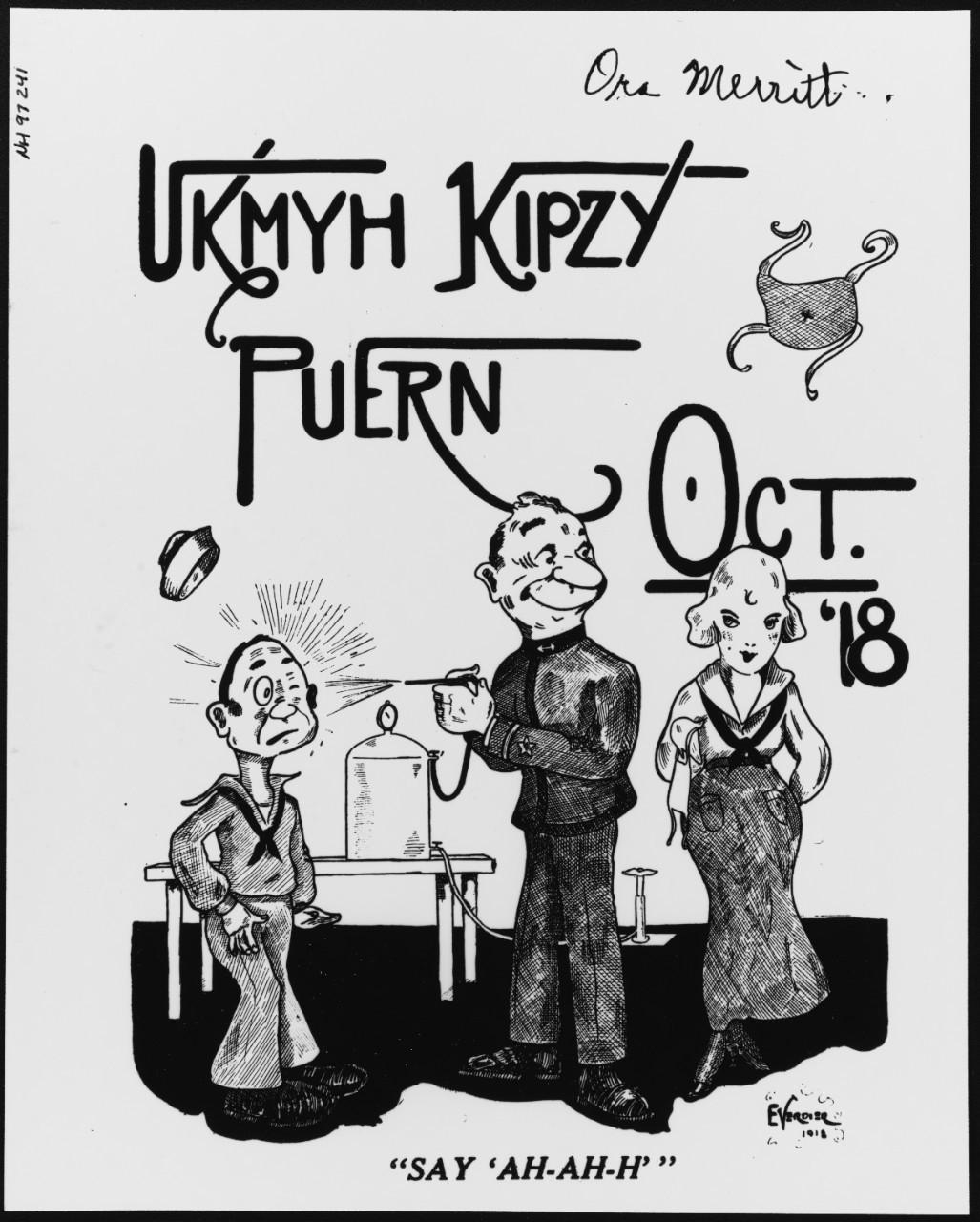
Ukmyh Kipzy Puern

However, the interesting thing of the day was that while idly looking for Naval Hospitals, I then stumbled upon this image, which I simply had no choice but to share with you:

Ukmyh Kipzy Puern – October 1918

Ukmyh Kipzy Puern” – what kind of language is that?, you may (very reasonably) ask. Well, this was the front cover of the monthly magazine of the U.S Naval Cable Censor Office, San Francisco, California. Written in Bently’s Telegraphic Code (you can download the 1921 version here), this telegraphically encodes the real title – “The Monthly Gob“. (Of course it does.) Remember, if a word was more than five letters long, it was charged as two words.

The catalogue notes add “The cartoon, and the face mask drawn in upper right, may reflect countermeasures against the 1918-19 influenza epidemic”. So it seems relatively little has changed in a century or so, hohum. :-/

It turns out that I’m far from the only person to have dived headlong down the Project Helios rabbit-hole. While reading through ballooninghistory.com’s “Who’s Who” pages of balloon-related people (originally compiled by Robert Recks), I found J. Gordon Vaeth’s entry on the V page.

  • s: Officer in the U.S.Navy, LTA Command.
  • l: 1947-50, FAI-Balloon Commission; 1947-50, U.S.Represenative of the In’tl. League of Aeronauts; 1947, Naval research Coordinator of Project “Helios” (cluster strato-balloon, 100 science projects); 1948-50, Naval research Coordinator of Project “Skyhook” (cluster strato-balloon, cosmic ray sampling); 1955-56, Originator of Project-FATSO. The first manned airborne Telescopic & Spectroscopic Observatory.
  • l: Author of many articles on sport & scientific ballooning; Author of “200 Miles Up” on atmospheric research by balloon, 1956; Author of “Graf Zeppelin,” 1958.
  • a: 3000 Tennyson St; Washington, DC 20015.
  • r: Correspondence.

Which explains exactly how Vaeth was able to include information on Project Helios that I’ve not found elsewhere in his Epilogue section of “They Sailed The Skies” – it’s because he worked on it, of course.

I then wondered – as historians do – which institution or library J. Gordon Vaeth (b. 1921, d. 2012) left his papers to. And it didn’t take long to find them in the Smithsonian: and, yes, this includes a folder on Project Helios.

Nosing around the Smithsonian Archives quickly led me to Senior Curator David H. DeVorkin’s papers, which (again) include Project Helios:

Project Helios ONR Files – Chronology of project Helios file, photocopied letters, and index cards

I guess I would already have known this if I had patiently waited for my copy of DeVorkin’s book (1989) “Race to the Stratosphere” to land on my doorstep before blogging. *sigh* And, nicely, the Smithsonian has a collection of photographs that did and didn’t make it into Race to the Stratosphere.

Finally, there’s also a Project Skyhook collection there from the ONR (containing Project Helios papers) – and Vera Simons’ papers also mention Project Helios (though the timing may possibly be slightly off).

So, whereas I thought last night that I might have hit a brick wall in this research thread, today it seems that I instead have the shoulders of several giants to clamber onto. Which is nice.

All the same, it’s looking very much as though I’m going to have to physically go to the Smithsonian to read up on all this. But maybe I should ask David DeVorkin if there’s anything big I’ve missed here…

As per various recent posts here, I’ve been trying to find out about a 1947 US experimental military balloon accident, as recounted by Duke Gildenberg in Craig Ryan’s “The Pre-Astronauts” (pp. 20-21). Back then, it seems to me that the only manned experimental balloon was the one being built for the Office of Naval Research’s Project Helios using a cluster of polyethylene balloons, as designed by Jean Felix Piccard. If I’m right, this would date the accident to between June 1947 (which is when General Mills had 500lb of polyethylene film ready to make into balloons) and mid-September 1947 (when Project Helios was finally shut down).

However…

  • Craig Ryan had nothing extra to add when I asked him about this incident
  • When I asked NARA, it holds archives on Project Helios’ successors (1948+), but nothing on Helios
  • Commander George W. Hoover never published his tell-all memoirs on the early years of the ONR
    • I haven’t yet had a reply from his son George W. Hoover II, though still remain hopeful

I also contacted Sheryl K. Hill (whose excellent dissertation on Jeannette Ridlon Piccard I mentioned previously) about the Piccard Family Papers at the LoC (to which she referred extensively). The Piccard letters she quoted show that the Navy replaced Jeannette Piccard with highly experienced balloonist Lt Harris F. Smith USNR as pilot for Project Helios. However, I haven’t yet had a reply from Hill.

J. Gordon Vaeth’s “They Sailed The Skies” further added that Lt. Harris F. Smith was then, amidst yet more US Navy mid-1947 political chicanery, replaced by a different (and far less distinguished, balloon-wise) US Navy Commander, though this commander’s name was not recorded. Given that this commander might well have been the balloon pilot who had the accident, I put some effort into trying to work out who he was…

Navy Balloonists

At this point, Mark Lutz at the Lighter Than Air Society kindly came to my (partial) rescue here, with a list the LTAS maintains of Navy LTA aviators up to 1945. But cross-checking its list against the US Navy lists in Ancestry highlighted two problems with my search. Firstly, Navy ranks can be hard to pin down – specifically, there was a difference between permanent rank and acting rank, where many acting ranks seem to have been inflated in late 1945. (I suspect this was to do with military pensions.) And secondly, even though I was able to find the US Navy Officers List for 1st July 1947, I haven’t yet found the equivalent list for the Naval Reserve. So, for example, I was unable to find Lt. Harris F. Smith (because he was USNR).

All the same, by looking for Captains and Commanders who had the LTA Aviator qualification (‘3’) in the July 1947 US Navy Officers List, I managed to compile two decent-sized lists of names (23 and 33 entries respectively) and dates of birth. Looking these up in familysearch.org yielded dates of decease for all but George William Campbell (b. 15th Jul 1902).

Of all the rest, the most interesting by far was Captain Charles Hansford Kendall (b. 17th July 1904, d. 27th Aug 1949). He was a pre-WWII US Navy balloonist (who competed in Gordon Bennett races): his name pops up in J. Gordon Vaeth’s “They Sailed The Skies” (pp. 102-104). His ballooninghistory.com entry reads (‘B’ means ‘Balloon’):

  • b: 17 Jul.1904 Baltimore, MD.
  • e: U.S.Naval Academy, 1928.
  • s: Officer in the U.S.Navy; Balloon & Airship Instructor; Lt.Commander, Commander of Airship Squadron ZP12 in 1941; Executive Officer of USS-Shaw, 1943;
  • f: Received B-Training at Lakehurst Naval Air Station; FAI-ACA B-License #1083 issued 27 Jul.1934; More than 1525 LTA hours by 1933; Last LTA duty 1944.
  • l: 1933, Aide (to T.SETTLE) in G-Bennett B-Race; 1934, Winner of U.S.National B-Races; 1934, Placed 12th in G-Bennett B-Race.
  • r: Who’s Who in Aviation 1942-43; The Airship 29 Dec.1943 p3.

The Carters of Blenheim” (1955) offers a little more information about him:

During World War II as a Lt. Commander [he] commanded a destroyer in the Pacific Area and after the war was returned to Lakehurst, New Jersey, and attained the grade of Captain in the U.S. Navy. He died August 26, 1949. On July 16, 1938, he married Boudinot Atterbury Oberge.

It goes on to say that Kendall had two sons: Charles Hansford Kendall (b. 13 Jun 1939) and John Kendall (b. 29 Jan 1943).

Perhaps I’m wrong, but I can’t help but think that Kendall seems to fit the description I’m looking for – a high-ranking Navy commander with extraordinarily deep ballooning and LTA piloting experience, but yet who never really got the ballooning ‘brand recognition’ (say) Tex Settle did.

Is Kendall the US Navy Balloonist I’m Looking For?

TL;DR – maybe he is, maybe he ain’t.

Regardless, I’d be very interested to see his obituary, and there also seems to be a six page US Navy biography of him (I’ve asked the Navy Archives if I can see the portion covering 1946-1949), which may well cast some light on this.

The best possible historical source would seem to be Commander George W. Hoover’s (unpublished) memoirs, but… hoping for that seems to be hoping for too much. Oh well!

To my great surprise, the copy of J. Gordon Vaeth’s (2005) “They Sailed The Skies” that I ordered from the US (and hence wasn’t expecting for a few weeks) arrived today. It’s a colourful, fascinating, and very well-illustrated book (and I thoroughly recommend it). Yet I was most interested in his final “Epilogue” chapter that deals (along with various other post-WWII ballooning stories) with Project Helios.

“Project Durante”

Having first established Lieutenant Harris F. Smith’s absolute suitability for piloting Project Helios’ balloon cluster (“unflappable… a Princeton graduate, accomplished in diplomacy and personal relationships”), Vaeth then opens up a completely new angle on what happened to Helios that I haven’t seen anywhere else (p. 138):

A flight to the top of the atmosphere and a world’s altitude record was a glittering attraction. It brought engineers, physicist, biologists, medical doctors, and others out of the woodwork, all wanting a piece of the action. Lt. Cdr. George Hoover, the project’s sponsor at the Special Devices Center, took to calling it Project Durante, recalling that comedian’s line that “everybody wants to get inta da act”.

Those who became involved included Navy “brass” who allowed Smith to be elbowed out and replaced by a Navy commander with no record of significant ballooning achievements.

So it seems that I now have an entirely new missing Navy pilot to find, one distinguished mainly by his, errm, indistinctitude.

Continuing, Vaeth repeats the now-standard explanations for Project Helios’s failure, i.e. the polyethylene film was unreliable, and launching a cluster of hundred balloons all at the same time was just too difficult. All the same, I have to point out that Charlie Moore and the other Project Mogul guys were launching clusters of General Mills polyethylene balloons in early July 1947 using a Project Helios frame (and apparently with Lt. Harris F. Smith’s help), so it clearly wasn’t that unreliable or that difficult. Hey ho.

Note that Princeton’s archives has a file linked to Harris F. Smith, though because it is dated 1941, it almost certainly relates to his undergraduate activities there rather than to his time in the US Navy or later.

George Hoover’s (Missing) Autobiography

Craig Ryan’s (1995) “The Pre-Astronauts” briefly mentions (p. 277) that the ONR’s (by then retired) Commander George Hoover was busy working “on his autobiography at his home in Pacific Palisades, California. His book will tell the whole story behind the events at the ONR in the 1940s“. Ryan continues (echoing Vaeth’s summary above):

According to Hoover, other organizations within the Navy, civilian contractors, and – later – the Air Force all attempted to gain control of and take credit for the ideas and technology in Project Helios. “I had to work on these things secretly, give them code names, and bury them inside all the other projects I had going on. Let me tell you, it was a real cut-throat operation.”

However, I’ve found no indication that Hoover ever finished writing up his life story: he died in March 1998. There’s a nice summary of his life here, and a tribute to him given the following month in the House of Representatives. Perhaps his family might one day donate his papers to the Library of Congress.

The occasional gentle thunk sound of a book landing on my doormat has of late been replaced by a near-continuous clunking sound, as my second hand book addiction has changed gears. It feels like I now know just about everything anyone sensible would eer want to know about Unit 731, Fu-go balloons, the Roswell Incident, War in the Pacific, Project Helios, Project Mogul, Piccard family minutiae, etc etc. And still books keep arriving.

Anyway, here’s a brief 16x-speed scan of what I’ve been working my way through in the last few days.

Jeannette Ridlon Piccard

I was very pleased to find a biography of Jean Felix Piccard’s wife Jeannette Ridlon Picard online. This was Sheryl K. Hill’s (2009) in-depth (and yet very readable) dissertation “ ‘Until I Have Won’ Vestiges of Coverture and the Invisibility of Women in the Twentieth Century: A Biography of Jeannette Ridlon Piccard“.

The central primary source that Hill relied upon was the The Piccard Family Papers, Manuscript Division, Library of Congress, Washington, D.C., that had been donated to the LOC by Jeannette Piccard, and which you may (possibly) recall being mentioned here previously.

And so it is that Hill seems to have read all the correspondence from all the boxes I was most interested in, which hopefully has saved me an awful lot of time and effort. 🙂

In the section “Stratospheric Flight Déjà vu: Helios Project” (pp. 249-252), Hill briefly tells the story of how Project Helios unwound (from Jeannette’s point of view) [p. 250]:

However, within months it was evident the Navy Department was taking over the project, now classified “confidential: project number 9-U-J,” and known as “Free Balloon Research Laboratory.” Part “B-1a” specified the contractor “shall design, construct, test and fly the stratosphere balloon specified in the contract with a crew approved by the Navy.” The December 1946 news release indicated the ONR had “entered into a contract with the General Mills Aeronautical Research Laboratory for the construction of a special cluster-type balloon and gondola to be used for scientific studies in the higher altitudes…The ascent itself [was] planned for mid-June [1947] from the Naval Air Station at Ottumwa, Iowa…” The news release indicated the “services” of Jean Piccard were “under contract,” but no mention was made of Jeannette’s role as pilot.

It didn’t take too long before the ONR pulled the money rug from under the whole project [p. 251]:

Although Jean remained optimistic that a clustered-balloon flight could be made, the
Navy pulled its financial support in June 1947, stating “operational tests of the prototype
balloons which were to be used in a cluster to form a lifting medium for project Helios
have clearly demonstrated that a piloted flight cannot be accomplished this year.
” Jean
wrote his fellow scientific collaborators that he would do “all…possible…to organize a
stratosphere flight at the earliest possible date…
” “I shall not leave you stranded,” he
stated, “but I shall make a serious effort to get other sponsorship.

And that, as far as the Piccards seem to have been concerned with Project Helios, was that: despite their (literally) high hopes, they never did manage to reach the stratosphere together. For me, the #1 unanswered question was whether they secretly planned to inaugurate the 20-Mile High Club? Hill doesn’t say, so I guess we’ll never know.

Lt. Harris F. Smith USNR

So it seems that we are left with a small (but niggling) gap in the ballooning timeline between the end of Project Helios (June 1947) and the start of Project Skyhook (where the first balloon was launched on 25th September 1947). Note that there seems to be no record of “Project 9-U-J” anywhere: in NARA, just about everything with “9-U-J” turns out to be an OCR error. So for now I’m running with the idea that 9-U-J was just an internal ONR reference for Project Helios, rather than some other top secret project name.

According to Craig Ryan (The Pre-Astronauts, p.63), the ONR replaced Jeannette Piccard as pilot with “balloonist and airshipman Lt. Harris F. Smith USNR”. I’m pretty sure this is the same “Lt. Smith from Navy NYU” who arrived at Alamogordo on 28th June 1947, as noted in Albert Crary’s logbook, because this would help explain how the Project Mogul team moved from serial linkage between balloons to using a Project Helios (parallel) cluster mounting around this time:

Balloon expedition personnel arrived Saturday evening – Peoples, Trakowski, Mears, Ireland, Olsen, Moulton, Alden from AMS and Moore, Schneider, Hackman, Smith, Hazzard, 2 others and a Lt Smith from Navy NYU.

According to Fold3, Harris F. Smith had service number 4041150, and in 1942 was stationed at Lakehurst Naval Air Station, NJ. And according to the blurb for J. Gordon Vaeth’s (2005) “They Sailed The Skies” (my copy will arrive from America in a few weeks’ time, *sigh*), it was Harris F. Smith and William J. Gunther at Lakehurst who revived US Navy ballooning after WWII.

Because Ancestry’s account doesn’t include access to Fold3’s “Premium Features” (or indeed to Newspapers.com’s “Premium Features”), my best current guess is that this was Harris F. Smith born 4th September 1919 in Newark, NJ, died 26th Jan 2013 in New Jersey.

The 1947 Manned Balloon Incident

Now that I have a copy of Craig Ryan’s “The Pre-Astronauts”, I’m able to see the full text (and reference) for the 1947 manned balloon incident (pp. 20-21) I mentioned before:

One of the first postwar manned balloon flights sponsored by the military was launched from the Tularosa Basin in 1947 with the intent of crossing the Rockies and landing somewhere along the Eastern Seaboard. Unfortunately, the entire flight’s supply of ballast was expended in the crossing of the Sacramento range to the east of Alamogordo and the balloon’s journey ended just short of Roswell. A potential embarrassment, the aborted continental crossing was kept quiet and the pilot’s name never released. “We were naive as hell,” explained one of the NYU scientists.

Craig Ryan’s notes for this chapter gives the source of this story as an interview with Duke Gildenberg, who had worked in the NYU team in 1947, and then after graduation worked at Holloman AFB (which, prior to late 1947, was Alamogordo AAFB) from 1951 to 1981. Yet there are two curious things about this story. Firstly, the first manned polyethylene balloon flight on record was Charles B. Moore in 3rd November 1949 in Minneapolis. And secondly, even though Gildenberg was interviewed many times about the events of 1947 (four years before he started at Holloman), the interview with Gildenberg in Ryan’s book is the only place I’ve seen this incident mentioned anywhere.

Hence I’m currently trying to work out who that unfortunate balloonist was. It seems entirely possible that it was Lt. Harris F. Smith, but – as Gildenberg says – the flight was “a potential embarrassment”, and “was kept quiet”. So I’m guessing it will take a fair bit of work to retrieve it from the archival maw.

Note that this 1947 incident seems entirely separate from the 1959 incident with Dan D. Fulgham and Captain Joe Kittinger (“I also recall an incident involving a manned balloon flight.” etc) that Gildenberg gave testimony about decades later.

Earliest balloon launch date

According to this site, the first plastic balloon tests were on 24th April 1947:

This report describes the first outdoor inflation and flight attempt of a full-size pliofilm balloon on April 24, 1947. Purpose of the test was to obtain data on (1) proposed method of inflation; (2) use of plastic ground cover; (3) behavior of the aerostat at low wind velocity; (4) weighing off the aerostat; (5) rate of ascent; (6) operation of appendix; (7) excess lift for safe take-off without dragging; (5) balloon suspension system; (9) behavior of suspended parachute. Several preconceived opinions on these points were found wanting. A suspension harness failure precluded an actual flight. Nevertheless, the experiment was very revealing, producing information vital to any future attempt. Prior to the first outdoor inflation, a trial inflation had also been successfully made at the balloon loft.

The project update for Helios seems to imply that by May 1947, General Mills’ balloons were going well, though Piccard’s fancy high-altitude gondola-made-for-two was still very much a work in progress:

Between June 1946 and May 1947 the contractor has designed and built the gondola and auxiliary equipment for Helios to within 75% of completion, and has tested and built seven large, and several small balloons made of various plastic films. Through trial and error it has been shown that the present design will fly if the proper plastic film is used. The ideal balloon material has not yet been found, but an adequate plastic film, polyethylene, is now in production and 500 lbs. of this film will be available for assembling in June. A balloon which loses practically no lift in twelve hours has been developed. It has a diameter of 70 feet and a volume of 165,000 cubic feet. By stressing the cellophane-taped seams, it is possible to use a film of lower tensile strength and keep the weight of each cell below 100 pounds.

Presumably the “500lbs of this film [that] was available for assembling in June [1947]” went towards Project Mogul’s relatively small needs. Might the rest have been made into a separate balloon?

Interview with Gilruth

Finally, there’s a curious almost-an-out-take in an oral history interview with Robert Gilruth given by David DeVorkin:

GILRUTH: Yes, I remember that Piccard was very, very hurt by the National Geographic that would not give them a dime, and they gave so much to these other people. There was a colonel I can’t remember his name now —

DEVORKIN: Anderson, and a Major Kettener?

GILRUTH: No. There was one that lost his life or almost lost his life. I can’t remember those things anymore.

Which colonel was Gilruth was referring to here?