“A man is found dead in the desert, next to an open package. How did he die?”

Many will immediately recognise this puzzle format, which became popular for a few years thanks to the 1967 publication of Edward de Bono’s “The Use of Lateral Thinking”. Nowadays, de Bono’s whole “Lateral Thinking” fad is long forgotten, because – in truth – all it really claimed was that not all puzzles yield to linear analysis, so sometimes to get to an answer you’ve got to shake the tree a bit.

Fast-forward now to Peter Senge’s (1990) “The Fifth Discipline: The Art & Practice of The Learning Organization”, which introduced holistic problem-solving to many. This is the idea that reducing complex systems to individual components can make some problems impossible to solve, because you’re not looking at the big picture. I should also point out that this is oddly reminiscent of Douglas Adams’ book “Dirk Gently’s Holistic Detective Agency” (1987) and its sequels, where seemingly unrelated events turn out to be connected in surprising ways.

But if you’re looking for a funkier, 2020s take on problem-solving under uncertainty that somehow reboots and refreshes these angles, I suspect your search will be in vain. (Perhaps that’s a book I should write?) All in all, the best advice currently on offer for genuinely hard problems would seem to be:

  1. Shake the tree a bit;
  2. Make sure you see the full picture; and (if all else fails)
  3. Ask Dirk Gently.

Roswell as a Lateral Thinking Puzzle

Let’s now lean hard into the witness-centred version of Roswell that appears in Carey & Schmitt’s book “Roswell: The Ultimate Cold Case”, and present that in the same puzzle format:

“A round-ended metal capsule with no engine or life support system is found in the arroyo. It contains three small alien-looking people, two of whom are dead, while the third cannot speak. Two other sites are found a few miles away, one with many shards of paper-thin metal debris, plus fragments of lightweight I-beams with unknown writing on.”

This, I believe, is an (only very slightly) stripped-down version of the puzzle the US Army was faced with in 1947. I further believe that the US Army:

  1. Latched onto a false solution (i.e. that it was an alien spacecraft);
  2. Covered that up as an issue of national security;
  3. Terrorised witnesses and concealed evidence as far as possible; and
  4. Has, ever since then, kept covering up the messes left by its previous coverups.

Why on earth did the US Army act like this? And, moreover, why does it continue to act like this even now? What kind of mad confuddlery is going on here?

The birth of the “Secrecy Silo State”

To me, Roswell is a symptom of something much, much bigger, which in 1947 had only really just begun: the modern US security state. Though this was made official by the National Security Act (enacted 26th July 1947), the ideas behind it – to create a peacetime security state based on the wartime security state – had already started to be put into practice by President Truman, Oppenheimer, Groves, Conant et al.

This took the set of wartime management practices used by the Manhattan Project and similar tech projects, and codified them into a peacetime management toolkit. The heart of this involved using secrecy not as a choice, but as a de facto starting point for everything. The default position was to disclose nothing, and (later) refuse to confirm or deny anything: and, as per the CIA, use plausible deniability. The state gave no transparency, no accountability, no access: the media were controlled, licensed, sanctioned, and quickly leash-yanked back into line if they started to dig in a ‘wrong’ place.

We can see this with Operation Crossroads in 1946: despite being planned very much as nuclear success theatre, many things went wrong (for example, the first test’s [“Able”] bomb [“Gilda”] missed its target by 649m; decontamination was almost impossible; and so on) and journalists proved much harder to force into line than expected. David Bradley subsequently wrote that “the accounts of the actual explosions, however well intended, were liberally seasoned with fantasy and superstition, and the results of the tests have remained buried in the vaults of military security“.

So, secrecy and accountability were immediate casualties of the new security state. But another wartime management practice accompanied secrecy: silos. Secrets were actively held and managed in small local silos – groups, teams, committees, even individuals. There was no global secrecy, just lots of local secrecy.

And this is, I think, what people often fail to grasp about America since WWII: it’s not that it’s a state that is built on secrets, but it’s a state that is built on lots of silos of secrets, all jealously owned and gatekeeped (gatekept?) by different groups and interests. And which rarely fit together.

The Problem With Silos

You’ve probably already worked out the rest of the arc here, but I’ll be explicit: as Peter Senge highlighted, you really need to see the big picture in order to solve particularly complex problems. And silos full of secrets make that almost impossible to achieve.

Because secrecy silos often isolate problem-solvers from conflicting information and opinions, they can often act as what we now call “echo chambers”, amplifying bad ideas and interpretations, which then (thanks to the way the silo is isolated) can get locked in. My belief is that this is precisely what happened with Roswell: a bad conclusion (about aliens who weren’t aliens) became a gospel truth, one so dangerous that it had to be immediately covered up (and then kept covered up).

Many people have written about the practical issues of secrecy, including Timothy Melley (whose book “Covert Spheres” on this subject I’m currently waiting for). A Professor of English Literature, Melley argues that literature becomes a way that people use to help imagine what the state is “getting up to” inside a secrecy state.

However, I think there’s a big difference between a secrecy state (i.e. one where the state monolithically holds secrets, so that you can talk meaningfully about a ‘government conspiracy’) and a secrecy silo state (i.e. one where lots of silos hold secrets, but not in a joined-up kind of way). For example, The X-Files told stories not only about The Syndicate (an archetypical silo of secrets) but also about lots of other groups holding secrets: yet unless you’re carefully tracking the overall story arc, people often think it’s about a single monolithic government conspiracy, jumpscare lolz, and whether Mulder and Scully are going to finally have sex. So maybe it’s all a bit more complex than the way Melley presents it.

But local silos also lead to disjointed management decisions based on partial (and often incorrect) knowledge, and leadership being forced to make macro decisions based on conflicting reports and opinions. You don’t have to look far into the history of the CIA to to see how this plays out geopolitically – Bay of Pigs, U2 spy plane, etc. I further suspect that bad decision-making built on the culture of secrecy silos played out on even bigger geopolitical stages – weakening Russia so much that it empowered the rise of Putin. But that’s another story.

Roswell 1947

So for me, because Operation Crossroads was in the Pacific, the Roswell Incident seems to have been the very first time that the modern US secrecy silo state was properly tested on US soil, with ordinary people caught in the middle of it all. And the US Army failed every test – they abused human rights in the service of controlling the narrative, covering up something that they didn’t even remotely understand (then or now), simply because that was how the whole modern state apparatus now ‘rolled’.

And as far as I can tell, it is still failing every test to do with Roswell. And you don’t need to be Dirk Gently to figure that one out.

Almost since the day it happened, the Roswell Incident has been presented as pantomime rather than history. The pro-UFO camp cheer whenever a vaguely plausible alien explanation pops up; while the skeptic camp get their kicks from booing stupid theories. Aliens? They’re behind you! Oh, no they’re not!

Well, I’ve had enough. And since nobody else on this whole stupid planet seems able to, I’m now standing up to say: the panto’s over. There were no Roswell aliens. The real story was a bunch of people so scared of losing a Cold War that they would do inhumane things to other people. And should their whole disgusting plan go bad, they believed that a combination of plausible deniability and burning the goddamn evidence would save them from being hanged until dead.

And guess what? It turned out that they were right. But only thanks to a stupid modern fairy story, one that had been playing out in the press for the whole of the previous week.

‘Aliens’

And that in turn was only because one bunch of idiots really, really believed in that fairy story. And that bunch of idiots wasn’t even MUFON.

It was the US Army.

The reaction of Colonel Blanchard (commanding officer of Roswell Army Air Field) was surely typical of many in the US Army. He initially suspected the ‘cipher mystery’ writing on the I-beams in the Roswell debris field was Russian, and that the whole thing was therefore some crazy Russian plot. But… when that writing quickly proved not to be Russian, what was he to believe? Maybe… it… was… aliens… after… all?

So, what did the Army do? They covered it up. And then covered it up again. And when that became too hard to sustain, they covered it up again. The dumbest thing? They almost certainly didn’t even know what it actually was that they were covering up (or whose asses they were saving), but they covered it up anyway. And they probably still don’t know, even today.

What a bunch of colossal idiots.

So, here we are, more than seventy-five years later, and they’re still at it. Everyone in the Roswell pantomime continues playing their traditional parts. It’s the same old stupidity. Nothing has changed.

The pinnacle of academic coverage of Roswell has become metacommentary about how it is some kind of ‘modern fable’. And if there’s a history of the Roswell Incident that has any substance beyond a thin patchwork of fragmentary witness statements, I’ve yet to find it. (Please don’t ask me to reflect on how many miserable non-books I’ve had to trawl through to reach that opinion, that would be cruel.)

It’s 2025, so can we please shut this whole miserable pantomime down now? Aliens didn’t do Roswell, people did Roswell, and it’s blindingly, pathetically obvious that they did. This needs forensic historians with scalpels, not sociologists.

Since posting on the problems presented by the Roswell ‘alien’ capsule, I’ve done some more thinking, trying to get inside the head of a 1947 biophysicist planning some kind of unethical human-subject high-altitude experiment, that we might now think of as “the Roswell experiment”. So, here’s my reconstruction…

Physiologically, what was Project Helios trying to learn?

We can glimpse this the 19th May 1947 meeting that basically shut Project Helios down. David DeVorkin quotes (“Race to the Stratosphere”, p. 285) Alan T. Waterman as saying:

A high altitude flight was viewed with increasing importance because only through such a program could a stable platform be maintained at various heights in the atmosphere from which many very important special studies could be made. These investigations could probably not be made in any other manner, and it was this fact that had justified the project originally.

What were these “investigations”? Not the Signal Corps’ “sound propagation experiments” added in Feb 1947 (p.278), which sound to me a lot like what the US Army’s Project Mogul was trying to do. Nor the experiment of dropping missiles from specified heights (which Hoover subsequently kept Helios barely alive to do). Nor even the “restricted” projects run by “agencies interested in ballistic missile guidance research [who] wished to strengthen Helios’s planned sky brightness and infrared horizon visibility studies”. (p.279)

But if we rewind right back to the project start, George Hoover stated that Helios would “collect data for furthering the study of the construction of cockpits for protection of the human element” (p.272). And I think it’s plain as day that this was not just ejector seats, or protection against supersonic flight, but also protection against cosmic rays. So I expect that this would have been proposed by one of the “17 groups [who] had responded positively” to Hoover’s Jan 1947 call for “basic research”.

Hence I believe that the high-altitude human-subject experiment that ended up being dumped just outside Roswell was designed to test the reaction of human subjects to sustained high-altitude exposure to cosmic rays.

What were the constraints on this experiment?

Given the (substantial) ethical problems involved, I can reconstruct a set of technical constraints and political constraints.

Technical Constraints

  • Live human subjects being exposed to cosmic rays at high altitude (20km?) for a sustained period
    • (How would the presumed tissue damage from cosmic rays be analysed? Unethically, I suspect.)
  • A pressurised environment
    • i.e. a capsule, broadly similar to Settle and Burgess’ “Flying Coffin”, or indeed Winzen’s capsule
  • A balloonist
    • Presumably in a pressure suit
  • A gondola
  • A balloon envelope capable of lifting the balloonist, gondola, and experiment into the stratosphere
  • A “lifting gas” (i.e. a gas that is lighter than air)
    • Hydrogen or helium were the only two practical options
      • Hydrogen had much greater lift, but needed better envelope seams, and was explosive
      • Helium was very scarce post-war, and would not have been available for a huge balloon

My guess is that, for ~300kg total weight and a target altitude of ~20km, this would have required the single (i.e. non-Helios-cluster) hydrogen balloon to have a diameter of ~20m, which is pretty huge.

Political Constraints

  • Plausible deniability
    • i.e. there should be no paper trail linking the experiment back to the experimenters
    • i.e. there should be no paper trail linking the experiment back to the balloonists
  • Cover story
    • There should be a plausible cover story prior to launch.
    • There should also be a plausible cover story in the case of a failed experiment, one that points well away from everyone involved.

What did all those constraints mean in practice?

Currently, my best guess was that the original cover story wasn’t “extraterrestrial” or “aliens”, but “Japanese“. To that end, a Japanese bamboo gondola was used (presumably captured after WWII, and then supplied by NAS Lakehurst), along with the unfortunate Japanese test subjects. (However, when the hydrogen balloon exploded, it shattered the gondola into tiny pieces, leaving the “hieroglyphic” writing as merely a cipher mystery to confound Jesse Marcel and everyone else since.)

Moreover, combining the technical constraints with the political constraints meant (I believe) that the human subjects inside the capsule would have had basically no life supportno food, no water, no toilet, no CO2 scrubbing, no additional oxygen – because the way those things were supplied would have conflicted with the need for plausible deniability.

I of course think that all of this was abominable, despicable, disgusting, horrible and wrong.

But if that’s what happened, that’s what happened.

Balloon flight logistics

OK, so we can see that the experimenters have placed the human test subjects in a pressurised metal (probably formed from 1/8th inch-thick aluminium sheets) capsule. But the lack of insulation means that launching in the July daytime in New Mexico would cause the temperature inside to start at 25 degC or higher and rapidly climb, killing everyone inside within a couple of hours.

Similarly, if the flight was done just after sunset, the temperature would start at around 25 degC and would rapidly drop, giving everyone inside hypothermia within (I guess) three hours.

Hence, the most logical time to launch would seem to have been about two hours before sunrise. (As an aside, stratospheric balloons would have been more effective to launch by night, because colder night air is denser, making the initial lift more pronounced.) Anyway, here are my temperature calculations:

The initial night time temperature in the capsule would be ~20 degC, and by sunrise this would fall to a few degC. This would be cold, but if the subjects were all wearing the kind of silk garment mentioned by witnesses (silk is an excellent insulator, while also being very lightweight), this would be uncomfortable but tolerable. After that, the temperature would start to rise in the early morning sun, yielding a maximum experiment length of roughly five hours. This is also roughly as long as I suspect the occupants would have had before they would all have suffocated from CO2 poisoning.

Sunrise in New Mexico around 3rd July 1947 was at 5.50am, so I estimate the original launch time was around 3.50am. Conversely, I also believe that the balloon never got close to the stratosphere, because no metalclad envelope of that time would have been checked for hydrogen leakage (only for helium leakage). So I would expect that it would have limped upwards, the balloonist quickly using up all the ballast, before coming down less than an hour after launch (i.e. still before sunrise).

This is also why I don’t believe this matches up with any “flying saucer” reports of the time, because none of them I’ve found were round about sunrise.

What happened to the flight?

I’m going to stick my neck out and say that the flight described by ‘Duke’ Gildenberg to Craig Ryan (in the latter’s “The Pre-Astronauts”, pp. 20-21) sounds an awful lot like what seems to have happened here:

One of the first postwar manned balloon flights sponsored by the military was launched from the Tularosa Basin in 1947 with the intent of crossing the Rockies and landing somewhere along the Eastern Seaboard. Unfortunately, the entire flight’s supply of ballast was expended in the crossing of the Sacramento range to the east of Alamogordo and the balloon’s journey ended just short of Roswell. A potential embarrassment, the aborted continental crossing was kept quiet and the pilot’s name never released. “We were naive as hell,” explained one of the NYU scientists.

If this is the same balloon flight, then what we are reading here also reports the ‘pre-flight cover story’ told to a gullible Duke Gildenberg, i.e. that the “military” (i.e. US Navy) balloonist was aiming to fly his balloon all the way to the east coast “Eastern Seaboard” (presumably most of the way to NAS Lakehurst).

Feel free to disagree.

There are numerous Roswell witness statements that mention what the ‘Roswell aliens’ (who I would instead call ‘test subjects’) found in the ‘capsule’ were wearing, but these are spread throughout the (already very diffuse) literature. Hence I thought it would be helpful to wrangle them all (unless you know of any others?) into a single place: so here they all are.

(As an aside, Jim Ragsdale’s account was just not credible enough to go on the list, in case you’re wondering.)

So, what do witnesses say that the ‘Roswell aliens’ were wearing?

  • Joseph Montoya (Carey & Schmitt, “Witness to Roswell”, p.92)
    • “Each wore a silvery, tight-fitting, one-piece flight suit”
  • Chaves County Sheriff George Wilcox, quoted by Inez Wilcox, quoted by Barbara Dugger (1995)
    • “They wore suits like silk.”
  • Captain Oliver Wendell “Pappy” Henderson, quoted by Sappho Henderson
    • “He said the material that their suits were made of was different than anything he had ever seen.”
    • “Clothing was of material unlike anything he had seen before.”
  • “Cactus Jack”, quoted by Iris Foster, in Kevin Randle, “UFO Crash at Roswell” (p.115)
    • “Their blood, according to Cactus Jack, was like tar, thick and black, and stained their uniforms. Cactus Jack was positive that they had been wearing silver uniforms.”
  • Anonymous archaeologist, speaking to Kevin Randle in 1990, “UFO Crash at Roswell” (p.116)
    • “It was wearing a silvery flight suit and had one arm bent at a strange angle, as if it had been broken.”
  • Barney Barnett (in 1950), reported by Vern and Jean Maltais, in Berlitz “The Roswell Incident” p.55
    • “Their clothing seemed to be one-piece and gray in color. You couldn’t see any zippers, belts or buttons.”
  • Mary Ann Gardner’s patient (1975), quoted in Tom Carey’s “The Continuing Search for the Roswell Archaeologists: Closing the Circle”, in IUR vol 19, No. 1 (1994):
    • She described them as being small in stature with “big heads and slanted eyes” and wearing silvery flight suits.
  • Gerald Anderson (in “The Roswell Report: Case Closed”, Appendix C) [now thought to be unreliable]
    • They were wearing one piece suits. All of them were dressed exactly the same. It was sort of a real shiny silverish gray color.
    • Q: No zippers, buttons?
    • A: No, I saw no zippers, no buttons.
    • Q: Insignias?
    • A: No, no insignias. The only thing that was different, you know, and they all had this, but the only that was different from the silvery gray thing, the suit, was that down like a seam line, like there was a seam on his shoulder and around the collar it was trimmed in what appeared to be maroon, like cording.
    • Then the suits were continuous with their footwear. We could see right this area down, it seemed to be less pliable then it was up here, like this was a stiffer area, like they were boots or shoes or something. But they were all dressed exactly the same.

Update: add the “Guy Hottel” memo to the list, why not?

Thinking about it, I should perhaps also add the description given in the (in)famous Guy Hottel memo. Though this has been spun and re-spun a thousand or more times, it should really be here:

  • Mr <redacted> informant, reported by Guy Hottel, head of the FBI’s Washington field office (1950)
    • “Each [flying saucer] was occupied by three bodies of human shape but only three feet tall, dressed in metallic cloth of a very fine texture. Each body was bandaged in a manner similar to the blackout suits used by speed fliers and test pilots.”

On the surface, nothing links the two at all: the Roswell Incident happened at the start of July 1947, while the CIA was formed in September 1947. But… perhaps there’s something a bit deeper to be had here.

CIA Covert Operations

If – like me – you think that Roswell was entirely man-made (and not at all ‘alien’), then perhaps the historical pattern it matches will turn out to be where Agency X stumbles upon Agency Y’s black ops project. Regardless of whether you call this ‘interagency conflict‘, ‘compartmentalization failure‘, or a ‘rogue operation‘, this is something that happened many times during the second half of the 20th century:

  • U-2 spy plane (1950s-1960s)
    • This was the CIA’s secret high-altitude reconaissance programme. The Agency withheld details from the public and some military authorities, and at times explained away reports as UFO sightings.
  • MKULTRA / Operation Midnight Climax (1950s-1960s)
    • A CIA human-experimentation programme that used hospitals and other places without informed consent.
  • Operation CHAOS/MHCHAOS (1967-1974)
    • The CIA’s covert domestic surveillance programme targeting US activists caused friction with the FBI and other agencies because the CIA concealed the programme’s scope and methods.
  • Project Azorian / “Glomar Explorer” (1974)
    • The CIA’s covert project to retrieve Soviet submarine K-129 involved an elaborate cover story that kept the US Navy and its contractors largely in the dark.

Yes, these were all CIA covert operations. And I haven’t even mentioned the Church Committee (which revealed CIA plots/attempts to assassinate foreign leaders) or the Bay of Pigs (with its “plausible deniability”). And there were many others.

What I believe we see in the Roswell Incident – high-altitude science, human experimentation, elaborate cover stories, Cold War vibe, agency misdirection, etc – closely matched what the CIA did subsequently. So my argument is that, despite the timing difference, Roswell is most usefully viewed through a CIA ‘lens’.

But in the end, the CIA is just people – albeit scary people with a collectively broken moral compass who, viewed from the outside, have often proved hard to distinguish from terrorists. So: where did these people come from? What preceded the CIA?

1945-1947: After the war, but before the CIA

The US wartime body that most closely resembled the CIA was the Office of Strategic Services (1942-1945). This was a one-stop shop for sabotage, black propaganda, and guerilla operations, all carried out with ‘limited’ (i.e. sometimes entirely absent) ethical guardrails. There were similar intelligence apparatuses (apparati?) for the US Army (such as G-2 and Special Branch) and the US Navy (The Office of Naval Intelligence), but the OSS was arguably the biggest and baddest of them all. And, post-war, plenty in government were aware of its war-time excesses and really wanted it gone.

So, while the US government tried to work out how to transition from a hot war (OSS) to a Cold War (CIA), the period 1945-1947 ended up as something of an interregnum. I also believe, following Nick Redfern, that the Nuremberg Doctors’ Trial (1946-1947) cast a heavy shadow over scientists’ ethical ‘footprint’ in this time. Yet Redfern’s readiness to blame ethical issues on ‘Paperclipped’ Nazi scientists seems a tad generous to me: American scientists of this period had no obvious oversupply of ethics.

Let’s Go Ethics Shopping

Two specific agencies I’ve been looking at that were active during 1945-1947 were the AEC (the Atomic Energy Commission, as famously lambasted by Tom Lehrer) and NEPA (Nuclear Energy for the Propulsion of Aircraft). Both had no shortage of ethical challenges in this period.

“The Old AEC”

Though the AEC was legally established in 1946, it didn’t actually start work until 1st January 1947. Initially, many of its responsibilities overlapped with the Manhattan Engineer District, which was what remained of the Manhattan Project after WWII. The MED was run by General Leslie Groves, who initially thought his job there was simply to “hold the line”, but then quickly realised that he needed to do rather more to keep it all from actually collapsing.

One controversial topic at the MED was human-subject radiation experiments (I believe historian Barton Bernstein covered this). To get these experiments greenlighted, MED officials did what I would call ‘ethics shopping‘ between the Army Surgeon General, the Manhattan District’s health physics division, the University of Chicago Metallurgical Laboratory, and (later) the AEC’s Division of Biology and Medicine. This involved constantly reframing their shady experiments either as a military necessity, as an industrial safety study, or as a classified national-security matter, until they found an agency who would let them get away with it. Basically: approvals agency won’t approve your dodgy experiment? Try a different one! (And another, and another.)

NEPA

Militarily, NEPA was a grand design to build high-altitude nuclear bombers able to stay airborne for long periods: the idea was to give the US an enduring edge in the emerging Cold War. This involved coordinating between the Manhattan District (and then the AEC), the Army and Navy Air Forces, plus various contractors (such as GE, Fairchild, Oak Ridge labs).

Historians of nuclear propulsion (e.g. Richard G. Hewlett & Francis Duncan) think that NEPA planners sometimes employed ‘bureaucratic maneuvering‘ to keep things moving despite ethical or framing difficulties. For example, when AEC reviewers had concerns about radiation-exposure protocols, officials rerouted those proposals to US AAF security. Similarly, when AEC-adjacent scientists proved to be stricter about ethical standards biological-effects studies, NEPA instead shifted them sideways to military medical labs. All of which is basically ethics shopping, of course.

Summary: Ethics is more than Brentwood

The CIA wasn’t just an agency (if not The Agency), it was also a state of mind, one that viewed ethics not as a project blocker but instead as merely a presentation issue. If you truly believed in the ideological Rightness and God-given Glory of the Perfect American State, even the pretence of justification was superfluous: your job was to do whatever it took. Which is, basically, the core recipe for unbridled terrorism that gave shape to the CIA.

These days, people like to deride the CIA for being filled with failsons, all eager to impress their surrogate abusive father-figure managers by unquestioningly doing whatever they are asked, however shady or wrong. However, in 1947 perhaps the reality was far, far worse: I can easily imagine the CIA initially filling its ranks with the ethics-free dregs of these interregnum years, with brutal, inhumane consequences.

So, my point here is not that Roswell was a CIA project (because it wasn’t): but rather that I think Roswell was planned and executed by exactly the same kind of ethics-lite state-obsessed zealots who before very long proudly slid their shoes under their shiny new CIA desks. My thesis: to understand Roswell, I think you should try to understand the CIA circa 1947, because both were dredged from the same toxic well. Feel free to disagree with this, of course. (But you’d be wrong.)

Some historical researchers like to track the known ownership of things, e.g. they follow the Voynich Manuscript’s ownership trail from Sinapius to Kircher all the way through to the Beinecke. For me, I couldn’t think of anything worse – I want to know about the prehistory of an artifact, its uneasy secret life long before it ever became shelfmarked, catalogued, pigeonholed, and memed.

Similarly, for the Roswell Incident, I want to know what did (and didn’t) happen right at the start, before people started weaving so many sophisticated stories around it. Anyway, I thought it would be helpful to post my reconstruction of the initial timeline of the Roswell Incident, because I think this differs in a number of places from other researchers. The sources I found particularly useful for doing this were:

I’ve divided my account into three separate parts, because… well, you’ll see why.

Part 1: What ~Did~ Happen

30 June 1947 (Monday)

  • Ranch foreman Mack Brazel is living in a shack without electricity or lighting on the J.B Foster ranch. His family live in Tularosa: they have not visited the ranch all month.
  • Brazel rides out to a particular field to check on the sheep. He sees nothing unusual. (S&R p.4)

3 July 1947 (Thursday)

  • Brazel, accompanied by 7-year-old neighbour Dee Proctor, returns to the same field. There he finds a load of thin metallic debris, lightweight beams, a circular burn mark and a big set of scrape marks.
  • The sheep don’t like it, and won’t go through the debris, making Brazel’s life difficult
  • Then, on another site a few miles to the east, Brazel finds “something” else (but nobody knows exactly what that was, even now).

6 July 1947 (Sunday)

  • Mack Brazel goes into Roswell to visit Chaves County Sheriff Wilcox, specifically to complain about what he found in the field.
    • While Brazel was there, journalist Frank Joyce (of KGFL) happened to call Sheriff Wilcox for any news (Joyce used to do this regularly)
    • Wilcox gives Brazel the phone
    • According to Joyce, Brazel tells them both about the “debris”, the “stench” and the “dead bodies” (S&R)
    • Joyce: “Well, you know, the military is always firing rockets and experimenting with monkeys and things. So, maybe…“. Brazel: “God dammit! They’re not monkeys, and they’re not human!
    • Wilcox doesn’t believe Brazel.
  • Brazel asks Joyce for advice, and Joyce tells him to call the air base.
  • Brazel phones the US Army Air Force base and tells them about it
  • Capt. Sheridan Cavitt and Bill Ricketts get sent out: they follow Brazel back to the site
  • Cavitt and Ricketts return to the US Army base with debris

7 July 1947 (Monday)

  • Bill Ricketts and Maj. Jesse Marcel go to the debris site
    • They fill their respective vehicles with debris and go back to the US Army air base
    • Marcel is bemused by what he think is curious geometric writing on the stick-like debris
  • Joyce tells radio station KGFL owner Walt Whitmore, Sr. about Brazel
  • Whitmore drives to the Foster Ranch, picks up Brazel, and brings him back to his own house in Roswell. There he records an interview with Brazel. Brazel then spends Monday night there.

8 July 1947 (Tuesday) – first part

  • At 11am Mountain Time (MT), Roswell Army Air Field commanding officer Colonel William Blanchard announced the recovery of a flying disk. (WTR, p.40)
  • Roswell Daily Record, July 8 1947, p.1, col. 6
    • The intelligence office of the 509th Bombardment group at Roswell Army Air Field announced at noon today, that the field has come into possession of a flying saucer.
    • According to information released by the department, over authority of Maj. J. A. Marcel, intelligence officer, the disk was recovered on a ranch in the Roswell vicinity, after an unidentified rancher had notified Sheriff Geo. Wilcox, here, that he had found the instrument on his premises.
    • Major Marcel and a detail from his department went to the ranch and recovered the disk, it was stated.
    • After the intelligence office here had inspected the instrument it was flown to “higher headquarters.”
    • The intelligence office stated that no details of the saucer’s construction or its appearance had been revealed.
  • p.1, col.1
    • Reactions [from a a number of local citizens] ran the gamut from scoffs at the whole idea to serious thoughts that they represented experiments by the government. No one interviewed thought they came from sources outside the United States.
  • p.1, col 7
    • The Oregonian said today that Maj. Gen. Nathan F. Twining, chief of the AAF material command, told it flatly that the “flying saucers” are not the results of experiments by the armed services.
  • Sacramento Bee, July 8 1947:
    • ROSWELL (N.M.. July 8. – (AP) – The army air forces here today announced a flying disc has been found a ranch near Roswell and is in possession of the army. Lieutenant Warren Haught [sic], public information officer of the Roswell Army Air Field, announced the find had bee[n] made “sometime last week” and had been turned over to the air field through cooperation of the sheriff’s office.
    • Higher Headquarters
    • “It was inspected at the Roswell Army Air Field and subsequently loaned” by Major Jess. A. Marcell [sic] of the 409th Bomb Group Intelligence office in Roswell “to higher headquarters.”
    • The army gave no other details.
    • Haught’s [sic] statement:
    • “The many rumors regarding the flying discs became a reality yesterday when the Intelligence office of the 409th (atomic) Bomb Group of the 8th Air Force, Roswell Army Air Field, was fortunate enough to gain possession of a disc through the cooperation of one of the local ranchers and the sheriff’s office of Chaves County.
    • “The flying object landed on a ranch near Roswell some time last week. Not having phone facilities, the rancher stored the disc until such timas he was able to contact the sheriff’s officem who in turn notified Major Jesse A. Marcel, of the 509th Bomb Group Intelligence office.
    • Inspected at Roswell
    • “Action was immediately taken and the disc was picked up at the rancher’s home. It was inspected at the Roswell Army Air Field and subsequently loaned by Major Marcel to higher headquarters.
    • The rancher’s name and the location of his place were withheld.
    • George Walsh of radio station KSWS which provided first news of the announcement said only Major Marcel, Colonel W. H. Blanchard, commanding officer at Roswell, and the rancher had seen the object here.
    • The sheriff, Walsh reported, upon receiving word from the rancher went immediately to the intelligence officer at Roswell Field.

Part 2: The US Army Takes Control (of the Narrative)

8 July 1947 (Tuesday) – second part

  • Mack Brazel is brought in by the US Army, and interviewed at length
  • Brazel (accompanied by MPs) gets marched round for a second interview with Frank Joyce.
  • Brazel now tells Joyce a completely different story about what happened (S&R):
    • Joyce: “The story is different, especially about the little green men.” Brazel: “Only they weren’t green.
  • Brazel is detained by the US Army for several days, and given an Army physical (WTR p.41)
  • The US Army takes possession of the tape recording made by Walt Whitmore
  • At ~4.30pm Central Standard Time (CST), General Roger Ramey (the Eighth Air Force commander and Blanchard’s supervising officer) gives his own press release. (WTR pp.40-41)
    • This lays out the basic Roswell ‘narrative’ that the Army will use going forward

9 July 1947 (Wednesday)

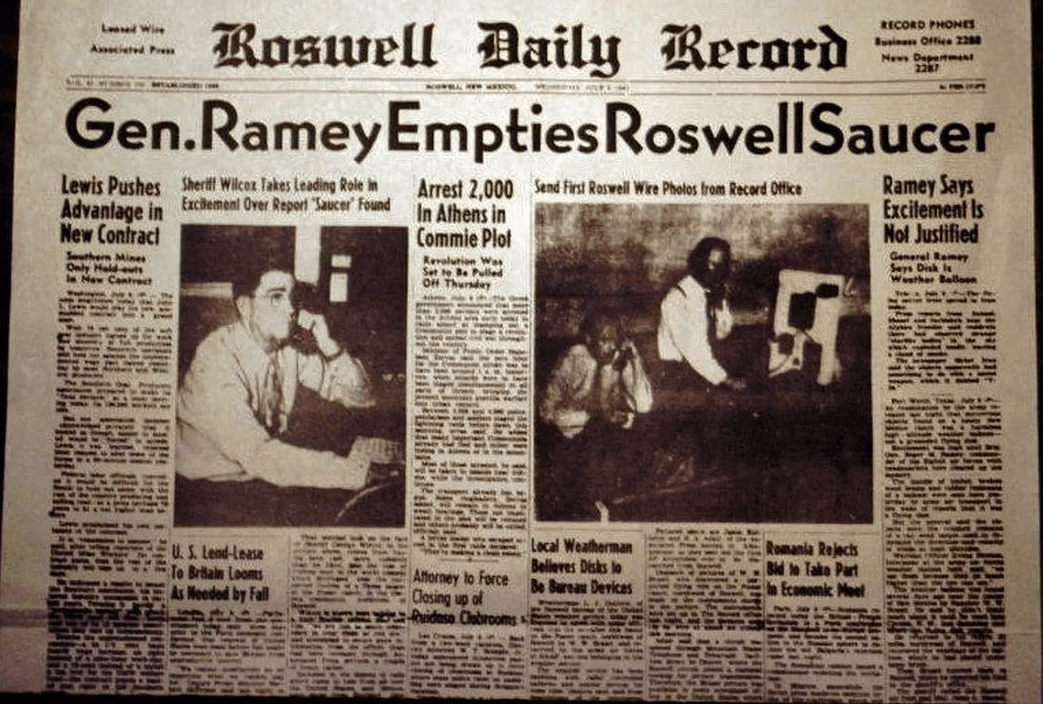
  • Roswell Daily Record, July 9 1947, “Gen. Ramey Empties Roswell Saucer
    • Ramey Says Excitement is Not Justified
    • General Ramey Says Disk is Weather Balloon
    • Fort Worth, Texas, July 9 (AP) — An examination by the army revealed last night that mysterious objects found on a lonely New Mexico ranch was a harmless high-altitude weather balloon — not a grounded flying disk. Excitement was high until Brig. Gen. Roger M. Ramey, commander of the Eighth air forces with headquarters here cleared up the mystery.
    • The bundle of tinfoil, broken wood beams and rubber remnants of a balloon were sent here yesterday by army air transport in the wake of reports that it was a flying disk.
    • But the general said the objects were the crushed remains of a ray wind [sic, Rawin] target used to determine the direction and velocity of winds at high altitudes.
    • Warrant Officer Irving Newton, forecaster at the army air forces weather station here said, “we use them because they go much higher than the eye can see.”
    • The weather balloon was found several days ago near the center of New Mexico by Rancher W. W. Brazel. He said he didn’t think much about it until he went into Corona, N. M., last Saturday and heard the flying disk reports.
    • He returned to his ranch, 85 miles northwest of Roswell, and recovered the wreckage of the balloon, which he had placed under some brush.
    • Then Brazel hurried back to Roswell, where he reported his find to the sheriff’s office.
    • The sheriff called the Roswell air field and Maj. Jesse A. Marcel, 509th bomb group intelligence officer was assigned to the case.
    • Col. William H. Blanchard, commanding officer of the bomb group, reported the find to General Ramey and the object was flown immediately to the army air field here.
    • Ramey went on the air here last night to announce the New Mexico discovery was not a flying disk.
    • Newton said that when rigged up, the instrument “looks like a six-pointed star, is silvery in appearance and rises in the air like a kite.”
    • In Roswell, the discovery set off a flurry of excitement.
    • Sheriff George Wilcox’s telephone lines were jammed. Three calls came from England, one of them from The London Daily Mail, he said.
    • A public relations officer here said the balloon was in his office “and it’ll probably stay right there.”
    • Newton, who made the examination, said some 80 weather stations in the U.S. were using that type of balloon and that it could have come from any of them.
    • He said he had sent up identical balloons during the invasion of Okinawa to determine ballistics information for heavy guns.
  • Roswell Daily Record Chronicle, July 9 1947
    • W.W. Brazel, 48, Lincoln county rancher living 30 miles south east of Corona, today told his story of finding what the army at first described as a flying disk, but the publicity which attended his find caused him to add that if he ever found anything short of a bomb he sure wasn’t going to say anything about it.
    • Brazel was brought here late yesterday by W.E. Whitmore, of radio station KGFL, had his picture taken and gave an interview to the Record and Jason Kellahin, sent here from the Albuquerque bureau of the Associated Press to cover the story. The picture he posed for was sent out over the AP telephoto wire sending machine specially set up in the Record office by R. D. Adair, AP wire chief sent here for the sole purpose of getting out the picture and that of sheriff George Wilcox, to whom Brazel originally gave the information of his find.
    • Brazel related that on June 14 he and 8-year-old son, Vernon were about 7 or 8 miles from the ranch house of the J.B. Foster ranch, which he operates, when they came upon a large area of bright wreckage made up on rubber strips, tinfoil, a rather tough paper and sticks.
    • At the time Brazel was in a hurry to get his round made and he did not pay much attention to it. But he did remark about what he had seen and on July 4 he, his wife, Vernon, and a daughter Betty, age 14, went back to the spot and gathered up quite a bit of the debris.
    • The next day he first heard about the flying disks, and he wondered if what he had found might be the remnants of one of these.
    • Monday he came to town to sell some wool and while here he went to see sheriff George Wilcox and “whispered kinda confidential like” that he might have found a flying disk.
    • Wilcox got in touch with the Roswell Army Air Field and Maj. Jesse A. Marcel and a man in plain clothes accompanied him home, where they picked up the rest of the pieces of the “disk” and went to his home to try to reconstruct it.
    • According to Brazel they simply could not reconstruct it at all. They tried to make a kite out of it, but could not do that and could not find any way to put it back together so that it would fit.
    • Then Major Marcel brought it to Roswell and that was the last he heard of it until the story broke that he had found a flying disk.
    • Brazel said that he did not see it fall from the sky and did not see it before it was torn up, so he did not know the size or shape it might have been, but he thought it might have been about as large as a table top. The balloon which held it up, if that was how it worked, must have been about 12 feet long, he felt, measuring the distance by the size of the room in which he sat. The rubber was smoky gray in color and scattered over an area about 200 yards in diameter.
    • When the debris was gathered up the tinfoil, paper, tape, and sticks made a bundle about three feet long and 7 or 8 inches thick, while the rubber made a bundle about 18 or 20 inches long and about 8 inches thick. In all, he estimated, the entire lot would have weighed maybe five pounds.
    • There was no sign of any metal in the area which might have been used for an engine and no sign of any propellers of any kind, although at least one paper fin had been glued onto some of the tinfoil.
    • There were no words to be found anywhere on the instrument, although there were letters on some of the parts. Considerable scotch tape and some tape with flowers printed upon it had been used in the construction.
    • No strings or wire were to be found but there were some eyelets in the paper to indicate that some sort of attachment may have been used.
    • Brazel said that he had previously found two weather balloons on the ranch, but that what he found this time did not in any way resemble either of these.
    • “I am sure what I found was not any weather observation balloon,” he said. “But if I find anything else besides a bomb they are going to have a hard time getting me to say anything about it.”

Part 3: What ~Didn’t~ Happen

Schmitt and Randle‘s (1989) “Roswell, July 9, 1947” lays out numerous ways in which the US Army’s (Part 2) account was not only different from the (Part 1) account, but also manifestly false. They point out:

  • The suggested date of the incident (14th June 1947) was wrong
  • Brazel was alone at the ranch
  • Brazel did not go to the site with his son Vernon
  • The description of the debris changed
  • The lettering on the debris did not look like English letters at all
  • New details (such as the “flowered paper tape […] bearing the initials D.P.“) got added
  • Brazel did not go to Roswell to sell wool on the Sunday
  • Brazel did not try to make a kite from the debris

For an event which the US Army clearly wanted to downplay, it seems as though an awful lot of things they wanted people to think did happen didn’t happen.

In fact, I’d contend that S&R’s assessment that the US Army replaced the Part 1 narrative with its own (entirely false) Part 2 narrative has become an axiom of modern Roswell Incident research. And yet all subsequent US Army and US Air Force accounts rely completely on the Part 2 account.

One Event, Multiple Cover Stories

S&R think that “the [July 9th] article is the result of a cover story in the making. It is filled with lies that first hand testimony has recently exposed.” (p.23) And while I think this is essentially correct, I’d add that there actually appear to be not just one but multiple cover stories at play here.

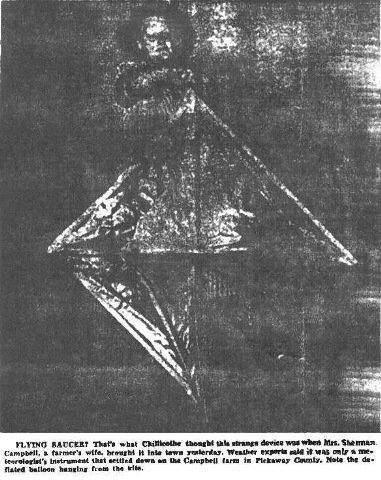
Firstly, S&R describe (p.6) a superficially-similar story from Circleville OH: “On July 5, 1947, Sherman Campbell found a strange object on his farm in Circleville, Ohio. The local sheriff identified it immediately as a weather balloon, and on July 6 there were pictures printed in papers around the country of Mrs. Campbell holding the kitelike structure.” Here’s a picture from Patrick Gross’s useful site, printed in the The Columbus Citizen, Columbus, Ohio, USA, on July 6, 1947:

So, the first cover story would simply appear to be: ‘it was a kite-like weather balloon, like the ones in Circleville that had been in the news in the previous few days‘. (They didn’t mention Rawin at first, but that is what this first cover story seems to have evolved into.)

But if you accept that, there must also have been a second cover story, one consistent with sliding the date backwards by more than a fortnight, and with the “flowered paper tape” that was added to the narrative. Neither of these was consistent with the first cover story, so why complicate things?

My own belief is that one of the first things the US Army people did was check to see if the debris in the field found by Mack Brazel might have been from (their own) Project Mogul. And then when they found it wasn’t, I believe that they planted details to make it look as though it might have been. Either way, I think it’s clear that they spoke with someone on the Project Mogul team (perhaps even Charlie Moore, why not?), and that was where the flowered paper tape and the earlier date came from.

If that’s right, then the second cover story in the US Army’s evolving smorgasbord of cover stories was: ‘it was a Project Mogul high-altitude balloon‘. Of course, it wasn’t that at all, but here we are.

So, years later, when Charlie Moore is looking at the US Army’s Part 2 version of events, he can say – hand on heart – that it looks like a Project Mogul balloon (because of the planted flower tape detail) and the timing is kind of consistent with one of the missing Project Mogul balloons (because of the planted date shift). But this is, of course, fake logic, because the whole lot is built not on the (real) Part 1 narrative but instead on the (fake) Part 2 narrative.

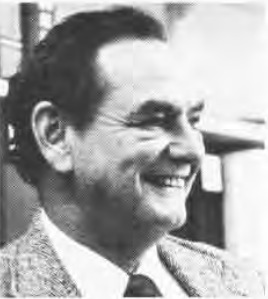
When airship-obsessive Vice Admiral Charles Rosendahl retired in November 1946, the US Navy looked around for a suitable successor to run NAS Lakehurst, the Navy’s top airship (and airship R&D) site. yet the person they appointed was perhaps a surprise to some. This was T. G. W. ‘Tex’ Settle, who – despite his obvious qualifications for the job – had left the airship side of the Navy some years before, complaining loudly about political infighting. The top role Settle now took on at Lakehurst was known as CNATE, and his immediate boss at the Office of Naval Research was Commander George Hoover. [Image from here, p.18, 1976]

Commander George Hoover, photographed around 1976 or so

Why is George Hoover relevant? Well… given that the capsule reportedly found at Roswell site #2 would have needed a huge balloon to lift, and that the only organisation that had made metalclad LTA (“Lighter Than Air”) in the preceding 25 years was the US Navy, I’ve been looking veeeerrrrry carefully at what Tex Settle was doing as CNATE in the first half of 1947. (Bad news: Settle hated paperwork, so the archives don’t have even 1% as much for him as for Charles Rosendahl, who kept it all, bless him.) This especially includes all the meetings relating to Jean Piccard’s Project Helios as it slowly fell apart during that period.

So, as a corollary, I was obviously also very interested in what Settle’s boss George Hoover was doing back then, and what he had to say or think about what was going on. (Though I wasn’t able to get a copy of the memoirs that he was composing when he retired, sadly). And so I was fascinated when I found a 2010 page on Anthony Bragalia’s website that describes what Hoover reportedly told researcher William J. Birnes about the Roswell Incident.

What Did He Say, What Did He Say?

Look, I’ll just cut [to the chase] and paste Bragalia’s bullet-points summarising what George Hoover told Birnes (and Hoover’s opinions on the subject, needless to say, are not mine, not at all):

  • UFOs are not the “biggest secret” – it is the entities behind them that was of most concern
  • Roswell was in fact a crash event of “visitors from somewhere else”
  • The entities were “not so much interplanetary as much as they were literally also time travelers.” They are extra-temporal.
  • The visitors are clearly “from the future.” There is reason to believe that they may even be “us” from a future Earth.
  • These “future humans” have the ability to “manipulate reality around us”
  • The government feared the intentions and abilities of the “visitors”
  • These visitors are able to use the power of consciousness in extraordinary ways to morph reality
  • We human beings are far more powerful in potential than we ever dreamed that we are. We don’t yet comprehend our extraordinary future capabilities.
  • The visitors remain at essence, though “corporeal” and “physical” – and secret attempts at reverse-engineering the visitor’s crash material were made
  • Incredibly, Hoover admitted that he himself was engaged in such technology transfer as a Naval Intelligence Officer with Top Secret clearances

What Does It Mean, What Does It Mean?

Now, if you are – like Bragalia – an avid UFOlogist, I’m sure this is exactly the kind of thing you want to hear coming from the mouth of someone well-respected & high-up in the US military. From the above, it would appear that at least some people in the US military absolutely believe the Roswell wreckage is wildly-advanced alien stuff, and that it has been trying to reverse engineer it. This is essentially Bragalia’s entire thesis, his entire research programme: for decades, he has particularly focused on the “memory metal”-like aspects of the thin metallic debris. (There’s a good summary of Bragalia’s thoughts on this in Appendix IV of “Witness to Roswell” (2009), pp. 275-284.)

If, however, you are like me, trying to understand the dynamics within NAS Lakehurst in 1947 (and also not believing a single word about Roswell if it’s adjacent to the word ‘alien’), it has an entirely different set of meanings.

So… What Do You Think This Actually Means, Nick?

For me, the second most interesting thing here is that Commander George Hoover seems to have got himself absolutely tangled trying to reconcile all the different things about Roswell.

This can only mean (I’m pretty sure) that, when looking at the Roswell Incident from the inside of the military ‘bubble’, it would appear that the physical evidence they have access to (but we don’t) suggests that it’s both very human and very alien all at the same time.

But how can both be true at the same time? Hoover fast-forwards past the mere mundanities of the present-day, and speculates whether the (much-too-human-like) so-called ‘aliens’ might in fact be humans from the future. It appears that Hoover believed this cleverly resolved some of the (otherwise intractable) internal contradictions with the evidence, or else he wouldn’t have said it. But to be absolutely clear, the technical modern description of this is, of course, a crock of <insert word here>.

To be fair, I would agree with Hoover that there are definitely players involved in the Roswell Incident who have the ability to “manipulate reality around us“. But these are not LGM in Basement Level 27 of Area 51 using their telepathy to beat Bob Lazar at poker, but the plucky Army PsyOps people, messing with everyone’s minds since 1947, bless ’em all.

But for me, the most interesting thing of all here is simply that if someone had used US Navy metalclad test balloons in the first half of 1947, the ONR’s Commander George Hoover didn’t have the faintest idea about it. Because it would appear that he absolutely bought into the US Army’s whole wobbly ‘crashed alien craft‘ story, hook, line and s[t]inker. It seems that if something secretive was going on in Lakehurst during that period, details of it never really wafted upwards of Tex Settle’s desk.

Finally, I should add: people often have this romantic view about the military, that it’s somehow a giant Borg mind with pure top-down lines of command, and that there are therefore no secrets. Well… sorry, but no. Back then, once you got to a certain level, it was pure political shenanigans, with everyone carving out little empires of control and doing deals with what limited power and control that they had. Settle certainly knew this (his 1939 memo on the US Navy LTA makes it clear): but perhaps, when push came to shove and the right opportunity came in front of him, he wasn’t actually above doing exactly that himself.

Witness accounts indicate that the 1947 Roswell Incident was spread across three separate sites:

  • #1: The debris field sitelots of thin metallic debris
  • #2: The crashed craft sitea Volkswagen Beetle-sized ‘alien’ capsule + dying little people
  • #3: The Dee Proctor siteummmmm, Mack Brazel found “something” here

Sites #1 & #3 were fairly close together on the J. B. Foster ranch (where Mack Brazel worked as the ranch supervisor), while site #2 was several miles east-southeast of them. I have seen no indication whatsoever that Mack Brazel went to site #2 (several sources say explicitly that he never went there).

As has been extensively described in the literature, site #1 contained nothing more than a large scattering of curious metallic debris, a burned section of land, and a scraped trail. (For decades, it was widely presumed / believed that the supposedly alien craft ‘skipped’ off the ground at site #1, before supposedly crashing at site #2, which is why you may occasionally still see this referred to as the “skip site“.)

Honestly, there was nothing much physically on site #1 that might cause anyone to lose a great deal of sleep, except possibly a cipher mysteries blogger trying to cross-reference all the stories of alien writing on the debris found there. So I find it hard to believe that site #1 was the cause of Mack Brazel’s belief.

Take away sites #1 and #2, then, and you’re left with site #3. Even today, nobody wants to talk about site #3, but in many ways this is the most intriguing of the three. What on earth did Mack Brazel see at site #3 that caused him and his family decades of anguish?

The Obviously Missing Next Paragraph

This is the point where an AI would insert a load of eye-pleasingly plausible nonsense, because there’s such a gigantic hole in every single account here that it simply begs to be filled. But the simple truth is: nobody knows what was at site #3.

Pretty much all UFO researchers have had a shot at filling this gap. One of the most well-used attempts asserts that Brazel was so traumatised by his encounters with the military (Brazel’s family was living in Tularosa at the time, and he spent several days detained on the Army camp in what must have felt like a prison) that he somehow ended up convinced that the whole thing was some alien craft phenomenon.

But read that back again: none of it is an actual explanation: rather, it explains away what happened, and without proof or evidence. And I’d add that I think most other attempts people have made here quickly cross the line into Explain-Away-Land, somewhere I try to avoid where possible.

The only non-explain-away account I can see here is to wonder whether it was in fact the “something” that Brazel found at site #3 (as Dee Proctor told his mother) that convinced him that aliens were involved. And that’s still far more of a question than an answer.

Having said that, when Brazel went back (with a military escort) to talk with Frank Joyce at KGFL, at the end of the interview the journalist light-heartedly referred to “little green men”. As the famous story goes, Brazel angrily muttered “They weren’t green!

So riddle me this: why did Brazel say that if he hadn’t been to the crash site (site #2)?

It’s easy to explain away a heap of lightweight debris in a scraggy field in the middle of nowhere as, oh, it’s just a weather balloon (as the US Army tried in 1947) or possibly as oh, it’s just a Project Mogul balloon (as they also tried, decades later), even if the resemblance was only superficial at best. But, as Walter Haut’s affidavit makes clear (Witness To Roswell (2009), p.285), the task was to explain away that, rather than draw attention to the other thing:

“Gen. Ramey proposed a plan which I believe originated with his bosses at the pentagon. Attention needed to be diverted from the more important site north of town by acknowledging the other location.”

To be honest, General Ramey’s diversionary plan has been doggedly followed for decades, to what looks like resounding success. Moreover, the ‘alien capsule’ crash site side of the whole Roswell narrative has been so comprehensively rubbished and yet so inflated with unattributed / confabulated accounts all at the same time that onlookers can’t figure out which mad extreme to believe; and so typically end up believing neither. Tongue only slightly in cheek, it would be easy to trace the roots of corrosive modern political discourse back to this metallic capsule.

The Cheese and the Worms

Was the Roswell Incident a real thing, or is it no more than a story that people with nothing better to do with their time (*cough*) like to garnish a historical nothingburger with? It seems that half of the academic papers on the Roswell Incident now treat it simply as a ‘modern American folk fable’, rather than a bitterly contentious event wrapped by a hundred layers of partisan spin and misinformation. One might argue that the one thing that definitely died that day in 1947 was any kind of respect for the truth.

As an aside, Carlo Ginzburg’s fascinating book “The Cheese and the Worms” (1976) lays out how a sixteenth century Friuli miller called Domenico Scandella went on trial for his heretical belief:

I have said that, in my opinion, all was chaos, that is, earth, air, water, and fire were mixed together; and out of that bulk a mass formed – just as cheese is made out of milk – and worms appeared in it, and these were the angels.

But frankly, the notion that an otherwise-empty rounded-end aluminium cylinder with a bunch of dying tiny ‘aliens’ in it – modern-day ‘angels’ who appeared ex nihilo, like worms in Scandello’s cheese – just appeared North of Roswell NM surely seems every bit as ludicrous here in the 21st century. And yet people have been feasting on this whole poisoned cheese ball for decades now. But… I digress.

The Problems with the Roswell ‘Capsule’

Anyhoo, if you accept the witness statements on the ‘alien’ capsule to any degree, it seems hard not to at least accept that something ended up in the scrubby ranchland outside Roswell. But if you think a balloon carried the (non-alien) capsule there, then you rapidly run into a whole load of issues… with the capsule itself, that is:

  • No CO2 scrubbing (e.g. soda-lime), no heating (e.g. cold management)

Given that the sealed capsule had no CO2 scrubbing, the CO2 levels inside would have quickly climbed, causing dizziness, loss of consciousness, and death. If the capsule was (as asserted) roughly the size of a Volkswagen Beetle, my back-of-envelope calculations imply the occupants could have had no more than five hours at most (and highly unpleasant ones at that) before they started dying. Your mileage may vary.

  • No life support, no water, no food

Even if some of the occupants did manage to live (and there was talk of most of them ending up dead), there was no reported sign that their lives were really being supported in any way. Honestly, you’d be hard-pressed to conclude that their survival was a priority in any way to those behind it all.

  • No engine, no energy, no motive power, no controls, no anything

It was a “vessel” only in the sense that a flimsy plastic flower pot is a vessel, just strong enough for you to get your pansies home from the garden centre. Bear in mind that the few previous stratospheric gondolas all had complicated mechanisms to allow the balloonist inside the gondola to interact with the balloon above: but I believe there was no obvious sign of that here. As a corollary, it would seem that if there was a balloonist / pilot involved in this, they were outside this capsule, not inside it.

  • No parachute, no cushioning, no heat shields, and dropped from a low height

The capsule was dinged, but it wasn’t so wrecked that its basic shape was unrecognisable. So: my best guess is that it was dropped from a low height (say, ten to twenty feet?), but not really any higher.

  • If the capsule was lifted by a balloon, that would have needed to be a sizeable balloon

Project Mogul used trains of helium balloons, before moving to Helios-style clusters of helium balloons: and that was for a relatively small payload. (Trying to achieve constant-altitude flights, which was the point of that missions.) If this capsule had been intended to get to any height at all, it would have needed to be carried by a sizeable balloon: and that was something way beyond Project Mogul’s paygrade.

  • Not a civilian balloon

In 1947, there wasn’t any civilian ballooning in America. Don Piccard had (famously) taken his balloon pilot’s licence in Feb 1947 using a captured Japanese Fu-Go balloon held at NAS Lakehurst, but the wave of non-military ballooning he later inspired and drove was still many years away. And even Charles Moore’s improvised balloon trip under a polyethylene balloon still hadn’t happened yet.

Nick’s Thoughts On All This

In some ways, using a sizeable, metalclad, US Navy balloon as the core of explaining what happened here might seem to be problematic, because that would imply that this inhumanity was deliberate. Had a truly horrible suspension of ethics happened here? Were the people (Americans, surely?) behind all this no better than the Nazi physicians who were (as of mid-1947) being tried at the Nuremberg Doctors’ Trial?

Even if you disagree with many of Nick Redfern’s “Body Snatchers in the Desert” details, this is essentially the dark heart of his argument: that the whole point of the Roswell ‘alien’ story was to divert everyone’s attention towards the curious metallic balloon debris in the New Mexico scrubland, and away from the inhumanity and (what you’d have to say looks a lot like) human experimentation going on in the capsule.

My current opinion – which may change, of course – is that I suspect the experiments were constructed aiming more for deniability than for deliberate mythopoiesis. If the capsule were to be discovered (as indeed it was), I think the basic plan was for it to be an unlabelled mystery (i.e. one without any external reference points), and perhaps even a mystery that in the end vaguely pointed more towards Japan than, say, Oak Ridge. But the US Army wasn’t in on that whole insider gag, and the idea that this was in fact an “alien spaceship” took hold, with grotesque (and far-reaching) consequences. Such as the Netflix series.

In many ways, ‘aliens‘ was the one story pretty much everyone wanted to be true here. Don’t you think?

Tom Carey and Donald Schmitt’s “Witness to Roswell: Unmasking the Government’s Biggest Cover-up” (2009) is, as you’d expect from the title, a curated collection of the many, many statements they and others have elicited from people who were, in one way or another, witness to the Roswell Incident.

Today I thought I’d bring all those witness fragments that relate to the (widely believed to be) ‘alien’ capsule together in one place, because jumping between them all in my notes was becoming quite tiresome. I’ve also tried to arrange them in a kind of logical sequence, following the capsule as it was taken from the ‘crash site’ just north of Roswell NM to the Army base on the south side of town.

Rolland Menagh, as reported by Rolland Menagh Jr in 2005 – Witness to Roswell, p.106

My father was an MP who guarded the UFO crash site north of Roswell. He saw the ship, which he described as being round or egg-shaped and seamless.

Edward Harrison – Witness to Roswell, p.103

“And I say, “How come they have an 18-wheeler out there haulin’ a balloon around?”

James W. Storm – Witness to Roswell, p.107

After a few minutes, a “snub-nosed tractor and lowboy flat trailer showed up.” On the back of the lowboy was a tarp that was covering “a saucer part so big (that) it was covered.” The lowboy continued towards Highway #285, which runs north to south through the centre of Roswell, where it becomes Main Street.

Richard Talbert – Witness to Roswell, pp. 105

“The low-boy had a tarp on it, and there was something under the tarp. I don’t recall now how I did it, but I was able to get a quick look under the tarp. I think it must not have been securely tied down on one end, or it just came loose, and it flapped up briefly as it went past me. Anyway, I saw a silver, oval-shaped something that was approximately 4 to 5 feet wide by about 12 feet long and 5 to 7 feet high. It had a dome on it, but it was damaged because it was cut off at one end.”

Paul McFerrin – Witness to Roswell, p. 105

“We were walking down Main Street when we saw this big, military flatbed transporting an egg-shaped object through town, obviously heading for the base. The flatbed trailer had a tarp over the object but you could pretty much tell what shape the object underneath was.”

Jobie MacPherson – Witness to Roswell, pp. 105-106

“It was coming from the north heading toward the base and went right past me. Jeeps and a flatbed truck. I could see mangled metal sticking out on the flatbed and something else that had a conical shape to it, like a pod.”

Earl V. Fulford – Witness to Roswell, pp. 110-111

When the rig got close enough, Fulford could see that it was pulling a lowboy trailer, and that the lowboy was carrying something under a tarp that was “about the size and shape of a Volkswagen Beetle”

Walter G. Haut (affidavit) – Witness to Roswell, p.286

“It was approx. 12-15 feet in length, not quite as wide, about 6 feet high and more of an egg shape. Lighting was poor but its surface did appear metallic. No windows, portholes, wings, tail section or landing gear was visible.”

Julie Shuster

“At one point I asked [Haut] about the size, and he said the craft was about 25 feet in diameter.”

Tom Carey

“The ship which [Haut] described was about the size of a Volkswagen Beetle, more of an egg-shaped object […] And when asked point blank what he believed it was that he had seen, without hesitation he’d say, ‘It was not from this Earth, it was something manufactured off this Earth.’”

George Newling – Witness to Roswell, pp.118-119

“It was shaped like a ‘tear-drop’ and slightly damaged, but still intact. It appeared to be metallic and grayish in color, about 4 to 6 feet high and 10 to 12 feet long, and it had what appeared to be small, hexagonal cells or plates running the length of it on what I assumed was its underside.”

Bill Ennis – Witness to Roswell, p. 118

“It was a spaceship. After all these years, I still don’t know how that ship flew. There was no engine! Before I go, I’d like to know.”