
I’ve spent twenty-odd years thinking about the mystery of the Voynich Manuscript’s gallows glyphs; and I thought I’d post about how I believe these glyphs evolved. Whether or not I’m right probably doesn’t matter much, because I suspect I may be the only researcher looking at this particular mystery.
The only similar attempt I can recall was when Steve Ekwall posted about the “folding key” (that had been revealed to him by an Excitant Spirit), plus his other page here. What I’m doing here isn’t remotely like that, but seeing as nobody has mentioned Steve in a decade or more, I thought his pages could do with a bit of link love.
My Core Beliefs (About Voynichese)
Cryptographically, my core beliefs about how Voynichese happened are:
- Voynichese did not appear ex nihilo (it’s far too sophisticated and tricky)
- Rather, it was an evolution and a merging of earlier fifteenth century cipher systems / tricks
- If we look carefully, we can catch glimpses of those earlier cipher systems / tricks
- Its structured glyph patterns point away from mid-fifteenth century homophonic ciphers
- Instead, its small cipher alphabet points to other tricks, e.g. steganography and transposition ciphers
- As far as arbitrarily complicated transposition ciphers go, there is a single reference (in Alberti), but we have no matching transposition ciphertexts or other contemporary references to rely on
As far as what the other component cipher systems might be, my inference has long been that one of them was originally a verbose (paired glyph) cipher designed to steganographically conceal the visual presence of Roman numbers. For example, if CLXVI were each encoded as or [C], ol [L] / am [X] / al [V] / ar [I], the number LXXXVII would encode as olamamamalar. Note: this may not be quite how it ended up being used in the Voynich Manuscript, but my guess is that this is where these verbose pairs came from.
What, then, of the gallows glyphs? Where did they come from, and what happened to them along the way? These are the kinds of questions this post is trying to answer (however imperfectly).
Oh, and before I launch into the different evolutionary stages, my core belief is that the gallows glyphs have retained their original shapes throughout all this, but that their function has expanded and developed. Just so you know.
Evolution #1 – Cipher Alphabet Selector (x2)
In the first evolution, I believe there were exactly two gallows glyphs, and that they had the same shapes as the Voynich Manuscript’s EVA t and EVA k. These would have been used only in the first character of a paragraph of ciphertext to indicate one of two cipher alphabets to use, visually concealed as a scribal flourish. We still see echoes of this earliest evolution in Herbal A pages (but mainly p-glyphs), such as the page-initial glyphs on f8v (EVA t) and f27r (EVA k):
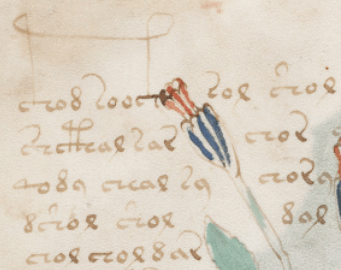
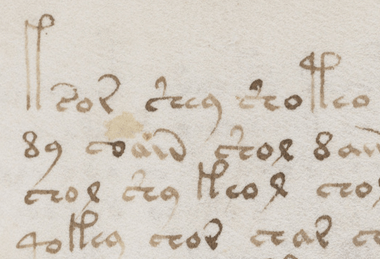
The specific reason I think this is because of their shapes: I believe the shapes of these glyphs signalled to the decipherer not only which of two cipher alphabets to use, but where on the cipher ledger page to look for that cipher alphabet. That is, the cipher ledger page for the overall cipher would have contained two ciphers, one written out horizontally (EVA t) and one written out vertically (EVA k).
In a way, this would have been like an early homophonic cipher, but crossed with steganography. It feels like a branch of cryptography that had not yet hit its mid-fifteenth century stride, but as an evolving practice of secret writing whose history had yet to be written. Hence I’d tentatively date this first layer to the 1420s or maybe the 1430s.
Have I or anyone else seen a page of a cipher ledger with both a horizontal cipher key and a vertical cipher key? No, I don’t believe so: but nonetheless I still believe this was the first stage of the glyph evolution.
Evolution #2 – Fake Cipher Alphabet Selector
The next evolution introduced fake cipher selector glyphs at the start of paragraphs and pages – EVA p and EVA f. I believe that this usage is a feint, designed to make code-breakers suspect (wrongly) that the ciphertext they’re trying to crack uses the older cipher system: and that this is exactly what we see in the Voynich Manuscript.
But… why introduce fake cipher selector glyphs at all? My belief is that the cipher creator introduced the (stage 2) fake gallows glyphs to replace the (stage 1) original gallows glyphs, because they wanted to reuse the original glyphs for a different (but related) cryptographic trick, which we’ll see in the next section.
Also: I believe this second stage implies that the cipher creator had shown the first evolutionary stage to multiple potential patrons, in an attempt to sell his cryptographic / intelligencer services to them: or else there would have been no need for tricky misdirection. So I believe this tells a story not of a complete outsider, but rather of someone on the periphery of one or more fifteenth century courts, trying to use their cryptographic smarts to gain patronage.
Evolution #3 – EVA k = Vertical Transposition Cipher Token
In this third evolution, EVA t still referred to a horizontal cipher key and EVA k still referred to a vertical cipher key. That is, the glyph shapes retained the original visual cue to where on the page to look for the key, but the keys had moved to a new place (and on a new page).
So, where are these putative keys? I’ll start with the vertical key: it’s the first token (which might be a glyph or a glyph group) inserted at the start of each line. The idea that there is some kind of insertion going on at the start of lines is an idea that has been floated for decades, e.g. supported by statistical studies indicating that the first word of a line is normally a little longer than the second word. This of course plays havoc with vocabulary (because it yields lots of unique words) and any proposed explanatory grammar (because line-initial words mess up nice neat models).
All the same, few have proposed explanations as to what this vertical key might be for. Philip Neal in particular talked about this a lot: in his honour, these letters are often described as a “vertical Neal key”, though I believe he never felt comfortable hypothesizing about what that might mean cryptographically.
Me, I’m far more comfortable with hypotheticals, because otherwise we keep on hitting Wittgensteinian “whereof walls”. Here, my hypothesis is that EVA k is a transposition token that decipherers should replace with the token inserted at the start of the line. This makes this mechanism it very much a transposition cipher, but rather than a rail-fence cipher (which kind of relies on seeing letters as movable type, and is therefore more of a post-Gutenberg transposition cipher) it is a line-centric transposition cipher.
For an encipherer, then, the sequence would be something like this:
- Scan though the whole of a single plaintext line
- Find the (I imagine) single consonant that appears the most on that line
- Insert an enciphered version of that letter at the start of that line
- All instances of that letter within the line would then be replaced by EVA k
Let’s try this on a concrete example:
TO SLEEP PERCHANCE TO DREAM AY THERES THE RUB
FOR IN THAT SLEEP OF DEATH WHAT DREAMS MAY COME
OK: the most common consonant in the first line is R or T (four times each), and in the second line T (four times). So, replacing the first line Rs and the second line Ts with $ (standing in for EVA k) gives:
RTO SLEEP PE$CHANCE TO D$EAM AY THE$ES THE $UB
TFOR IN $HA$ SLEEP OF DEA$H WHA$ DREAMS MAY COME
Now, on its own, this cipher trick is far from fearsome: but when arrayed as one of a carefully chosen set of cipher tricks, I think it can be quite the monster.
Evolution #4 – EVA t = Horizontal Transposition Cipher Token
Whereas the third stage was a line-centric transposition cipher (i.e. you didn’t need to look beyond the current line to encipher or decipher the text), this fourth evolution is a paragraph-centric transposition cipher. What that means is that a horizontal key is concealed somewhere in the paragraph, and that each time a decipherer encounters an EVA t in the text, they replace the EVA t with the next token along from the horizontal key.
OK, so where is this horizontal key? There seems little doubt to me that it will always be found somewhere on the top line of a paragraph. My suspicion is that in the earliest iterations of the cipher, this horizontal key may well have been placed right at the start of the paragraph. But as time went by, this was seen as a weakness, and so the encipherer would have needed to (what code-makers call) “bury” it inside. (For example, Typex used “buried codresses”, though this always sounds to me like an elaborate fish funeral.)
So, where on the top line of a paragraph should we be looking for these horizontal keys? In my previous post, I went looking for model-unfriendly long words: two of these (highlighted by Mauro) were in Q20 on the top line of paragraphs – chkaidararal on f115v, and shoefcheeykechy on f104v. These could very easily be horizontal keys, right? While that’s indicative, that’s really not systematic enough.
Once again, Philip Neal possibly comes to our rescue. One Voynichese behaviour he has long been intrigued by is the presence of pairs of words on the top line on paragraphs where both words contain EVA p. Philip wondered whether these pairs might somehow be signalling or bracketing a key phrase of some sort: though, as before, he remained hesitant about lurching forward from there into some kind of cryptographic hypothesis. But all the same, it has to be said that these p-paired horizontal Neal keys feel a lot like some kind of metatextual feature, whether a concealed title, or colour hint or what.
Whatever the actual explanation for these Neal keys, they feel almost consciously designed to disrupt nice neat statistics and/or linear language hypotheses about Voynichese. For if you take out all the paragraph-initial EVA p instances, as well as all the EVA p instances in p-paired horizontal Neal keys, then the number of EVA p instances remaining in the text drops down to almost none.
So… where exactly on the top line of a paragraph are the keys? What is the tell for a cipher key? I… don’t know. Yet. But I continue to look. Today I’m wondering whether I might be able to work backwards from odd words like chkaidararal and shoefcheeykechy to understand the visual cues on the page placed there to help a decipherer see the key. And the final answer may well have something to do with horizontal Neal keys. Hopefully we’ll get there before too long.
Evolution #5 – Where Transposition Doesn’t Work
A key problem with these two transposition ciphers is that they rely on you having neat lines and neat paragraphs to embed keys in. But what about pages built around circular diagrams? Here there is neither an obvious top line, nor an obvious line-start to insert before. So I believe a different kind of key would be needed.
For what it’s worth, I believe that an additional verbose cipher was introduced for these pages: ok / yk / ot / yt. Just to make things difficult for you. So I therefore think that “ok” is a verbose cipher, but “k” is a transposition cipher. But I might be wrong.
OK, So Where Next With All This, Nick?
I first suggested much of the above in “The Curse of the Voynich”, nearly twenty years ago: so for a fair few Voynich researchers this is far from breaking news. All the same, there’s lots of other stuff here that is new, so I think it was worth bringing the thread a bit more up to date.
Really, the big ‘where next‘ step here is simply to see if there’s some kind of visual cue (or an evolving set of visual cues) that signals to the decipherer exactly where a horizontal key is buried (e.g. on the top line of a paragraph). But if I’m the only person searching for this stuff, you better not hold your breath waiting for the next update, because it might be some time.
Hi Nick,
thanks for this post! I’ve been following research on the Voynich manuscript for over 20 years now (thanks to the YouTube algorithm for pulling me down this rabbit hole 😉).
I remember that when I first saw the scans of the manuscript pages, I thought to myself: These gallows characters look like some sort of instruction on how to read the text… But then again, how would that explain the unusually low word entropy observed in the manuscript?
Jürgen Plötner: explanations are easy to construct, easy to tweak when someone complains, and usually tell you next to nothing – most supposed “explanations” do nothing but explain away the problem (i.e. why they think the problem isn’t actually a problem), without actually solving it. The right questions to ask are more concrete, and are more along the lines of: what concrete mechanisms can account for these behaviours?
In the Voynich manuscript, one of the (multiple) concrete mechanisms I strongly believe is in play is verbose cipher (which I mentioned briefly in the article). This would be where multiple glyphs encipher a plaintext letter, e.g. qo / or / ol / ar / al all encipher a single plaintext letter. (I don’t include ch and sh here because they’re both single glyphs that the EVA transcription has turned into multiple letters.) This yields very predictable follow-on pairs, which has the effect of skewing the entropy statistics (which is what I believe you’re asking about).
Nick, the context you describe –
“.. that the cipher creator had shown the first evolutionary stage to multiple potential patrons, in an attempt to sell his cryptographic / intelligencer services to them: or else there would have been no need for tricky misdirection. So I believe this tells a story not of a complete outsider, but rather of someone on the periphery of one or more fifteenth century courts, trying to use their cryptographic smarts to gain patronage.”
would offer a possible resolution to the old paradox – ‘why encipher a well-known text?’ To seeing a block of ‘impossible’ text transformed before your eyes, as it was being deciphered, into something very well known – as e.g. a recipe for Pepper Water – would surely impress.
One niggle, though – if the aim were to present courtly fifteenth-century Latins with a guide to that cryptographic method, why include so many drawings, and drawings in a style so *very* unlike the style which, we know, appealed to the taste of contemporary nobles in Latin Europe? I’m not saying you need to have an answer for this – another ‘whereof’ probably – but it is another among the questions raised by this troublesome old ms.
The thread on the (close to) statistical independence between prefix before & suffix after EVA ‘k’ in Bio B words (https://www.voynich.ninja/thread-4764.html) is a new item high on my list of constraints on theories. I wonder how roughly statistically independent word final and word intial digrams or trigrams are in various natural languages…
Karl: that’s a strong-looking result. Maybe the proof I’m looking for will be found in combining line-initial tokens with k-prefix and k-suffix values on that line. Thanks!
Nick
Thank you for your 20 years of study .
I tio have spent 20 years publishing number theory aspects of the
of the officially unbroken 1925 BCe Akhmim Wooden Tablet. The five problems
divided one volume unit (hekat) by n =. 3. 7, 10, 11, 13, and five proofs built upon multiplication and division as fully inverse operations to one another .
Quotient (Q) and Remainder (R) were first encoded by changing a division problem into a multiplication problem , and proved each answer correct by multiplying each n answer by the initial divisor , returned 64/64 , the initial hekat scaling factor .
My unsolved problem actually is 160 years old , related to the first Western
efforts to decode Egyptian fraction math contained in the Berlin Papyrus ,
and the RMP. The RMP was placed in the British museum in 1863, related to the untimely death of Henry Rhind who purchased the RMP and EMLR on the streets of Cairo in 1858.
An formal paper paper explaining the following is available .
64/64 x 1/n = (Q/64 + 5R /n(1/320)
For 100 years scholars like Chace, et al, have claimed success in decioding the 87 problem Rhind Mathematical Papyrus , written by Ahmes in 1659 BCE..
Nick
I too have worked 20 years on an unsolved problem the proof side of the 1925 BCE Akhmim Wooden Tablet .
The initial quotient and remainder answers were published in 2006
https://www.academia.edu/74318674/The_Arithmetic_used_to_Solve_an_Ancient_Horus_Eye_Problem
connected to like problems left unsolved by Chace, et al, 1927 , such the
n = 6,, 20, 40 divisions of a hekat in RMP 81, Ahmes bird feeding problem .
The unsolved proof side has been solved , and will be published as an
appendix to a longer narrative connecting Egyptian fraction math from 2050 BCE Egypt to Greeks, Arabs , Fibonacci and Galileo in 1600 CE. a period of 3,650 years .
Best Regards
Milo Gardner , Cryptanalyst
Trained by US Army 1957
broke Russian and Arabic
codes 1957-1959
The Gallows is one of the simpler Problems to overcome. As they mostly occur on designated positions they must represent a second garniture of letters, represented by orher glyphs elsewhere. As always it’s futile to give these hints…
It is as certain that they are now ignored as it is certain that there will be no progress with the Voynich at all…
Sh, ch… These are one glyphs because Most probably they are one single letter in the plaintext – put away your Europeen glasses
I’ve been working on a hypothesis on folio 29v called the “Latinbrew Theory”: I believe the author was a native Hebrew speaker learning Latin, and the writer was encoding Latin plant or ritual knowledge phonetically via Hebrew logic and mapping the visual form of Latin letter shapes into Voynich glyphs.
I used AI to apply that logic, and what I’ve found is that 29v specifically reads exactly like a herbal procedure list.
I think the entire page reads:
Boil gourd twice with valerian, then add bark? (Unconfirmed on bark)
Boil gourd, cannabis, valerian;
repeat boil & cannabis
Chamomile, celandine, sage, cotula, basil
Chamomile x2, nigella seed x2, gourd
Cannabis x2, nigella seed, valerian, chamomile
Sage x2, basil, bark, nigella seed
Nigella seed, cannabis, chamomile, cannabis, valerian
@I dunno man
Sounds like the usual sort of medico-pharmaceutical recipe, Why add ‘ritual’?.
@ I dunno man,
perhaps for ‘gourd’ ‘curcubit’? Term for a vessel shaped like a bottle-gourd.
Nick, here there. Hope you are well. How closely do you hold this hypothesis? Is it
replacing your Antonio Averlino/ Filarete guess or just a new Alternative?
Not exactly a cipher, Nick, but you might enjoy a couple of articles by Michael Lapdige and Peter S. Baker which talk about work by Abbo of Fleury. I was interested in it when working on the Voynich map and looking into concepts of co-ordinates and position.
One of their articles, ‘More Acrostic Verse by Abbo of Fleury’ was published in 1997 in The Journal of Medieval Latin (Vol. 7 pp.1-27.)
Incidentally connects with use of Hyginus, which is nice because my first impression of some among the calendar’s month emblems was that they were akin to forms used in early Fleury.
PS – I’m sorry to say that after so long I can’t recall if I took my photocopy from the Journal, or printed it off from some online pdf.
What are your thoughts on the naibbe cipher?
Nick,
What are your thoughts on labels in the context of this method?
It is certainly interestingly to explore vertical and horizontal triggers to alternate alphabets that evolved in complexity over time; however, it would take a strange mind indeed to develop an entirely separate system for the standalone labels. Curious if you have thoughts on how the labels fit into this type of system.
Tim T: when I thought about labelese back when I was writing Curse, I wondered whether o + gallows (e.g. in ‘otolal’) and y + gallows (which also appears disproportionately often in labels, as I recall) might be a verbose cipher way of filling in the gaps left by the inapplicability of transposition cipher to non-block-structured text.
Thx Nick,
Understanding its quite impossible to have an original discussion on decades old topic, but just wanted to explore any new ideas on multi-alphabet triggers within a word (without being verbose) as that’s one of the few ways I imagine the labels, acting as labels.
Cheers,
Tim T.
Hi. This doesn’t relate to the matter at hand, but it crossed my mind. Does anyone know what Umberto Eco thought of the Voynich manuscript? He was obviously interested in it as if you get a copy of the Yale facsimile he has his picture taken for it, so it isn’t impossible that he spoke to someone at Yale about it. I don’t know his level of cryptographic skill, but he seems like a person that would have been a good person to put it in context given its guessed upon timeframe.
At the end of the article, Nick asks “Where to go next”. And you also look for some visual clue in the manuscript. The visual clue that the author Eliška shows to everyone who is trying to decipher the text is located at the very beginning of the manuscript. Specifically, on the page marked folio 2r. On that folio, a homophonic substitution cipher of the number 3 is shown. This is a very important clue. Every scientist should therefore first find out what substitution cipher it is. The cipher is generally called: Kabbalistic numerological system of gematria. At the root of that symbolic plant are the letters C, G, S, L. (that is a whole series of letters of the number 3). Without knowledge of that Jewish substitution, no one will ever be able to decipher the text of the manuscript. What is more important, in order for someone to be able to decipher the text, they must know the old Czech language, in which the text itself is written. The researcher should also be able to speak German, Polish and Latin. Because there are several of those words in the text of the manuscript. Next, what is important. It is important to know the letters that are in the handwriting. The EVA alphabet is good at about 30 percent. And because there is a very complex substitution cipher when writing handwriting, where one character can be replaced by 4 letters, frequency analysis is out of the question.
There are some alchemical symbols listed by the Viennese occultist Gustav Wilhelm Geßmann in The Secret Symbols of Alchemy, Medicine, and Astrology of the Middle Ages that look a bit like some of the Voynich letters/symbols, as pointed out by Miss Mary D’Imperio. See p 122:
https://www.nsa.gov/portals/75/documents/about/cryptologic-heritage/historical-figures-publications/publications/misc/voynich_manuscript.pdf
The symbol she reproduces for urine is very similar to one of the “gallows” characters – https://www.voynich.nu/img/eva/t.gif – in the VMs, but I couldn’t find it in the above mentioned book and indeed the Geßmann symbols for urine reproduced in this (p 638) look completely different:
https://bookofsymbols.wordpress.com/wp-content/uploads/2017/03/dictionnaire-des-symboles.pdf
Is Miss D’Imperio taking the piss? Or is it an example of her gallows humour?
According to René Zandbergen: “Figure 42 in D’Imperio, taken from Gessmann (1922) shows some similarities between Voynich MS characters and a few alchemical symbols. There are only a few examples, and it is not certain whether this is coincidental or not, since these alchemical symbols were not known to me to have been in use in the early 15th century.”
The closest I could find was on p 195 (Nachtrag ie Addendum) of the Geßmann tome:
Perniscere? – ie To perish?:
https://archive.org/details/DieGeheimsymboleDerAlchymie/gessmann-g-geheimsymbole-1922-RTL010443-LowRes/page/n195/mode/2up
Gustav Wilhelm Geßmann:
https://www.astro.com/astrowiki/en/Gustav_Wilhelm_Ge%C3%9Fmann
He also wrote:
“The Plant in Magical Belief. A catechism of magical botany. With an appendix on plant symbolism. 268 pages, 12 illustrations…With a chapter: “The Position of Plants in Astrology”.”
https://books.google.co.uk/books/about/Die_Pflanze_im_Zauberglauben.html?id=OgAvh33a5rMC&redir_esc=y
Bit of a mysterioso chap (weirdissimo?) as shown in this photo of him (or at least taken by him) with a girl in Dubrovnik:
https://uk.pinterest.com/pin/image-from-page-214-of-magnetismus-und-hypnotismus-eine-darstellung-dieses-gebietes-mit-besonderer-bercksichtigung-der-beziehungen-zwischen-dem-mineralische–546765211007398376/
See also another odd photo by him of thought transference – Bozo and his (ex-) poodle and once favourite acolyte Dusty?:
https://pdr-assets.b-cdn.net/essays/worlds-without-end/23319549130_0fab144e7d_o.jpg?width=1200&height=765
A comment and three questions:
Information about scribal practice for medieval Latins’ herbal mss, specifically formatting, leads me to think that the Voynichese (i.e. the written) text in the Vms’ vegetal sections likely to be of much later composition than the images and quite possibly be unrelated in its content. On the last – text-content independent of image-content – I think Nick suggested something similar in 2006 without suggesting a time-lag.
Q1. On p.185 of *Curse of the Voynich* Nick mentions that rising interest in cipher-cracking and creation among Italians occurs from/after the Treaty of Lodi, which was signed in 1454. Have any cryptographers here come across some recent dig into that connection?
Q.2 In same (p.186) Dati presents to Leon Batista Alberti what Nick describes as the twin cryptographic challenges of the day, one being a way of breaking – as the quoted passage reads – “enciphered messages… intercepted and brought to us by spies”. I’m curious about whether, or what, we know about those ciphers whose use presumably pre-dates the 1460s. By ‘know’ I mean actually known from study of dated examples.
Q.3. This question doesn’t require an answer, on the principle that a person who has seen or knows about a thing and who has the means to object to it if they wish, but lets it ride, may be presumed to have no particular objection (Qui tacet consentire videtur). May I have permission to quote as a more general comment than its present context, “Explanations are easy to construct, easy to tweak when someone complains, and usually tell you next to nothing – most supposed “explanations” do nothing but explain away the problem … without actually solving it. The right questions to ask are more concrete, and are more along the lines of: what concrete mechanisms can account for these behaviours?” (source) N. Pelling, ciphermysteries July 12, 2025 at 9:27 pm (date-stamp to include the link).
A further question for the cryptographers –
Has anyone run practical tests to see if – and if so how well – Thomas Ernst’s opinion that the Voynichese glyphs are all are a set of scribal abbreviations produces an intelligible translation of the Voynich text? Have any of the cryptographers tried it out?
For those who missed his talk, so soon removed from youtube vid,
Ernst’s abbreviations came from Dresden, Sächsische Landesbibliothek – Staats- und Universitätsbibliothek Dresden, Mscr.Dresd.P.33, a ms on paper dated to about 1441/1442, containing texts of Aristotle in Latin ad German by several hands, but the relevant abbreviations being attributed, by Ernst, to a certain Herman Heym/Haym.
So – does his set of correspondences work at all? Has anyone working on Voynichese tried it out?
Diane: just in case you haven’t heard, Wilfred & Ethel Voynich’s great nephew Geoffrey Hinton be back in the news once again and he seems to be making a habit of it. The emeritus professor, former Google big wig, widely recognised as the father, godfather of artificial intelligence as we know it (no it’s not Gordon Cramer), has come out once again calling for caution on what could become of we humans if we chose to follow likes of bullish Pres. Trump that want to press on regardless. Goodness, hope you Voynicheros get to the bottom of the mystery before we run out of time. Perhaps the gifted gentleman will come clean on his family’s secret sooner that later now that the VM cat’s out of the bag.
John,
Not sure what you mean about the Vms’ cat being out of the bag. I have as little to do with AI as possible, but avoiding its presence is now impossible. I particularly resent it’s supposing I haven’t the concentration-span needed to read a few thousand words without needing ‘Daddy’ to tell me not to bother my pretty little head – it will tell me what I shall be told to think.
Also still quite useless as a research-aid – far worse than the net was fifteen years ago when Google used to find just what I said it should, not whatever AI happens to suppose I ought to want to know.
I’m spending much more time in the libraries, these days, than I was just 5 yrs ago. AI’s neurons still can’t do the sort of lateral-thinking/associative connection which humans can do so well, if and when they find time to ponder questions before moving into the usual ‘get-data; computerise-data; computer-process-data’ routine that has produced so much pseudo-scientific junk in recent years (a general comment, not Vms studies only) .
John. No one will solve Voynich even if they work on it for another hundred years. Otherwise, Michal had a cat in his logo. Which was on his correspondence. And that cat (as I wrote to everyone many years ago) is holding a mouse in its mouth. The whole meaning of that logo is: The cat is playing with a mouse.
Prof. Josef Z: ah yes, Sessa be the famous Venetian printing house logo “disimillum infida societas” that Mike Voynich borrowed when he first went stateside to promote his new biblio (Unique books of London?) venture aimed at ripping off gullible wealthy American book collectors and his motto was ” don’t put your faith in them’s can’t be trusted” (meaning yankees).
Prof – the same motif appears elsewhere and earlier, as (for one example) in the house and business-house of Francesco di Marco Datini, a merchant born in Prato in c.1335 and who spent almost 30 years of his life in Avignon (1358-1382) initially to benefit from that city’s being the chief city of western Christendom – that is as the papal capital.
Other people used the same motif which, as I recall, realises an Italian proverb of that time about how the wise businessman operates… sitting until he sees ‘the’ opportunity arise and then pouncing on it without a second’s hesitation. I looked into that question some time ago as an incidental question … If you look more widely think it may also have been employed by one or more printers . If it interests you, I can check if I made notes at the time, but it was just a by-the-way sort of question to do with a wall-painting of a kind of Eden-garden made for Datini.
Anyway, distinctly Italian in this form and seen most often from the mid-fourteenth century onwards.
Cheers
Diane: Think I recall Rich saying that when Sessa finally closed down due to Papal harassment and effects of the plague around 1630, family had moved to Naples by then, it’s remaining stationery stock including ink was confiscated by the clergy for its own purposes, whilst top grade vellum was sold off to local printers for use as cover material for manuscripts etc. Whilst its palimpsest scraped pre used sheets were most likely stored away for later use by Spanish forgers in centuries to come. Told you so!
John. Diane. Thanks for the info. I haven’t looked into the logo that far.
John –
Our messages crossed…
There’s no cat-and-rat (or cat-with-mouse) in the Voynich manuscript is there? My point is that it served as a moral-lesson sort of image, and is attested by not later than the fourteenth century.
Regarding “dissimilium infida societas”. I’m interested in the evidence for this. –
Seems more like an accusation than a guiding principle. Are you quite sure it was a printer’s motto? I suppose it might have been misunderstood to mean something like, ‘Falsehood is heresy’ or something.. meaning that a faithful reproduction is no heresy… but that’s not actually the sense of the Latin.
Can you ask Rich for his reference? I expect he will have some.
Diane: I’m not in touch with Rich S. these days as I’m following a different path to the Voynich truth. From memory, I think the answer you’re seeking on the Sessa logo/motto origins etc., may be found on his site guide index under ‘Ethel Voynich’ strangely enough.
….Sorry Diane, thinking now that the ‘Ethel’ heading was relating to her Voynich plant identification hand notes, not the Sessa cat and mouse stuff. Anyhow you’re sure to find it some place on the index and there are pictures to assist while delving through it.
If Dusty could provide links she would have done what I am now having to do!
“The Sessa coat of arms features a cat gripping a mouse (or rat) in its jaws…
“There seems to be no genuine Voynich family coat of arms. But why would Voynich adopt that of the Sessas? What was it about that coat of arms that appealed to him?
“The answer lies in Irkutsk in Eastern Siberia. Irkutsk was the province of Voynich’s exile in the late 1880s. Since 1690 the Irkutsk Governorate has used one form or another of an emblem remarkably like that of the Sessas’ coat of arms…”
As for the motto:
” The Sessas developed ornate versions of their coat of arms, some of which included the Latin motto Dissimilium Infida Societas, “Association with those not alike [oneself] is treacherous” – a truth presumably illustrated by the fate of the mouse or rat.”
https://www.colinmackinnon.com/attachments/The_Voynich_Coat_of_Arms_and_Michael_Voynichs_Flight_from_Siberia_W.pdf
No mention of Wilf getting bitten by a werewolf in Tibet, Mongolia, Shangri-la or even Pimlico.
Cat with a mouse in its gob from an Ms held at the Bodleian:
https://catexplore.com/wp-content/uploads/2023/08/Cat-Bodleian-Library-MSRawl-328c-1536×1021.jpg
Date Statement:
14th century, middle
Place of Origin:
Italy, South?
https://digital.bodleian.ox.ac.uk/objects/3100477a-2ca0-436c-bd34-cb41fe2976ae/
“In medieval Europe, cats held a particular fascination for monks and scribes, who often included them in the margins of manuscripts. From whimsical marginalia to symbolic representations, cats in medieval manuscripts reveal a wealth of information about the relationship between humans and felines during this period…
“Cats were…used in medieval libraries to prevent rodents from chewing on manuscripts which were made out of stretched animal skin called vellum. Rodents would also go after communion wafers which were made out of wheat.
“Consequently, cats became a common sight in monastic communities, where they helped to protect the precious manuscripts and other valuable items stored in scriptoriums.”
But cats could be good AND evil.
“The widespread medieval fear of cats in Europe was initiated with the issuance of Vox in Rama on June 13, 1233, by Pope Gregory IX. In this papal bull, which aimed to suppress heresy, was the first European church document to link cats with Satanic practices and witchcraft.
“Cats faced further demonization under Pope Innocent VIII, who proclaimed in his 1484 papal bull on witchcraft, “Summis Desiderantes Affectibus,” that felines were “the devil’s preferred creature and the idol of all witches.””
An illustration of this appears in the below:
“In Alphabetum Narrationum by Arnold of Liège compares the cat hunting a mouse with a devil stalking a human soul.”
https://catexplore.com/wp-content/uploads/2023/08/Black-cat-mouse-Harley-3244-1255-1265-british-library-1320×882.jpg
Lots of info on cats in Mss in the article from which the above quotes and pics are taken:
https://catexplore.com/cats-medieval-manuscripts/
PS This cat seems to have benefited from Dusty’s recent gender reassignment surgery:
https://static.boredpanda.com/blog/wp-content/uploads/2018/03/ugly-medieval-cats-art-107-5aafb1e6506fe__700.jpg
A typical day over on Tomcatsbytwo
https://static.boredpanda.com/blog/wp-content/uploads/2018/03/ugly-medieval-cats-art-7-5ab258f8248d2__700.jpg
Some more great medieval cats (60 of ’em in total) HERE:
https://www.boredpanda.com/ugly-medieval-cats-art/
Steph H: AI Gemini just stuffed up my response to your non acceptance of the Sessa cat & mouse theme adopted as the future Voynich trademark circa. 1900. A temporary reprieve be in order for now, though be ready for m retaliatory reply and you won’t like what I have to report, no way out for you believe it or not!
Below the emblems of the “Irkutsk Governorate” is written “chernyj bobr” and “tigr” (I’ll spare myself the reproduction in Cyrillic) — black beaver or tiger.
Steve – thanks for your efforts. Of the images, I think we may set aside any dated later than c.1440; others among your examples clearly relate to their associated written text and without reading that, the image can’t be evaluated even if the ‘clue’ might be present as some proverbial saying about the creature. Others again take a very different form from the target image (in my case Datini’s walking cat), or employ a style plainly not that of the appropriate region and/or period. Asrking where Wilfrid got the idea for his cat-and-rodent, the heraldic beast from Irkutsk *might* be relevant, that Governate existing (so wiki informs me) from 1764 to 1926. Obviously not relevant to Datini or to anyone else before 1440.
If I had to guess, and I hate guessing, I’d suggest Wilfrid saw it as an early printer’s mark, liked the motto associated with it, and adopted the image for that reason. I haven’t seen an example – but then I haven’t looked for one.
This page shows the Sessa cat-with-rodent-tail. The post includes these comments:
The Cat and Mouse devices of the Sessa family, who resided and worked in Italy from the end of the fifteenth to the beginning of the seventeenth century, are quite eye-catching …. The Sessa family of Venice adopted the cat as their device in some forty-odd variations over four generations of printing and publishing.
So not just one version..
No rats or cats in the Vms, I think.
So what has it to do with the mis-named ‘gallow’ glyphs?
re: “this page shows”
https://ucdculturalheritagecollections.com/2023/06/29/delightful-devices-the-art-of-the-printers-mark/
Steph: In short, always best I say; Wilf Voynich had seen a woodcut cat and mouse motif on the vellum cover of a volume published by J. H. da Sessa Co. of Venice circa. 1490 entitled Travels of Marco Polo. He liked it and it reminded him of his own brief visit to Peking. So much so that he made it his own, being mindful that he had no need of a legal trademark as every man and his dog used and abused it. Subsequently when he formed his own rare book selling business, Fine Unlisted Biblios London ??? he used the very same on his ornate sales cattledogs as with has fancy stationery which became a well known calling card for his later sales in the big time mericas, aided by ever faithfull servant Anne Nill. There you go, still have any doubts about Wilfrid’s travels? you’re not Robinson Crusoe mofo.
Darius
You say the writing below the emblem says tiger and (black) beaver but Colin McKinnon states that the image shows a tiger with a sable.
“The sable (Martes zibellina) is a species of marten, a small omnivorous mammal primarily inhabiting the forest environments of Russia, from the Ural Mountains throughout Siberia, and northern Mongolia. Its habitat also borders eastern Kazakhstan, China, North Korea, and Hokkaido, Japan.” (Wikipedia)
I can’t read (or speak) Russian, in the Cyrillic alphabet or otherwise, so I couldn’t possibly comment.
Diane
I don’t think anyone has said there is a cat and mouse in the VMs.
This whole (silly) discussion seems to have started when Dusty Sanders commented that the VMs cat was “out of the bag”.
https://ciphermysteries.com/2025/07/12/towards-a-secret-history-of-voynichese-gallows#comment-578068
My own contribution was a) to provide a link to the Sessa image she was waffling on about and b) to give a couple of links to some very basic articles about cats in medieval manuscripts.
Of course you need to understand any image in its specific context but I thought some interesting general points were made about the symbolism of cats in the period. And I for one had a larf at some of the “ugly” medieval moggies.
Your (Former) Policemanly Excellence Fat Dusty
Firstly let me assure you that the Anonymouse who has just posted a comment on another thread has nothing to do with Ann O(nymous), Buddhist protective deities or no Buddhist protective deities. Ann, as I informed readers a while back. was trampled to death by a herd of swine on Chipping Sodbury High Street. My money regarding the mouse is on Pelling – note the emoji!
Here’s your Marco Polo logo:
https://vgesa.com/facsimile-libro_maravillas-marco_polo.htm
The same emblem appears on a Sessa printing of Machiavelli’s Discorsi sopra la prima deca di Tito Livio, which I am sure you are familiar with despite your feeble protestations about being an “uneducated dunderhead” with regard to said political theorist (although that HAS to be true in a general sense) over on the Tamam Shud/Somerton man thread.
https://milestone-books-de.cdn.bibliopolis.com/pictures/003364_01.jpg?auto=webp&v=1614779401
https://www.milestone-books.de/pages/books/003364/niccolo-machiavelli/discorsi-sopra-la-prima-deca-di-tito-livio-divisi-in-tre-libri-nuovamente-ristampati
You will have to pick up a copy of The Cat as a Printer’s Trademark: The Case of the Sessa Family by Sonja Svoljšak and Urša Kocjan:
https://www.jstor.org/stable/26547837
Looking into the Sessas, perhaps the VMs was produced for or by a member of that illustrious family. Or has that all been raked over (and dismissed) before?
“The Sessa family was a Milanese house of very ancient nobility originating from Sessa, a Swiss locality once in the diocese of Como from which it took its name and over whose castle it exercised its lordship in the late Middle Ages.”
https://it.wikipedia.org/wiki/Sessa_(famiglia)
After all. look at the cool crenellations on the castle in their family crest:
https://upload.wikimedia.org/wikipedia/commons/5/55/Coa_fam_ITA_sessa2.jpg?utm_source=it.wikipedia.org&utm_campaign=imageinfo&utm_content=thumbnail_unscaled
(Argent, an open castle turreted with two pieces crenellated in the Ghibelline style Gules, supporting on the keep a swan White, with its chief Or, charged with an eagle Sable, leaning on the two towers.)
Ghibbeline merlons:
https://www.shutterstock.com/search/ghibelline-merlons?dd_referrer=https%3A%2F%2Fuk.search.yahoo.com%2F
Albio Castle? See: https://it.wikipedia.org/wiki/Castello_d'Albio
“The presence of the family in Sessa soon gave rise to a Noble Corporation which for a long time held together the vast agnation: it exercised the condominium on the Albio Castle…In the years 1512 – 1516 the territory originally enfeoffed to the Sessa family…until then part of the Duchy of Milan, was donated by Francis I of France to the Confederates [Switzerland] with the Treaty of Fribourg . The Swiss, having taken possession of the new lands, immediately gave the order to dismantle the fortresses of Malcantone, including the Castello d’Albio, which had already been devastated by the sacking carried out by the Confederates in 1511 and by then abandoned by its lords…”
Did you notice any uncanny resemblance between the cat in the Sessa printer’s trademark and the animal on the far left of f116v?
https://www.uflib.ufl.edu/spec/rarebook/devices/sessa1510ax.htm
https://www.jasondavies.com/voynich/#f116v/0.306/0.141/4.00
Okay, the latter appears to have cloven hooves, but so what?
Then there’s Wilf’s (?) handwriting in the mysterious “”Russian letters”. Check it against the written text of f116v.
“In Box Six of The Grolier Club’s Voynich Collection, in a folder labeled “Voynich, W. M., Letters ca. 1891,” lie three mysterious letters hand-written in Russian. Each is one sheet of paper fully covered with writing on both sides…According to the Italian scholar Dario Besseghini, who has translated Letter One
into English, all three are written in the same hand and mention the same persons, but have different signatures.
“The contents of Letter One, which is written on stationery of the Society of Friends of Russian Freedom, are bizarre and enigmatic: the letter appears to be a kind of coded message from an informant to a police official. The other letters, one written on plain paper (Letter Two) and one on graph paper (Letter Three), have not been translated from the Russian nor have their contents been studied.”
https://www.colinmackinnon.com/attachments/Russian_Letters.pdf
I know what a (self-confessed) dunderhead you are, so I’ll give you a little tip – you can rotate the letters so you can see them properly! Quite possibly they have been studied further and all translated by now (or maybe debunked) but I can’t be bothered to look.
Besseghini writes:
“Only the first letter is addressed to a Russian police officer: the other two are addressed to a woman with whom the writer is apparently on very friendly terms…The last words of the first letter are in Polish, in latin script. The rest, but for a couple of addresses, is in pre-1917 Russian, in cyrillic script. The handwriting is rather typical for the late 19th century, but it is a very bad one. Many letters end up having practically the same shape…”
Do let me know your thoughts on these important matters as soon as you can dear Mme Dusty.
I have the honour to kneel before you.
Steve
PS The supposed visit Voynich made to Peking seems to be, to put it in polite terms, utter bollocks. René Zandbergen writes on his site:
“After two failed attempts Voynich managed to escape [from Siberia]. Voynich himself later spread the story that he made his way to Mongolia where he joined a caravan and spent months wandering with them until he reached Peking, but this is not credible, as already pointed out by Rafał Prinke. The date of his escape is 12 June 1890 and his arrival in London 5 October 1890. This is only 115 days, and a normal boat trip from Shanghai to London in those days took about as much. Instead, he went straight West through Russia, until he reached Hamburg, Germany, where, according to popular tradition, he sold his coat and glasses to buy some herring and bread and pay for a third class ticket on a fruit boat bound for England. After a treacherous journey Voynich arrived at the London docks hungry, dirty, without any money and speaking no English.”
Ann O @ Anno (annus) Inimod (drug used to treat brain function decline) How’s that grab you arsehole. You have nothing to add in your latest diatribe on Wilfrid’s travels in the far east to what’s been hashed over before in much more detail from recognised Voynich Manuscript scholars going back to sans medieval times, me included. What you weren’t prepared to do mofo was to have a crack at the simple four letter code defined in f84r by the eight naked nymps that your near namesake Anonymouse had the gumption to try, with some modest success ie., 50%.
Stiff S: Gone to a deal of additional trouble there m’Lady. Much of your histerical stuff and nonsense has been done to death in past threads both here, Ninja and elsewhere, most notably in Rich SantaColoma’s 1910 genre chronicles ‘where once I used to spend my time’. Even your cat like Voynich cloven footed bovidea/capra browsing tree goat and Rich’s wrongly identified headless Pangola/Armadillo body gets a mention by some of the main stream misinformed Ninjas and miscellaneous Voynichero (my def) medievals. You may have overlooked (accidently on purpose) my barely readable Voynich ballad which was posted twice from memory, but was never subject to any critical acclaim, not even by Diane or Rene. I thought it was OK especially lines touching on crenellated ghibelline merlons of the castle keep, plus a guest appearance by Pelling’s SM fancy Thomas Lawrence Keane who was all the rage at some stage, bullet holes and all 5′ 7″ of him. You might care to relocate my polm and re hash it at your discretion by all means for folks who missed it likes of Bonzo Bowes & HMV Clive who might get a chance to rag it.
John. Your comments are very nice. You mention the Cat and the Goat again. The goat depicted in the text is also important. The scholar should find out why there are so many goats depicted in the manuscript.
Steve,
That “popular tradition” sounds more like malicious invention. I wonder where Rene picked it up… did he give a reference for it?
Diane
I can see your habitual tactic. Pick up on and nitpick about a completely trivial point and ignore the meat and drink of the issue. No idea about your question, you’ll have to ask “Just Walk Away” René! Wilf should have gone for a hamburger rather than herring under the circumstances.
Prof Jay-Z
Sanders gets on my goat too.
Dusty
I have noticed of late how you are “mirroring” my vocabulary and style more and more. “Diatribe” and “M’Lady” are the most recent examples. Dunno whether to be flattered (you obviously subject my comments to close scrutiny in order to learn rhetorical techniques and pick up some verbal tips) or feel sullied.
I’ll leave Anonymouse to play riddling games with you as that sort of thing bores me to tears – and not the sort that you’d find in your well-worn bloody shirt.
One thing’s for sure. You won’t get your knackers in a knot or even knitted up cos you ain’t got ’em any more since last years extensive surgery. A little bird tells me that you are already having regrets about it since you ended up sounding like Alvin Chipmunk, and are now pretending to everybody you come into contact with that you have lost your voice. They think a CAT got your tongue but some of us know better.
https://youtu.be/yF1h2mJK3RA?si=x3mcSBS3aA0BWRxC
Scholar? You’re more like a scollop – no make that trollop you deracinated old bag.
Stiff chedda: you’re like a cloven footed pangolin on a hot tin roof. “diatribe and M’alady” [sick], ain’t no sacrosanct Bristolian verbage; that be the pot calling the kettle black like a scribal copycat if ever there was such. Just to think I’d stoop so lo’s to ape a dork like you; well now ain’t you got tickets on your all high’n mighty churlish self…DORK, now there be one hum dinger of my own for you to abuse at your pleasure, my pleasure too!
Steve. You write great too. I take back that (crazy).
Steve,
Wanting to know if there’s reason for what a person asserts seems fairly normal practice to me. To respond ad.hominem has been a drearily-predictable tactic to distract others’ attention from questionable/speculative assertions. Another that is common – you might like to try this – is to adopt the air of a world-weary aristocrat and advise/order others to “pay no attention”.
What amazes me, still, is how docile and gullible most people are when ordered not to look, not to doubt, not to question, just to believe.
So, it looks, still, as if the only basis for describing the Jewish Mr. Voynich as arriving ‘dirty’ isn’t something he said about that boat and the way refugees were entering England. I’d hoped there might be more to it.
Dork: just popped the cork on alleged theft of intellectual property rights in the form of certain copied verbage, to wit the rarely used, often abused hum dinger word DIATRIBE. Seems I’d been fraufilently using it since time immemorial on this very blog and you’d be on the money if you were to mention abuse/overuse in my particular offending. Be my guest if you dare pestulance, and put DIATRIBE up on CM’s handy site search. You’re sure to be (less than) impressed with my generous useage thereof therein, as opposed to other I don’t care to nominate. Can’t find ‘sweet fanny adams’ under any of your childish byline aliases which be no surprise.
The distinctly non medieval pool as identified in f84r has ten naked nymphs, not eight as I was given to believe. Their individual body contortions and upper limb formation spells out the letters F U B L however the keen observer must gaze upon the full image for a minute for it to become fully clear. As for interpretation it can represent any one of several versions that may have been put up for display on the shopfront at 175 Piccadilly Circus, London or highlighted in Wilfrid Voynich’s later catalogues, for example, Fine Unlisted Books London, Unlisted being sustituted for Uncirculated and Books for Biblios. If latter be the order, the same initials could represent books of the old testament for quick sale in which case the promo might translate to Forgotten Unlisted Biblio Lamentations or similar. Guess Anonymouse deserves the prize for offering up a well formulated unique Niponese solution that shows more sense than my own humble effort.