
For fun, I recently went looking for films that contained images of ciphertexts that could actually be cracked. Of course, plenty of films include plausible-looking ciphertexts, but I had no idea whether any took audience interest in code-breaking seriously enough to do it ‘for real’.
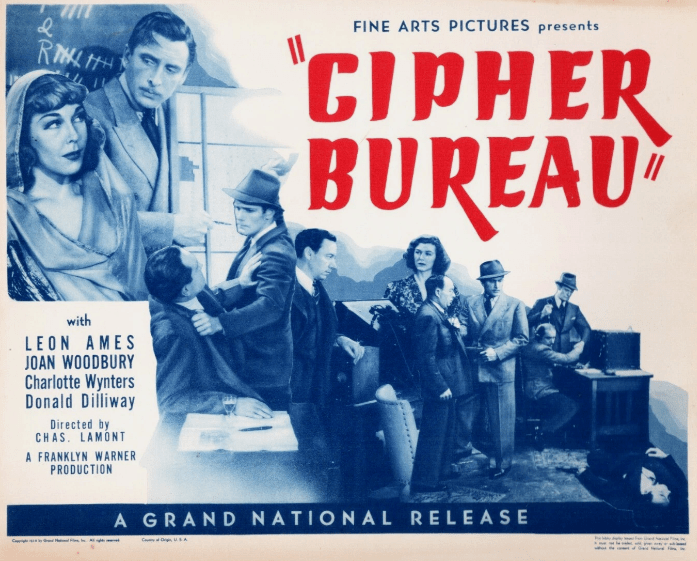
I was therefore pleasantly surprised to find “Cipher Bureau” (1938), a nice little (one-hour-long) film that not only shows you some ciphers on screen, but also (kind of) breaks them in front of your eyes. And it’s available for free (and without YouTube ads) on the most excellent Internet Archive.
“But what of the ciphertext?“, I hear you cry. So here it is (barring any slopying cips on my part):
1.  PRRAHEHO
2.  ALBTMIRS
3.  EEASENSU
4.  SHLWMMHN
5.  TRVEMDTG
6.  NTAOORTE
7.  EEYWAYRH
8.  AMVRCIYD
9.  RAOELOUO
10. LOAREFRR
11. JDFWOUCU
12. PRNORNEA
13. AYFINITR
14. EFEBDOVG
15. CFILGMID
16. HRHONCIL
17. KOCLTMDE
18. TETTAYLA
19. AREAHENC
20. OFOEHLEY
21. ETHRIDSK
22. LSTGTEDO
23. LRERSIFE
24. SNENATRR
25. OARAPAOR
Of course, you can choose either to break this yourself (a luxury nobody had in those pre-video recording days), or to just watch the film and watch the protagonists break it (starting from around 24:00). But to be fair, you don’t have to be the very talented Tony Gaffney to pretty much read this cipher off the page. (I hope that’s not too big a hint that’s it’s a tionsispotran hercip.)
Personally, I enjoyed the film almost as much as Joan Woodbury appeared to enjoy playing Therese Brahn. Oh, and the Jason Robards in the film is actually Jason Robards Senior, who had a stalwart Hollywood career long before his son joined in on the fun.
PS: I’ll cover another fun cipher from this film in a separate post. And I’ll cover the sequel (“Panama Patrol”) separately too.
Here’s NP on a YouTube mystery video, at link https://www.youtube.com/watch?v=0A2H2dJ0d_c&t=1s
Thanks Curio,
Interesting presentation Nick 🙂
I’d thought cryptography was more advanced in 1938 :-).
A small mystery in this film: The “Musicwriter” typer shown in the breaking of the third cipher was not invented until after WWII, with Cecil Effinger getting the idea in 1945 and filing for the patent in 1950 (see his wikipedia page).
From the close-ups of it in use, I think they just replaced the strikers of a regular typewriter with musical note symbols. When we see the typer in action, all the typed symbols are in a horizontal row, close together (around F above middle C, if that’s meant to be the treble clef). There is some realistic-looking music on the sheet, but it was clearly pre-printed and the typist simply started after that part.
I probably don’t need to mention that if the claimed encryption scheme were used, the message would not sound at all like music, much less the music we heard.