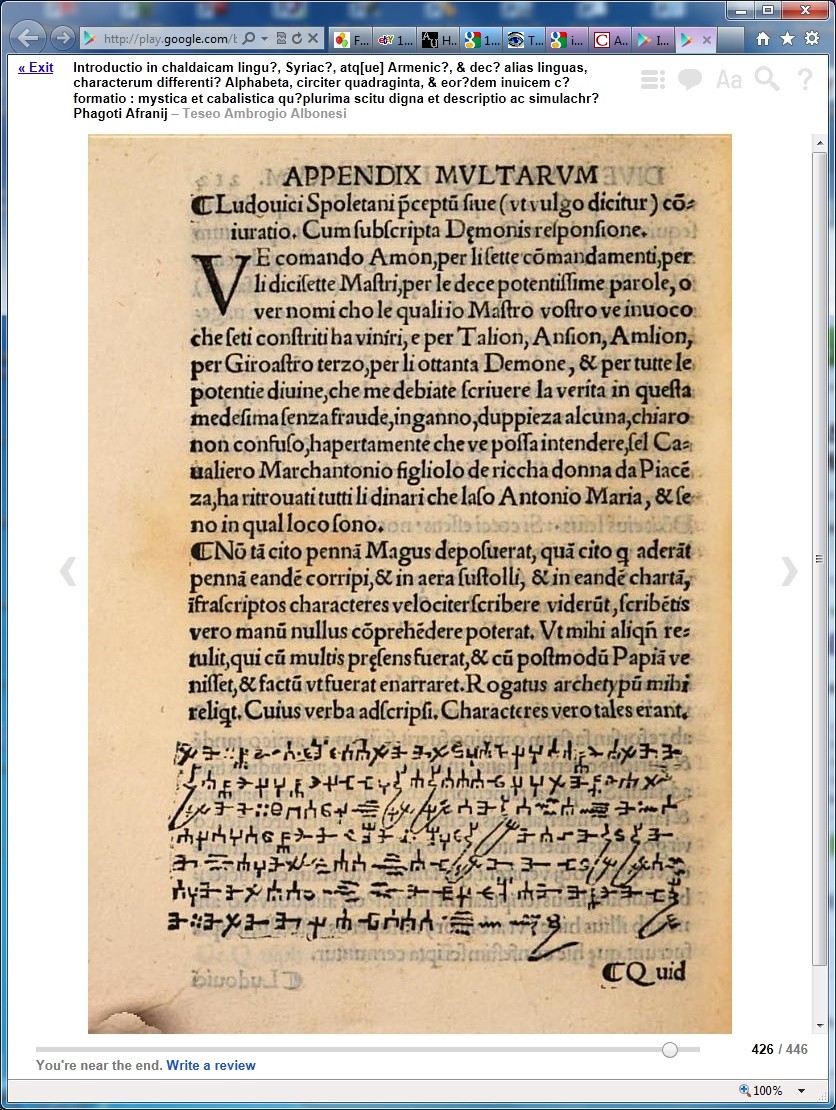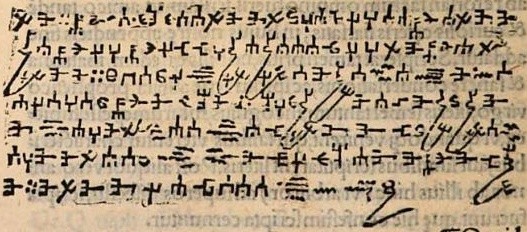
A curious book called “The Devil in Britain and America” by John Ashton (1896) reproduced an image of some writing that…
“is supposed to be the only specimen of Satanic cal[l]igraphy in existence and is taken from the ‘Introductio in Chaldaicam Linguam,’ etc., by Albonesi (Pavia, 1532). The author says that by the conjuration of Ludovico Spoletano the Devil was called up, and adjured to write a legible and clear answer to a question asked him. Some invisible power took the pen, which seemed suspended in the air, and rapidly wrote what is facsimiled. The writing was given to Albonesi (who, however, confesses that no one can decipher it), and his chief printer reproduced it very accurately.” (Preface, pp.v-vi)
This basic “Devil’s Handwriting” story has been reproduced & rehashed many times on the Internet: my thanks to the indefatigable Dave Oranchak for passing it my way last summer, when I used it as a slide for my London Rare Book School talk… (but then forgot to post it here, d’oh! Sorry!)
Though at first sight it all seems rather like an urban myth, it turns out that Albonesi’s book (with the catchy title “Introductio in Chaldaicam linguam, Syriacam atque Armenicam et decem alias linguas characterum differentium alphabeta circiter quadraginta et eorundem invicem conformatio“) is not only very real, but also (according to a book chapter by Daniel Stolzenberg) one of “the foundational texts of Oriental philology, as well as [one] of the earliest studies of comparative linguistics” (p.308). In fact, a copy recently sold at auction for $6899.
So… what was the Devil doing in Albonesi’s details, exactly? Well, it turns out that Albonesi (1469-1540) corresponded with the French linguist, astronomer, diplomat & cabalist Guillaume Postel “on the subject of this and other magical or otherwise unusual alphabets” (p.308, note 21), and the story of Ludovic of Spoleto’s alleged encounter with the Devil seems to have arisen from there.
However, from my own crypto historian viewpoint, I have to say that Trithemius’ idea of hiding ciphers behind a demonological or necromantic facade was very much of the moment circa 1532: so I strongly suspect that what we’re looking at here is probably a cipher concealed behind a devilish story, rather than (say) some kind of quasi-moralistic hoax.
But can we crack it? Well… there are some problems. The best scan I have (at the top of the page, taken from the 1539 edition) isn’t of excellent quality, and it contains many similar-looking characters which could well be copying errors introduced when the book was prepared for printing. Hence transcribing this may not be quite as easy as many other ciphers you’ll see.
Still, it does largely resemble a “pitchfork-themed pigpen” cipher, and the cipher shapes look to have been consciously improvised around Devilish themes (pitchforks and bats?), so there may well be some kind of simple underlying symmetry to its letter/cipher organization that emerges once you get the hang of it. Plaintext is likely to be Latin or Italian, I guess. Unless it’s Adamic, Enochian, or the Green Language, of course, but I’m not holding my breath for any of those. 🙂
Guesses: it’s possible the “bats” are groups of “enciphered I” shapes (i.e. III or IIII, etc) while the ‘.’ is an enciphered U/V. The flourished pitchfork might encipher the full stop at the end of a sentence. Might the plaintext turn out to be nothing more than a joke making fun of Albonesi or Postel? Could be! Hopefully we shall see…
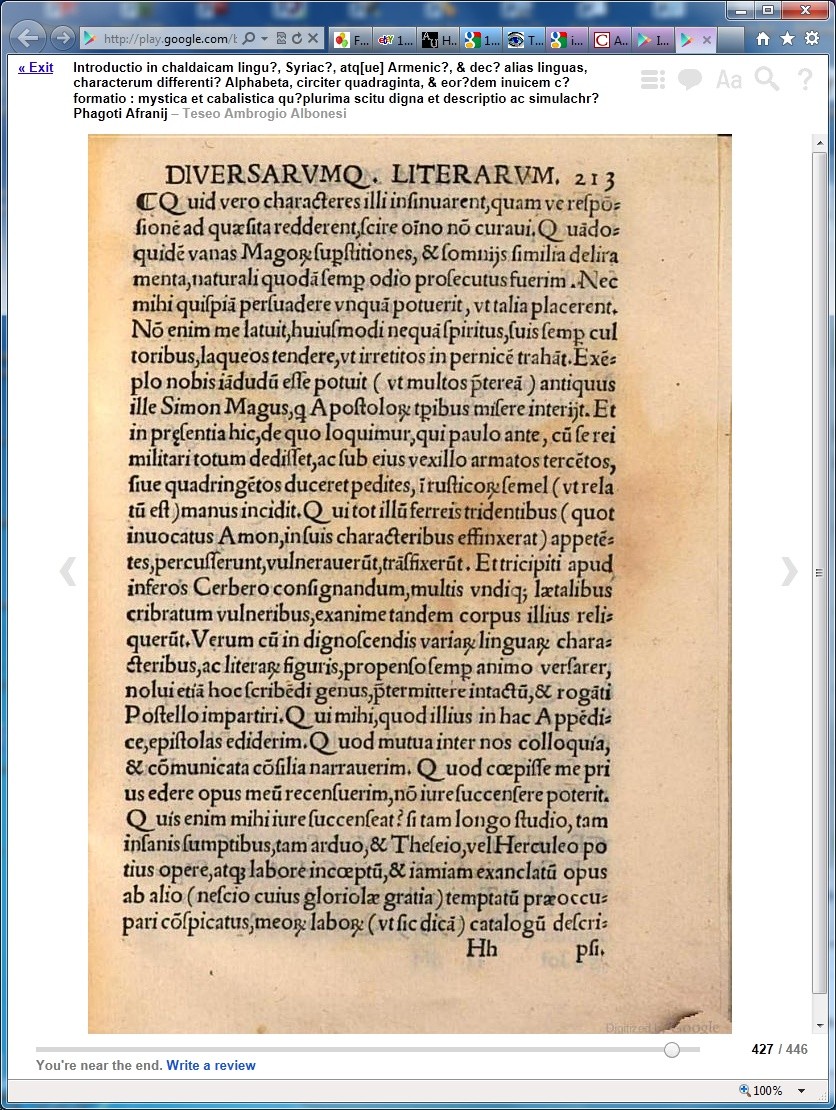
PS: I can’t now find the online copy of Albonesi’s book, but here are links to screengrabs of p.426 and p.427, in case you want to see the text surrounding it.