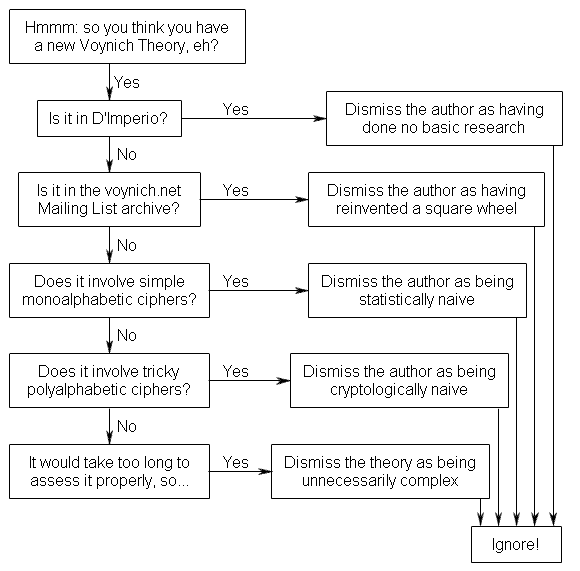
Of course, you knew all about this kind of idea stompery already, I’m sure: but all the same, it’s nice to see it made so plainly visible in a flowchart. And, as I’ve been copying across my Voynich Theories page to this new website, here’s the equivalent Voynich Theory flowchart:-
At the beginning of this year, I became interested in the mystery surrounding the invention of the telescope, spurred by Richard SantaColoma’s outrageous claims that the enciphered Voynich Manuscript contained images of telescopes disguised as strange tiered albarelli. But really, who did invent the telescope? Where did it come from?
At first, I thought the answer ought to be straightforward to find out, particularly as this year (in fact this month, September 2008) marks the 400th anniversary of the supposed invention. But the more accounts I read, the less I believed.
You see, for four centuries, people have asserted that three Dutchmen suddenly invented the telescope all at the same time: but my opinion is that this is a placeholder for an explanation rather than a proper explanation – bluntly, whatever actually happened back then, you can be fairly sure that that wasn’t it.
When you strip it all down, there are basically two rival accounts to choose from: the mainstream story (“three Dutchmen invented it, take your pick whichever you prefer“) and the one offered by the Milanese rich kid courtier Girolamo Sirtori in his 1618 book “Telescopium, siue Ars perficiendi nouum illud Galilaei visorium instrumentum ad sydera”. Essentially, Sirtori said that he had gone to Gerona and met the real ‘first inventor’ of the telescope, a man called Roget of Burgundy: however, given all the uncontestable documentation in Dutch archives, historians had long thought this too marginal a research lead to pursue. And anyway, Sirtori offered no means by which Spain and Holland were connected.
However, I managed (thanks to Google and the helpful staff of the Municipal Archive in Barcelona) to dig up a transcript of an obscure 1959 radio broadcast written by a particularly dogged investigator called Jose Maria Simon de Guilleuma – an optometrist, scientific instrument collector and amateur historian from Barcelona. He was so intrigued by Sirtori’s account that he spent probably a decade or more sifting through numerous Spanish and French archival sources – and in so doing verified much of Sirtori’s story.
Fascinating stuff! And furthermore, when I combined Simon’s findings with more up-to-date research, a brand new narrative of the invention of the telescope presented itself, which I believe joins all the disparate pieces together (in a kind of intellectual history sort of way).
I wrote up my findings and reconstruction, sanity checked them with several very experienced telescope historians, and submitted them as a fairly substantial article to History Today (it’s on the front cover, you can’t miss it). Perhaps it’ll cause a stir, perhaps not – but all the same, it’s certainly a fully-rounded hypothesis which I hope will prove to be a spur to other historians and researchers to look that bit further.
There’s a short piece in the Guardian today by Ian Sample, and I did a short interview on Radio 4’s Today programme this morning: there’s also a longer piece in El Mundo, and doubtless several more to come out this week. But for the full story, you’ll have to buy a copy of History Today for yourself… 🙂

A few years ago, people Googling for “Voynich” started to see a sponsored “AdWord” link on the right hand side provocatively posing the question of whether there might be some link between the Voynich Manuscript and Leonardo da Vinci, and pointing them to www.edithsherwood.com.
Naturally, I pointed out that this hypothesis was a load of rubbish, primarily because Leonardo was left-handed, and the VMs was written by someone right-handed – a pretty good prima facie reason to dismiss the claim. Edith also relied on a particularly partial reading of the month names in the zodiac section (one of them when mirrored looks a bit like “lionardo”): but failed to notice not only that they all read like Occitan month names (which there is absolutely no reason to think that a young Florentine like Leonardo would have used), but also that they were plainly written by someone else.
Still, unlike the majority of Voynich theory proponents out there, she is at least looking in the right century and (I believe) in the right physical milieu (and possibly even the right town, in a roundabout kind of way): and for that I am grateful. No, don’t be like that: I really am. honestly.
Since then, Edith’s website has had some ups and downs (of which being hacked by some kind of Russan spam harvester and having its mail inboxes overflow were probably some of the downs). But over the last month, she has returned to it and begun to fill it with many additional pages detailing her and her daughter’s thoughts on actual plants apparently matching the drawings in the VMs. They refer to some of Mr Dana Scott’s botanical identifications (but repeatedly refer to him as a her, which Dana doubtless finds irritating), though largely propose their own matches.
Unfortunately, at such a large historical distance, finding botanical equivalents is a hugely hazardous way of trying to move forward: and the secondary claim to have localized the VMs’ production to Italy and/or the Mediterranean from the resulting set of highly contentious / non-obvious plants is simply not methodologically sound, however they try to spin it.
Though many people have taken this same tack over the years, that doesn’t make it a sound methodology: in fact, the consistent lack of progress achieved by it is very probably a clear indicator that doing so is in fact brutally unsound.
What is going on? I think that what we see expressed in the herbal drawings is not metaphor (a symbolic equivalent to or conceptual parallel of an original object) so much as metonymy (where component parts stand in for the whole). One classic example linguists give of this is the way Cockney geezers call a car a motor (or, in its gloriously glottal-stopperish glory, a “mo’er”), where a key component (“the motor”) is sufficient to stand in for the whole (“the car”). You may also recall this from Alexei Sayle’s “‘‘allo John go’ a new mo’er… / I keep tropical fish / in my underpants” [etc etc]).
Despite all that, the possibility remains that Edith and Erica might have managed to make some good observations. As I’m not a botanist, all I can say is that I think their reading of colours in the VMs is once again codicologically naive (because there seem to be plenty of reasons to conclude that most of the strong “heavy” colours in the VMs were not added by the original author): which would unfortunately seem to point in the opposite direction.
After a summer break full of dull-as-ditchwater technical woes, I’ve finally managed to restart my rusty old “Voynich News” blog (on Blogger) as the shiny new “Cipher Mysteries” blog (on WordPress). Although I’m most of the way through migrating the 200-ish old posts over *sigh*, what you’re reading now should (fingers crossed) be the first new post.
Incidentally, I’ve got a busy week coming up, with my big telescope article finally coming out in History Today – there’s plenty of media interest in it going on behind the scenes, so should be “interesting times”. I also have six book reviews on their way here (including Adam Mosley’s “Bearing the Heavens” and Richard Belfield’s “Six Unsolved Ciphers”), as well as a whole heap of meaty historical cipher stuff to cover: but please bear with me while I get this new site straight – getting it all ship-shape again will take a few days…
In the meantime, you might enjoy the funny picture I put up on the Cipher Mysteries ‘about’ page… Enjoy! 🙂