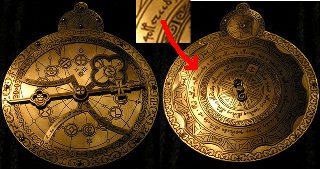
Here’s a nice bit of craft by someone called “iisaw” (Eric Coyote Elliott), who’s made a fabulous astrolabe-like instrument and posted a couple of pictures of it on the DeviantArt website – click on the picture there for a detailed view.

enigmatic_instrument_by_iisaw_mini

As you should be able to see, Eric used Voynich lettering (probably the EVA font) when etching enigmatic script on his enigmatic instrument. He writes:-

This “Cosmolabe” is a prop for a movie. The fifteen circular symbols on the front represent different worlds and the signs on the outer rim are components of magical runes used to travel between the worlds. The instument itself is a way to calculate which runes need to be used for opening gates between specific places.

Cool! What’s also nice is the way that it mirrors many of the circular diagrams in Quire 9. As to the text, I can see “qoksheedy” (which only appears on f108v) there, though the phrase it is in does not: so it looks to me like he’s done a nice job of simulating Voynichese, possibly even better than Gordon Rugg’s grilles ever did. 🙂

At last, my copy of Arthur W.J.G. Ord-Hume’s “Perpetual Motion: The history of an obsession” (which I mentioned here) has arrived, though I must admit to a certain amount of disappointment that its chapter 15 (“Perpetual Lamps“) only runs from page 194 to page 199. All the same, if that is all we have, then let us pick up that baton and run with it…

Ord-Hume discusses Fortunio Liceti’s “De Lunae Subobscura Luce prope coniunctiones“, which turns out (I think) to be Chapter 50 (L) of his 1640 book “Litheosphorus“: there’s an online scan at the Wolfenbütteler Digitale Bibliothek here, though (once again) it turns out to be only some six pages long.

Though Ord-Hume mentions various bits from Della Porta, his main source seems to be the section in Bishop John Wilkins’ 1648 “Mathematicall Magick, or The wonders that may be performed by Mechanical geometry” entitled “Subterraneous lamps, diverse historicall relations concerning thsir duration for many hundred years together“.

I’d heard of the book before: it merits a mention on p.309 of William Eamon’s enjoyable “Science and the Secrets of Nature” (1994), who notes both that it used the word “Magick” in an ironic sense, because “vulgar opinion… doth commonly attribute all such [machines and devices] unto the power of Magick“, and that Isaac Newton was an “avid reader” of it [as was Christopher Wren]. Also on my bookshelf is “The Rosicrucian Enlightenment Revisited” (1999), where Paul Bembridge (in his article “Rosicrucian Resurgence at the court of Cromwell“) briefly namechecks Wilkins’ mention of the eternal lamp allegedly in the tomb of Christian Rosenkreutz. (It’s in Yates too, of course).

[Incidentally, because Curse readers will remember my discussion of early modern wind-powered cars, I should say that Wilkins also talks about Simon Stevin’s wind-wagon, and even includes a rather faked-up line drawing of it (you can see a copy of it here).]

Yes, I’d love to buy a proper copy of Wilkins’ book, but… a first edition apparently went at auction earlier this year for £1000: oh, and there’s a copy at B & L Rootenberg up for $3500. OK, the dollar’s weak, but it’s not that weak, right?

Thankfully, Kessinger Publishing sell (for rather less cash) a print-on-demand reproduction which you can buy through Amazon etc: but note that (rather unhelpfully) they’ve modernised the spelling of the title to “Mathematical Magic“. Anyhow, I’ve ordered a copy, and will post a blog entry about it when it arrives…

Yes, I’m probably just as amazed as you are: that a lowly pop-culture artefact such as the VMs could ever be plausibly mentioned in the same sentence as Chelsea FC. Tolstoy or Chekhov (the writer, not the Star Trek navigator, you fooool) maybe: but… the Voynich Manuscript? Naaah.

Yet in post #566 on “The Intelligent Forum” at CFCnet forums, long-time forum member “Hanuma” writes:

We weren’t the first or last side to struggle against [Liverpool], so Rafa hardly worked out the Voynich Manuscript when he went all-out defence and hoped for the best.

Stunning stuff! 🙂

No, not the 2008 film (though that too has a crystal skull-based storyline): I’m talking about the 1995 book by Max McCoy, which Bantam have just (May 2008) reissued apropos of nothing (apart from perhaps trying to surf the wave of the film’s gigantic marketing spend?)

The Voynich Manuscript makes its appearance very early on (p.27, actually the first page of Chapter 1): McCoy manages to present its history very lightly and not bog the reader down in too many details. But as the book is set in 1933, there wasn’t a whole UFO angle to cover (or other such modern confections). Instead, you get a little bit of Newbold, Bacon, alchemy, Major John M. Manly (!!!), John Dee, Kelley, the Shew Stone, and even a quick reference to Wilfrid Voynich in New York: basically, everything moves briskly along in the kind of proper screenplay-like way you’d hope from an Indy novel. Yes, there’s even the occasional snake (for readers playing Indy buzzword bingo, I guess).

I’ll admit it: I was charmed by the book. It’s small (293 pocket-size pages), no larger than you’d imagine a Japanese commuter squeezing into a pocket, and reads so quickly that at some points (most notably in the end sequence past the oasis) I deliberately closed my eyes to slow the pace down so that I could properly picture the scene in my mind.

Historically, the book has a deliciously light touch throughout, in particular when Indy and his companion are improbably rescued by an elderly French couple called Nicholas and Peronelle (p.200) – and if you can’t work out who they are by that stage in the story, you very possibly deserve to be shot.

I liked all the atlantici history and the Shelta Thari stuff (there’s a Wikipedia page too) woven in: but note that when McCoy writes “Nus a dhabjan dhuilsa“, he probably means “Nus a dhabjon dhuilsha” [‘The blessing of God on you’], though I’d prefer not to pick a fight with a tinker / tinsmith as to which one is correct. Incidentally, my guess is that McCoy picked up the reference to Thari from Roger Zelazny’s 10-book ‘Amber’ series.

Inevitably, there are some historical mistakes in the book (the VMs wasn’t in Yale in 1933, I’m pretty sure that the British Museum had a positive rotograph of at least some of the VMs in 1929, etc), but frankly I couldn’t care less. It’s a delightful, frothy, whip-cracking romp through alchemical history, that I think should be required reading for any modern Voynich novelist.

Well, we now have a name for Richard Douglas Weber’s forthcoming Voynich novel: “The Voynich Prophecy”. His author page on the Publisher’s Marketplace site seems to describe his novel as a euro thriller with a kind of neo-Nazi alchemy twist: he’s also posted up a four-minute video montage on YouTube for the book, where it is described as an “occult conspiracy thriller”.

Curiously, Weber’s whole media approach to novel promotion / marketing seems quite opposite to the kind of thing novelists have been doing. I went to a lecture in the Borders in Kingston a few days ago given by the very pragmatic Alison Baverstock (soft-promoting her actually very good book “Marketing Your Book: an author’s guide): sadly, the best current advice she had for authors seemed to be to try to make press out of your personal circumstances, the examples given being (a) losing half a limb (b) sleeping with a celebrity, or (c) having police take over your house during an armed incident.

As for me, I feel caught in the no-man’s land between these two extrema: while I have no huge faith in the traditional book-selling industry’s agenda and methodologies in the age of the Internet and digital print, I’m still just that bit too old-fashioned to montage loads of borrowed images on YouTube. But I have an MBA: and MBAs are forever looking for a “middle way” that finesses the best of both worlds, rather like intellectual historians steering a path between unreliable accounts. Hopefully I’ll find my own answers in the end…

In a recent post, I mentioned the idea that the d’Agapeyeff cipher might involve a diagonal transposition on the 14×14 grid cryptologists suspect it may well have been based upon. To test this out a bit, I wrote a short C++ program (which I’ve uploaded here) which turns the number pairs into characters (for convenience) and prints out all four diagonal transpositions (forward, reverse, forward boustrophedon, reverse boustrophedon) starting from each of the four corners.

Because the number of doubled and tripled letters is a simple measure of whether a transposition is likely to be plausible or not, I counted those up as well. The next metric to calculate would be the unique letter adjacency count (i.e. how many unique pairs of letters appear for each ordering)… but that’s a task for another day.

Interestingly, transpositions starting from the top-left corner (and their reverse-order reflections in the bottom-right corner) have no triple-letters at all, as well as far fewer double-letters (9/10/11 compared to 13/14/15) than transpositions that start from the top-right. Though intriguing, I don’t know if this is statistically significant: I haven’t determined what the predicted doublet and triplet count would be for a totally randomised transposition, perhaps calculating that too that would be a good idea.

For any passing cryptologers, here is the ASCII version of the d’Agapeyeff cipher (as output by the C++ code) when arranged as a 14×14 grid (in numerical order but without J), followed by the 16 diagonal transpositions with their associated double & triple counts. My guess is that the top left corner reverse diagonal transposition (the second one down, starting “KBDMIDPIK…”) is most likely to be the correct transposition, but we shall see (hopefully!) if this is true…

K B M P Q B Q D L D Q I P O
D I I M O N L C L L I I M B
D K N M O Q K I E N K K K S
C E E L C L K P K K D B M R
P I C M K I N L E L O P D P
D P P C M G B N B L L G L D
C K M L D N C M P L C C C Y
I L Q Q O C P O E D P E B T
B B P Q P Q I Q G K D E K F
E N B D I L M O B M D Q L S
E B D O O Q N P I Q L E G I
N N P M N D B G B E B N K R
G C M M G G N M P O K M L N
G O B M N K L D K I P L B R

*** Top left corner ***
Forward order…
KDBDIMCKIPPENMQDIEMOBCPCLONQIKPMCQLDBLMCKLKCLEBQLMIKILDE
NPQDGNPELQNBBQONBLKNIIGNDDPCCNEKKIPGCPOIQPMBLDKMOOMMOLIO
PLOBKBBMNQMQELLPMSMGDNOGDCGDRNGBPBKPCLPKNGIMDECDLMBQDEBY
DPELQKTKOBELFIKNGSPMKILLRBNR
–> number of doubles = 11, number of triples = 0
Reverse order…
KBDMIDPIKCQMNEPBOMEIDQNOLCPCDLQCMPKILCKLKCMLBDLIKIMLQBEQ
LEPNGDQPNEIINKLBNOQBBNPIKKENCCPDDNGOMKDLBMPQIOPCGBKBOLPO
ILOMMOSMPLLEQMQNMBRDGCDGONDGMPLCPKBPBGNDCEDMIGNKYBEDQBML
TKQLEPDFLEBOKSGNKIIKMPRLLNBR
–> number of doubles = 9, number of triples = 0
Simple boustrophedon (forward then reverse)…
KBDDIMPIKCPENMQBOMEIDCPCLONQDLQCMPKIBLMCKLKCLDLIKIMLQBEE
NPQDGNPELQIINKLBNOQBBNGNDDPCCNEKKIPOMKDLBMPQIOPCGOMMOLIO
PLOBKBSMPLLEQMQNMBMGDNOGDCGDRPLCPKBPBGNKNGIMDECDYBEDQBML
DPELQKTFLEBOKIKNGSIKMPLLRNBR
–> number of doubles = 10, number of triples = 0
Reverse boustrophedon (reverse then forward)…
KDBMIDCKIPQMNEPDIEMOBQNOLCPCIKPMCQLDLCKLKCMLBEBQLMIKILDQ
LEPNGDQPNENBBQONBLKNIIPIKKENCCPDDNGGCPOIQPMBLDKMOBKBOLPO
ILOMMOBMNQMQELLPMSRDGCDGONDGMNGBPBKPCLPDCEDMIGNKLMBQDEBY
TKQLEPDKOBELFSGNKIPMKIRLLBNR
–> number of doubles = 9, number of triples = 0


*** Top right corner ***
Forward order…
OPBIMSQIKRDIKMPLLKBDDDLNDPLYQCEKOGCTBLIKLLCBFQNKPELCEKSP
OQKLBLPELIMMOLNNPDDQGRBIMCIBMEKDEKNKINLKGCOGMLNLRDKEMMNP
QBQBMBDECCDCIOIEKLCIPLOQMPBOPPPMQPLNGPIDKQQIQBMKCLPDODND
IBBONGLBNDMGKEBPMNENMMNCBGOG
–> number of doubles = 14, number of triples = 2
Reverse order…
OBPSMIRKIQPMKIDDDBKLLYLPDNLDTCGOKECQFBCLLKILBSKECLEPKNQI
LEPLBLKQOPRGQDDPNNLOMMNKEDKEMBICMIBRLNLMGOCGKLNIKBMBQBQP
NMMEKDLKEIOICDCCEDPOBPMQOLPICIPGNLPQMPPKMBQIQQKDDNDODPLC
LGNOBBIKGMDNBNMPBEMMNEBCNOGG
–> number of doubles = 15, number of triples = 1
Simple boustrophedon (forward then reverse)…
OBPIMSRKIQDIKMPDDBKLLDLNDPLYTCGOKECQBLIKLLCBFSKECLEPKNQP
OQKLBLPELIRGQDDPNNLOMMBIMCIBMEKDEKNRLNLMGOCGKLNIKDKEMMNP
QBQBMBLKEIOICDCCEDCIPLOQMPBOPIPGNLPQMPPDKQQIQBMKDNDODPLC
IBBONGLKGMDNBEBPMNMMNENCBOGG
–> number of doubles = 13, number of triples = 0
Reverse boustrophedon (reverse then forward)…
OPBSMIQIKRPMKIDLLKBDDYLPDNLDQCEKOGCTFBCLLKILBQNKPELCEKSI
LEPLBLKQOPMMOLNNPDDQGRNKEDKEMBICMIBKINLKGCOGMLNLRBMBQBQP
NMMEKDDECCDCIOIEKLPOBPMQOLPICPPMQPLNGPIKMBQIQQKDCLPDODND
LGNOBBIBNDMGKNMPBEENMMBCNGOG
–> number of doubles = 14, number of triples = 0


*** Bottom right corner ***
Forward order…
RNBRLLIKMPSGNKIFLEBOKTKQLEPDYBEDQBMLDCEDMIGNKPLCPKBPBGNR
DGCDGONDGMSMPLLEQMQNMBBKBOLPOILOMMOOMKDLBMPQIOPCGPIKKENC
CPDDNGIINKLBNOQBBNQLEPNGDQPNEDLIKIMLQBELCKLKCMLBDLQCMPKI
QNOLCPCBOMEIDQMNEPPIKCMIDBDK
–> number of doubles = 11, number of triples = 0
Reverse order…
RBNLLRPMKIIKNGSKOBELFDPELQKTLMBQDEBYKNGIMDECDNGBPBKPCLPM
GDNOGDCGDRBMNQMQELLPMSOMMOLIOPLOBKBGCPOIQPMBLDKMOGNDDPCC
NEKKIPNBBQONBLKNIIENPQDGNPELQEBQLMIKILDBLMCKLKCLIKPMCQLD
CPCLONQDIEMOBPENMQCKIPDIMDBK
–> number of doubles = 9, number of triples = 0
Simple boustrophedon (forward then reverse)…
RBNRLLPMKISGNKIKOBELFTKQLEPDLMBQDEBYDCEDMIGNKNGBPBKPCLPR
DGCDGONDGMBMNQMQELLPMSBKBOLPOILOMMOGCPOIQPMBLDKMOPIKKENC
CPDDNGNBBQONBLKNIIQLEPNGDQPNEEBQLMIKILDLCKLKCMLBIKPMCQLD
QNOLCPCDIEMOBQMNEPCKIPMIDDBK
–> number of doubles = 10, number of triples = 0
Reverse boustrophedon (reverse then forward)…
RNBLLRIKMPIKNGSFLEBOKDPELQKTYBEDQBMLKNGIMDECDPLCPKBPBGNM
GDNOGDCGDRSMPLLEQMQNMBOMMOLIOPLOBKBOMKDLBMPQIOPCGGNDDPCC
NEKKIPIINKLBNOQBBNENPQDGNPELQDLIKIMLQBEBLMCKLKCLDLQCMPKI
CPCLONQBOMEIDPENMQPIKCDIMBDK
–> number of doubles = 9, number of triples = 0*** Bottom left corner ***
Forward order…
GOGBCNMMNENMPBEKGMDNBLGNOBBIDNDODPLCKMBQIQQKDIPGNLPQMPPP
OBPMQOLPICLKEIOICDCCEDBMBQBQPNMMEKDRLNLMGOCGKLNIKNKEDKEM
BICMIBRGQDDPNNLOMMILEPLBLKQOPSKECLEPKNQFBCLLKILBTCGOKECQ
YLPDNLDDDBKLLPMKIDRKIQSMIBPO
–> number of doubles = 14, number of triples = 2
Reverse order…
GGONCBENMMEBPMNBNDMGKIBBONGLCLPDODNDDKQQIQBMKPPMQPLNGPIC
IPLOQMPBOPDECCDCIOIEKLDKEMMNPQBQBMBKINLKGCOGMLNLRBIMCIBM
EKDEKNMMOLNNPDDQGRPOQKLBLPELIQNKPELCEKSBLIKLLCBFQCEKOGCT
DLNDPLYLLKBDDDIKMPQIKRIMSPBO
–> number of doubles = 15, number of triples = 1
Simple boustrophedon (forward then reverse)…
GGOBCNENMMNMPBEBNDMGKLGNOBBICLPDODNDKMBQIQQKDPPMQPLNGPIP
OBPMQOLPICDECCDCIOIEKLBMBQBQPNMMEKDKINLKGCOGMLNLRNKEDKEM
BICMIBMMOLNNPDDQGRILEPLBLKQOPQNKPELCEKSFBCLLKILBQCEKOGCT
YLPDNLDLLKBDDPMKIDQIKRSMIPBO
–> number of doubles = 13, number of triples = 0
Reverse boustrophedon (reverse then forward)…
GOGNCBMMNEEBPMNKGMDNBIBBONGLDNDODPLCDKQQIQBMKIPGNLPQMPPC
IPLOQMPBOPLKEIOICDCCEDDKEMMNPQBQBMBRLNLMGOCGKLNIKBIMCIBM
EKDEKNRGQDDPNNLOMMPOQKLBLPELISKECLEPKNQBLIKLLCBFTCGOKECQ
DLNDPLYDDBKLLDIKMPRKIQIMSBPO
–> number of doubles = 14, number of triples = 0


I’ve been meaning to put this Big Fat List of English-language Voynich-related novels together for a while: I’ve appended links to the most significant review / blog mentions I’ve made about them. I’ll update this every once in a while, so please feel free to drop me a line if you have or know of a Voynich-themed book you think should be mentioned or reviewed.

English-language Voynich novels in print:

“Return of the Lloigor” by Colin Wilson in Tales of the Cthulhu Mythos (1969) [mentioned here]
The Face in the Frost John Anthony Bellairs (1969) [mentioned here]
Indiana Jones and the Philosopher’s Stone Max McCoy (1994) [mentioned here]
The Grinning Ghost Brad Strickland (1999) [mentioned here]
Enoch’s Portal A.W.Hill (2001) [my review]
Popco Scarlett Thomas (2004) [my review]
The Magician’s Death Paul C. Doherty (2004) [mentioned here]
Shattered Icon (2004) / Splintered Icon (2006) Bill Napier [mentioned here]
Codex Lev Grossman (2005) [mentioned here]
Vellum Matt Rubinstein (2007) [my review]

Forthcoming Voynich novels:

“The Castle of the Stars” Enrique Joven [mentioned here and here]
The Source” Michael Cordy [mentioned here]
“In Tongues of the Dead” Brad Kelln [mentioned here]

Voynich novels in development (working titles where known):

Richard D. Weber [mentioned here and here]
Bill Walsh [mentioned here]
William Michael Campbell (“The Voynich Solution”) [mentioned here and here]
Andrea Peters (“I’m Sorry… Love Anne”) [mentioned here]

Back in the early days of this blog (i.e. last Autumn), Voynich News ranked at about 150th if you did a Google search for “Voynich” – not bad out of 230,000 pages, but certainly with room for improvement. 🙂

Earlier this year, it clawed its way up to about 20th, and then last month up to about 12th: it now it appears anywhere between 1st and 11th (!). I don’t really have any sensible idea why Google’s rankings move around so much: perhaps all the sites are close-to-equally ranked, and the fluctuations arise from a butterfly beating its wings beside an overheated Mountain View server. Yet it seems that this particular butterfly is working especially hard at the moment…

As for the pages that usually rank above Voynich News: well, the Wikipedia entry deserves its place (despite its unbearable focus on the massed ranks of the possible), while I have nothing but praise for Rene Zandbergen’s majestic site. But most of the rest of them are starting to look a little bit old and unmaintained: for instance, John Baez’s Voynich page dates back to January 2005, while the World Mysteries Voynich page seems essentially unchanged from 2003. Admittedly the Crystalinks VMs page has improved over time, but it is still fairly unhelpful.

I suppose this gets to the core of what annoys me most: there isn’t a single Voynich page out there that I would comfortably call “helpful”, apart perhaps from the “Introduction to the Voynich Manuscript” blog entry I put up here a while back (and even though this gets to the point and is reasonably brief, it is still twice as large as it really ought to be). To be honest, I’d write a whole book in that style if I could sustain it for more than three pages… but I suspect I probably couldn’t. Oh well.

Google, of course, has no obligation to direct people either to helpful or to unhelpful sites: it is merely trying to “Do No Evil” (“Eidolon V“? “Devon Oil“?) in its quirky SMERSH-like way, and if its Byzantine page ranking algorithm somehow manages to get you a bit closer to where you want to go, so much the better. Maybe I should find a way of convincing Google’s automated tools to put up some helpful sitelinks (the mini-list of links you sometimes see below search results) for Voynich News: but that’s a mountain to climb another day…

If you haven’t yet been properly introduced to the enjoyable confusion surrounding the Voynich Manuscript, you might well enjoy this very brief New York Times article from 1999 by Michael Pollak, entitled “Can’t Read It? You Can Look at the Pictures“.

I particularly enjoyed the soundbite from William R. Bennett Jr., who nicely points out that ‘‘The manuscript itself seems to have the attraction of a poisonous flower“. And so we’re back to that whole Little Shop of Horrors thing again… oh well!

A month ago, I posted up a blog entry about Dan Burisch’s claimed decryption of the Voynich Manuscript, which a surprisingly large number of people have since read (my blog entry, not the decryption). Burisch claimed that an alien called “#3-15” held by the secret organization known as “Majestic” (presumably an updated version of Majestic-12) had decrypted the VMs, and that its plaintext turned out to be a message from the far future placed in the hands of Roger Bacon 700 years ago about the amazing inventions Dan Burisch has yet to make in the near future: but that whole decryption has been placed in “File 21” somewhere in Europe, and you can’t see it, sorry.

As odd arguments go, this is a thing of curious beauty. Let’s see: an alien (who you’ll never meet) held by the (alleged) modern inheritors of a secret organization (most of whose founding documents appear to have been forged) has decrypted a (probably 15th century) cipher document, revealing that it was written down in (a mangled & ciphered) Hebrew by Roger Bacon (in the 13th century), to whom the actual content was passed from the far future, and which concerned the (yet-to-happen-but-surely-must-be-soon) inventions and discoveries made by Dr Dan Burisch, except that you can’t see the decryption apart from four (frankly rather wobbly) words. Fantastic or fantastical? You decide.

Putting on my historical hat… if (like me) you read papers on Antonio Averlino’s libro architettonico, you often run into very similar problems trying to parse what is being said. Though Averlino’s libro is on one level a kind of encrypted autobiography, it simultaneously functions both as an allegorical novel and as an historical-novel-within-a-novel. Which is to say that readers constantly have to decide what is real, what is imagined, and what is contructed. Would a modern librarian place such a book in fiction or non-fiction?

Of course, Averlino was not crossing those kind of artificial boundaries, because they had not yet been drawn up. Early Renaissance thought was very fluid, very undifferentiated: perhaps the humanistic conceit of trying to gain eternal fama (fame) through their works made sense because the rigid scientific constructions of time we now rely upon had not yet been put in place – perhaps the distant past and remote future somehow felt closer then than they do these days.

In those terms, maybe Dan Burisch’s conception of time is so, errm, alien to us in that it is, rather like Averlino’s, quite undifferentiated and continuous in a vaguely pre-scientific way: a kind of sci-fi reprise of the early Renaissance mind. Perhaps Burisch somehow experiences past and future events all overlapping and concertinaed together, like a kind of strange temporal synaesthesia. Or perhaps he’s just mad, who knows?

Anyway, we have an update on the story. According to a message apparently from Dan Burisch forwarded yesterday to The Golden Thread BBS, “the policy of the Eagles Team [is now] not to comment on the contents of the Voynich Manuscript“, because “it contains such dangerous information, going to prison or being executed would be preferable to disclosing it“. Furthermore, “When I said to you [Fran?] the annotations to Folio 21 [“File 21”?] were not dangerous, I meant it in the context of you seeing it. I never intended you to post it. I apologize to you for the miscommunication, and to the public about the cryptic nature of this post. With this, that is the way it must FOREVER stand.” Which presumably means he won’t post anything more on the subject of the VMs: a shame, as I’d like to know what it said.

The Internet is a strange place: these days, you can tell people think something is interesting not when you find a hundred banal blog entries pointing to it, but rather when you discover that it has been appropriated as a plot element in several online alternate-reality role-playing games. In those terms, the whole Dan Burisch saga to me most resembles neither a conspiracy nor a pathology, but instead a kind of fat-rulebook sci-fi RPG played out between a small group of dungeon masters and the opposing team, “the public”. Roll that octahedral die one more time, baby…

UPDATE: Yet more on Dan Burisch…