What do I research, “history” or “mystery”? The latter, saith my uncle Eric Alexander: his own eight-year-long history research project has involved his diving deep into the murky pool that is British archives, and revolves around Henry Cort (1740-1800), whom Wikipedia calls (somewhat tartly, I think) “an ironmaster”.

Granted, I’m definitely not doing Eric’s kind of archival history, trawling through documentary evidence to verify, clarify, and patiently illuminate. Rather, my interest in “cipher mysteries” is focused more on the nature of the knots that constrict the flow of knowledge around such odd objects – a kind of epistemological meta-take on history, using these (apparently) mysterious objects as lodestones to guide the way into the locked historical psyche.

Hmmm: I am at least self-aware enough to see that I suffer from a bad case of eighteenth-century French philosophy, insofar as I see “history” and “science” merely as two views onto the same unified field (in the Renaissance, they weren’t even separated yet), and “mysteries” merely as handed-down lumps of knowledge whose particular misconnection differs from other knowledge only in a matter of degree, not of kind.

To us fully-paid-up Enlightenment rationalists, the point of history lies not in knowing what happened, but in the process of finding out what happened. Ultimately, I’d like us all to be historians, not to memorize (or even to fake) stuff like royal lineages (the kind of spurious historical apologetics John Dee excelled in, unfortunately), but to use its palette of research skills in our daily lives – to actively bring to light that which has been occulted, in whatever area, for whatever reason.

That’s not too much to ask for, is it? 🙂

Here’s an odd little thing: a site ranking 200 different jobs. What I found interesting there was the complete lack of overlap between the top ten “best” jobs (based on a combination of “Stress, Work Environment, Physical Demands, Income and Outlook”)…

(1) Mathematician, (2) Actuary, (3) Statistician, (4) Biologist, (5) Software Engineer, (6) Computer Systems Analyst, (7) Historian, (8) Sociologist, (9) Industrial Designer, (10) Accountant.

…and the ten most “satisfying” jobs…

(1) Clergy, (2) Physical Therapist, (3) Firefighter, (4) School Principal, (5) Artist (Fine Art), (6) Teacher, (7) Author, (8) Psychologist, (9) Special Education Teacher, (10) Construction Machinery Operator.

I’ve marked in bold those hats which I wear most days (although I’m sometimes accused of being too “preachy” about the VMs, I don’t think I could claim to be a member of a Voynich “clergy”) – 6/10 from the first list, and 1/10 from the second. Curiously, though, I found “Author” to be just about the least satisfying job of all: far too obsessive and antisocial while writing, and more brickbats than bouquets afterwards. 😮

Also, I really wouldn’t have predicted “Historian” would be one of the top 10 highest-rated jobs: but perhaps part of the reason for the enduring level of interest in the VMs is that it appeals to affluent, clever people in good jobs who have leisure time to waste how they please. 🙂

A few years ago, Sarah Goslee (who I believe has her own blog here) gradually become more and more interested in medieval / Renaissance history, specifically (in accordance with her science background) with cosmology, astrology, botany, and cryptography. I doubt any Cipher Mysteries regular would be hugely surprised to find out that, somewhere along in the way, she ended up “hooked” on the Voynich Manuscript. 🙂

Her VMs research has mainly concentrated on PCA (Principle Coordinate Analysis) of the VMs’ text: which I think is a bit of a shame, given that the text was apparently constructed in an anti-analytical way to render that kind of approach largely useless. Oh well!

However, infinitii recently emailed me (thanks!) with a link to Sarah’s fascinating description of the late medieval manuscript simulacrum she constructed. Inspired by a fifteenth century Italian herbal and a fifteenth century Austrian alchemy notebook (MS LJS419 and MS LJS382), she set out to create her own SCA (Society for Creative Anachronism)-style astronomical notebook. Structurally, this has limp vellum binding, rag paper, oak gall ink, quill pens, and writing patterned after a fifteenth century herbal: contents-wise, it has a calendar, the metonic cycle, Domenical letters, location of the sun, etc.

It’s a nice, brief description of a well-contained project: recommended! 🙂

Every once in a while, a history book comes along that really humbles me, that leaves me speechless not from its erudition, brilliance or sophistry, but from a certain hard-to-pin-down historical “X Factor”: a kind of connectedness in the thinking that yields rounded arguments but with a human dimension.

Some brief examples? Though critics may say he overreached his evidence, I found Carlo Ginzburg’s “Ecstasies” an amazing piece of work: Evelyn Welch’s “Art and Authority in Renaissance Milan” I found inspirational too. The first half of Rolf Willach’s “The Long Route to the Invention of the Telescope” was electrifying: and so forth.

And now to add to this list, here’s The Secret History of Hermes Trismegistus” by Florian Ebeling (translated from the German by David Lorton), a book whose very subtitle flashes up a subject that you might well think obscure in extremis: “Hermeticism from Ancient to Modern Times“.

The book delivers everything you’d expect of it: it is patient, academic, marginal, cross-referencing, liminal, with a broad intertextuality to its reading, yet still managing to cover everything from Herodotus all the way through to Umberto Eco. In fact, the list of interesting / influential people somehow ensnared by the Hermetic ‘project’ seems to go on forever: Roger Bacon, Nicholas of Cusa, Sebastian Franck, Pico della Mirandola & Marsilio Ficino (of course), Paracelsus, Casaubon, Kircher, Newton…

Was there ever a “golden book” hidden in a monastery wall by Antiochus I, that told what Aristotle secretly taught Alexander the Great? No, not a hope: and, much as Casaubon pointed out, the whole Hermes Trismegistus thing doesn’t really stand up to close philological scrutiny – basically, it’s a crock (and I don’t mean a crock of gold).

However, I do think that the strange Hermetic-alchemical-mystical-revelatory dance helps to capture a lot of the edges of our cultural knowledge over the centuries – that its mixture of high claims and dodgy details is rather like a shiny (but non-shewing) shewstone, reflecting back people’s preoccupations and obsessions far more strongly than anything it reveals. And Ebeling’s book captures these brilliantly!

Here’s another post inspired by the book I’m currently reading, Joscelyn Godwin’s “The Pagan Dream of the Renaissance”.

Whereas 15th century Renaissance art was largely orderly, linear, a lot of Mannerist late 16th-century art is disorganized, curvilinear, riotous – this has led to the label of antirinascimento, the “Anti-Renaissance”. But to someone like Godwin with both feet in the iconological trenches, this speaks of a deeper dichotomy – between the ordered Apollonian meme and the disordered Dionysian meme. Godwin pitches the austere, Roman-loving Quattrocento humanists’ dry perspective against the carnal obsessions and pagan thematics of corrupted Cinquecento cardinals – an extended Apollo vs Dionysus grudge-match in an art historical arena.

All of which is quite cool, in an iconological sort of way. 🙂

But once you start looking at things in this way, you begin to see echoes everywhere: in my own research area of Quattrocento ciphers, you could view Alberti’s über-ordered cipher wheel as a quintessentially Apollonian solar device, and then compare it with the apparently disordered, fragmented Voynich manuscript cipher statistics (that I link with Antonio Averlino, AKA Filarete) – Roman austerity against Greek cunning.

Yet does this kind of dichotomistic model really give us a real insight into the kind of secret history that iconologists believe lurks just beneath? Or is it just a modern quasi-thermodynamic meta-narrative (historicizing the universe’s eternal battle of order vs disorder) being stamped over the top of something that is no more significant than a difference in personality?

Reading anything to do with iconography makes me feel like I’m watching a renegade episode of the X-Files, where Mulder and Scully are arguing the toss over something foolishly marginal. Though occasionally I have brief moments where I think “Yes, that does make sense”, you simply cannot infer from the existence of a debate that any of the mad theories being proposed has to be correct. Oh well!

Update: Dennis Stallings points out off-list that the Apollo vs Dionysus grudge-match as an art-historical thema only really kicked off with Nietzsche’s (1872) “The Birth of Tragedy”, which is entirely true – here’s a nice 1996 paper showing (basically) how you can use the A. vs D. dichotomy as a way of blagging your way through literature studies. 🙂

Last summer, I mentioned here that I had listed a few of my VMs-related books on LibraryThing: it’s a nice little social web gizmo for bibliophiles like me who don’t otherwise get out much. But given that the number of people who have listed their books there has since increased to a quite staggering 500,000, it has become (as its founders probably hoped) a resource in its own right.

Perhaps most directly useful is its ability to tell you who has books in common with you: by thumbing through their (often well-stocked) virtual bookshelves, you can find many other related titles you might never have otherwise heard of.

For example, the person there with the most books in common with me is Brian Ogilvie, an “intellectual and cultural historian, specializing in early modern Europe, the history of science, and the history of scholarship” – precisely the kind of person whose library I’d love to mooch around. The beautiful thing, of course, is that now I can! Here (post-mooch) are some of his 1323 books I’d like to see:-

  • “Alchemy and authority in the Holy Roman Empire”, Tara Nummedal (2007)
  • “The Art of Natural History: Illustrated Treatises and Botanical Paintings, 1400-1850” (Studies in the History of Art Series), Therese O’Malley (2008)
  • “Books of secrets: Natural philosophy in England, 1550-1600”, Allison Kavey (2007)
  • “Botany in medieval and Renaissance universities”, Karen Reeds (1991) [How on earth did I miss Karen Reeds’ book?]
  • “Carolus Clusius in a New Context: Towards a Cultural History of a Renaissance Naturalist”, Florike Egmond (2008)
  • “The Clock and the Mirror”, Nancy G. Siraisi (1997)   [I’ve been meaning to read this for a decade!]
  • “Curiosity and Enlightenment: Collectors and Collections from the Sixteenth to Nineteenth Century”, Arthur MacGregor (2008)
  • “The eye of the Lynx : Galileo, his friends, and the beginnings of modern natural history”, David Freedberg (2002)
  • “Herbs and Herbalism in the Middle Ages and Renaissance” (Variorum Collected Studies Series, Cs 650), Jerry Stannard (1999)
  • “History, Medicine, and the Traditions of Renaissance Learning” (Cultures of Knowledge in the Early Modern World), Nancy G. Siraisi (2007)
  • “Leonhard Rauwolf; sixteenth-century physician, botanist, and traveler”, Karl H. Dannenfeldt
    (1968)
  • “The Microscope in the Dutch Republic: The Shaping of Discovery”, Edward G. Ruestow (2004)
  • “Peiresc’s Europe: Learning and Virtue in the Seventeenth Century”, Peter N. Miller (2000)
  • “Pristina Medicamenta: Ancient and Medieval Medical Botany” (Variorum Collected Studies Series, 646), Jerry Stannard (1999)
  • “Renaissance and revolution : humanists, scholars, craftsmen, and natural philosophers in early modern Europe”, Judith Veronica Field (1997)
  • “Secrets of nature : astrology and alchemy in early modern Europe”, William R. Newman (2001)
  • “Technology, society, and culture in late medieval and Renaissance Europe, 1300-1600”, Pamela O. Long (2000)
  • “Thinking with Demons: The Idea of Witchcraft in Early Modern Europe”, Stuart Clark (1999 )
  • “Transmitting Knowledge: Words, Images, and Instruments in Early Modern Europe” (Oxford-Warburg Studies), Sachiko Kusukawa (2006)

There – you now have an ideal reason for listing your own books on LibraryThing. 🙂

Geraldine Brooks’ novel “The People of the Book” (2008) tells the story of a (fictional) Australian book conservator called Hanna Heath, and her encounters with a (real) codex called the Sarajevo Haggadah. In this sense, it is very much akin to the Voynich Manuscript novels I review here, which typically use the mystery of the VMs as a projective backdrop for their quasi-historical stories of life, death, passion and (occasionally) beauty, plucking the occasional codicological thread from our collective skein of Voynichological ignorance to frouf up into a faux Restoration wig.

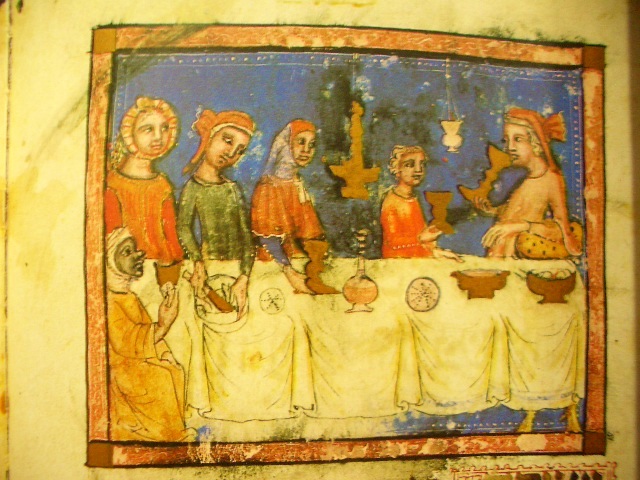
One page in particular is returned to again and again: I wished this had been on the book cover so that I could see for myself what the fuss was about. Well, here it is, book fans (and there are plenty more on this Talmud site, and on this facsimile publishing site here):-

haggadah_seder_small
Sarajevo Haggadah – family seder illustration

Brooks has given her book a formal, almost musical structure: chapters set in Hanna’s present day ping-pong with chapters recounting enjoyable storylets of the Sarajevo Haggadah’s (imagined) past, each evoked by a single codicological detail – an insect’s wing (Parnassius mnemosyne leonhardiana, just so you know), a missing clasp, wine stains, saltwater, a single white hair. In each case, the life and atmosphere of a particular historical Jewish community is nicely evoked: and there are plenty of little structural surprises scattered throughout to keep a sense of movement in the narrative.

haggadah-marginalia-small
Sarajevo Haggadah marginalia from Venice, 1609

In one important sense, the point of the novel is that it tries to draw a parallel between (a) the process of trying to get to know the past of an object, and (b) the process of trying to get to know oneself: this is, after all, what history (as a tool) is for. Yet despite aiming her bow in such a noble direction, Brooks doesn’t quite hit the bullseye: though her protagonist finally uncovers the secret lives both of the haggadah (just as I’ve said with the VMs, incandescent lighting rocks) and of her family, she remains fundamentally the same shallow, dissatisfied shagette we met in the first chapter.

Yet in other ways, the real meat of the novel is in Brooks’ account of the codicology, based in part on observing real-life Austrian book restorer Andrea Pataki working with the actual Sarajevo Haggadah in December 2001. Brooks’ description of the texture and sheer tactility of an up-close (but slow-motion) encounter with a ancient manuscript is both detailed and (in my experience, at least) highly evocative of how this kind of thing actually does play out in reality. If you won’t ever get to touch a real-life manuscript yourself, maybe reading “The People of the Book” isn’t such a bad alternative. 🙂

Look, I enjoyed it and I hope it does well for Brooks: with “The Reader” doing so well at the cinema, I can quite imagine this being picked up  (doubtless Kate Winslet could do a bonza Ozzie accent). Yet whereas The Reader was about hiding illiteracy, Brooks’ book is more about uncovering literacy, using codicology to imaginatively reconstruct the lives of the people behind this amazing book. As such, I can only applaud.

In a comment to a recent post on Alberti & Averlino, ‘infinitii’ asks what my recommendations would be for a Voynich Manuscript reading list… a deceptively hard question.

Apart from the direct literature on the subject (Mary D’Imperio’s “An Elegant Enigma”, my “The Curse of the Voynich”, and perhaps even Kennedy & Churchill’s “The Voynich Manuscript”), probably the best first step would always be to buy yourself a copy of “Le Code Voynich” – not for its prolix French introduction *sigh*, but simply so that you can look at the VMs’ pages in colour. The best guide to the manuscript still remains the evidence of your own eyes. 🙂

All of which is the easy, lazy blogger answer: but the kind of proper answer infinitii alludes to would be much, much harder. I should declare here that the VMs’ life in Bohemia (and beyond) strikes me as merely a footnote to the main story (though admittedly one that has been interminably expanded, mainly for lack of proper research focus).. Given that I’m convinced (a) 1450 is pretty close, date-wise; (b) Northern Italy is pretty close, location-wise; and (c) it’s almost certainly some kind of enciphered book of secrets, then the main subject we should be reading up on is simply Quattrocento books of secrets.

Doubtless there are three or four literature trees on this that I’m completely unaware of (please tell me!): but as a high level starting point, I’d recommend Part One (the first 90 pages, though really only the last few touch on the 15th century) of William Eamon’s “Science and the Secrets of Nature” (1994). Unfortunately for us, Eamon’s main interest is in Renaissance printed books of secrets. “In Nature’s infinite book of secrecy a little I can read” (Shakespeare, Antony and Cleopatra), indeed. 🙂

From there, you’ll probably have to drill down (as I did) to individual studies of single books. Virtually everything written by Prager and Scaglia fits this bill, such as  their “Brunelleschi: Studies of His Technology and Inventions” (1970) and “Mariano Taccola and His Book De Ingeneis” (1972). I recently blogged about Battisti and Battisti’s splendid “Le Macchine Cifrate di Giovanni Fontana” (1984), and that is also definitely one to look at (though being able to read Italian tolerably well would be a distinct help there). I’ve also read articles by Patrizia Catellani on Caterina Sforza’s “Gli Experimenti” (which has a smattering of cipher in its recipes), and read up on the possible origins of Isabella Cortese’s supposed “I Secreti” (which is about as late as I’ve gone). Beyond that, you’re pretty much on your own (sorry).

As general background for what secrets such books might contain, I can yet again (though I know that infinitii will groan) only really point to Lynn Thorndike’s sprawling (but wonderful) “History of Magic & Experimental Science” (particularly Volumes III and IV on the 14th and 15th century), and his little-read “Science and Thought in the XVth Century”. Thorndike’s epic books stand proud in the middle of a largely desolate research plain, somewhat like Kubrick’s black monoliths: if anything else comes close to them, I don’t know of it.

As far as Quattrocento cryptography goes, David Kahn’s “The Codebreakers” is (despite its size) no more than an apéritif to a book that has yet to be written. I found Paolo Preto’s “I Servizi Segreti” very helpful, though limited in scope. For Leon Battista Alberti’s cryptography, Augusto Buonafalce’s exemplary modern translation of “De Cifris” is absolutely essential.

What is missing? There are a few relevant books I’ve been meaning to source but haven’t yet got round to, most notably the century-old (but possibly never surpassed) “Bibliographical Notes on Histories of Inventions & Books of Secrets” by John Ferguson. You can buy an updated version with an index and a preface by William Eamon, for example from here.

In many ways the above is no more than a very personal selection of books, and one obviously based around my own particular research programme / priorities. Yet even though I have tried to cover the ground reasonably well over the last few years, there are doubtless large clusters of (for example Italian-language) papers, books and particularly dissertations I am completely unaware of.

It should be clear that I think the basic research challenge here is to build up a properly modern bibliography of Quattrocento books of secrets, and thereby to map out the larger literature field within which the whole idea of ‘the VMs as an enciphered book of secrets’ can be properly placed. Perhaps I should use this as a test case for open source history?

Apart from Cipher Mysteries, the Voynich blogosphere has been far too quiet of late. Even Elias Schwerdtfeger’s “Das Voynich Blog” is, despite some intriguing posts in the past, fairly subdued.

And so it is a breath of fresh air to see a new blog from an old friend: long-time Voynich mailing list member Elmar Vogt has recently started up his Voynich Thoughts blog. Elmar has already posted a whole heap of nice snippets, such as the German Wikipedia entry’s comparison of the plant on f56r with drosera intermedia (which I mentioned here and here), a nice comparison of the Sagittarius archer with a drawing in a 15th century woodcut, as well as a circa-1450 head-dress comparison with a zodiac nymph.

Part of me really wants him to put these fragments into context – for the Sagittarius page, for example, how it was suggested long ago that the zodiac motifs might well have largely been copied from a (probably 14th century?) German woodcut calendar; a discussion of the Sagittarius archer’s (probably 14th century and fairly rustic) crossbow; plus a wider comparison of the crossbowman’s headwear with (say) the 15th century “turban” / chaperon as depicted by Robert Campin and Van Eyck.

Yet another part of me simply wants Elmar to fill his blog with that thing he does so very well – which is to use his keen logical eye and pleasantly acid German wit to be entertainingly tart about Voynichological nonsense. Wherever contemporary haruspicators pop up to read their imagined stories into the VMs’ well-scanned entrails, I’ll always be delighted to read Elmar’s commentary.

Trivia time: it’s no great secret that software developer Elmar has long contributed text edits to Wikipedia (such as its VMs page) under the monicker “Syzygy“: but what is perhaps less known is that, as a fan of the Atari ST, he chose this as a homage to the company Atari – Nolan Bushnell and Ted Dabney used “Syzygy Engineering” for their original company name.

Hmmm… I’m not sure he’d be much impressed by the two computer games I wrote for the ST: 3D Pool and Loopz. Oh well!  🙂

One hugely influential piece of modern writing is Eric Raymond’s “The Cathedral and the Bazaar“:the central metaphor contrasts huge, monolithic, closed-source software developments (i.e. “the Cathedral”) with agile, distributed, open-source software developments (i.e. “the Bazaar”).

Raymond’s metaphor is just a metaphor: but all the same, there are plenty of none-too-subtle quasi-religious overtones at play here, which tend to colour the whole argument in favour of the Bazaar (which is his point, basically).

In the spirit of Raymond’s Bazaar, I’ve been wondering for a while whether I could (effectively) open-source my history research. Because I’m not a tenured academic, I don’t need a steady stream of refereed papers to justify my position to a departmental head: my interest in (for example) the Voynich Manuscript is more or less entirely about scratching an historical itch. And so “going open source” is something that is actually feasible, even if the precise (technological) details of quite how to achieve this are as yet unclear.

What I have in mind would be broadly in the same vein as the Voynich “challenges” page I put up a few years ago, only 10x times more focused. This would take the form of an ever-evolving page of open research challenges, each with references to (and summaries of) any relevant papers and books, and with (here it gets a bit vague) contact details for other researchers looking at the same problem and/or some kind of online forum for discussing each challenge.

Essentially, Eric Raymond’s central claim is that if you raise a daring enough flag, people will follow it: and as I think there are compelling arguments for tackling each of the research challenges I have in mind, this seems like a good fit. However, I find Raymond’s “Bazaar” troubling, as it seems to me to be based on a kind of free-market wheeler-dealer economics model, whereby each of the entities functions independently… as if competitive market trading will always provide an optimal solution to any problem. Applying this kind of superficial economics cant to software development (or even to historical research) is largely nonsensical: it’s just a metaphor, there is no “market” per se to regulate. Besides, as the key problems in large-scale software development are mainly to do with collaboration rather than competition, there’s good reason to think that the Bazaar is a flawed metaphor.

In the real world, I suspect that the actual model opposing The Cathedral is (sadly) far too often instead The Pub Quiz Team – a near-random group of people hoping to work as a team, but only occasionally gelling in anything approaching a purposeful way. And I say this having last night been on a Berrylands pub quiz team that came last by a mile – unsurprisingly, I don’t like pub quizzes much.

Applying this idea to the main Voynich mailing list, what has unfortunately happened over the last five years is that it has somehow turned from something surprisingly close to Eric Raymond’s idealized Bazaar (lots of individual researchers doing their thing within an overall research programme, trading ideas rather than punches) to a bickering pub quiz team, which can’t even agree its team name, let alone the answers to any of the questions.

In just about every important way, then, the VMs mailing list (in its present form) encapsulates more or less all of the things I would like to avoid in an open-source collaborative history project. As with most enterprises, knowing what to avoid is a reasonable starting point, but bear with me while I try to work out those pesky details…