Here’s something I’d really love to attend: as part of the upcoming annual meeting of The Bibliographical Society of America at The Grolier Club on Friday 23 January 2009, some papers from the BSA’s New Scholars Program are being presented, one of which is by Timothy L. Stinson (from North Carolina State University) and called “Knowledge of the Flesh: Using DNA Analysis to Unlock Bibliographical Secrets of Medieval Parchment“. Having said that, I might be able to save you the fare to New York: here’s a link to an article that summarizes what Timothy Stinson is doing – basically, he is trying to use vellum DNA as a tool for localising individual manuscripts (rather than have to rely on anything so wobbly & interpretative as palaeography)… once he’s built up a large enough corpus of DNA samples.

This is not hugely far from something I have long thought about (for the Voynich Manuscript). I suspect that DNA comparison of the material used in its bifolios could yield a solid first step towards the original page-order, by reconstructing the likely original quire groupings (there is no obvious reason to think that its quires would have been constructed in anything apart from the conventional manner). Back in 2006, I also used matching skin flaws (along the spine) to predict how one of the original quires was cut from an animal skin – it would fascinating to have a parallel DNA data track to compare this kind of analysis with.

In short, while Stinson is interested in inter-textual DNA comparisons, I’m interested in intra-textual DNA comparisons. However, even though the latter might be the kind of techy humanities project you’d half-expect to pop up somewhere like the Institute for Advanced Technology in the Humanities, I don’t actually think it will happen any time soon. Unless you know better…?

Update: Bill Walsh sent in a link to a nice National Geographic story with more technical detail on Stinson’s DNA research. Thanks, Bill – neat! 🙂 And here’s another one from SciAm.

Here’s a nice little blog entry on Rick Smith’s Cryptosmith blog, talking about encrypted documents (rather than just encrypted messages), specifically the enciphered diaries of Charles Wesley (who co-founded the Methodist Church) and of Beatrix Potter.

The 2008 BBC article Rick links to also discusses a war diary made by RAF prisoner of war Donald Hill, and an as-yet-not-fully-decrypted shorthand diary kept by Lord Hailsham. If you want some juicy modern stuff to decipher, the Margaret Thatcher Foundation is looking for cryptological volunteers to decipher more of Lord Hailsham’s notes – there’s even an Excel spreadsheet there with words they’ve cracked so far. Hmmm… sounds like a job for the tireless Tony Gaffney. 😉

For the Beatrix Potter movie website Rick Smith linked to (discussing her diaries), the Second Law of Web Thermodynamics has unfortunately kicked in (“the fancier the website, the sooner it dies“). However, here’s what the Wayback Machine has recorded for it:-

Beatrix Potter’s diary is a true insight into her life. Written in code with the belief that it would never be read, the only surviving entries date from 1881 to 1897. At times she corresponds with a girl called Esther – an imaginary person in Beatrix’s life which perhaps points towards the inevitable moments of loneliness she must have felt, particularly whilst Bertram, her brother, was away at school.

Her diary takes us into her world and she writes not only of her day to day life – family visits, trips to art galleries and exhibitions, but also the turbulent side of the wider world – riots, mobs, murders and political and social upheaval.

It was not until 20 years after Beatrix’s death that the diary code was cracked by the tireless work of Leslie Linder. On Easter Monday 1958, through recognition of a date mentioned and a little more research the first word was deciphered – ‘execution’. This word marked the beginning of the enlightenment and Leslie eventually worked out the code, deciphering the symbols bit by bit.

Summoned to the Tower of London for wine & canapés? Do you honestly think I could refuse?

Every year, the History Today Awards organizers find ever more inspiring/imposing historical venues to give out a small set of prizes (best undergraduate dissertation, best historical book, best picture editing in a book, and this year’s special award for “best vaguely historical person called Simon Jenkins who we happen to like very much“): but how they plan to top the fog-enrobed theatricality of the Tower of London for their 2010 shindig I don’t really know. Buckingham Palace? Windsor Castle? Aboard the Mary Rose? 😉

Of course, the real point of such events is to meet a whole succession of nice & interesting people in and around the general History sphere, such as Terka Acton from Thames & Hudson and James Bellini (AKA The Historian of the Future), etc and perhaps get mildly drunk with them. And so at 9pm a good proportion of the attendees decamped from the Tower to the Wetherspoons just opposite, where I got to chat with the small (though perfectly formed) History Today team, particularly Paul Lay (the new editor) and Sheila Corr (who did such a splendid job on the pictures for my telescope article), as well as with other recent History Today contributors such as the Royal Holloway’s Daniel Beer (and his über-engaging partner Katya).

The only downer of the evening was that as we all went to leave, I found that some ethically-challenged attendee had apparently stolen my copy of Deborah Harkness’ very enjoyable “The Jewel House” from the table in the pub. It wasn’t a review copy, it was a Christmas present from my wife, and frustratingly I was just about to get to every historian’s favourite bit (the copious endnotes). All the same, I’ll post up a review here while the book’s still fresh in my mind, doubtless cursing under my breath as I type. Oh well!

Back in February 2005, I decided to use my m4d image-processing 5k1llz to try to see how much of the erased owner’s signature at the bottom of f1r (the very first page) of the Voynich Manuscript I could reasonably reconstruct.

tepenec-raw

The reason the signature is so invisible is because some (probably early 17th century) owner physically scrubbed that part of the page really, really clean, to the point that there’s basically no ink there, nada, zilch. All that remains is no more than a subtle half-shadow, a ghostly echo that you have to enhance over and over and over to snatch even a vague glimpse. Well, that’s what I did four years ago – and here’s what ultimately came out of the process:-

tepenec-fake

By a twist of fate, I discovered this week just how correct my interpretation of the signature is (it’s actually surprisingly close). But that’s actually someone else’s story, which I hope to blog about at a later date…

Here’s a quicky list of books I’m looking forward to reading in the near future, some of which will doubtless already have been gift-wrapped by oddly-familiar elves. Of course, those with book tokens or pockets wadded full of spare cash may prefer to wait until January/February 2009 to read my reviews first, but where’s the fun in that? 🙂

The Suspicions of Mr Whicher by Kate Summerscale. Though it was pricy in hardback (I first mentioned it here), it looks to be a must-read in softback. A fascinating historical take on the birth of modern forensics under the mass-media gaze in Victorian England (with awards aplenty for the writing).

The Jewel House: Elizabethan London and the Scientific Revolution by Deborah Harkness. I just saw this briefly mentioned in the Guardian Review section last Saturday: it deals with the proto-scientific community in Elizabethan London. Plenty of old friends of ours (L’Obel and co) pop up, so should be a fascinating slice of historical pie.

John Dee’s Conversations with Angels by Deborah Harkness. Another fascinating slice of broadly the same historical pie by the same author. I have long said that the full story of Dee’s angelic discussions has yet to be written (though Renaissance Curiosa had a good attempt): perhaps this will take us a step closer? I hope so…

Flat Earth: The History of an Infamous Idea by Christine Garwood. This is something I’ve covered in the blog before (I reviewed Russell’s “Inventing The Flat Earth” a while back, for example) and thought nobody apart from me had much interest in it, but (to my surprise) here’s a brand new book on the subject.

The Emergence of a Scientific Culture: Science and the Shaping of Modernity 1210-1685 by Stephen Gaukroger looks interesting too. Publishers now think that the word “magisterial” in any review is supposed to be some kind of kiss of death, but when the subject matter presses so many of my buttons, I don’t really care. 🙂

At the end of the year in which John North died, I’m also thinking about doing a completist thing in 2009 and working my way through his works: specifically, rereading The Ambasssador’s Secret and God’s Clockmaker (of course), but also going through some of his articles I haven’t seen.

I’ve had a number of off-blog posts, all commiserating with my apparent Voynich research burnout. All very kind, thank you for your support – but it ain’t actually so. Rather, what has happened is that I’ve been facing up to the shape of Voynich research to come – a change of direction so huge that I simply can’t carry it all on my own shoulders.

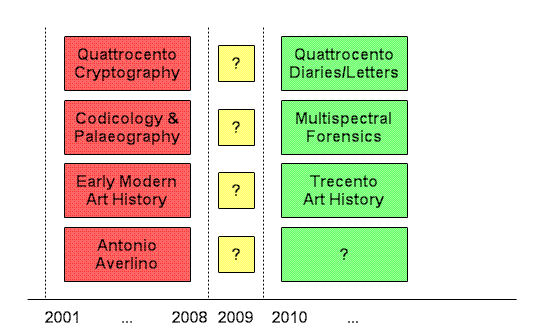
How will you recognize this Voynich Research 2.0? Once you fully accept the VMs’ basic art history (that it was made sometime between 1450 and 1500), the logical conclusion is that we should stop looking in the easy-but-wrong places (1.0, red below) and start looking in the hard-but-right places (2.0, green below)…

voynichresearchflowchart

The reasoning is simple: because the VMs is a mid-Quattrocento object, the right place to be looking for contemporary mentions is in Quattrocento diaries and letters circa 1450-1475, the right place to be looking for sources for the imagery and secrets in the VMs is in the Trecento (specifically the Florentine Trecento), while codicology and palaeography now need to give way to multispectral forensic evidence. As for “whodunit”, I still think that it will turn out to be Antonio Averlino (as per my efforts within the Voynich Research 1.0 paradigm), but it will take a whole new kind of concerted search to uncover the full story behind the VMs.

My prediction is that 2009 will be the year when Voynich researchers will start to make the transition over to Voynich 2.0 thinking (and a whole lot of academics will join the party too), while by 2010 the whole 1.0 paradigm will be lost on the fringes.

So, what’s it to be? Where are you headed next?

The high point of the Medieval Studies conference calendar is undoubtedly the International Congress at Kalamazoo, Michigan: but career academics have long demonstrated reserve about (if not outright fear of) presenting anything there on the minefield that is the Voynich Manuscript.

For a start, even its name is historically imprecise: if it turns out to be post-1450, it’s not really medieval per se but “early modern”, and so shouldn’t technically be called a “manuscript” at all. Yet given that its stylistics arguably point to the late 1440s at the very earliest, while its quire numbering hand remains resolutely 15th century, it probably falls just on the wrong side of that particular line. Still, Kalamazoo is a broad church, with plenty of room for all denominations, so nobody’s going to get too picky about that.

Yet though the VMs does occasionally raise its head above the swallowtail merlons in Kalamazoo specialist sessions (such as the 2005 and 2006 “Codes and Ciphers Through The Middle Ages” panels which I mentioned here), it seems a very long time indeed (ever?) since anyone took it on in a full presentation. So all credit to the courageous Angela Catalina Ghionea, who has just announced her Voynich Manuscript-centred session scheduled at the 44th International Congress on Medieval Studies on 7th-10th May 2009, called “The Alchemical “Voynich”. New Evidence for a Genuine Alphabet, Shamanic Imagery, and Magical Plants“.

Might this be the start of something big? If 2008 was the Novelistic Year of the Voynich, could 2009 turn out to be the Academic Year of the Voynich? Right now, I’d probably instead punt my armchair pundit’s virtual wad on 2010 being the year it finally goes mainstream: but it would nice to be proven wrong for a change. 🙂

Fancy a walk around London? There are some real scorchers to choose from at London Walks, a company offering fascinating pedestrian slices through the many-layered cake that is our dear Londinium. But for Voynicheros, one walk in particular stands out: “Anarchy in the UK – Mob Rule & Terror Tactics” hosted by writer Ed Glinert, and which should start at Goodge Street at 10:45 am on 17 Jan 2009 (I found it mentioned here on a weirdlondon blog).

The walk is planned to cover “Voynich, Kropotkin, Maletesta, plus Orwell, Stalin, Lenin and even Hitler!“: so, not really your average Saturday morning walk around town, then. £7 for adults.

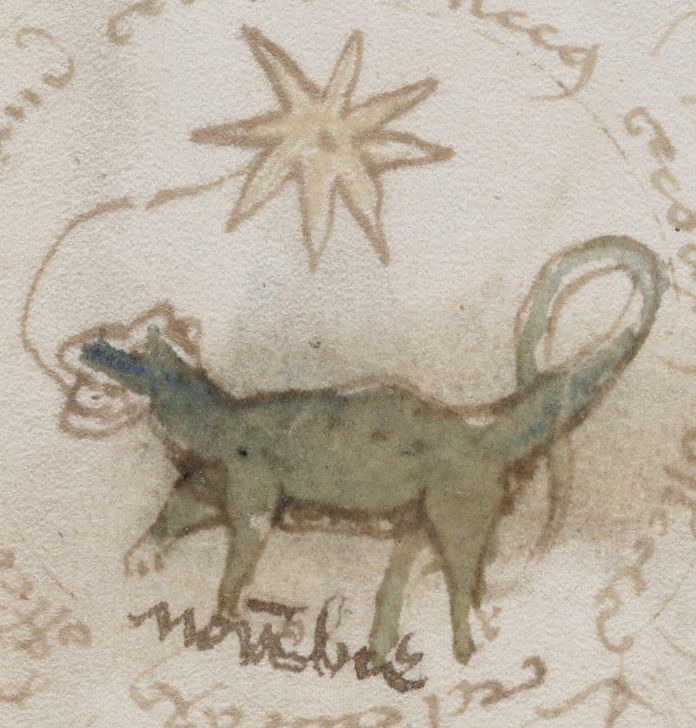
While snooping around the (mostly empty) user subsites on Glen Claston’s Voynich Central, I came across a page by someone called Robin devoted solely to the Scorpio “Scorpion” page in the VMs. This has an unusual drawing of a scorpion (or salamander) at the centre, and which I agree demands closer attention…
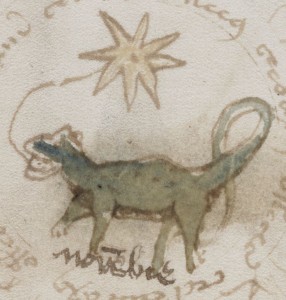
Voynich Manuscript f73r, detail of scorpion/salamander at centre of Scorpio zodiac circle

My first observation is that, while the paint in the 8-pointed star is very probably original, the green paint on the animal below is very likely an example of what is known as a “heavy painter” layer, probably added later. But what lies beneath that?

Luckily, there exists a tool for (at least partially) removing colour from pictures, based on a “colour deconvolution” algorithm originally devised (I believe) by Voynich researcher Gabriel Landini, and implemented as a Photoshop plugin by Voynich researcher Jon Grove. And so the first thing I wanted to do was to run Jon’s plugin, which should be simple enough (you’d have thought, anyway).

However… having bought a new PC earlier in the year and lost my (admittedly ancient) Adobe Photoshop installation CD, Photoshop wasn’t an easy option. I also hadn’t yet re-installed Debabelizer Pro, another workhorse batch image processing programme from the beginning of time that I used to thrash to death when writing computer games. If not them, then what?

Well, like many people, I had the Gimp already installed, and so went looking for a <Photoshop .8bf plugin>-loading plugin for that: I found pspi and gimpuserfilter. However, the latter is only for Linux, while the former only handles a subset of .8bf files… apparently not including Jon Grove’s .8bf (I think he used the excellent FilterMeister to write it), because this didn’t work when I tried it.

For a pleasant change, Wikipedia now galloped to the rescue: it’s .8bf page suggested that Helicon Filter – a relatively little-known non-layered graphics app from the Ukraine – happily runs Photoshop plugins. I downloaded the free version, copied Jon Grove’s filter into the Plug-ins subdirectory, and it worked first time. Neat! Well… having said that, Helicon Filter is quite (ready: “very”) idiosyncratic, and does take a bit of getting used to: but once you get the gist, it does do the job well, and is pleasantly swift.

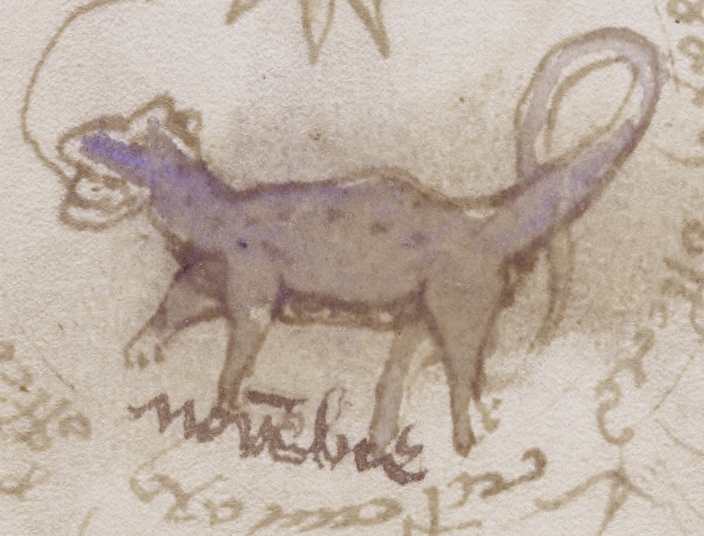
And so (finally!) back to that VMs scorpion. What does lie beneath?
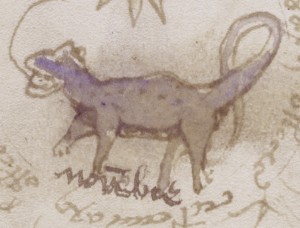
Voynich manuscript f73r detail, but with the green paint removed

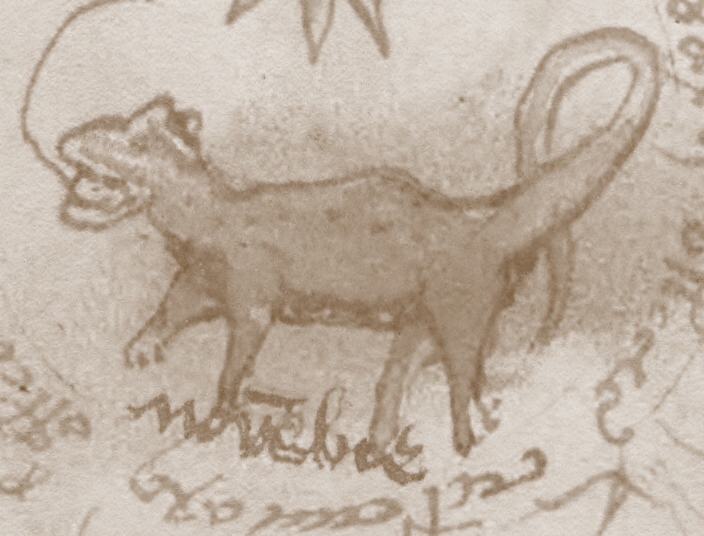
And no, I wasn’t particularly expecting to find a bright blue line and a row of six or seven dots along its body either. Let’s use Jon’s plugin to try to remove the blue as well (and why not?):-
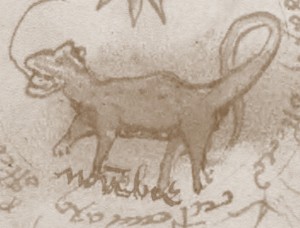
Voynich Manuscript f73r central detail, green and blue removed

Well, although this is admittedly not a hugely exact process, it looks to me to be the case that the row of dots was in the original drawing. Several of the other zodiac pictures (Gemini, Leo, Virgo, Libra, Sagittarius) have what appears to be rather ‘raggedy’ blue paint, so it would be consistent if Scorpio had originally had a little bit of blue paint too, later overpainted by the heavy green paint.

And so my best guess is that the original picture was (like the others I listed above) fairly plain with just a light bit of raggedy blue paint added, and with a row of six or seven dots along its body. But what do the dots mean?

I strongly suspect that these dots represent a line of stars in the constellation of Scorpio. Pulling a handy copy of Peter Whitfield’s (1995) “The Mapping of the Heavens” down from my bookshelf, a couple of quick parallels present themselves. Firstly, in the image of Scorpio in Gallucci’s Theatrum Mundi (1588) on p.74 of Whitfield, there’s a nice clear row of six or seven stars. Also, p.44 has a picture of Bede’s “widely-used” De Signis Coeli (MS Laud 644, f.8v), in which Scorpio’s scorpion has 4 stars running in a line down its back: while p.45 has an image from a late Latin version of the Ptolemy’s Almagest (BL Arundel MS 66, circa 1490, f.41) which also has a line of stars running down the scorpion’s back. A Scorpio scorpion copied from a 14th century manuscript by astrologer Andalo di Negro (BL MS Add. 23770, circa 1500, f.17v) similarly has a line of stars running down its spine.

In short, in all the years that we’ve been looking at the iconographic matches for the drawings at the centre of these zodiac diagrams, should we have instead been looking for steganographic matches for constellations of dots hidden in them?

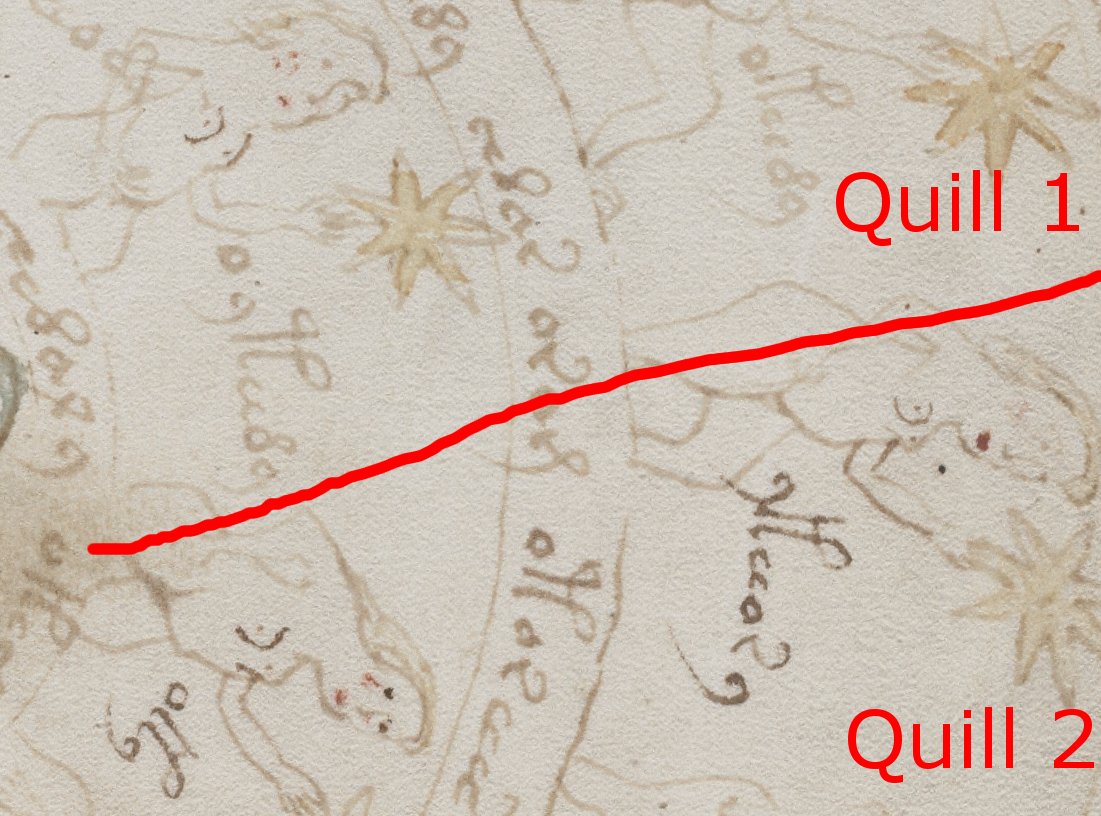
Incidentally, another interesting thing about the Scorpio/Sagittarius folio is that the scribe changed his/her quill halfway through: which lets us reconstruct the order in which the text in those two pages was written.

Firstly, the circular rings of text and the nymphs were drawn for both the Scorpio and Sagittarius pages. The scribe then returned to the Scorpio page, and started adding the nymph labels for the two inner rings, (probably) going clockwise around from the 12 o’clock mark, filling in the labels for both circular rows of nymphs as he/she went. (Mysteriously, the scribe also added breasts to the nymphs during this second run). Then, when the quill was changed at around the 3 o’clock mark, the scribe carried on going, as you can see from the following image:-
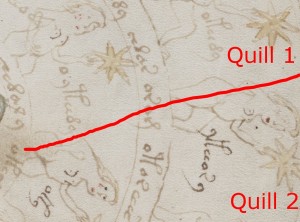
Voynich manuscript f73r, label details (just to the right of centre)

What does all this mean? I don’t know for sure: but it’s nice to have even a moderate idea of how these pages were actually constructed, right? For what it’s worth, my guess is that these pages had a scribe #1 writing down the rings and the circular text first, before handing over to a scribe #2 to add the nymphs and stars: then, once those were drawn in, the pages were handed back to scribe #1 to add the labels (and, bizarrely, the breasts and probably some of the hair-styles too).

It’s a bit hard to explain why the author (who I suspect was also scribe #1) should have chosen this arrangement: the only sensible explanation I can think of is that perhaps there was a change in plan once scribe #1 saw the nymphs that had been drawn by scribe #2, and so decided to make them a little more elaborate. You have a better theory about this? Please feel free to tell us all! 🙂

Here’s a quicky idea…

I have (possibly literally) a ton of books in my library, most of which seems to revolve around early modern / Renaissance history, telescopes, ciphers, and themes touching on aspects of the Voynich Manuscript. And somehow the mound keeps on growing, week on week. Even though I love them all, I can appreciate that (actually) this is a bit of a waste: and that I should really find some way of sharing the ones I’m not currently referring to with like-minded telescope / mystery / cipher / history aficionados (such as you, of course!)

All the same, it’s not immediately obvious how. For example, Marke Fincher wants (quite rightly) to borrow my copy of James Morrison’s excellent book “The Astrolabe” – but it’s a hefty old thing, and so wouldn’t be cheap to pop in the post. And so the right question to ask is: what’s a good way to share?

The image vaguely forming in my mind is of a roughly-once-a-month meet in a central London pub, where I wheel along a heap of books (some pre-requested, others just of general interest) and merrily pass them on, hoping to see them return intact at some stage in the future. I’ve been meaning to meet up with various people anyway (basically, to catch up with Marke and Philip Neal etc), and so adding a book-sharing angle on it seems to me like an eminently sensible community-ish thing to do.

Would anyone else be interested? Email me or comment below, thanks! 🙂