While sorting out boxes of old books at the weekend, I dug up a 1955 Penguin copy of François Rabelais’ Gargantua and Pantagruel. It’s one of those books you tell yourself you’re going to read ‘one day’, safe in the knowledge that such a day will probably never arrive.

…which (in this case) would actually be a crying shame, because it’s cracking stuff. Rather than being some kind of moralistic Renaissance fable written by a worthy-but-dull soul, it’s actually a mad Renaissance satire on such books, written by an erudite drinker to amuse and entertain other erudite drinkers. In fact, even ‘ribald‘ is far too wimpy a word to describe it:  in the absence of some hitherto-unknown 30-syllable German word that would fit it perfectly, ‘blisteringly fecal‘ is about as close as I dare get.

Honestly, you’d like it, trust me! 😉

Yet for centuries after Rabelais, authors seem to have lost their bawdy anti-fable mojo: James Joyce is about as close as moderns get (but he’s a wholly different kettle of mad fish, to be sure). Irvine Welsh has flashes, but he’s still no Rabelais, sorry! Anyone else? Your suggestions on a postcard, as always. 🙂

Actually, I’d say that the closest modern artform to the kind of thing Rabelais wrote is in fact the dirty txt msg – everyone seems to know someone who gets twenty filthy texts a day. Where do all these come from?

Well, if Rabelais is anything to go by, I’d say that the prototypes for most smutty jokes were probably dreamed up during the 15th century, yer blessèd Quattrocento (though he did dress them all up in his own distinctive way, it has to be said).

And so I took up a writing modern challenge: could I fit Rabelais’ wonderfully ripe story [Book 3, Chapter 28] of Hans Carvel (jeweller to the king of Melinda) into a 160-character text message? Here’s the result:-

"While you wear this ring",
said the Devil in Hans Carvel's dream,
"no other man can £%*& your wife!"
She woke up yelling "Hey!
Take your finger OUT of THERE!"

How little has changed over the centuries, eh? Enjoy! 😉

According to this recent Wired article, Rajesh Rao, a computer scientist from the University of Washington, has run a Markov chain finder on the 1500-odd fragments of (the as-yet-undeciphered) Indus script – and has ‘discovered’ that it is “moderately ordered, just like spoken languages“.

Well, ain’t that something.

In a depressingly familiar echo of the ‘hoax’ debate over the Voynich Manuscript, the most important result is that it argues against Steve Farmer’s (2004) case that the Indus fragments were merely “political and religious symbols, i.e. not a language at all, but just odd visual propaganda of some sort.

Language is a tricky, evolving, misunderstood, dynamic artefact that typically only has meaning within a very specific local context. The failure of linguists to “crack” the Indus fragments (all of which are very short) is no failure at all – we are massively disadvantaged by the passing millennia, and cannot easily trace the structure within the flow of ideas (the perennial intellectual historian hammer).

Having said that, what I read as Farmer’s basic idea – that researchers have for too long looked for a definitive script grammar as an indicator of advanced literacy – is an excellent point. And so the notion that Indus script analysts should perhaps be instead looking for some kind of arbitrary / non-formalized explanation (a confused model, rather than a complex one) is sensible. My opinion is that Farmer is overplaying his skeptical hand, and that the script is very probably communication (as opposed to mere decoration) – but is it written in something we would recognize as a language? Apparently not, I would say.

Incidentally, Indus script uses roughly 300-400 symbols (depending on how you count them), with the most frequent four symbols making up about 21% of the texts: inscriptions (many on potsherds, also known as ostraca) are all short, with an average length of only 4.6 symbols. All of which makes the script completely unlike known languages – but all the same, what is it?

Perhaps Rajesh Rao’s Markov models will reveal some kind of pointers towards its hidden structure, towards the truth – but as to Rao’s suggestion that they may well yield a “grammar”… I suspect not.

PS: Farmer cites Gabriel Landini & Rene Zandbergen’s paper (funny, that), though points out that Zipf’s Law is an ineffective tool for differentiating language-based texts from non-language-based texts. Just so you know…

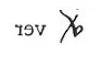
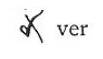
A new day dawns, bringing with it a nice email from Augusto Buonafalce in response to my post on Leonardo da Vinci’s ‘x’-like abbreviation for ‘ver (as recently mentioned by Edith Sherwood).

buonafalce_verbuonafalce_ver_normal

Augusto points out that if you remove the plain diagonal line in the reflected version, what remains appears to be similar to a ‘b’… but isn’t. In the 15th century “mercantesca” script, this particular ‘b’-like shape was used to denote ‘v’: Leone Battista Alberti suggested (in his Tuscan grammar) that this shape should be more widely employed to help tell ‘v’ apart from ‘u’. Specifically, Alberti’s ‘b’-like shape looked like this:-

buonafalce_b

Now, mercantesca hasn’t really been discussed in the context of the Voynich Manuscript before (Google returns no useful hits, while even the old VMs mailing list archives appear to be silent), which is something of a shame – for if arch-Florentines such as Leonardo, Alberti, and even Michaelangelo used it, mercantesca must surely have been as close to the beating heart of the Quattrocento project as the much-touted (but very different) ‘humanist hand’.

(The ‘humanist hand’, you may recall, is an upright, formal script that was a conscious revival of an earlier script – which is why dating the Voynich Manuscript based on supposed similarities with the the humanist hand alone is so contentious.)

While the formal humanist hand was used mainly for writing in Latin, the informal mercantesca (which flourished from 1350 to 1550, peaking around 1450-1500) was used mainly for writing in the vulgar tongue: when written well, it is sometimes called ‘bella mercantesca’.

There’s a reasonable literature on this which a Voynich researcher with palaeographic leanings ought to have at least a reasonable look through.:-

  • Orlanelli, G. ‘Osservazioni sulla scrittura mercantesca nel secoli XIV e XV’, in Studi in onore di Riccardo Filangieri (Naples 1959) I, pp.445-460
  • Irene Ceccherini (Firenze): La Genesi della Scrittura Mercantesca. (summary of 2005 poster session)
  • Albert Derolez, The palaeography of Gothic manuscript books (2003)

Having said that, it is perhaps the 45 volumes of the CMD (the Catalogue of Dated Manuscripts) produced over the last 50 years that need checking here, particularly the CMDIt (the Italian section), I suspect. A proper palaeography research challenge is something I’ve been meaning to post about for a while: but that’s definitely a job for another day…

Stuff to be thinking about! 🙂

(Here’s a guest post by Voynich researcher Marke Fincher that I’ve edited to Cipher Mysteries house style – I hope you enjoy it!)

Let’s say you want to do something really crazy, like decode the Voynich Manuscript. What… you do? Well, good luck to you! And to help on your way, here are some handy (but hard-earned) rules of thumb that might just help you achieve what nobody else has managed in five centuries…

(1) Don’t waste time on very well-trodden ground

  • Don’t make assumptions. Don’t make assumptions about what it can or can’t be. One of the reasons the Voynich Manuscript remains unsolved despite all the brilliant minds that have worked on it is probably due to similar assumptions. Keep your mind open – there has to be a first for anything which is by definition unprecedented.
  • Get more facts, as well as different types of facts. It is always a good use of time to go out and “get more facts”, by which I mean: get more detail, qualify (and quantify) what you know / expect / suspect / predict, study entirely new areas and learn more about what the VMs actually is.  If you try to link the different areas of your knowledge together, in due course better fitting hypotheses will emerge naturally.
  • Strong disproof is more useful than weak proof. It is far easier to prove what the Voynich Manuscript isn’t than to prove what it is. Keep a list of “it can’t be X because of Y” statements,  but check through them periodically. Don’t spend ages studying what it “could be”,  just study what it is (and what it is not) i.e. don’t spend too much time trying to fit your pet hypothesis to the facts.
  • The drawings aren’t just window dressing. Study the images as much as you study the transcriptions.  You should check and relate what you learn from the transcription back to the real thing as much as possible.  Check any suggestive text results manually against the images & vice versa.

(2) Appreciate the rational patterning underlying ‘Voynichese’

  • Get a good working grasp of Voynichese. One good pragmatic way to achieve this is (a) to learn the EVA transcription system and (b) to transcribe an entire A-language page and an entire B-language page for yourself. Once you’ve done this, you should start to see that the countless patterns at play within the text are not (despite what some linguists like to claim) really like the ones you find in normal languages.
  • Look for differences in system between pages. As far as these patterns go, some pages show similar rules at work, while others exhibit important differences – be warned, ignoring these differences between different system variants is undoubtedly a Very Bad Idea. Do your best to categorise the VMs pages into what you think are consistent sections (hint: these may not actually be on currently adjacent pages). Futhermore, it’s another Very Bad Idea to analyse large sets of pages without first satisfying yourself that the same system is at work throughout those pages.
  • Determine which letters are usual and which are unusual. Take the time to compile a study of the unusual and rare symbols, especially the unusual gallows variants and “bench” symbols. Might these shapes hold clues to the function of the regular symbols of which they appear to be variants?

(3) Look at the patterns inside words

  • Study symbol order preferences and rules within words.  There is more evidence of the nature of the system at work here than anywhere else.   It is one of the best places to start to get a feel for the thing.
  • Study repeating sequences (but NOT in terms of whole words).  Introduce some flexibility/fuzzyness to your matching of sequences or you’ll not see it all (but not too much, or you’ll go crazy).
  • Study the extent of “anagrams” within the vocabularies and contrast with known languages.
  • Study the extent of “words within words”. Similarly, look at the hierachical nature of Voynichese word formation.

(4) Look at the patterns between words

  • Study the relationships between words.  They are not like “real” words. Don’t just study vocabularies, word-lists and generative grammars in isolation.  Relate those structures and rules to what appears on actual pages (i.e. study them in context) and you will see a lot more of what is going on.
  • Be wary of coincidental relationships.  Contrast the real patterns with coincidental ones by randomizing the word order and repeating the analysis.
  • Adjacency relationships exist across spaces.  Study these and always be aware of them. Be extemely wary of spaces and assumptions of what they are there for.
  • Study the ‘families’ of similar words. Do they just look the same or do they operate similarly as well? There are also vital things to learn here about variation in Voynichese.

(5) Look at the positions of words inside paragraphs, lines, and pages

  • Study the position within the line and paragraph that ‘words’ appear.  There are plenty of unusual happenings here that any reasonably comprehensive explanation would need to cover.
  • Repeat any analysis that you do on the VMs on real-world language samples. Contrast the results and try to understand the differences you find. Many “unusual properties” of the VMs turn out to be properties of known language as well!  🙂
  • Pick some of the hardest properties to explain and target those first. Systems which match the easier properties of the VMs to recreate whilst ignoring the more perplexing and problematic properties aren’t really very helpful.  The more unusual the property, the more it probably has to say about the actual system at work.

(6) Transcriptions can hide problems, not just expose them

  • Check your transcriptions. There are errors (of course) but also many situations where the transcribers were uncertain of what to record, or glossed over unusual or awkward details in the actual text.  There are also details not captured in any of the current transcriptions which could well turn out to be crucial.
  • Repeat any analysis methods you use on multiple transcriptions. Compare and contrast the results.

(7) Be patient – this whole process takes an awfully long time!

  • Once you get going, five years can pass by in a flash. So be warned!

Once upon a time (twenty years ago, back when I still had hair), I used to play for Hackney Chess Club in the London League: after most matches, the team would decamp to Brick Lane for a late night curry and a swift-ish couple of pints. Happy (if somewhat calorifically excessive) days. 🙂

And so it has recently been a thoroughly pleasant surprise to encounter another Hackney player from that same era (Tony Gaffney) engaged in his own historical cipher odyssey – applying his devious problem-solving instincts to crack long-unbroken ciphers, such as the 1564 Bellaso challenge cipher #6 (described in detail here a couple of weeks ago).

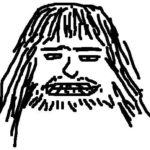
Incidentally, I asked Tony if he had a reasonably current photo of himself I could put on my blog – sorry but no, came the reply. And so I sent him a quick sketch of how I remembered him from all those years ago, to see if much had changed:-
tony-gaffney-sketch

That’s like looking in a mirror – only the hair’s too short“, came the reply. So, here’s my best guess as to what (the fairly reclusive) Tony Gaffney looks like circa 2009:-
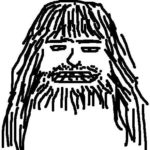
tony-gaffney-sketch-v2

Hmmm… it does make me wonder whether there is some kind of karmic balancing law at play in the universe, a zero sum game by which every inch of hair I lose has to reappear on someone else’s head (Tony’s, specifically). But I digress!

As expected, having cracked 1564 #6, the indomitable Mr Gaffney rapidly moved onto Giovan Battista Bellaso’s other challenge ciphers. Could he beat the inevitable crypto pack & make the next crack?

The answer was an emphatic yes: Bellaso’s 1564 challenge cipher #2 was next to fall. Tony’s starting clue was the third word (SDARGBFSTRS), an eleven-letter word with the same first letter and last letter. Having tried out ‘equinotiale‘, a series of crossword-like puzzles then offered themselves up for solving, leading eventually to the following plaintext (and once again, note that Tony cannot read Italian):-

dal circolo equinotiale versoil nostropolo artbt
RSX OSIUBPD SDARGBFSTRS BXDADRR HCIALBLDSA ODFMA
451 5123451 45123451234 2345123 4512345123 34512
sescopra asaipiu terrache acqua etdaldeno circolo verso
ERIMAIEU XAURHPG BSEHTUNR UMIFS SFOTRRRCE OSIUBPD GTIDB
45123451 4512345 34512345 12345 451234512 5123451 51234
ilpolo btarti sescopra asaipiu acqua chetera dicoche verso
RRICXE XETLCN ERIMAIEU TDXNFRC XOGBO TMTAXDS ORUBORO CSEIE
234512 512345 45123451 2345123 45123 4512345 1234512 34512
ilnosnrro poloartico sono nelemontagne etsoto lemontagne
SSGBACILB FERBSHAQTC ECCE HRXOFBIETNHR RELACC QRBEGCSQFX
123451234 1234512345 4512 451234512345 512345 4512345123
grande cavernosita nenedi acqua etventi etverso elpolo
MEUFSS OUBXDIDLQCS ITFXRN TULGU SFAOGCN XCGTIDB SPFERB
451234 51234512345 512345 23451 4512345 3451234 451234
antartico none cosi
XIETLCNNE GBIT NEDP.
451234512 3451 1234

With help from Renaissance cipher historian Augusto Buonafalce, this yields Bellaso’s thoughts on why there is more land towards the North Pole than towards the South Pole:-

dal circolo equinotiale verso il nostro polo artico se scopre assai piu terra che acqua et dal deno circolo verso ilpolo antartico se scopre assai piu acqua che terra dico che verso il nosnrro polo artico sono (ne) le montagne et soto le montagne grande cavernosita nenedi(piene) acqua et venti et verso el polo antartico non e cosi

From the equinoctial circle towards the Arctic pole there is exposed much more earth than water and from said circle towards the Antarctic pole there is exposed more water than earth because towards our Arctic pole there are the mountains and underneath the mountains large caves full of water and winds and towards the Antarctic pole it is not so.
(Translation & enciphering/typesetter error corrections courtesy of Augusto Buonafalce)

Not content with having solved two of Bellaso’s challenge ciphers, Tony then turned his attention to the 1564 cipher #1: once again, an unusual short sequence was enough of a clue to get him started. In this instance, he noticed the palindrome DABAD in the ciphertext, and wondered whether that might be his old friend PROPORTIONE (which you may recall helped him solve 1564 #6). The cipher system turned out to employ ten alphabets changing not with every letter but with every word.

diptdexloxarsoxdicoxchexlepetoxesemprexconformexa
PSDLPQNSDMXLNEAUPHFBXDUCOHUHCLDXCXPMBXERMGXMCOTFO
1      2  3    4    5   6      7       8        9
lasuaxcausaxdbxlarmaxlungaxdastaxinesaxsonoxpiunumerax
HOENOIPGMFGLPGNSHIXHMRCSDXAUTMATBOQUASCBLPLDMUIOIPXBUE
      10    1  2     3     4     5     6    7
departexunitexchenonxsonoxnelacortaxetuicrtusxunitaxpote
STAPCETFNUXFSIPNRHBHLICXCNTPSHGDINHMOMCQULMCNADRPATBLIBU
8       9     10     1    2         3         4     5
ntirestxdelepalexdiferoxetdilegoxprocedexperchexaierxno
QBOMUABCXHOHNROHDTUHXBNETESHUTNMFBDAQSRSICREPNRLUSQFNTD
        6        7      8        9       10     1    2
nresistibxdelcircoloxdicoxfinitixadinfinitumxnulamxese
TIPLRLNRUMGORUQLUEREAUPHFBGOQOBOCRXGPUGPGCFQDOIGQPETDT
          3          4    5      6           7     8
xproportionemxlafiguraxsfericaxnonaxprqncipiioxdxeldia
FBDABADFXAUSGIXGSTAMEGLIRQFSOUNTDTHMFLISUQFQQEAUBUPHOS
 9            10       1       2    3          4
metroxaprincipioxetfinex.
RUBMICRNAGPTGNGLDXDHUOXE.
      5          6

With a few typesetter corrections and words reconstructed (because many doubled letters in the plaintext were converted to single letters, introducing a certain amount of ambiguity that you have to read Bellaso’s clues to resolve), this almost certainly originally read something closer to:-

Di ptde lo arco dico che le petto?(l’efeto) e sempre conforme a la sua causa db l’arma lunga d’asta in esa sono piu numera de parti unite che non sono nela corta et uicrtus unita potentirest delle palle di ferro et di lengo procede perche aier non resistib del circolo dico finite ad infinitum nullam esse proportionem la figura sferica non a principio del diametro a principio et fine.

Interestingly, inside this Italian plaintext is embedded a phrase in Latin (which I have highlighted above) that Google notes as appearing in a 1957 article by Bruno Busulini called “Introduzione a una storia e filosofia del calcolo infinitesimale” (Introduction to a history and philosophy of infinitesimal calculus): and so seems highly likely to me to be Bellaso quoting approvingly from someone else’s Latin book on calculus. Next time I’m at the British Library, I’ll try to get a copy and see where the quotation originally came from…

Once again, my hearty congratulations go out to Tony Gaffney for solving these cipher mysteries!

Following some interesting off-blog email exchanges triggered by my recent post on the Knights Templar and the Turin Shroud, I’ve taken a fresh look at the evidence, and have a new suggestion… 

The document that Barbara Frale turned up in 2003 appears to confirm a long-standing suspicion among a number of sindonologists (i.e. Shroud researchers, not people who study Donald Sinden) – that the Image of Edessa is the same thing as the Turin Shroud – and that it was secretly held & venerated by the Knights Templar between times (presumably giving rise to confused talk of kissing bearded idols, etc).

Just so you know, the Image of Edessa’s basic timeline looks like this…

  • 525AD – 544AD: first appearance in Edessa – possibly hidden in a wall above a city gate
  • 609: captured by the Sassanians
  • 944: returned to Edessa and moved to Constantinople
  • 1204: disappeared during the Sack of Constantinople

…whereas the Turin Shroud’s timeline looks like this…

  • 1357: displayed in a church at Lirey by the widow of the knight Geoffroi de Charny
  • 1390: Pope Clement VI allowed the shroud to be displayed
  • 1418: the “Winding Sheet” entrusted to Humbert, Count de La Roche, Lord of Lirey
  • 1452: given to the Duke of Savoy by Humbert’s widow Margaret

Yet there is something rather incongruous about the idea that the image on the shroud is actually of Jesus. Glen Claston points out (by email) that while early images depict Jesus much as you would expect Jews of the period to be depicted (i.e. short-haired, because nobody was allowed into temples with long hair), after 600AD images start to appear with long hair and a beard.

turin-shroud-face-enhanced

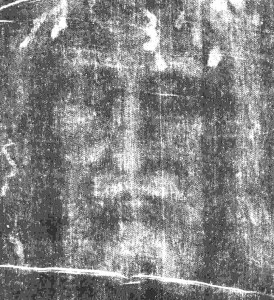
Glen’s understanding is that the only people at the time who had long hair were Nazirites (who took a vow not to shave their hair and abstain from grapes, wine and vinegar). In fact, probably because of the surfeit of “Da Vinci Code”-style novels and “H0ly Blood Holy Grail”-style books, the (formerly very marginal) issue of whether Jesus was a Nazirite has now become much debated.

(Incidentally, the most famous Old Testament Nazirite was Samson, which is why it was such a big deal to cut his “seven locks” – and modern Rastafarians have a creed which is apparently derived from the Nazirite vow, which is why they value herbs over alcohol. Hence one surprising issue with the Turin Shroud is whether the squiggles around the face [above] are actually proto-dreadlocks!)

That is, the culturally agreed image of Jesus started out as a mainstream Jew but around 600AD began to transform into something more like a Nazirite. But why should this be so?

My art historical suggestion (which has doubtless been made numerous times before, but what the hey, here it is again) is simply whether it was the appearance of the Image of Edessa in the sixth century which caused this change in the iconography of Jesus’ haircut. That is, rather than any subtle textual misunderstanding of “Nazarene” vs “Nazarite” (as is so often proposed), might it be that artists saw (or heard about) the ‘miraculous’ Image of Edessa and decided to use that as a visual basis for what Jesus looked like?

(Note that this is merely an hypothesis about the cultural reception of the Image of Edessa from 600AD onwards, rather than about any forensic / physical analysis of the object itself – it makes no difference whether the Shroud is genuinely miraculous or some 6th century craftsman’s subterfuge.)

Incidentally, one Turin Shroud-related issue that crops up again and again concerns the apparent height of the person wrapped in it: it is frequently asserted that this person would have been too tall to have been a Jew living two millennia ago. Yet what isn’t widely known is that there is a body of evidence that seems to imply that the Turin Shroud spent some time suspended on a kind of hanging wooden frame (probably for display in Edessa and Constantinople, it would now appear).

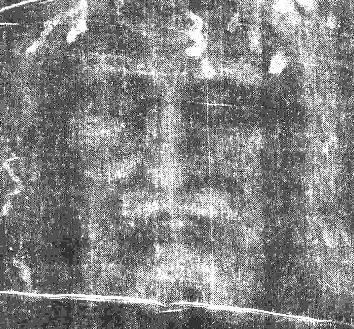
And so… why is the suggestion not then made that the herringbone linen of the Turin Shroud might simply have stretched lengthways under its own weight while being displayed? This might well have yielded a pervasive 10%-15% stretch, which (as I understand it) is broadly the kind of height difference in question. If you look once more at the face above, can you not see (as I do) an image that has been slightly vertically stretched? As a guide, here’s what it would look like at 85% of height:-

turin-shroud-face-enhanced-squashed
Turin Shroud, contrast-enhanced negative, 85% of height

Something to think about, anyway! 🙂

PS: as far as the haircut goes, I suspect that artists subsequently evolved Jesus’ haircut to a kind of worst-of-both-worlds middle-length trim – too long to be allowed in a Jewish temple, but too short to qualify as a proper Nazirite’s uncut hair. Might this be some kind of metaphor for the evolution of religion in general? I’m afraid you’ll have to work out your own moral narrative for this – I’m too busy looking at the evidence. 😉

OK, I’ll admit that the following has no ‘cipher mystery’ angle whatsoever: all the same, it’s a truly remarkable story that trumps 90% of Templar fiction.

According to a piece in The Times, in 2003 a historian at the Vatican called Barbara Frale uncovered a misplaced document (dating to after 1287) which seems to prove beyond much doubt that it was the Knights Templar who brought the Turin Shroud back from Byzantium and venerated its “bearded figure” for a century. Historians had long known of its indisputable 14th century history in Italy and its (often-questioned) 12th century history in the town-formerly-known-as-Constantinople – Frale’s discovery thus sensationally answers the long-standing question of where the shroud was in the 13th century. Additionally, it answers many open questions Templar conspiracy theorists have long riffed on about the nature of their alleged heresy and the secret religious things they brought back from the East.

But… hold on, I hear you cry, wasn’t the Turin Shroud scientifically proven to be a medieval hoax? Well, another news story from the last few days (which I also picked up from the Daily Grail newsfeed, but this time from the Daily Mail) relays some unreported comments from a member of the 1978 testing team, the late Dr Raymond Rogers (he died in 2005). Rogers came to believe that the piece of cloth they had taken for testing was from a medieval section that had been added to mend a fire-damaged part of the shroud – by 1998, he realised that what they had examined was a piece of cotton that had been heavily dyed in order to colour-match the rest of the (far older) linen.

Of course, the really big question is whether this sounds the death-knell for trashy Templar historical fiction. Without some bizarre demonomantic kruft to riff off, that whole historical episode must surely cease to hold the seditious / heretical pungency romantic authors seem to relish so much. All the same… I do suspect that novelists for years to come will carry on telling us that the location of the Templars’ accursed treasure is encrypted in the Voynich Manuscript. Oh well!

Update: more details in this follow-up post on the Turin Shroud

Edith Sherwood recently posted up a webpage comparing one of Leonardo da Vinci’s abbreviations with the third character on the Voynich Manuscript’s back page. She says that this is an ‘x’ – a letter which doesn’t appear in Italian, but which Leonardo often uses to denote “ver“. Might she be right?

pox-labor-large

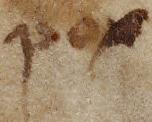
Just to be sure, let’s zoom right in on that first word: is this ‘pox‘, ‘pof‘, or ‘por‘ (etc)?

pox-large

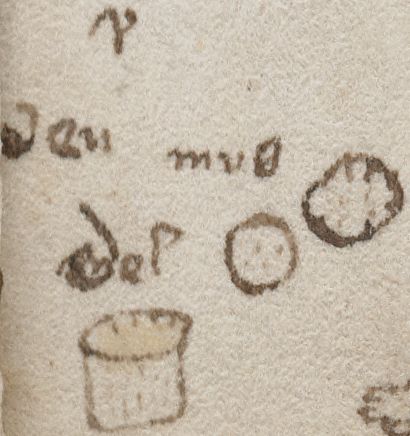
Does that first letter seems oddly familiar? Let’s look at the letters in the bottom-left margin of f66r:-

y-en-muc-mal

So, the stakes are high insofar as these pieces of added writing (on f116v and f66r) both appear to be by the same hand – and so understanding one better might well also help us decrypt the other.

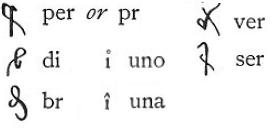
Anyway… for her ‘x’ claim, Edith refers us to the “Clavis sigillorum” (key to the ‘seals’ i.e. to the special symbols) on pages 1-4 of Jean Paul Richter’s (1883) “The Literary Works of Leonardo Da Vinci” (later reprinted as “The Diaries of Leonardo da Vinci”), which we can now see online here, courtesy of Cornerstone Book Publishers (who publish a zesty mix of Masonic, Esoteric & Pulp Fiction books, just so you know). In common with many other Quattrocento Florentines, Leonardo often placed a (nasalizing) bar above a, e, i, o, and u to indicate an, en, in, on, and un (or sometimes am, em, etc). But the special abbreviating symbols he used were:-

leonardo-abbreviations-v2

So, as you can see, Leonardo did indeed use an ‘x’-like abbreviation for ver: but is this what we see on f116v? To my eye, there’s something that doesn’t quite ring true: partly because the distinctive shape used by Leonardo is not really present – but mainly because the ‘x’-like character that is there has so clearly been emended by someone using a different colour ink.

It therefore seems very likely to me that a later owner guessed that this should read ‘pox‘ (for whatever reason) and emended it accordingly: but was this (as Edith Sherwood claims) what was originally written here? I think very probably not. So… what does it say, then?

Back in 2006, I hazarded a guess (Curse, p.27) that this line was written in Occitan and originally read “por labor a mon aut…” followed by EVA ‘och‘ (Voynichese): now, though I still suspect Occitan, my current reading (somewhat to my surprise) is that it starts with “por le bon simon s…

Lest you think this is some kind of slightly delayed April Fool’s joke (and that I’m trying to sneak in a reference to Duran Duran singer/lyricist Simon Le Bon), please be assured that it’s honestly not – “le bon simon” is simply what it seems to say in this (admittedly much-disputed) margin. Unless you know better? Look at it for yourself and feel free to post your own reading!

And finally… here’s a link to a nice little web application that transforms a message you type in into Leonardo’s handwriting. Now that you are an expert on Leonardo’s abbreviations, you should quickly realise that this fails to handle both “per“, “ver“, “di“, “br“, “ser“, “uno“, and “una” and “an“, “en” (etc) properly. Incidentally, Leonardo also replaced “j” for “i” if it was next to an “n” (so that the resulting letter-pair wouldn’t get confused with an “m“), which this (otherwise very cool) app also doesn’t handle correctly… but perhaps I’ve covered enough arcane palaeographic ground for one day, and should stop there! 🙂

Jacob Collard, a sophomore at Big Walnut High School (in Delaware County, Ohio), put together a Science Fair project entitled “Comparison of Grapheme Frequencies and Locations in Undeciphered Voynich Script and Geographically Similar Languages“. This so impressed the judges that he was asked to take it forward to the Central District Science Day at Columbus State Community College, where he won the “Best Linguistics Project for a High School Student Award” (according to this page). Congratulations to him!

Jacob now has four weeks before the “60th Annual State Science Day […] on the Columbus campus of The Ohio State University” – if he’d like someone to cast a Voynichological eye over his work and perhaps suggest some fixes or improvements before May 9th, I’m sure I could find a ready volunteer. 🙂

Hmmm… how long before teachers start using the Voynich Manuscript in junior school to teach children how not to do history? It can be more valuable to know what to avoid, wouldn’t you say? 😮

I think you can split historical revisionists into two broad camps: (a) desperate mainstream historians looking outwards to fringe subjects for a reputation-making cash-cow book; and (b) clever writers on the fringes who appropriate the tropes and tools of history to construct a kind of literary outsider art that is (almost) indistinguishable from history. That is, revisionism is a church broad enough to cover both historians posing as outsiders and outsiders posing as historians. 🙂

Yet probably the most dispiriting thing about nearly all the novel freethinking theories thus constructed (by either camp) is how boringly similar they tend to be, oxymoronifying the phrase “free thinker”. Did Alberti really write the Hypnerotomachia Poliphili? [Hint: no.] Was Leonardo da Vinci really a Grand Master of the [insert made-up name] Secret Society? [Hint: also no.] Read (as I have done) a fair few of these and you’d rapidly come to the conclusion that most trains of thought out there run along well-oiled rails, with nary a point in sight. Point-less stuff, indeed.

Of course, if you try to revisit something / someone particularly well-documented, you face a dauntingly uphill challenge from the start: which is why oddly nebulous objects and obscure people attract the most attention (from both revisionist camps) – because for these, there’s that much less that needs to be explained away from the start before you can really go to town & have some fun.

In this general vein, here’s a nice (2000) article by Mark Newbrook from The Skeptic magazine (it’s on pp.42-47), which brings together literally dozens of fringe historical revisionist communities (Velikovskyists, Saturnists, Afrocentrists, Dravidian- / Mayan- / Latvian- / Hungarian- / Basque-/ Etruscan-centred histories of language, Dogon, etc) to highlight their common traits – most of which seem to centre on a misplaced faith in the fallacies of eighteenth-century linguistic / etymological thought. It has to be admitted that the devotion shown to following through these mad ideas is sometimes quite extraordinary. Did Jesus on the Cross really cry out in Mayan? [Hint: don’t even go there.]

It’s no great secret that most hypotheses floated to explain the Voynich Manuscript, the Rohonc Codex, and the Phaistos Disc match this overall template (i.e. of a simple linguistic misunderstanding taken to massive lengths). Even when top-drawer outsiders (David Icke, Dan Burisch, Terence McKenna etc) throw their lizard-skin top hats into the ring, the same tired old rabbits limp out… ‘Roger Bacon‘, ‘it’s the aliens wot dunnit‘, ‘hoax!’ and so forth.

Of all these , though, it is the “hoax” theorists that are stupendously annoying – not because they happen to be right or wrong (which is another question entirely), but because for the most part they use the idea as a kind of intellectual trick to sidestep the entire evidence corpus, preferring instead to revel in schadenfreude, poking fun at other researchers as they lock intellectual horns with the mute rhinoceros of meaninglessness (and lose the battle, of course).

In all these cases, the correct question to be asking is simply what kind of material, physical evidence would amply demonstrate the presence of a hoax – merely proving the possibility of a hoax (as Gordon Rugg famously tried to do for the Voynich Manuscript in 2004) is both hard work and vacuous. Or, if you prefer to stick with Popperian falsification, how can we actively disprove the notion that artefact X is ancient?

And so it all swings round to a resoundingly 19th century hoax, the Frisian Oera Linda Book (which I picked up on from Lady Goodman’s blog page). This describes all kinds of odd things (such as “Atland”, a 17th century revisionist Atlantis), and claims to have been written in 1256, but copied from texts some of which dated back as early as 2194 BC. Errrrm… “zeker niet, mevrouw“, methinks.

If you absolutely have to sample its purple faux historical prose, there’s an English translation here. To me, it all reads like a ‘worst-of‘ compilation of creative writing courses’ historical modules: but perhaps you’ll find some hidden depths there to which I’m blind. But is this a hoax? [Hint: for sure!]