As regular Cipher Mysteries readers will know, I’ve recently become particularly interested in early modern correspondence as a way of peering into the dispersed scientific networks that began to develop and extend during the late sixteenth century (the so-called “invisible colleges”), very much along the lines described for Tycho Brahe’s familia by Adam Mosley in his recent book Bearing the Heavens.

However, one key problem is that there’s an awkward quiet between the (early sixteenth century) Republic of Letters and the (mid-to-late seventeenth century) Scientific Revolution correspondence where relatively few letter-writers really stand out – Tycho Brahe (of course), Marin Mersenne, Tadeas Hajek, Fabri de Peiresc.

Incidentally, Peiresc (“the Prince of Erudition”) left more than 10,000 letters, of which only about 3,200 have been published. Fascinatingly, the Annales historian Robert Mandrou tried several decades ago to use this to chart the “geography of ideas” implicit in Peiresc’s correspondence network, through what Robert Hatch calls “simple yet eloquent maps”. There’s more on how Peiresc’s set of letters was split into two here.

Also, QMC has an initiative on this topic called the Centre for Editing Lives and Letters (“CELL”), with subprojects on the correspondence of Francis Bacon, Thomas Bodley (as in the Bodleian Library, of course), and the relatively little known Elizabethan intelligencer/diplomat William Herle. One recent CELL, errrm, inmate called Samuli Kaislaniemi has a nice set of links on the topic, including one to a National Archive wiki!

But I’m digressing (arguably even more than normal).

I recently found another Renaissance letter collection which I had been unaware of: the Clusius Correspondence Project at Leiden University, which holds most of botanist Carolus Clusius’ letters. Intriguingly, this was particularly focused on plants and gardening, and so was the kind of place where a mention of everyone’s favourite enciphered-early-modern-herbal manuscript might plausibly appear – and so I emailed Florike Egmond whether she had come across anything remotely like the VMs mentioned in Clusius’ letters.

Sadly, her answer was no: in fact, she pointed out that the letters contain “almost no references at all to herbals / manuscripts about plants“. Having said that, she also noted that a reference might yet surface in some of the letters with Clusius’ book-focused Italian correspondent Pinelli, or (rather less probably) with Hugo Blotius. All the same, as they say in showbiz, “‘No’ only means ‘no today’“.

Hmmm… as a final aside for the day, I really wish there was some kind of “meta-list” of early modern correspondence projects out there, one that listed started, planned or proposed, started-but-abandoned and as-yet-unstarted correspondence projects – a kind of correspondence project project, if you like.
As a Brit, there’s a very particular class of American-made sequel that fills my film-watching soul with despair. On planes and slow Sundays, you’ve doubtless caught a few exemplars yourself: “Garfield 2”, “Agent Cody Banks 2: Destination London”, “National Lampoon’s European Vacation” all spring readily to my mind, but these form but the tip of a particularly yellow-coloured iceberg.

The template is horrifically simple: having achieved moderate success with a first film by pandering to a peculiarly parochial home market, the US-based producers then look for somewhere vageuely ‘exotic’ (but still English-speaking) in which to set the follow-up. Almost inevitably, dear old Lahn-don Town gets the nod: and thus usually commences the exhausting directorial circus of finding American acting talent who can produce comedy UK regional accents as badly as American screenwriters can write them.

So far, so insular: but what gets my goat is not the fact that London has been chosen (actually, it’s a complex, interesting, intensely compromised place with a billion stories of its own), but rather that what gets realised in celluloid is a kind of bizarre fairytale version, complete with pea-souper fogs, whistling Cocker-ney cabbies (what, Polish and Cockney??), scheming upper-class twits (inevitably with huge estates in the country), and salt-of-the-earth plebs (without two brass farthings to rub together). Sorry to say it, guys, but these days London is actually more Dick Cheney than Dick Van Dyke.

All the same, I’d have to say that those much-maligned American film producers could just about pull off this whole stunt and, indeed, produce a masterpiece from this cloying amalgamation of unpromising clichés. But by this stage their budget has all-too-often already disappeared into the cavernous pockets of the oh-so-amusing comedy lead characters: and thus vanishes into painfully thin air any notion of hiring a writer of real genius, the kind you’d need to bring such a dead-before-it-was-ever-born project to life.

And so onto James K. Rollins’ new book “The Voynich Project” (2008).

Rollins builds his story around a polarity eerily familiar to Indiana Jones fans, teaming a lantern-jawed hero and a feisty female archaeologist against indestructible disfigured Nazis wielding futuristic weaponry. Into this (already somewhat eggy) mix he adds a group of Indigo children (each with their own superpower), just about every English-speaking secret military force in the world, ancient maps, Carl Jung’s Red Diary, and the Vatican, etc etc. Oh, and there’s an American Indian consciously modelled on Chewbacca. Sure, it’s not Shakespeare: but is it Dan Brown?

Look – I’m a sucker for the kind of pacy, evocative writing that you would need to turn such a morass of potboiler elements into a genuine piece of fun. However, from my own European point of view, that train never really arrives – instead, the book comes across as a stream of mystery-themed ideas machine-gunned in the reader’s direction, as if the countless holes in the story can be filled through a kind of macho puppydog exuberance. Sorry, JK: though notionally a “Euro-thriller”, its scope and writing are both just too narrowly American to win me over.

But there’s also the whole Voynich Manuscript side of the book.

Rollins has clearly taken the time to read up on the VMs and to engage with its strange pictures, for which I applaud him (I even get a brief mention in the notes at the end, which is nice, however unwarranted). Unfortunately, one thing manages to spoil the whole party.

Briefly, what happens is: hero goes to the British Museum/Library to meet man studying the alchemical side of the Voynich Manuscript; because the man has disappeared, the hero instead meets his sister (who also happens to work there); they go to a pub in the East End; hero learns about the woman’s mysterious Celtic tattoo on her back; Nazi thugs enter the pub; she produces a key from above the back door; they escape out to the rear into a messy gunfight… and when the woman is eventually captured by the Nazis, her tattoo turns out to contain an ancient map / key to the secrets hidden in the Voynich Manuscript.

The problem is that this central storyline exactly reprises probably the best-selling (and quite possibly the best-written) Voynich novel yet, Max McCoy’s (1995) “Indiana Jones and the Philosopher’s Stone” – you know, the one I recommend that all aspiring Voynich novelists should read first. If there had been just a handful of similarities, I could possibly have passed over them in silence – but this is all much too much for me to bear.

No reviewer ever wants to be in this position – but honestly, what else can I say?

Here’s something I stumbled upon recently & thought I ought to share…

Between 1935 and 1940, French scholar Seymour de Ricci published his gigantic Census of Medieval and Renaissance Manuscripts in the United States and Canada. Not content with that, he quickly moved on to a similarly epic project: a Census of Medieval and Renaissance Manuscripts in the United Kingdom. However, following his death in 1942, this ended up as a huge set of index slips (roughly 60,000 of them).

Because some of his secretarial costs were underwritten by the Institute of Historical Research, the Palaeography Room at University College London’s Senate House Library now holds the “De Ricci Slip Index“: about 65% describes books in public repositories, with the remainder describing those held by private collectors. Though De Ricci gained his information from wide and varied sources, he was especially reliant on sale catalogues (at his death, he had amassed 30,000 of these!). It has to be said that De Ricci was not hugely consistent in his note-taking: but for anyone doing provenance research on manuscripts, his slip index is a vital (if relatively little-known) resource.

Rather charmingly, the UCL webpage describes the thirty four boxes of slips as “idiosyncratic but recklessly and persistently useful“. Which is not far from the set of principles this blog tries to adhere to. 😉

..and not a drop of ink to spare. A quick digression about some unexpected UK archives…

I’ve long been a fan of the M25 Consortium: no, it’s not some wryly-named Croydon-based arts collective, but a searchable multi-library catalogue, a bit like a WorldCat for Londonista academics. However, until today I didn’t know that there are other parallel meta-catalogues under broadly the same geographical aegis.

For example, the fairly unsnappily-titled Masc25 (short for “Mapping Access to Special Collections in the London Region”) is a work-in-progress über-catalogue of special collections around London (though quite how the University of Brighton fits in to the scheme is anyone’s guess).

Also, the (slightly more amusingly named) AIM25 (“Archives In London and the M25 area”) is designed to help you find archive collections (the correct term is actually a [singular] “fonds) in the London area.

On a slightly grander level, the Manchester-based Archives Hub tries to do much the same kind of thing… but for the whole UK. There are some gems, such as the National Fairground Archive, and the Upware Republic Society (an independent state founded in a Cambridge pub): though I’m not nearly so sure about the collection of sheep ear-marks, nor the Algal memoirs (but perhaps they’ll grow on me). Overall, what is particularly good is the very detailed level of information that often appears here – so hooray for that!

By way of comparison, the grand-daddy of UK fonds finding aids is simply the National Register of Archives: though search results from this do occasionally really hit the mark, it has to be said that they often fall short – simply because it has such wide coverage (as opposed to deep). But what can you do?

But it’s not a crown of gold, nor a crown of thorns: also known as the Aleppo Codex, it was transcribed around 930AD on the banks of the Sea of Galilee, before being seized by Crusaders in Jerusalem in 1099. From there, it travelled to Cairo, and then onwards to Aleppo in Syria where it remained for centuries.

What is it? Though not a cipher manuscript (unless you happen to believe in the Bible Code, yada yada yada), to Jews it contains the authoritative version of the Old Testament. The problem is that, in all the post-WW2 chaos in Syria, the book was smuggled around the Middle East (allegedly in a washing machine at one point) to safeguard it, with about 40% of its 491 pages being somehow dispersed in the process.

So: where are the lost pages now? Though new fragments turn up every few years, nobody really knows – investigators get close, but then everyone keeps schtum. It’s a fascinating literary detective story: but will it have a happy ending?

Following on from Philip Neal’s translations, I wondered to myself: what might be lurking in Jesuit archives (specifically to do with Jacobus de Tepenecz / Sinapius)? And so I thought I’d have a quick snoop…

For Jesuitica in general, sjweb.info has a useful list of Jesuit archives, of which the big three are (1) Georgetown University’s numerous Special Collections [Maryland District of Columbia]; (2) Loyola University Archives [Chicago]; and (3) the Maurits Sabbe Library at the Katholieke Universiteit Leuven [Belgium]. Incidentally, Georgetown has a very cool favicon, hats off to their web designer. 🙂

A slightly wider web-trawl yields more resources: an EBIB article on a giant Jesuit library in Poland (with an online catalogue), and the Library Sankt Georgen in Frankfurt am Main. Doubtless there are many more to be found, but that is at least a starting point.

As an aside, the Society of Jesus was born at the height of the Republic of Letters, with its missionary empire spanning the globe supported by extensive letters (I saw Matteo Ricci’s Lettere [1580-1609] flash past during my unproductive Jesuit catalogue searching), so in some ways one might expect that Sinapius might be plugged in to that whole network. Yet he emerged from the [presumably unlettered] kitchen staff at Krumlov, and may have not been primarily inclined to write as much as others. It may well be that there simply are no Sinapius letters out there to be found (probably a bit of Melnik-related decree signing, but not a great deal else).

Yet on the other (Paracelsian) side of Yates’ Rosicrucian divide, we see Georg Baresch’s 1637 letter to Athanasius Kircher which praised the latter’s “unprecedented efforts for the republic of letters”. Plainly the idea of the Republic of Letters was still very much alive in the pre-Kircher years: but the question inevitably remains, hanging awkwardly in the air – where have all those letters gone? Were they lost or destroyed, or are many simply lying uncatalogued in private archives?

Incidentally, Christopher Clavius is a famous letter-writing Jesuit mathematician: while François De Aguilon first used the word “stereographic” (for astrolabe-style projections), and his book on optics (Opticorum libri sex philosophis juxta ac mathematicis utiles ) had illustrations by Peter Paul Rubens.

For the voluminous scientific correspondence of Peiresc (1580-1637) who left about 3200 letters and Marin Mersenne (1588-1648) who left around 1100, you might try trawling through the “Correspondance du P. Marin Mersenne”, 16 vols. (1932-1986) or Ismaël Boulliau’s (1605-1694) 5000 unpublished letters. Even though these may well all fall just past our particular time-frame of interest, you’ll never know if you don’t look. [For Boulliau, see Robert Hatch’s chapter 4 in The formation and exchange of ideas in seventeenth-century Europe].

I don’t know: basically, I experience alternating waves of optimism and pessimism about the Voynich Manuscript’s post-1600 history – there’s too little and too late. I get the feeling that Sinapius is a bit of a cul-de-sac, and that we should be looking earlier and towards Southern France for a brief flash of our mysterious herbal manuscript inside the correspondence of the day. But what letters are out there? How would we ever find them?

On the one hand, “Linus’ Law” asserts that if enough people collaborate to solve a problem, it becomes simple – hence open source software. On the other, even though more people have eyeballed the Voynich Manuscript in the last two years (thanks to the Beinecke Library’s scans posted on the Internet) than in the previous four centuries, the overall level of discourse seems to have gone dramatically downhill over that same period.

I used to believe that everyone’s contribution was potentially worthwhile, because anyone might see a connection that helps to unlock a door: but this inclusive liberal viewpoint isn’t tenable any more, basically because you have to be able to read the VMs’ pictures in a pretty sophisticated way to get even close.

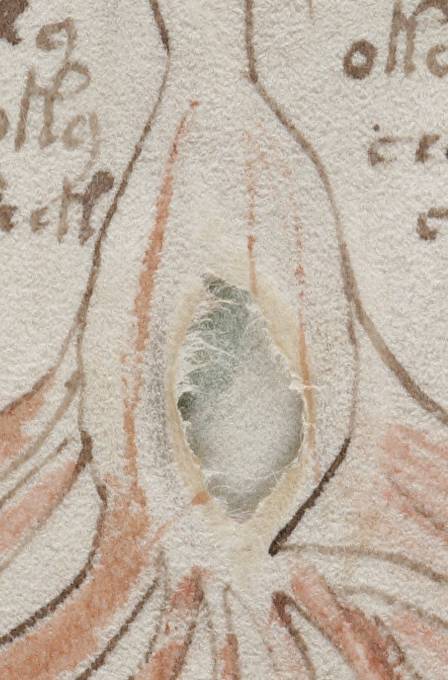
The curious rubbed-through hole on f34r/f34v of the Voynich Manuscript

Even for the very brightest, there are numerous traps to fall in: such as Sergio Toresella’s belief that the hole rubbed through the tree-trunk-like thing on f34r signals the mad scribe’s sexual frustration (it would require a great deal of work to rub such a neatly arranged hole through vellum). Perhaps Sergio is right (he’s extremely close in almost every other way): but this presumes a very specific kind of irrationality – and so the observation relies very heavily on the hypothesis to validate it, which is a kind of circular argument.

All of which colours my reaction to Zachary1392’s post on the Facepunch Studios forums: when looking at the same hole rubbed through on f34r/f34v, he sees it as a representation of female genitalia. Which (having then thought about it some more) he then concludes we should perhaps worship, as part of a Voynich religion.

In some ways, it’s an optimistic moment: a very sophisticated opinion informed by Sergio Toresella’s lifetime of studying medieval herbals, being duplicated by some amusing forum troll. But it’s also a pessimistic moment, because it gets us nowhere: “Greeman” on the same forum similarly points out:

Haha it was probably some shmuck from 600 years ago who thought;

“I bet if I write some crazy letters and draw some real fucked up stuff on a book someone will find it years later and totally freak out.”

It worked, you all got trolled from an Ancient Pothead.

Good Game.

While “Trogdon” helpfully suggested that, because one word looks like “crop” (EVA chol), the VMs might instead be a Photoshop tutorial. And Draicia thinks the whole thing might be a viral advertisement (but for what? Another Dan Brown novel? Have book publishers suddenly evolved?)

I think that all this forum chatter demonstrates something quite basic: that Linus’ Law sucks for things you can’t easily decompose. Reductionism is such a fundamental tenet of scientific thought that nobody even thinks to mention it these days – but the awkward dizzying truth is that to get started on difficult problems, scientists actually have to actively exercise their scientific imagination to generate novel decompositions (which may or may not be right), within which the hard slog of execution can be split up amongst a virtual cloud of volunteers / academics /  workers. Hence string theory, etc.

Linus’ Law fails for the VMs because nobody wants to sign up to any apparently mad theory before committing any serious amount of effort to testing it. But the truth underlying such an odd object will most likely appear somewhat alien (if not outright demented) to our present day minds – and so any person proposing the hypothesis is naturally expected to do all the hard work of proving it.

The sad thing about the VMs is that we do now have a collection of basic art historical facts and observations which tell us broadly where and when the VMs came from: but these point to so prosaic a subset of answers that almost nobody wants them to be true. Far more interesting to put your trust in David Icke’s, Dan Burisch’s, or Gordon Rugg’s brand of alternate history: they’re scientists, aren’t they? (Errrrrrrm…)

Put it all together, and I think the wisdom of the crowded forums perhaps points to the antithesis of Linus’ Law: that if enough people help to trample on every suggestion, nothing is simple. Or perhaps even simpler: given enough troll eyeballs, everything becomes worthless junk. Oh well. 🙁

Italian scientists claim to have solved two mysterious deaths from the Quattrocento: those of Giovanni Pico della Mirandola and Agnolo Ambrogini, two big-brained Florentines at Lorenzo de’ Medici’s court who suddenly passed away within only a few weeks of each other in 1494.

Though some historians had conjectured the pair might have died of syphilis, the contemporary rumours of poisoning have apparently now been supported by the high levels of arsenic, mercury and lead found (very, very post mortem) “in Pico’s tissues and nails”, the report goes on. All fascinating forensic stuff, I’m sure. (With slightly more in the Telegraph’s coverage).

But… permission to speak, please, Mr Italian Scientists? The 15th century in Italy was full of hazards, no less from your friends than from your enemies. For example, the culinary fashion was for really undercooked meat (and lots of it), which can (quite literally) be a recipe for disaster – and whenever anyone died suddenly, the jabbing finger of retribution usually pointed at anywhere but the kitchen.

For the rich (i.e. those who could afford apothecaries), another major source of death-by-(mis)fortune was the arsenic-, lead- and quicksilver- (i.e. mercury-)based medicines that were sometimes in favour. I would say that the best thing about the medieval cure “theriac” was that its large number (often 70+) of ingredients usually meant that none of them came in a strong enough dose to kill you.

Put bluntly, I would be thoroughly unsurprised if other bones from similar Medici courtiers happened to exhibit precisely the same tox profile: but without actually killing them. And there are many reports of poisoning plots that failed – different groups used different poisons (the Borgias favoured inorganic ones, as I recall), often ineffectively. Did the two men’s similar deaths mean they shared the same enemy, or just the same apothecary and cook?

Merely pointing to the arsenic etc isn’t enough to tell the whole story: and this is why I sometimes despair at the sight of scientists’ trying to do history. Different types of evidence (and inquiry) yield different and complementary types of story, and it is usually only by linking all these together that the whole narrative emerges. These days, history is multimedia, or it is nothing.

Here, “historical documents that have only recently come to light” (suggesting that Piero de’ Medici was angered by Pico’s connection with mad preacher Savonarola) ought to give the inevitable documentary a spin in the right direction. However, only in Hollywood’s cheesier fringes might someone think that writing “kiiiiiill hiiiim” in a letter would be a good idea. Will the archives really have enough to hold it all together?

All the same, if someone could point to some coded letters written in 1493-1494 by Pico della Mirandola’s enemies, well, then we might just be in business… 😉

Halfway through Blunt and Raphael’s “The Illustrated Herbal”, a small lightbulb flickered briefly to life in my tired head. And it was to do with the VMs’ Occitan marginalia, something that has bugged me for years…

To my codicological eyes, the VMs appears to have had a busy time in the 15th century (with three or four inquisitive owners), a very quiet time for most of the 16th century, before an intense flurry of activity circa 1600 (when I think its folios were numbered and the “heavy paint” layer added), which is just about when its semi-documented life at the Rudolfine court begins.

But, like an alcoholic after a particularly mad binge, there’s a whole chunk of time missing in the middle – in fact, about a century’s worth. What happened then? Who owned it? How did the VMs apparently get from Occitania (probably Southern France) to Prague? And – most crucially of all – why did nobody think fit to mention such an intriguing object?

Now: even though in many ways I hate what I call “join-the-dots histories”, when evidence is completely lacking (as is the case here) you really don’t have much choice. Basically, pragmatic hypotheses (which historians need so as to be even remotely strategic about what they look to for evidence) have to come from somewhere: and so here is my (possibly new) suggestion for how the VMs travelled from Northern Italy to Southern France and onwards towards the Rudolfine Imperial court at Prague. It may be rubbish, but it is at least testable rubbish. 🙂

The dots I propose to conveniently join together in a line (along which the VMs might well have travelled) are:-

  • Guillaume Pellicier [or Pellissier, or Pelicier] (c. 1490–1568), Bishop of Montpellier, who was a French diplomat in Venice between 1539 and 1542, from where he brought back Greek, Hebrew and Syriac books. He was also interested in botany; was imprisoned for a while (it’s a long story…); and was a long-time patron and friend of….
  • Guillaume Rondelet [or Rondeletius] (1507-1566), who famously taught medicine and botany at the University of Montpellier, and wrote a definitive book on fish. Rondelet bequeathed his collection of manuscripts to his student…
  • Matthias [de] L’Obel (Lobelius), (1538-1616) a young (but soon to be famous) botanist; he travelled to the North, settling first in Holland, then England, then Holland, and then England again.

From there you can get the VMs to Prague in any number of ways, though many (of course) would like it to have been carried there by Dee & Kelley. While that last part is still in the realms of wishful thinking, I’m more interested here in working out if the Montpellier side of things might be true… but how?

Further reading-wise, here are the lowest hanging fruits of all: HTML text resources.

  • I’ve placed a copy of Rev. Charles Kingsley’s chapter 14 of “Health and Eduction” (1874) “Rondelet, The Huguenot Naturalist” on the Cipher Mysteries website here. By modern standards, the text is a bit cloying, let’s say: but an OK starting point nonetheless.
  • A relatively up-to-date summary of Guillaume Rondelet’s life (in French) is here.

For correspondence, all three men have stuff in various archives: Pellicier’s Venetian correspondence, Rondelet’s (mainly medical) letters were published in his “Opera Omnia Medica” (?), while L’Obel (from whose name we get “Lobelia”, incidentally) similarly has a few letters out there (his patron Baron Zouche, the 16th century apothecary Jean Mouton, etc).

As with most questions about French letters, Gallica has plenty of scans of creaky old books which may (or may not) be useful. Here are some quick links to start with, sorted by date (rather than by usefulness):-

  • 1554: Libri de piscibus marinis, in quibus verae piscium effigies expressae sunt. Rondelet, Guillaume. Matthiam Bonhomme (Lugduni). Online here.
  • 1557: Histoire des plantes, en laquelle est contenue la description entière des herbes… non seulement de celles qui croissent en ce païs, mais aussi des autres estrangères qui viennent en usage de médecine. Dodoens, Rembert (1517-1585). Impr. de J. Loe (Anvers). Online here.
  • 1572: Illustrations de Commentaires de M. Pierre André Matthiole, médecin Senois, sur les six livres de Ped. Dioscoride anazarbeen de la matière médicinale. Mattioli, Pierandrea (1500-1577). Guillaume Rouillé (Lyon). Online here.
  • 1579: Nicolai Dortomanni Arnhemij Libri duo. De causis & effectibus thermarum belilucanarum. / Carmina G. Salmuth, C. Heintzelij, A. Widholtzii. Dortoman, Nicolas. Apud Carolum Pesnot (Lugduni). Online here.
  • 1581: Plantarum seu Stirpium icones. De Lobel, Matthias. C. Plantini (Antuerpiae). Online here.
  • 1841: Notes et documents pour servir à l’histoire de Lyon, 1483-1546. T. 1.  Péricaud, Antoine (1782-1867). impr. de Mougin-Rusand (Lyon). Online here.
  • 1877: Étude historique sur l’École de droit de Montpellier, 1160-1793, d’après les documents originaux,…  Germain, Alexandre-Charles. Boehm et fils (Montpellier). Online here.
  • 1903: Les ambassadeurs français permanents au XVIe siècle. Vindry, Fleury. H. Champion (Paris). Online here. (Text starts on page 5)
  • 1911-1914 Bullaire de l’église de Maguelone. [Volume 1]. Rouquette, Julien (1871-1927). Online here.

Books to look at for Guillaume Pellicier (note the various spellings!) would seem to be:-

  1. 1886: Catalogue des manuscrits grecs de Guillaume Pelicier évêque de Montpellier, ambassadeur de François Ier à Venise. Henri Auguste Omont. A. Picard, Paris. In the Internet Archive here.
  2. 1891: Inventaire de la bibliotheque de Guillaume Pelicier, eveque de Montpellier (1529-1568). Henri Omont, in Revue des Bibliotheques, I, pp. 161-172. “Inv. used. Montpellier. Clergy, booklist printed”, according to this page on French wills. Gallica has apparently not yet scanned the 1891 edition (while the earliest currently on Google Books is 1897), which is a huge shame as this is the first place I’d like to look… oh well. 🙁
  3. 1899: Correspondance politique de Guillaume Pellicier: ambassadeur de France à Venise 1540-1542. Tausserat-Radel, Alexandre (1858-1921). Paris, F. Alcan.
  4. 1969: La diplomatique francaise vers le milieu du XVIe siecle, d’apres la correspondance de Guillaume Pellicier, eveque de Montpellier, ambassadeur de Francois Ier a Venise 1539-1542. J. Zeller. Slatkine Reprints.
  5. 1986: Les copistes de Guillaume Pellicier, éveque de Montpellier <1490-1567>. Annaclara Cataldi Palau, in Scriptorium 40, pp. 225-237. According to this website, “The author’s research on the Greek manuscripts in the library of Guillaume Pélicier, the French ambassador to Venice between 1539-42, relied heavily upon analysis of the watermarks to supplement other palaeographical and documentary evidence
  6. 1986: Les vicissitudes de la collection de manuscrits grecs de Guillaume Pellicier. Annaclara Cataldi Palau, in Scriptorium 40 (1), pp.32-53
  7. ????: Manoscritti greci della collezione di Guillaume Pellicier, Vescovo di Montpellier (ca. 1490-1568) : “Disiecta membra”. (I don’t know where it’s from, but ULRLS has a copy).

(Incidentally, Annaclara Cataldi Palau is a Professor at King’s College London, whose research interests are “Greek palaeography and history of book production“: so I presume that the last article was placed in the University of London Library system directly by her, in case you can’t find it anywhere else.)

Books which tend to get cited on Guillaume Rondelet are:-

  1. 1582: Vita Gulielmi Rondeletti, L. Joubert [Rondelet’s first biographer], in Opera Latina, 2 (Lyon, 1582), pp. 186-93. [Nancy Siraisi briefly discusses Joubert’s account in her “History, Medicine, and the Traditions of Renaissance Learning” (2007), pp.126-127]
  2. 1865: Rondelet et ses Disciples ou la botanique à Montpellier au XVIe siècle. Discours prononcé dans la séance solennelle de rentrée des Facultés et de l’École supérieure de pharmacie de Montpellier, le 15 novembre 1865 par J.-E. Planchon, directeur de l’École de pharmacie. If you’re interested, there’s a copy on AbeBooks for a paltry £363.04: or you can go to the Natural History Museum’s library instead (which is what I plan to do). 🙂
  3. 1899: La botanique en provence au XVIe siecle, II, Pierre Pena et Mathias de Lobel. L. Legré (Marseilles).
  4. 1926: Un manuscrit médical du XVIe siècle, contenant principalement des œuvres de Guillaume Rondelet: Notes bibliographique et biographiques, Suzanne Solente (with E. Jeanselme and Dr. M. Lanselle), in Bulletin de la Societe Francaise d’histoire de la Medecine, 20. pp. 3-36
  5. 1936: Guillaume Rondelet, J. M. Oppenheimer, in Bulletin of the Institute of the History of Medicine, 4, pp. 817-34.
  6. 1965: Guillaume Rondelet, C. Dulieu, in Clio medica, 1, pp. 89-111.

I’ll return to Lobelius another day (I’m still reeling from all the above). As it is, I’ve already jeopardised my membership of the Bloggers Union by including too much useful information in a single post. :-O

It’s an oldie, but a goodie: first published in 1979, Wilfrid Blunt and Sandra Raphael’s “The Illustrated Herbal” (particularly the revised 1994 edition) is a must-buy first read for any Voynich Manuscript would-be herbal decipherer – if only to make plain by how much its herbal pages differ from other contemporary herbals.

Of course, Blunt has sneaked a few pictures from the VMs in there (pp. 88-91); and though he cites Alfred Werner’s (1963) observation that one page in the water section is like “a plumber’s dream“, he quickly cautions that “…’Heath Robinson nightmare’ might seem more appropriate” (which is fair enough). But as for commenting on the plants themselves, Blunt is content to pass them by at some speed, in much the same way that Eric Sams fled from the ciphertext. You’ll just have to find your own answers, I guess.

What did I learn? A new way of looking at plants began to emerge from around 1380, which a handful of artists were plugged into – but which most plainly weren’t. For example, even Giotto wasn’t au fait with it (though he “painted birds and other animals with a tolerable naturalism, [he] still made trees like outsize herbs”, p.57), but Leonardo (circa 1500) certainly was (and I would add Van Eyck too). As far as herbals go, if you look at Rinio’s Liber de Simplicibus (1419) [which John Ruskin adored], or even Serapion the Younger’s Herbolario volgare (better known as the Carrara herbal, MS Egerton 2020) (1390-1400), I think there’s something ‘graphic’ about the rendering, that we might today recognise as a “draughtsman-like aesthetic”. But far, far beneath the soaring flights of these stunning, draw-what-you-see masterpieces, the pedestrian copy-what-you-know world of medieval herbals stumbled on regardless.

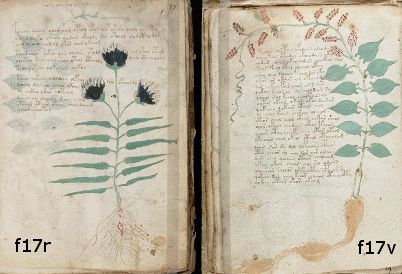
Voynich Manuscript f17r and f17v, side-by-side
Medieval and modern, on the front and back of the same folio!

In the big scheme of things, I would say that what we see in the Voynich herbal pages is annoying because it fails to fit in either of these two easy pigeonholes – neither the high flyers nor the low achievers. And so the VMs actually has a chasm on each side: and because it contains occasional flashes of both medievalism and modernity, it – doubly annoyingly – lets people read either (or indeed both!) of those into what they see. Yet in order for those flashes of modernity to be present at all, it has to postdate 1380, and must have had an author who was at least aware of both levels: while its overall drawing style matches 15th century stylistic conventions far, far more closely than it does 16th century ones. But there you go.

Blunt and Raphael’s work is built on two lifetimes’ worth of herbal scholarship and reflection: and, nicely, is happy to adopt a light tone when it suits the needs of the passage. This seems to happen particularly when quoting Charles Singer from the 1920s, such as Singer’s description of the Leiden manuscript as “a futile work, with its unrecognisable figures and incomprehensible vocabulary” (the VMs isn’t completely alone, then).

At the end of reading “The Illustrated Herbal”, I came away with my head buzzing with stuff, but none it about where the VMs’ herbals came from – Blunt’s Wittgensteinian “if you can’t say anything useful, stay silent” position on the VMs’ plants has a lot to commend it. No, what I was most inspired by was his discussion of the transmission of ideas about herbals during the 16th century: but I’ll have to return to that in another post (shortly)…