
Having just posted about Project NEPA (and now reading Alex Wellerstein’s fantastic “Restricted Data”), something clicked in the back of my head about Nick Redfern’s source “Black Widow” (in his book “Body Snatchers in the Desert”).
According to Redfern, she claimed that “[she] met a lot of the NEPA and ANP people at Oak Ridge...”. But Project NEPA started as part of the Manhattan Engineer District (under General Leslie Groves), and then control moved to the Armed Forces Special Weapon Project (again, under General Groves), and then to the Power Branch at AFWSP (under Donald Keirn), and then eventually to the AEC Division of Reactor Development (on 01 Feb 1949, the day after General Groves retired – which was probably no coincidence).
All through that process, the highest security rules applied: so Project NEPA really wasn’t something you could talk about idly over the watercooler, at Oak Ridge or indeed anywhere else. All of which means – I’m pretty sure – that the “Black Widow” can only have been working directly on Project NEPA. Which in turn made me think of…
“In the Atomic City”
Here’s Millicent Dillon’s account of being a young female graduate physicist working in “Atomic City” on Project NEPA in 1947. Dillon (nee Gerson) moved from being a physicist to being a writer a little later in life, and for me her writing has a nice, reflective tone that’s easy to read (but is hard to do). Other people have commented on the ‘precision’ of her writing, as though it springs from her time as a technical writer in Project NEPA’s Information and Handbook department. But precision can be learnt: emotional honesty takes proper talent.
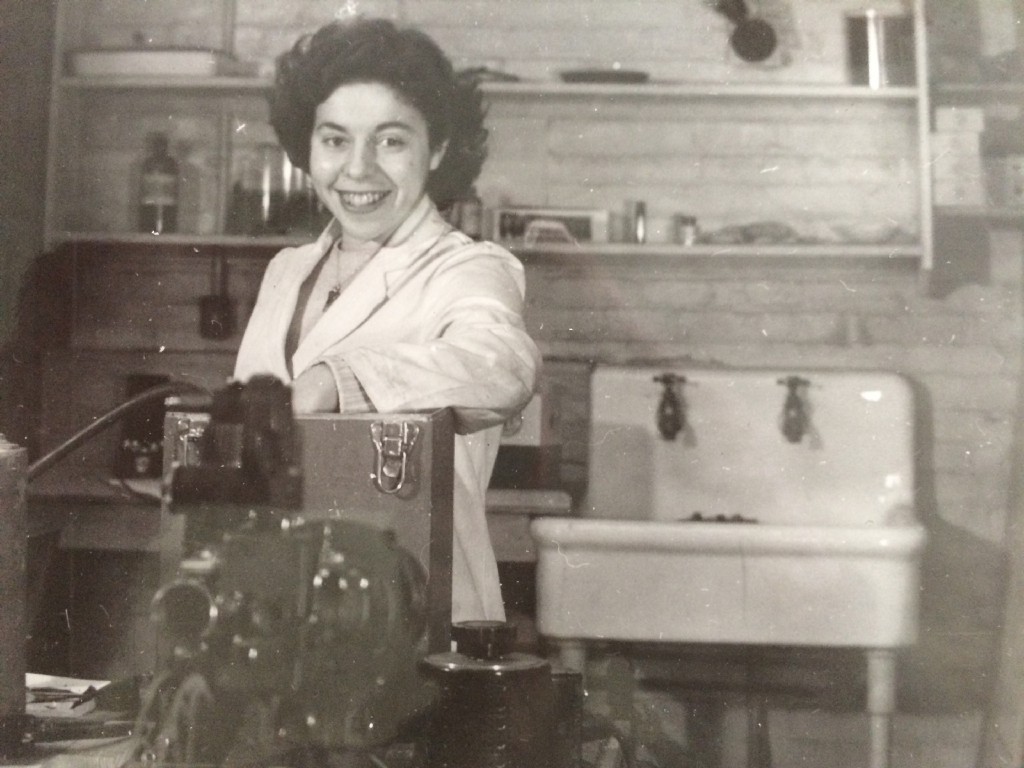
(Nice picture from this interview here with her in The Awl.)
Might she have been Nick Redfern’s secret source? It’s entirely possible, and as Dillon (sadly) died in January 2025, perhaps Nick R will tell us at some point. (Go on, Nick!)
She actually spent some time writing her memoirs (“In the Atomic City” was effectively an extract published in The Believer magazine). These were to be called “The Absolute Elsewhere”, but there’s no obvious sign that they were ever printed. But goshdarn, I really wanted to read them.
So I then found that her papers (19.32 linear feet!) had been donated to the Harry Ransom Center at the University of Texas (MS-01167). However, their date range is marked up as “1905-2002”, which feels as though “The Absolute Elsewhere” was probably retained by her family. So maybe we will see this published someday. (If so, please leave a comment here, I’ll be the first to buy it!)
Incidentally, her “Atomic City” article mentioned a book called “Race to Oblivion” by Herbert York, which you can borrow via archive.org. In fact, more or less all the people from this period or Project NEPA seem to have written their memoirs, which (to be honest) all seem to say little or nothing about the important stuff. It will be interesting to see how genuinely honest Dillon’s memoirs will turn out to be.
The May 1947 test (that failed)
In Nick Redfern’s book, the Black Widow mentions “that there were, I think, three classified balloon flights in May, June, and July 1947 and at least two were disasters. […] Sometimes there would be experimental shielding in a radiation experiment and the people would be separated – some having shielding, pressurisation, and some not, depending on the experiment.” (Body Snatchers, p. 9)
Back when I first read this, it made no sense to me at all. The weight of radioactive shielding would be just colossal, far greater than any balloon of this period could manage. Really, any experiment with this kind of shielding would need to go up in a meaty, chunky ol’ aircraft. And surely any plane with Project NEPA would have gone up much later than 1947? So I didn’t really see at all how this could have worked.
However, I recently found out about Project Chickenpox, MX-886. This was a project that General Groves helped kick off in October 1946 to make airborne atomic assembly laboratories. The basic idea was to kit out some C-97 aircraft with the necessary laboratory materials so that an atomic bomb could be assembled while in flight to its target (i.e. rather than having to wait for one to be assembled on the ground before loading it onto the plane). This is described in General Groves’ secret correspondence files (microfilm M1109), which you can buy online: and also in the AFSWP first year history (section 4.6.4 (e)).
Connecting the dots
Until today, I didn’t see how any of these individual points of data might be connected. But then I learned that one of the three C-97 planes owned by AFSWP crashed on 22nd May 1947. Here’s the report from the Prescott Evening Courier of the same day:
5 KILLED IN PLANE CRASH
Dayton, O., May 22 (/P) – Five persons were killed and two others were injured today when a four-engined army transport plane from Wright field crashed and exploded in a field about four miles east of Dayton.
Names of the dead were withheld pending notification of relatives.
A witness said the plane appeared to be in trouble as it swooped low. Seconds later, the plane tilted on its side and plowed into a ditch, then hurtled into a wheat stubble field.
An explosion turned the plane into a mass of flames.
Wright field officials said the plane, containing military personnel, was on a routine test flight.
The plane, a C-97, was the military version of the Boeing stratocruiser – a giant ship capable of carrying scores of troops or tons of cargo.
Wright field officers said they believed the plans stalled as it approached Wright field for a landing.
The injured personnel, whose names and conditions also were withheld were thrown clear of the plane.
They are at Patterson field hospital.
Might this – a secret C-97, easily able to lift a Project NEPA nuclear reactor and shielding into the air – have been one of the tests that failed disastrously?
Hi Cipher Mysteries, see if you can find out if any of her husbands ( she was twice divirced) were of African American origin. Nick Redfern has stated that the Black Widow’s husband was African-American. I live in London but am not ruling out paying an independent researcher in America to look for records at the National Archives to find the identity of the “Black Widow” and her African_American husband.