
The first ‘La Buse’ cryptogram was first described (and indeed ably decrypted) by Charles de la Roncière in his 1934 book “Le Flibustier Mysterieux”. Though only 17 lines long, the decryption was – though correct without any real doubt – as mysterious as the pirate of the book’s title.
Annoyingly, de la Roncière didn’t give sources for any of his evidence, almost all of which seemed to be tied up with French treasure hunters; much of his secondary narrative (e.g. about Le Butin) has yet to have a single external document verifying it; and his whole narrative is wrapped up with a fair few unsubstantiated myths and legends which seem to have appeared in his book for the first time anywhere.
Why did this sober and exceptionally well-respected historian get himself tangled up with this mess? What was going on back then? Seventy years on, there’s still no good answer for any such questions: the only people who think this could be real are treasure hunters (who want all treasure to be real, basically) and skeptical code-breakers (such as myself, who suspect the cryptogram might be genuine, even if the proposed link with La Buse itself is almost certainly spurious).
And then you have the second ‘La Buse’ cryptogram, the first image of which was first put on the Internet (I believe) by Yannick Benaben about a decade ago, as part of a La Buse-themed fiction he was writing. Though this has its cadre of true believers (such Emmanuel Mezino, whose book about it lurches violently between the twin cipher poles of clear-headed accuracy and woefully empty speculation), my own conclusion is that it is, if anything, even more confused than the first cryptogram.
This second cryptogram has an extra five lines of encrypted text appended to (broadly) the same 17-line cryptogram, using (broadly) the same pigpen cipher key: but whereas the decrypted cleartext of the first 17 lines makes essentially no sense at all, the extra lines shine through clear as a bell.
My cryptographic conclusion was this these extra lines were surely an extra layer, added at a later date (and by a completely different owner), i.e. that these are “super-marginalia”, added in for reasons unknown… though I tentatively predicted that it was to try to link the underlying 17-line cryptogram more definitively with the piratically successful (but ultimately hanged) Olivier Levasseur.
All of which was no more than an appetiser.
Because this was where online commenter CptEvil came in.
The Gold Bug
CptEvil noted that if you compare the start of the last five lines of the second La Buse cryptogram…
un bon verre dans l’hostel de le veque dant(S)
le siege du diable r(Q)uarar(N)te siz(X) degrès
f(S)iz(X) minutes deuz(X) fois
pour celui qui le decouvrira
juillet mil sept cent (T)rente(…in English…)
a good drink in the bishop’s hostel in
the devil’s seat forty six degrees
six minutes two times
for the person who will discover it
july 1730
…with the cryptogram used by Edgar Allan Poe in his famous short story “The Gold Bug”, you discover something rather extraordinary:-
A good glass in the bishop’s hostel in the devil’s seat
— twenty-one degrees and thirteen minutes
— northeast and by north
— main branch seventh limb east side
— shoot from the left eye of the death’s-head
— a bee line from the tree through the shot fifty feet out.
(Note that this was also suggested elsewhere on the web back in March 2015 by online commenter “indi”.)
Are these two cryptograms connected? Why, yes, they most surely are. But how? That’s far more difficult to answer than you might think, even though we probably only have three main scenarios to consider:-
(1) Did Poe Make Both Cryptograms?
Even though there are plenty of people who assert that Poe made the Beale Papers, I’ve yet to see any evidence beyond mere handwavery that this is so. And the same would seem to be true here… but yet the two cryptograms are connected.
(2) Was “The Gold Bug” The Second Cryptogram’s Source?
Interestingly, Baudelaire’s famous (1856) French translation of The Gold Bug (as CptEvil noted in a follow-up comment) uses “la chaise” to translate “seat”, whereas “le siege” only appears in a 1933 translation. Which would tend to suggest that if the second cryptogram was in some way a copy of Poe’s cryptogram (which, after all, was embedded in a pirate fantasy about discovering Captain Kidd’s treasure), it was probably made after 1933.
(PS: how did Alphonse Borghers translate this in 1845?)
CptEvil also points out that there is a distinct similarity between the treasure chest depicted in the second cryptogram…
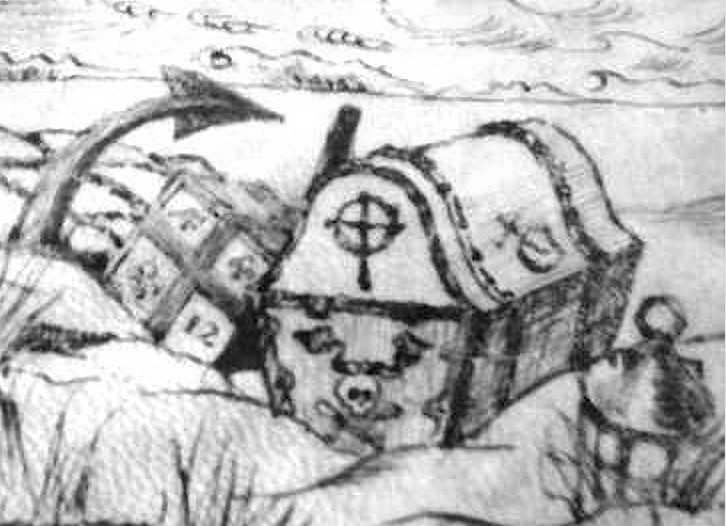
…and a fantasy treasure chest famously depicted by Victorian illustrator Howard Pyle:
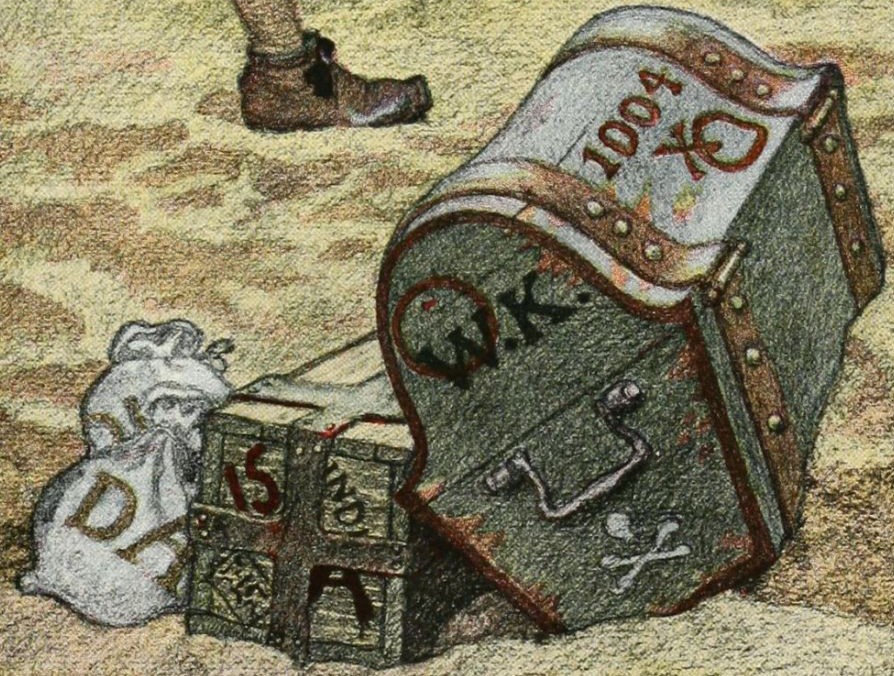
(This was also pointed out by online commenter “marc” later in March 2015.)
Note in particular the “XO” motif on the lid of the chest and the structural similarity of the square chest just to the left of the main chest: all of which would seem to be a giveaway, particularly as Howard Pyle seems to have made up almost everything he drew to do with pirates. (Indeed, most of Johnny Depp’s “Jack Sparrow” on-board piratical style seems to have been plucked directly from the Howard Pyle play-book, more than a century later).
And yet… just as we can’t (yet) rule out Poe having seen this second cryptogram, we can’t rule out Pyle having seen it either. And we also can’t (without a huge investment in time in tracking down the iconography of treasure chests) rules out the possibilities (a) that Pyle copied it from the second cryptogram, or (b) that Pyle and the second cryptogram’s author were both strongly influenced by the same image, perhaps found in an old pirate book.
Moreover, inserting a line from “The Gold Bug” would seem like quite a ridiculous thing to do if the overall intention was to make the cryptogram seem to date from 1730, given that Poe wrote his short story more than a century after Olivier Levasseur died. This fails the test of good sense, surely?
(3) Was The Second Cryptogram “The Gold Bug”‘s Source?
Between December 1839 and May 1840, Edgar Allan Poe wrote a series of articles in Alexander’s Weekly Messenger, in many of which he decrypted readers’ cryptograms. You can also trace aspects of these exchanges in Poe’s letters.
Rather more substantial is Poe’s A Few Words On Secret Writing from Graham’s Magazine in July 1841, though I should add that William Friedman didn’t think much of Poe’s non-systematic attempts at decryption (see p.41ff of this 1937 Signal Corps magazine).
From his correspondence, we know that by 1842 Poe had lost interest in decrypting the approximately one hundred reader’s cryptograms that even then still continued to crash on his beach, and in some of which “Foreign languages were employed”: and yet in 1843, his “The Gold Bug” played directly to that same audience on the same mysterious vein, with wild success. Poe also refers to a book in French on cryptography by Jean-Francois Niceron (though Niceron lived a century before La Buse): so it is entirely possible that Poe had contact with a French cryptographer of his era.
It seems entirely possible, then, that Poe might have been directly inspired by an encounter with the second cryptogram (or something exceedingly like it), to the point that he shaped his story around it. For are they not both pitched as pirate treasure narratives, with an exceedingly obscure key?
(Note that David Kahn, who likes The Gold Bug despite the fact that it is “full of absurdities and errors”, suggests in “The Codebreakers” that Poe may well have borrowed the basic Captain-Kidd-treasure-hunting plot from Robert M. Bird’s novel “Sheppard Lee”, a book Poe had previously reviewed – apparently, all you need to do is dream how to get to the treasure the same way three nights in a row, etc etc.)
But the single observation that most makes me suspect that Poe had seen the second “La Buse” cryptogram is simply that the plaintext revealed by his protagonist’s decryption makes no sense, even as a novelistic device. His cryptologic hero Legrand eventually makes sense of “Bishop’s Hostel” as “Bessop’s Castle”, which didn’t really make any sense to me when I first read the story many decades ago, and – frankly – still doesn’t ring even remotely true today.
So could it be that Poe actually constructed the story backwards from the phrase “A good glass in the bishop’s hostel in the devil’s seat”? If so, what does the phrase actually mean?
The most (in)famous Devil’s Seat of recent years is the “Fauteuil du Diable” (“Devil’s Armchair”) at Rennes-les-Bains, which somehow got entwined with the whole ludicrous “Priory of Sion” fantasy. But The Gold Bug would seem to have preceded that by many decades, so we can perhaps move swiftly past it. 🙂
It has been suggested that this in fact refers to the formerly-volcanic piton (mountain) on Réunion Island: though possible, this seems to be wading knee-deep in the inky waters of speculation. But beyond that, I’m kind of out of ideas.
All the same, the notion that “The Devil’s Seat” at “forty six degrees six minutes two times” (presumbly longitude measured east from Paris?) refers to a formerly-volcanic piton seems more probable to me than the notion that Poe plucked the phrase “A good glass in the bishop’s hostel in the devil’s seat” from the ether entirely a propos of nothing, even if he did dream it three nights in a row. But even so, I’d prefer to have even a soupcon of solid evidence either way, this is still all a bit too messy for my liking. 🙂
On Howard Pyle, the Thornton Oakley collection in Philadelphia has a lot of Pyle’s sketches and research notes, might be worth a look:
http://dla.library.upenn.edu/dla/pacscl/ead.html?id=PACSCL_FLP_FLPRBDPYLE
There is an interesting discussion regarding this in a thread that I started on Libertalia back in February 2014, where I first published the similarities with the Gold bug. The observation of the treasure chests and Pyle was however done by Gillou.
Nick, I seem to recall that Poe was an opium addict. And, maybe, manic-depressive? Perhaps there may be some medical history filed in one of the older sanitariums (of his time)?
I don’t think that Poe was an opium addict, Collins and de Quincey were…
I do not follow the “La Buse” story, yet some remarks.
1) That the plaintext makes no sense is not a solid argument. This is a romantic story, after all; oftentimes you dream of some nonsense in your sleep, and then you make a work of art out of it.
2) The introduction of the “Bessop’s castle” is by no means practically necessary for the plot: it would have been no difficulty to develop the plot without any “Bessop’s castle”, just with the “Bishop’s hostel”.
I would rather think over the question why Poe introduced the “Bessop’s castle” at all. If “The Gold-bug” had some real-world prorotype, then perhaps the “Bessop’s castle” was also part of the true story?!
3) Could this all be a case of erroneous translation (either from French to English or vice versa)?! Poe uses “glass” in its meaning of “telescope”, *specifically adding* that “the word ‘glass’ is rarely employed in any other sense by seamen”. However, if the phrase existed before “The Gold-Bug” was written, this might have been understood as the “drinking glass” by the translator, so this resulted to be “drink” in the French version. Or vice versa, if the original was in French.
However, “verre” is not strictly “drink” in French, it is literally a drinking glass, but generally it is glass as material, and, which is important – it can also mean a “lens”.
“Siege” is not “seat” as something we sit upon, but rather “residence” or “abode”.
“Le siege du Diable” – possibly, some haven?! But not very friendly one, I’m afraid.
4) “Forty six degrees six minutes two times” makes no sense. It’s either “Forty six degrees six minutes. Two times”, or “Forty six degrees. Six minutes two times”, or even “Forty six degrees. Six minutes. Two times.”
There is an interesting discussion regarding this in a thread that I started on Libertalia back in February 2014, where I first published the similarities with the Gold bug. The observation of the treasure chests and Pyle was however done by one Gillou.
There is an interesting discussion regarding this in a thread that I started on Libertalia back in February 2014, where I first published the similarities with the Gold bug. The observation of the treasure chests and Pyle was however done by one Gillou.
http://forum.lixium.fr/v-1855349080.htm
There is an interesting discussion regarding this in a thread that I started on Libertalia back in February 2014, where I first published the similarities with the Gold bug. The observation of the treasure chests and Pyle was however done by one Gillou..
Looking even further back in time, we find another interesting painting done by Johannes de Sacro Bosco in 1230. There are many similarities with the art-work in the second cryptogram. We see the sun, the moon, the stars, the Zephyr, but also the zodiac signs who are present around the church door in the cryptogram and the compass.
(Even if no bearing on this subject, note the big land south west of Africa on the globe)
A general question: is it possible to include URL’s in the replies? I tried with both replies above, but they (the full replies) just disappeared.
CptEvil: just replace the first ‘:’ and the last ‘.’ with spaces, I’ll insert them in by hand when I approve them. 🙂
Anton: (1) it is certainly now interpreted as a romantic story, but I don’t see a shred of romance actually within the 17-line cryptogram. (2) having “Bessop’s Castle” as a reading of “Bishop’s Hostel” seems the wrong way round, however I try to look at it. (3) There seems to be some kind of odd translation thing going on, but it’s not clear in which direction. In English, “seat” is also used to mean a sizeable abode, as in “we stayed at the Duke’s country seat”. (4) “Forty six degrees six minutes” makes sense as a longitude, but not as anything else – the rest I’m unsure about.
Nick:
46 degrees 6 minutes makes sense as any angular measure, not necessarily longitude.
Latitude, azimuth, altitude, ascension…
Actually 46 degrees East fall nicely onto Madagascar where alleged Kidd’s silver was found earlier this year (I think you wrote a post about that).
Might it be that Poe knew about the French note, somehow attributed it to Kidd and just substituted 46 deg. East with whatever suited him for his story?!
Nick: You write:
“Even though there are plenty of people who assert that Poe made the Beale Papers, I’ve yet to see any evidence beyond mere handwavery that this is so. And the same would seem to be true here… but yet the two cryptograms are connected.”
In the 16th and 17th paragraphs from the end of “The Gold Bug” (written prior to 1843 when it was published) we find these snippets directly intimating the Beale Papers story:
“an old family, of the name of BESSOP”
“about four miles”
“tavern”
“found without difficulty”
Literary steganography hides in BESSOP, Beale…
BES (meaning BE) + SOP (meaning ALE) = BEALE.
Anton: I’m pretty sure that 46 degrees east of Paris – it’s in French, after all – is Reunion Island, which was (of course) where La Buse was hanged. Or as you say, it could be 46 degrees east of Greenwich, because La Buse was captured on Madagascar. Either way, the numbers seem to make sense in the second cryptogram, but not in Poe’s cryptogram.
And so yes, Poe might well have known about the French note etc etc.
Paris is 2 degrees 20 minutes East, Reunion is 55 degrees 32 minutes East, so the difference is far from 46 degrees.
Wouldn’t 46 degrees North be somewhere near Oak Island, NS, Canada?
Perhaps the entire thing is a great Poe hoax.
I believe the cipher on the stone tablet found in the Oak Island Money Pit was deciphered using Edgar Allen Poe’s The Gold Bug.
“Forty feet below, two million pounds are buried”
I’m puzzled about the word ‘piton’ as it appears in this discussion; a piton was/is basically a large nail or spike which is driven into the hard rock of the mountainside. It could be used as a step or an anchor for the climbers’ ropes when traversing a mountainside.
So, Nick, do you still feel as though you’ve been climbing a very large mountain with not enough oxygen?
I can sympathize (impending blindness, deafness, and apparently some memory loss).
Still smiling 😉
Hi Nick, it’s a pleasure to see that you progress in this mystery… About your article on La Roncière’s book, he didn’t give his sources because he works under confidentiality. Do you know that La Roncière found one treasure (a real treasure) related to La Buse/Nagéon in Mahé between 1934 and his death ? Do you think a good historian like La Roncière has wrote a book based only on spéculation ? No, for sure, he was too much clever for this…
A question : you speak about the “first” cypher presented in La Roncière’s book. But take time to contact french institution (BNF, muséum…ect,ect…), you will see that the 17 line cypher doesn’t exist !!! French state hasn’t any trace of this document, because it doesn’t exist ! La Roncière’s source was the owner of the second cryptogram (with the draws…), the 17 lines was a creation (a uncomplete copy) of the 22 lines cryptogram made by La Roncière and his source…
About Poe and the cypher, my opinion is that Poe was contacted to decypher the document (much copy of the text of cypher with the draw have circuled in Mauritius Island between 1800 et 1850… One guy in possession of this copy contacted Poe, a cryptography specialist, to decypher the document.
What is the “Devil Seat” (le Siège du Diable) ? It’s not about Rennes les Bains or another mystery. The Devil’s seat design à rock sculpted like a chair, a seat, and you’ve got a photo of this rock in my book. You dont belive this theory about a rock sculped like a chair, a seat presented in my book… well read Le Clezio (“le chercheur d’or” and “voyage à Rodrigues). Le Clezio speak about his grandpa’s research on Rodrigues about a pirate treasure…and he said that his grandpa’s found a rock “like a seat, in accordance with cryptographic indication”… This ultimate sentance is clear… 😉
Have a good day, and a good research !
Emmanuel Mezino.
Hi Nick, it’s a pleasure to see that you progress in this mystery… About your article on La Roncière’s book, he didn’t give his sources because he works under confidentiality. Do you know that La Roncière found one treasure (a real treasure) related to La Buse/Nagéon in Mahé between 1934 and his death ? Do you think a good historian like La Roncière has wrote a book based only on spéculation ? No, for sure, he was too much clever for this…
A question : you speak about the “first” cypher presented in La Roncière’s book. But take time to contact french institution (BNF, muséum…ect,ect…), you will see that the 17 line cypher doesn’t exist !!! French state hasn’t any trace of this document, because it doesn’t exist ! La Roncière’s source was the owner of the second cryptogram (with the draws…), the 17 lines was a creation (a uncomplete copy) of the 22 lines cryptogram made by La Roncière and his source…
About Poe and the cypher, my opinion is that Poe was contacted to decypher the document (much copy of the text of cypher with the draw have circuled in Mauritius Island between 1800 et 1850…) One guy in possession of this copy contacted Poe, a cryptography specialist, to decypher the document.
What is the “Devil Seat” (le Siège du Diable) ? It’s not about Rennes les Bains or another mystery. The Devil’s seat design à rock sculpted like a chair, a seat, and you’ve got a photo of this rock in my book. You dont belive this theory about a rock sculped like a chair, a seat presented in my book… well read Le Clezio (“le chercheur d’or” and “voyage à Rodrigues). Le Clezio speak about his grandpa’s research on Rodrigues about a pirate treasure…and he said that his grandpa’s found a rock “like a seat, in accordance with cryptographic indication”… This ultimate sentance is clear… 😉
Have a good day, and a good research !
Emmanuel Mezino.
Manu: just like de la Roncière, you make a lot of assertions and claims, but without proof or evidence. Do you have any proof that de la Roncière even went to “Mahé between 1934 and his death”, let alone found any treasure? Have you looked at any of de la Roncière’s letters and correspondence?
The second cryptogram (please forgive me for calling it this, the letters are different in the two versions, while the relationship between the two versions implies to me that they both came from a common source, or that the 22 line version was derived from the 17 line one) is a very troubling document, with or without any speculative / presumed relationship to Poe. Have you yourself seen any copies of any letters from Mauritius from 1800 to 1850 that mention the 22-line illustrated cryptogram?
I shall look again at Le Clezio… it’s all very tangled, though. 🙁
Nick, about La Roncière, i promise i will not give my source, i have to respect it. It’s your right to not believe what I said, but i work several years on this story of La Buse, wrote a book (approved by a professional archeologue, who worked a little on this story : M. Surcouf Erick,…but not by you… what’s the matter ??? 🙂 ), i am not here to give false information…
About La Roncière’s book, published in 1934, he saw a cryptogram of 17 lines and say about it “photography bibliothèque Nationale (BNF)”. The fact is that the cryptogram in La Roncière’s book isnt a photography !!! its a retranscription on the impression paper… The best proof of this : i contact BNF, so much museum and institutions and all said me the same thing “this document doesn’t exist in any French archive”… There is a problem here : La Roncière said he published a photo with the 17 line cryptogram conserved at BNF…but this document doesn’t exist…
Like I said it to you more more time, there is a logical explication to this : the 17 lines dont exist, the original is the 22 lines, owned by Nagéon’s heir !!! La Roncière just published a part of the cypher (the first 17 lines) in accordance with the “contract” he got with his source. The 17 lines is a false, published to give more “credibility” to La Roncière’s book…Any proof that La Roncière work on the treasures on Mahé : he said himselef at the end of this book “les fouilles ont commencé…”… I have not read La Roncière correspondance, but an extract of the correspondance of La Roncière’s source…the same person which give information to R.Charroux…the same person who camed on Reunion Island in the 50’s, with a famous french explorator (Monfreid) to find La Buse’s and Nageon’s treasures which are in the same hiding place…
Read Le Clezio knowing this and all will be clear : the theory about the stars I present in my book is a fact, the sign discovered by le Clezio Grandpa’s are in link with la Buse cryptogram and are disposed like a starmap representation on the land (remenber emerald table : “ce qui est en haut est comme ce qui est en bas…). Knowing this, believing this star theory you will see that Le Clezio will be more clear 😉
About Poe and the cypher, i’ve got some element proofing that Poe was inspired by La Buse’s cypher (the 22 lines because the 17 line doesnt exist)… The famous “good glass in bishop’s hostel” isn’t a fantasy… its an element we discovered on la Reunion Island, in a cave with engraved sign. The “bishop hostel” is symbolising the cave, and the “good glass” is a big volcanic crystal (olivine or peridonit) buried in a particular place in the cave.
Before purchase the truth about this story, ask you one question : you got 2 versions of the cryptogram, one of 22 lines which i said its the original who inspired the 17 lines, which is in the and of a private owner since more generationq…and another cryptogram of 17 lines, nobody know where it come from and nobody got proof of his existence… Before any supputation on the 17 lines, proof me that it exists…the 22 lines exists, you got it in photo… That the starting point…after this…look for and you will find, i said you more in the mail i wrote you a few month ago than today…
The 22 lines is troubling you….not a surprise, its the original cypher… 😉
Have a good day, if you need more contact me 😉
Emmanuel Mezino.
Manu: the problem I have is that I have seen no external evidence for any of the many things you claim. Similarly, I have seen no external evidence for any of de la Ronciere’s claims and documents, even the ones that I’ve tried hardest to verify. You say: A is true, or B is false, or X means Y – but so far nobody can verify even a single one of these. For example, who now owns the documents claiming to be from Nageon de l’Estang? Even if they think the cryptogram(s) are too stuffed with treasure to show historians, why not release the Nageon de l’Estang documents? Say, for radiocarbon dating?
De la Ronciere was a very well-renowned historian, sure, but so far none of his pirate treasure story – or yours – adds up to any actual history. History isn’t what you are allowed to reveal by your sources (hi YF), but what can be argued based on evidence: and so far we have none of that whatsoever.
Well, you’re speculating on a story and you didnt got any fact about it, some people bring it to you and you dont believe it…what can i said more… ???? take a plane ticket, go in Mauritius, la Réunion, Mahé, La Digue, Fréguate and Rodrigues…and work !!!
The famous YF isnt my source (!), he is jut the owner of the documents, he is an indirect heir of Nageon de Lestang. Why he didn’t reveal all his document ? Its his choice and i understand it, he got in his hand all the paper of Nageon, his family found some treasures during the last century, treasure of pirates in Indian Ocean (and also one in Coco Island!!). But the problem is that they didn’t found all the treasure, it rest at least one on Reunion Island and another on Mahé… Do you think this man so stupid to give to all the world the documents needed to found a pirate treasure (a real !!! ) ?? Why this man will do analysis on carbon 14 to give a proof to the eternal sceptic that this document is authentic ??? Like he said me, his family found some treasures in Indian Ocean that’s the best proof of authenticity, some members of my team saw a proof of this discoveries…. This man dont care about all sceptic people, and now i understand why…you can give a proof to a blind he will never see it, he hasn’t the eyes for. My source is the man i called in my book “Mon Frère”…(my brother…) and not this famous YF…
Can tell you more that i work on this story since 5 years (with a book approved by a pro of the sector !!!), some members of my team since 38 years !!!! 38 years of land and archive experience…38 years, and during this time they can encounter so much people and catch a lot of document about this story…
You plain that you cant proof any thing…that’s wrong… I work five years and proof that the cypher hide a map of the “Scutum Sobiescanum”…I work five years and discovererd that there are at least three place in Indian Ocean (Reunion, Rodrigues, Seychelles…) where you can find engraved marks disposed like a giant star map on the land !!! Dont believe it ??? I gave photos of the signs on Reunion, a plan in my book and you dont believe it 🙂 I’ve got photos and a plan about a place in Mahé related to this story, and it confirm what i explain in my book. Read Le Clezion and you will see for the third place…can tell you more…take a plane ticket and go before saying you can’t verify what i advance…It’s not that you can’t verify it, but just you didn’t want, and that made a big difference…
there are two things that didn’t need proof : a lie…and the evidence…
The evidence is here : no 17 lines cypher exist, only a 22 the rest is pure affabulation and speculation… And i havnt work on speculation : i present a photo of the cypher (a real photo, which proof that this cypher is a fact, it exist, not like the 17 lines)… I also presented photo of landproof (the famous engraved marks. and all the mark i present in my book exist..you ve got a chance to found it if you gon on Reunion Island and read my book with a special eye…).that’s a good beginning i work on two things that exist (a 22 line cryptogram and engraved marks) and i’m able to made a link between the two !!! The must formidable is that the link between stars, the cypher and engraved mark i proofed on two other sites in Indian Ocean (and on the one of Mahé, we’ve got floor radar photos that show two things looking like two chest buried on this place…). You work on what ? Speculation, fantastic assertion on a 17 line which doesn’t exist ???? Really ??? Are you joking Nick ??? Do you think Erick Surcouf would wrote the preface of my book if i was telling real s*** ??? Nick, E. Surcouf is a pro (a real !), who made a lot of archeological dicovery all over the caribean area, he found land treasure and aquatic treasure or vessel vestige… If he wrote the preface of my book, there is a reason…this man didn’t engage his credibility without proof !!
To finish, i m fighting with french institution since 6 month and more. They think my book is really good because they havn’t any (and i said any!!) thing to oppose, or to refute what i present in my book… but they refuse to give me the authorisation or signing a contract before excavation because i dont want give the location without guarantee… I m not so mad to give the place where is buried a part of La Buse treasure and the part that Nageon buried after his shipwreck…
Nick, just an advice for your next research on the subject : you have to base on the things which exist…and that’s not the case for the 17 lines… or if you believe the opposite…proof it…
Have a good day, if you wanna more, add me on Facebook (emmanuel Onizem), i will add you to a group I create to share the maximum information i collect about this story.
History is what historian write…hystory and archeology are not speculation about things that doesn’t exist… Remenber this, it will be easier to go forward !
I see that the Libertalia link somehow popped in (a couple of times) above.
Here is the link to de Sacro Bosco:
https://apps.carleton.edu/reason_package/reason_4.0/www/images/780836.jpg
Senores Pelling & Mezino:
Just a hunch I discovered shortly before I had to evacuate from my mountain home (dreadful wildfire/California):
A small island (refuge for women) was quite often under siege by the pirates you are discussing. Perhaps it wasn’t the women the pirates were trying to capture, but rather ‘buried treasure” ? (Isla de Mujeres — goddess Ixtal). (?)
Nick: You may also want to visit the “MexicoLore” website. I’m trying to recall from which city the webpage’s hostess is maintaining her website — I believe it is London.
Thank goodness my mountaintop residence was saved from the 80-thousand acre fire storm. We had Cal-Fire teams from southernmost California to northernmost. Ten days of some of the hardest and most dangerous work in the world.
We are blessed!
beady-eyed won-der
72 years old as of 6 September
Manu: I will indeed be interested to read more about what you discover (even though I don’t really like Facebook). However, I would be more interested to see actual evidence that supports the stories you have been told and upon which you have based your interpretations and your book… because so far I have seen none.
Manu : Interesting ! can you share the floor radar photos that show two chest buried on Mahé ?
@all: I’ve been “monitoring” your threads about La Buse and his cryptogram for a couple of months.
I strongly recommend to dip into my recent publications
Erik A. Dresen, Paragon Island, Ventura Verlag (2015), ISBN 978-3-940853-29-5; Die Paragoninsel, Ventura Verlag (2015), ISBN 978-3-940853-28-8
which are dealing with these matters.
Wikipedia -> Olivier_Levasseur -> References
Amazon (.com)-> Paragon Island
Surely you will find some helpful hints as regards subject matter.
IMHO Poe’s “The Gold-Bug” should be linked to Stevenson’s “Treasure Island”.
😉
With kind regards,
Erik A. Dresen
So, Nick: Was Levasseur a true-to-life pirate? Or perhaps a character in a novel such as “Treasure Island” (by Robert Louis Stevenson) or Robinson Crusoe (Daniel De Foe) ?
La Isla de Mujeres was/is a small island where men stored their womenfolk — when they could see pirate ships headed their way. The island had cannon on its .parapets .
Even today, Mexican tour guides visit the island during the tourist season. The tiny island was famous for its “goddess” IXTAL. (Not quite a patron saint.)
Hi,
Do you want ro know the translation of 1 of the 17 cryptogram lines?
Ask me in that blog… but not the last lines!
If you read my blogs, you understand why…
Regards
@Erik A. Dresen:
In your book, you wrote:
“Age determination: 1703 – 1719 with a likelihood of 95.0 per cent (based on radiocarbon dating).” Is it fiction or reall?
Regards,
@Nick
Who is YF? Would it rather be YB for Yannick Benaben?
Regards,
Hi,
The point is that the transcription in latin alphabet seems not to be very understandable.
Do you know why?
– too many people make and publish false interpretations. Indeed, they try to give sense. Exemple: Volcanos,triskele?
– the langage in this cryptogram is older french or creol language …
– no spaces between the words. Why? Because, there is a map. That’s also why some words finish in the next line!
– some letters are false. Why? Thanks to a certain logic, you can connect some elements in the cryptogram and you will obtain a kind of map (side of a ravine)
Regards,
GLOBAL NEWS
I hereby submit for your consideration a discovery of unprecedented historical, geodetic, and macroeconomic magnitude: the final deciphering of Olivier Levasseur’s cryptogram (“La Buse”).
We are seeking investors, media outlets (television producers and editorial teams), and global institutions to initiate an engagement protocol.
Full technical repository: 👉 https://code4save.blogspot.com
Hi, i am from mauritius, someone here please
Gopaul Rakesh: hello!
Want to win a $1 million prize?
https://code4save.blogspot.com
Just find an investor or a television station to produce a documentary.
I deciphered Olivier Levasseur’s cryptogram and discovered that it is the record of a global alliance between Jesuit priests and corsairs/pirates that existed in the 16th, 17th, and 18th centuries to combat the cursed system of slavery.
It is the only existing backup of a sophisticated Templar intelligence created by a superior mind to destroy evil on Earth, because if they hadn’t done what they did, today we would be living in hell on Earth, where the cursed system of slavery would be so entrenched in our lives that no one would know what love is or have the slightest freedom.
Highlighting that the Jesuit Order originated from/is directly descended from the Order of the Knights Templar, which had been destroyed in 1307/1314 when its Grand Master Jacques de Molay was burned alive and the Order was destroyed by the Church and the French King Philip IV (the Fair), and legitimized by the Catholic Church.
They were engaged in a strategic war for over 200 years around the world to end slavery without bloodshed. However, in a Masonic development during the Seven Years’ War (1756-1763), the dominant, cursed system of the time killed more than 1.4 million innocent people, and the Jesuit Order was exterminated.
However, the objective of the alliance had already been achieved, as the economic deficit of the system was in place, leading to the beginning of the abolition of slavery in the following century.
For centuries, this alliance, in addition to freeing slaves across the seven seas, confiscated as much wealth as possible—gold and silver—to weaken kings, the church, and slave owners, thus creating a global monetary crisis to stifle the slave system and force its end, as occurred in the 19th century.
At the height of piracy, to protect the confiscated wealth, the alliance created many strategic depots around the world and, to mark these locations, built anamorphic stone structures that no one suspects to this day, unless they possess the decryption key, which was encrypted centuries ago in Olivier Levasseur’s cryptogram and whose secret has now been broken.
These locations, situated around the world, are ready to be filmed and their riches recovered.
The objective is to make the coordinates of each location available so that a television channel can produce a documentary, docuseries, game, etc., for global reach, which has undoubtedly become the largest and most explosive cinematic production of recent times.
Because the narrative that the television team will create, in a compelling and dramatic way, will bring disruptive facts based on real cases into the lives of millions of families, potentially changing established paradigms and generating radical changes depending on how it is constructed.
Access to the locations and negotiations with governments around the world will be conducted by the legal team of the partner television network, according to pre-established guidelines, including guaranteeing the legal rights to 50% of what is recovered and other intellectual property rights as a reward to the discoverer.
I intend to bring everything to light and I am seeking a renowned broadcaster with global reach to lead this project, which could be a feature-length documentary, a documentary series, a game, etc.
I am open to negotiating a partnership that is fair to both parties, and I am certain that the television network that embraces the project will have the best audience ratings for the next 100 years.
Sincerely,
Vilmar
Want to win a $1 million prize?
https://code4save.blogspot.com
Just find an investor or a television station to produce a documentary.
I see this type of research as a “laundry basket” of which you throw it all in, give it a spin, and share the dirt with everyone. Creative, but with little to consider as a reason to actually travel to these locations to dig. I mean this is all about a supposed “Hidden Treasure”, isn’t it?
I am cited in a Popular Mechanics article on the solve of the Beale Ciphers, having discovered their mining operations conducted in the Superstitions of Arizona. The Spanish were using the mines up and through the Treaty of Hidalgo, and the Confederates came through later to harness their own stores financed by JP Morgan, plotting out the affairs of the Knights of the Golden Circle and the World Zionist Congress during the Peralta Land Grab.
I also have documented my discovery of a Vault situated over 150′ off the ground in Vermont, known not only to the Freemasons as the source of a Religious Secret of the Great Mystery of the King James Version of the Bible, but also to the Spanish Empire as one of the sites of a mass of Gold and Silver they tapped once before handing the territories to the French.
The movements described in the La Buse ciphers was based on a legend, a story that was told about a Pirate that had been hiding in the regions near Mahe.
It was also known that he was gone for 9 years, which gave him plenty of time to return to France to make trade, and secure more supplies, before the English had gone on their hunt for him much later in the time line of his affairs.
So if you happen to just stumble on the coastal carvings along the shores of Plougastel Doulas, and heard about the “cipher challenge” that was offered to anyone that could break the cipher on the stone slabs, you might have noticed a few key points about the design, like the phrase “O CLEVAR ROCAR” across the top, as seen also in the top lines of the La Buse Cipher.
The carvings on the slabs also showed the words “ME JAMES, ROYAL ARCH MASON”……referencing James Currie, a Doctor that was a member of the American Freemasons order, friends with Thomas Jefferson. They were in communications with one another as Currie had travelled to France, as did Jefferson at a specific time during the planning of the French Revolution.
Currie had offered a recipe for a snoring woman as a part of the translation of the La Buse cipher, showing that they were planning something more than just a few colloquial cures, and that they had been offering a number of other leads in this template like the phrase “VIVA LA REVOLUTION” and “LOCATE OL LEVASSEUR CLANK” as a few phrases that were contained within these Dual-Layered texts, contained with the use of symbols in specific areas woven throughout on different lines.
A few little hints I’ve shown you to discern between these theories presented in this thread, having made such efforts to explain this all in detail on my own research page at http://www.facebook.com/LevasseurTroves
Now jump to the Gold Bug Cipher, which has nothing to do with the La Buse Cipher, and you will see that if you simply place the solve into a piece of graph paper you will find the denominators A B C in specific places where there are clear reads of Old English Box Cipher formats……explaining a three step plan that was made, as Poe was working with a number of people that would later become the Confederate States of America, led by members of the Mormon Klan that formed just after Queen Victoria outlawed Slavery in the UK.
These are a couple of lines from these segments in the Gold Bug Cipher.
A – A VASAL OF GOD IS IN THE VAULT
B – AS NORTH AND SOUTH SIDE
C – THE BEALE RANCH
Likewise in the French Version called LE SCARABEE D’OR you will find a series of French words contained in the Old English Box Cipher format that read about the site that is described in the A Section of his cipher.
And in dealing with these breaks that were made in the Gold Bug Cipher, the plaintext offers a number of perfect descriptions of a movement to the Vault in Vermont from a specific place along the Bouquet River in upstate NY, in which a series of rock slab carvings found along the river appear to have been a perfect replication of the painting from Et En Arcadia Ego, made during the Order of the Helm in 1606/7.
Poe was in the Military academy at West Point and had been stationed in that region so that he would naturally be akin to this discovery, which they used as the backdrop of the Mormon “gospel” to get people to flock West in hopes of mining Gold in California during the Expansion.
They were passing along information that would further solve the Great Mystery and put themselves into control over these sites to harness their massive amount of wealth, while using people as human shields to gear up for the takeover of Native American Lands.
The Gold Bug Cipher would then be used as a format for the creation of the Manifest Destiny plans to take over the entire Western half of the North American continent, and forge their plans to separate from the North during the plans he helped to pass along.
Poe would later be dressed up as a “Strawman” or Scarecrow, and be poisoned, left broke and for dead.
Think about the real story and how strange these claims that people are that are being made here……
Very Very Strange……to say the least.