
As has probably been abundantly clear for some time, I’m in the (dwindlingly small, possibly even only one member strong) group of people who suspect that the metallic debris in the Roswell Incident debris field (site 1) that looked like exploded metallic balloon envelope debris was in fact exploded metallic balloon envelope debris. I know, I know, it sounds crazy but that’s how it looks from here.
To be clear, the only people making metallic floaty envelopes at all was the US Navy. Its ZMC-2 metal-clad airship flew 752 flights between its launch in 1929 and retirement in 1941. So by 1947, the Navy hadn’t actually built or commissioned a metal-clad airship in nearly twenty years. Hence, viewing the Roswell debris as a metal-clad balloon blowing up might possibly seem a little stretched.
However, people had been calling for more metalclads for many years. Even after WWII, airship-obsessed Vice Admiral Charles “Rosy” Rosendahl was again calling for metalclad airships (SNAFU p.173 “The third phase should be revival of investigation into the very promising “metalclad” design […]”). Others still had proposed building even bigger metalclads, operating more like flying aircraft carriers than airships. All the same, without grinding through the (immense) Rosendahl archive, it’s hard to know exactly what was going on back then (he retired on 1st November 1946). A nice piece of Rosendahl trivia is that he was a member of ye Anciente and Secret Order of Quiet Birdmen.
If the exploding metallic balloon at Roswell was a US Navy exploding metallic balloon, then what happened to the US Navy balloonist? That is a question I’ve tackled in several other posts here, and there willI be more in posts to come. But today’s related question is: what was the balloonist wearing?
My belief is that the balloon was originally intended to fly high up, though this plan was scuppered by a series of miscalculations of the kind people make when they’re trying to do stuff covertly (and so don’t check their workings with people who would be able to point out the obvious errors).
As such, I believe the US Navy balloonist would have needed to be wearing some kind of pressure suit. But what was the state of the art in pressure suits back then?
WWII full-pressure suits
Between 1941 and 1943, John D. Akerman at the Strato Equipment Company of Minneapolis made a series of pressure suits for the US Army (remember that the Air Force was still part of the US Army then). However, early models were unpromising (“[…] suits were cumbersome to don and doff, it was nearly impossible to bend at the waist when the suits were inflated, and the helmets were uncomfortable to wear for long periods.” (“Dressing for Altitude“, pp. 46-47). Other suits were submitted by Goodyear and US Rubber as part of the same project.
One of the more promising ones was the Goodrich XH-5: “The suit was made of laminated rubberized fabric, and ball-bearing joints facilitated mobility at the elbows and knees. A Goodrich-designed self-sealing zipper ran from the crotch to the neck ring. Large, rounded bellows formed the arms and legs to improve mobility, leading to it being called the tomato-worm suit.” (DfA, p.56).
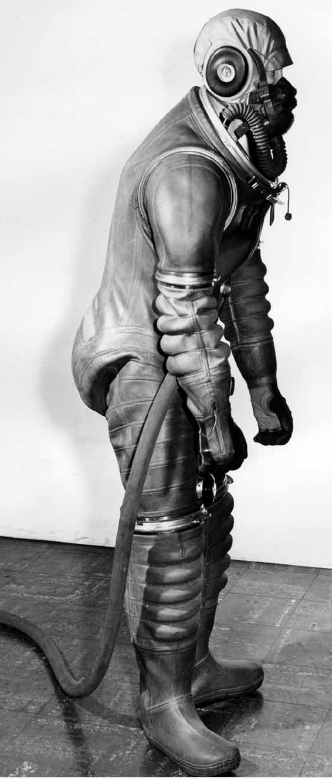
Interestingly, “[d]uring the summer of 1943, the U.S. Navy tested several of the Army pressure suits at the Naval Air Crew Equipment Laboratory in Philadelphia. LCDR Donald W. Gressly was the flight surgeon in charge, assisted by mechanical engineer L.W. Meakin ” (DfA p.60). One of these was an Akerman BABM suit, which seems to have been the BABM-18 (DfA p.62):
The suit was made of two layers of rubberized fabric, operated at 1.5 psi, and consisted of five pieces: an upper torso, trousers, a pair of gloves, and a helmet. Metal connecting rings at the neck, waist, and wrists secured the pieces together. There were leather straps running from the waist ring over the shoulders to
prevent rising and from the waist to the crotch to prevent elongation. A pocket under each armpit creased by thin wire aided mobility for the arms. Straps across the stomach and thighs provide breaking points in the inflated fabric for forward bending and sitting. Three clamps attached the gloves to a rubber gasket, and a standard Army harness and parachute was worn over the suit. There were five zippers on each suit: one 11-inch zipper on each side, one 11-inch zipper on the trouser at the waistline, one 11-inch zipper on the chest of the torso, and one 11-inch zipper on the back of the torso. In theory, flaps on the inner side of each zipper provided an airtight seal.
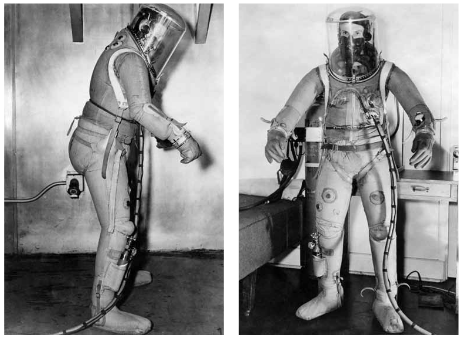
Ultimately, the US Army didn’t think that any of the suits that had been submitted were good enough to use. Similarly, the US Navy researchers concluded that they were “too heavy, uncomfortable, and not sufficiently ventilated to remove perspiration. Seemingly ignoring the state of the art in airtight fabrics, the Navy researchers believed any pressure suit should be made of a lightweight fabric, although they noted that the General Electric and Akerman suits, which used such fabric, tore too easily under pressure.” (DfA, pp. 67-68).
Note: DfA gives two references that I’ll need to track down:
- James V. Correale, “The Lightweight Full-Pressure Suit System of the U.S. Navy”, Air Crew Equipment Branch, Naval Air Material Center Philadelphia, 1959.
- “Navy’s Space Suit” Naval Aviation News, NavAer No. 00-75R-3, April 1953; “Developmental History of the Aviator’s Full-Pressure Suit in the U.S. Navy.”
The Strato Model 7
In 1947, the only US Navy full-pressure suit was the Strato Model 7, commissioned in 1946 from John D. Akerman under contract NOa(s)-8192. (DfA p.179) “The one-piece, tight-fitting garment covered the entire body except the face, which was covered by a detachable “goggle-mask.” [..] Two layers of nylon cloth provided protection for the neoprene sandwiched between them against local abrasions.” (DfA pp.179-180)
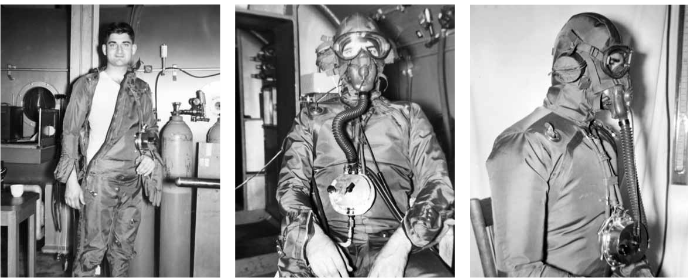
Five-finger gloves (as opposed to mittens) had zippers along the top to permit donning and doffing. The Model 7 glove used a custom zipper that was “tedious to close,” [..]. There was a neoprene diaphragm at the intersection of the glove and sleeve that allowed the suit to remain pressurized when the glove was removed. The gloves had separate ventilation and pressurization channels to provide comfort even when the suit was not pressurized.
The narrow-neck, close-fitting helmet covered the entire head and ears and was fabricated of the same material as the suit. Ventilation and pressurization of the helmet was through three flat, noncollapsible conduits that discharged air just above the ears and into the goggles. “Donuts” made of soft sponge rubber and chamois cloth protected the ears. The goggle-mask consisted of standard Navy goggles and
a pressure-breathing mask integrated into a single unit.
However, only a single Strato Model 7 was ever delivered to the US Navy, to fit “a very large man”.
It’s possible that the US Navy’s (single) Strato Model 7 was used, but all the same, I’d have to concede that the timing was extremely tight for this to have been used in July 1947. I’ll have to dig up the report from Akerman dated November 1947 and read more:
- Vernon G. Townsend, Vice President and John D. Akerman, Consultant, “Report on U.S. Navy Pressure Suit, Model 7, on Contract NOa(s) 8192,” November 15, 1947.
Note also that NARA has a record in Record Group 342 called “Flying Clothing – Strato Equipment Co.“, which I believe probably covers 1946-1947 US Navy correspondence with Strato (even though that’s an Air Force archival reference). I also suspect that David Clark Company may have more details.