
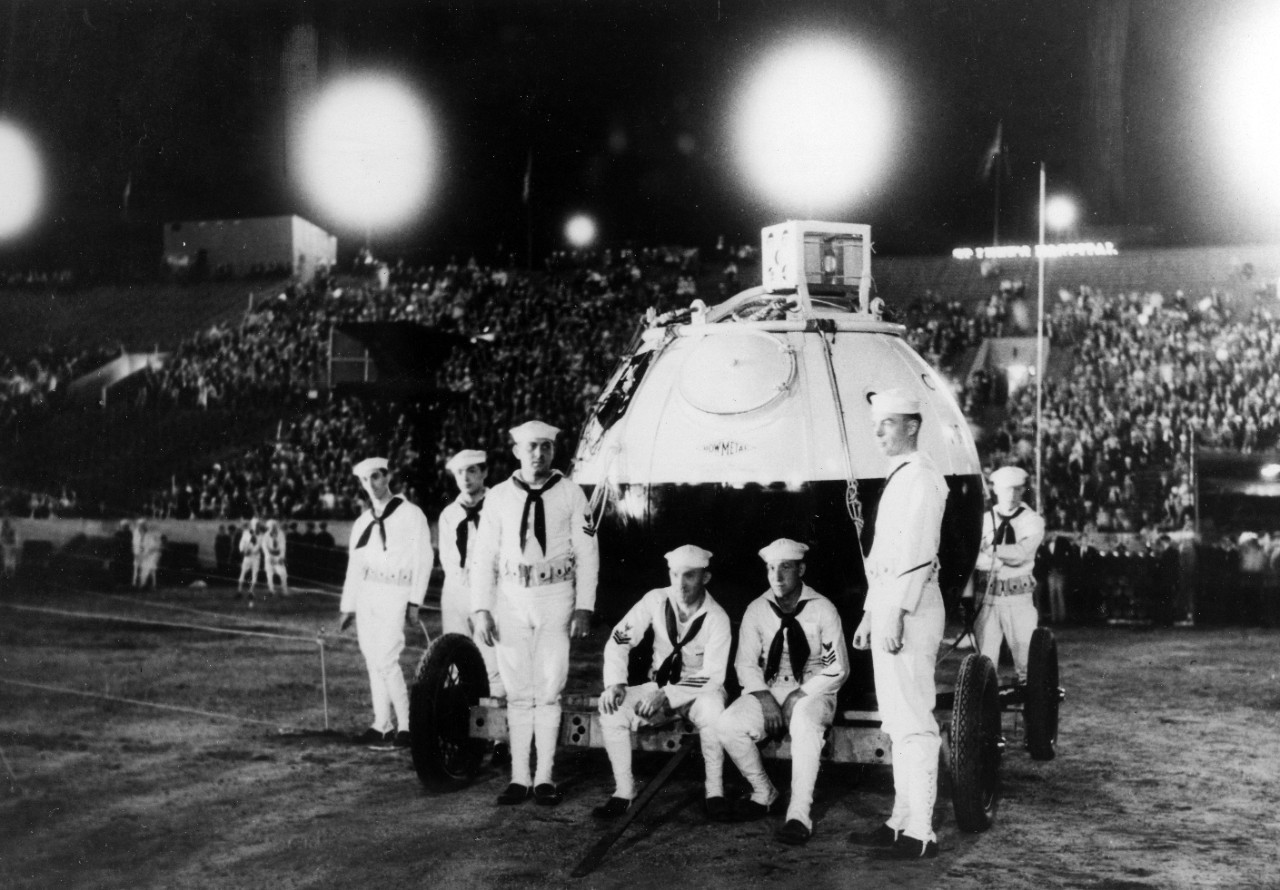
At 9:30am on 20th November 1933, US Navy Lt.-Cmdr. Thomas G. W. “Tex” Settle (assisted by US Army reservist Major Chester L. Fordney as his scientific observer) rose inexorably into the skies from Akron OH, in a pressurised gondola beneath a stratospheric balloon. Renowned balloonist Auguste Picard had been asked to pilot it, but had passed it to his twin brother Jean Picard, who in turn didn’t have a U.S. flying licence. Finally, after a load of political jockeying, Settle ended up at the helm. But to be fair, he was an astonishingly good balloonist. Here’s a picture of the gondola from Settle’s previous attempt in August 1933 (which had failed due to a faulty valve, yielding the headline “SETTLE UP! SETTLE DOWN!”)), protected by US Navy sailors:
As a side note, the world altitude record Settle set that day (18,665 meters) annoyed the heck out of Stalin, partly because the Russian balloon that had gone slightly higher earlier that year hadn’t been recognised by the FAI. One might argue, tongue only slightly in cheek, that this launched the Race for Space, and perhaps even the whole darn Cold War. Which is nice.
But Settle was an adventurer at heart, and wanted more – much more. So, even before setting the record he went to his friend Charles Burgess at BuAer (the Bureau of Aeronautics), and between them they cooked up an audacious plan to design a lighter, tighter gondola to go even closer to the edge of space…
The “Flying Coffin”
Well, it probably wasn’t called the “Flying Coffin” at first, but all traces of its original project name, number or reference seem to have disappeared. Perhaps assiduous searchers diving deep into the depths of Naval archive RG72 will be able to find more of a paper trail than I have managed so far (photos would be nice, but I haven’t found even one in the literature), but I won’t be holding my breath waiting.
Conceptually, the Flying Coffin’s design was simple (if not simples): a 7ft cylinder with rounded ends (so, more of a lozenge, really) made from the latest aluminium alloy, with just enough space inside it for an intrepid balloonist (Settle, undoubtedly) and a few lightweight scientific experiments to keep him company. My best guess is that the shell would have been 1/8″ thick, and so would have been half the weight of the Century of Progress (which was made of the magnesium alloy Dowmetal, and weighed 160kg). As a ballpark estimate, Settle flying solo in his Flying Coffin under the same Goodyear balloon could very possibly have gone 5km or more higher.
The design was easy: finding a project sponsor not so easy. But Settle had a plan for that too…
Admiral William A. Moffett
The late 1920s had been a time of intense inter-service rivalry between the US Army and the US Navy (the US Air Force was still part of the US Army back then), so Settle may well have pitched this as a record-breaking attempt (and to get one up on the Army). But Moffett – himself known as the “Air Admiral”, and the person who had founded BuAer in 1921 – was hugely into airships and balloons, and Settle knew him well. Honestly, I think Moffett would have wanted in, pretty much regardless.
And so Moffett approved Settle’s Burgess-designed gondola, and ordered it to be constructed at the Naval Aircraft Factory in the Philadelphia Navy Yard on League Island. Moffett was not only a master politician (he was a friend of Franklin D. Roosevelt) and Settle’s project’s sponsor but also its champion.
But then, on 4th April 1933, Moffett died when the USS Akron crashed into the Atlantic Ocean off New Jersey in thunderstorm, killing 73 of the 76 on board. This was the worst air accident for many years, and shook many people’s confidence in airships.
Not long after Moffett’s death (as with everything else to do with the Flying Coffin, details are scant), the project was halted: all the airship histories have to say is that the gondola was never fitted out, and so never made it into the stratosphere. The unfortunate death of its political champion coincided with budgetary backlashes against fanciful projects, all of which proved to be nails in Settle’s Flying Coffin.
What happened to it? My best guess is that, in its unfinished state, it ended up in the massive storage area in the (even more massive) Naval Air Station Lakehurst. Perhaps it will be visible in the corner of a historical photo somewhere, a speck almost too tiny to see against the scale of the airships docked there. I’ll keep looking…