
I first asked the question of whether there might be a mapping between the alchemical herbal manuscript tradition and the Voynich Manuscript in a 2019 post, having not long previously put up a post trying to link to scans of alchemical herbals. The fact that the Voynich Manuscript’s Herbal A pages originally (as far as we can tell) contained 97 plants and also that the (yes, very badly named) alchemical herbals list of plants has 98 plants is a coincidence I pointed out that is somewhat suspicious (but far from conclusive).
Always useful here is Philip Neal’s page on alchemical herbals. And more recently, Marco Ponzi published the Latin text of the alchemical herbals (compiled from various individual herbal manuscripts, because of various textual inconsistencies and lacunae). Minta Collins’ Medieval Herbals: The Illustrated Traditions is always good to have handy (though more to do with herbals than alchemical herbals).
And even though the book where this all really started was Vera Segre Rutz’s (2000) Il giardino magico degli alchimisti, I’d also now happily add Bryce Beasley’s 2024 thesis “Fantastic Herbals and Where to Find Them: Contextualizing and expanding the Alchemical Herbal tradition” to the list of resources I’d strongly recommend everyone interested read, particularly because it is downloadable online, and in English rather than Italian.
Beasley vs Segre Rutz
The first thing to note is that Beasley builds solidly on Segre Rutz: and while he is critical of various aspects of Segre Rutz’s foundational work (e.g. he argues that the suggested link to alchemy [e.g. via lunaria and herba folio] was inherently weak, whatever Aldrovandi thought; and he isn’t at all convinced by Segre Rutz’s use of hermeticism as a framework), his thesis is a complementary text rather than a replacement. Whereas Segre Rutz characterises the alchemical herbal tradition as having seven direct manuscripts and seventeen indirect manuscipts, Beasley extends this to 38 (though this is still far short of Toresella’s claimed 70). Note that (according to Beasley p.14, footnote 30) Segre Rutz seemed unaware of Toresella’s 1996 article on alchemical herbals.
Beasley, more generally, sees the alchemical herbal plants as falling into Jerry Stannard’s (1977) “magiferous” plants category, halfway between “magical” (fantastical) and “mundane” (real-world). For me, I suspect that Stannard’s three pigeonholes may be a little too neat, and that a lot of medieval manuscript copying was often done without any critical appreciation of the subject of the text (e.g. whether it made sense or had been miscopied), rather than a purely imaginary / fantastical plant.
Beasley’s list of 14 new manuscripts that would need to be added to the stemma codicum:
- Burlington, The University of Vermont Libraries, Ms. 2 (1475-1525) – http://cdi.uvm.edu/book/uvmcdi-108431#page/1/mode/2up
- Cassego, Museo Contadino di Cassego, Ms. 95 (1598)
- Civita Vaticanae, Biblioteca Apostolica Vaticana, Ms. Palatino Latin 1078 (16th century) – https://digi.vatlib.it/view/MSS_Pal.lat.1078
- Civita Vaticanae, Biblioteca Apostolica Vaticana, Ms. Chig.F.VII.158 (15th century) – https://digi.vatlib.it/view/MSS_Chig.F.VII.158
- Firenze, Biblioteca Riccardiana, Ms. Ricc. 217 (2nd half 15th century) – http://teca.riccardiana.firenze.sbn.it/index.php/it/?view=show&myId=c2322fb2-de37-4c8c-afa7-9b189c1421fc
- Firenze, Biblioteca Medicea Laurenziana, Ms. Redi 165 (15th century)
- London, Natural History Museum Library & Archive, Mss. Her. (early 16th century)
- Lucca, Biblioteca Statale di Lucca, Ms. 196 (15th century)
- München, Bayerische Staatsbibliothek, Ms. Cod.It. 149 (16th century) – https://www.digitale-sammlungen.de/en/view/bsb00094611?page=,1
- Paris, Bibliothèque du Muséum national d’histoire naturelle, Ms. 326 (1487, Italy) – https://bibliotheques.mnhn.fr/EXPLOITATION/infodoc/digitalCollections/viewerpopup.aspx?seid=MNHN_MS326
- Paris, Bibliothèque Sainte-Geneviève, Ms. 3369 (16th century) – https://portail.biblissima.fr/ark:/43093/mdata2dd6ccc38b17c6dfcaed56f293413d1cd0b268f7
- Philadelphia, Kislak Center for Special Collections, Ms. LJS 46 (early 16th century) – https://bibliophilly.library.upenn.edu/viewer.php?id=Oversize%20LJS%2046#page/12/mode/thumb
- Philadelphia, Kislak Center for Special Collections, Ms. LJS 419 (15th century) – https://bibliophilly.library.upenn.edu/viewer.php?id=Oversize%20LJS%20419#page/1/mode/thumb
- Udine, Biblioteca Civica Vincenzo Joppi, Ms. 1161 (15th century)
As an aside, Cipher Mysteries readers may possibly remember Ms. Chig. F.VII.158 from Alexandra Marracini’s work.
What next?
As is so often the case, even though Beasley’s thesis collects together a lot of useful information and makes it accessible, he doesn’t attempt to build up the tree of manuscripts and their (often hard to pin down) relationships. Hence, there as yet is no definitive (or even semi-definitive) ‘map’ of which herbal begat which other herbal etc: all we have is Segre Rutz’s tree for the seven direct tradition manuscripts (Beasley, p.40):
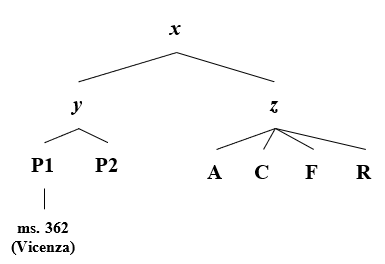
Here (as per Segre Rutz, p. XC):
- P1 = MS Lat: 17848
- P2 = MS Lat: 17844
- A = MS Aldini 211
- C = MS Canon. Misc. 408
- F = MS 18
- R = MS 106
- ms. 362 = Vicenza MS 362
- x, y, z = (missing manuscripts)
Beasley does point (p.66) to evidence that MS LJS 46 is “likely a descendant of” MS 106. Similarly, he does suggest that München, Bayerische Staatsbibliothek Ms. Cod. It. 149 may be “similar to Ms. Pal. Lat. 1078 and other manuscripts from the indirect sub-tradition” (p.60).
There are also lots of other nice details: for example, on Lucca MS 196 fol. 106r, a “left flower has a small note of a “bi” which likely is a note telling the painter to leave the flowers white or bianca in Italian”. (p.58)
What specifically set me thinking today was Beasley’s note on the Natural History Museum herbal (Mss. Her.) on p.56 that discusses the order of the alchemical plants, which I knew about but hadn’t really thought about for a few years:
The beginning 16 herbs perfectly copy the order of manuscripts Ms. 18, Ms. 106, Ms. Lat. 17848 and Ms. Aldini 211 and with a couple of exceptions Ms. Canon. Misc. 408, Ms. 17844 and Ms. 362.
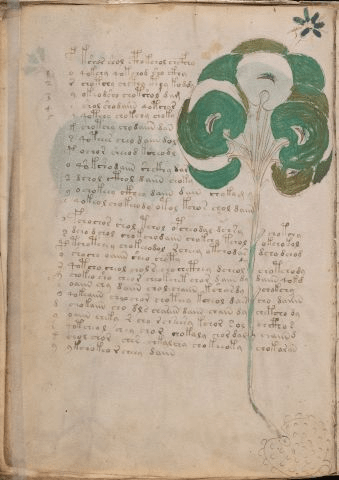
And so my thought for the day is this: has anyone tried to form candidate mappings between pairs of Voynich Manuscript herbals pages (i.e. on the two sides of a folio) with pairs of adjacent numbered images in the alchemical herbal tradition? That is, it has always been easy to speculate about a single-page connection between (say) the snakes / worms in the roots of the plants on Voynich Manuscript f49r and alchemical herbal plant 74 (herba forus, which also has snakes / worms in some manuscripts): but it’s hard to go beyond mere speculation with any confidence. So my point is that in this example we should perhaps also be thinking about f49v (on the rear side of the same folio as f49r) and alchemical herbal plant 75 (the next one along) to see if there’s a connection there too.
So, let’s have a quick look. Voynich Manuscript f49v looks like this:
Alchemical herbal plant 75 is herba capalarices, which (in the manuscript used by Marco Ponzi) looks like this:
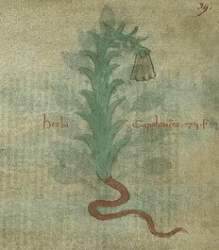
In this case there’s no obvious match, sure: but it would only take a single unexpected pair of images to be matched for us to smash through this wall. Well worth a further look? Yes, definitely. Definitely!
Thanks, Nick.
Diane: well, so much for Tavi’s welcome to Ninja one and all. All excepting those non entities with Revisionist leanings that is.
John,
I’m not sure what you mean. Have you read Beasley’s thesis? What do you think of that paper and of what Nick has to say about it?
It’s good to keep a sense of relative importance, so we don’t become flat earthers thinking the universe revolves around this site, or ninja (or my blog..).
On academia.edu for example, Dr. Cheshire’s work has more subscribers than ninja’s total membership since its inception, 3 times more subscribers than Nick’s blog and slightly less than 10 times so much more than mine.
We are not the centre of the online ‘Voynich universe’ and the wider world probably cares more about what Cheshire says than what we do.
We may be like mice fighting over tiny crumbs of old – sometimes very old cheese. Nick has brought a juicy new piece of cheese for everyone to share and ..
*sigh*
Diane: aged Nzlnd Epicure beats your Nick’s juicy new laughing cow cheese by a .. *sigh*
It is actually the navel of Venus.
Described in ‘Pliny the Elder (23-79 AD), The Natural History. ’
It appears a few more times afterwards. Nice to see the navel-shaped leaves and the tuberous root.
https://www.pantagruelion.com/500904/
I still have old Greek example pictures (I think ÖNB) here.
Someone once translated the Greek name as cotyledon. Whatever it may mean.
https://www.facebook.com/photo/?fbid=1714303415458972&set=g.504064963036643
Not so interested in f49v but don’t let ’em rattle ya.
More interested in Beasley’s herba folio. Been looking into his comments and I think somewhere along the line the wrong sense of ‘temperare’ was chosen.
Post should be up in a couple of days. or maybe less.
Very pleased to see this relevant blog post about the Voynich MS!
Rene: I try to post positive new stuff here, but it can take a while to find it… 😶
What should a scientist see and read on f 49v. The text says: On the tuber is the sign C. This shows how many years the father lived.
So every scientist counts the signs of the letters = C. If he counts well. Then he will find out that there are letters C = 41.
Further in the text it says: The father was born in 1431. (That’s when Jan II. of Rožmberk was born. He was Eliška’s father.)
1431 + 41 = 1472 = Eliška’s father died. He died of the plague.
Further in the text it says: What is the color of the rose of the caste?
Plant, Flower = green. = The Rosenberg family had a = Green rose in its coat of arms.
On the stem is drawn = heart. That heart is in the sentence where Eliška writes. That she loved her father.
So how should a scientist work. He should know the old Czech language. He should also know the Jewish substitution cipher. He should also know the history of the Rosenberg family.
Fellow scientists. The manuscript is very difficult to translate. This is not a simple substitution cipher. Here you need to master the Kabbalistic numerological system perfectly. This is a very complex substitution cipher.
Let me give you an example. I translated the entire page in 3 hours.
The scientist is certainly investigating why 1.2.3.4.5 is written in the upper left.
That means 5 sons. And therefore 5 colors. The family had a Rose in its emblem. 5 colors of roses. So the flower has 5 colors.
So that the scientist understands it well. So he can find it on Wiki = Division of roses. It is written there. 5 sons = 5 colors.
The family of Rosenberg = green rose.
Hello All,
I am happy and more than a little surprised to see that anyone on earth has taken the time to read through my thesis. While I have very little to say about the Voynich, I can say that I am continuing research on the alchemical herbals. If of interest, I would be happy to make a note and send Nick a copy when there is something worth reading.
Thanks for taking the time to provide comments, I am particularly interested to hear what you all have to say about the thesis.
I see the warted tuber like growth as the plant base of f49v as being similar in form and leaf structure with a type of pre Colombian new world sweet potato. Anybody care to disagree, please do.
Hello Bryce Beasley, I’m always late to the party, but having just read your thesis through a link on the ninja, I wanted to compliment you as well as ask a few questions.
So great job!
First, I know the VMS is treacherous ground for serious scholars, but in your opinion, is it conceivable that the VMS might be part of the alchemical or magiferus tradition of Northern Italy, given that a strong contender for its place of production is Northern Italy? I’m not a medieval botanist, but followed fairly easily through all your well-written descriptions and saw potentially a number of similarities.
Secondly, the VMS herbal botanical section really emphasizes in most cases a differentiation between root, stem and flowers, whether through an actual root cut-off, colours, style changes, etc. it’s almost insistent in this differentiation. Before Paracelsus coined the term “spagyric”, medico-alchemists were already splitting plants into these three sections, operating on them separately, and then recombining them. Apparently this method increased the resultant medicine’s potency. Stylistically, did you see this appear as a pattern in any other of the illustrations you analyzed?
I’ve got tons more questions but these are these are the most ones for me!
Some things worth noting about the VMS:
1. The Beinecke 2014 image of f49v was badly mangled during processing. It was contrast-stretched in such a way that the brightest areas became overexposed. The texture of the parchment and some details of the drawing were lost.
2. The colors other than light yellow were almost certainly applied much after the figure outlines were drawn and the text was first written (in pen, with brown ink), and are mostly random. There is at least one page where the leaves were painted red and the flower green.
3. I used to think that the light yellow color, exceptionally, was original, applied by the same Scribe who drew the outlines and wrote the text. However, on f72r2 (Gemini) and f73r (Scorpio) there are missing stars which were added in yellow paint, without the penned outline. I see this as hint that the Yellow Painter was not the original Scribe. If he were, why didn’t he draw the outlines too, when he noticed the missing stars?
All the best, –stolfi
One of my children has just pointed out that there’s spooky thing about folio 50r. It looks as if the centre of the flower holds portrait of Lisa Fagin Davis.
I was dismissed as a spoil-sport for saying the illusion caused by a couple of glyphs showing through a hole in the vellum.
The theory is more fun, I guess. The manuscript prophesying the coming of a palaeographer. (smiley emoticon)
Jorge,
That bleaching-out only happened with the second set of scans. I recall when commenting on what one early scholar had said “the vellum is coarse even for the thirteenth century” – and adding that this was yet another item of many on the negative side of the balance for those attracted by a ‘German’ hypothesis, that one could clearly see the rough finish of the vellum, the hair-follicles and so on in the then-current scans. Hardly visible now. The same leaching-out affected calendar’s colour-values as you say. It changed the green stars too – so I had people come and mutter that they couldn’t see what I meant about those either. And don’t start me on the re-pagination, which is so utterly unwieldy for researchers, even if convenient for library systems. But there it is. I’ve often wished one could ask the Beinecke why these things were done. I tend to assume there was a reason which seemed good to them.