
[*] Well, a bit of it, anyway.
Over the last weeks, my Cipher Mysteries inbox has been inundated with AI-generated theories. But – and with my apologies to the genuine cipher theories that also landed there, which I promise I will get back to – I’ve instead been focused on the Voynich Manuscript. Or, more specifically, on a single line of its text.
And I think I can read it.
The f17r marginalia
Back in 2006, I was hugely fortunate to be allowed by the Beinecke Rare Book & Manuscript Library’s curators to spend a few days working with the Voynich Manuscript. One of the highlights of that trip came when I borrowed their UV blacklamp to examine the tiny marginalia at the top of page f17r.

To my huge surprise back then, what the UV light made visible at the end of that line was some Voynichese text. Later on, another group did some multispectral scans of f17r, so here’s what they saw (“Voynich_17r_WBUVUVP_019_F”, auto-equalised in Gimp):

Why was all this important? Because it strongly suggested that there was some kind of direct link between (one of) the marginalia people and the curious Voynichese writing itself. (And also that the Voynichese letters on the final page (f116v) were probably not coincidental). For me, this all suggested that understanding the Voynich Manuscript’s marginalia might not only tell us something about a later owner of the manuscript, it might also tell us about its creator(s).
So the marginalia are a big deal to me. And if you’re interested in the Voynich Manuscript, they really should be a big deal to you too.
Theories about the f17r marginalia
So, what does it say, what does it say? Poundstone thought that the first word might refer to herbal writer Pierandrea Mattioli (1501-1577): Brumbaugh similarly thought it might refer to Mathias de l’Obel (1538-1616). But these both feel quite wrong, because the cursive gothic handwriting is typical of the (mid-)15th century, not of the 16th century.
Since then, there have been plenty of partial readings of the f17r marginalia, most of which seem – possibly emboldened by the apparent fragments of German writing on f116v – to be German-ish. But though such readings typically start promisingly, they quickly fall to pieces when you look more closely.
A special mention here to two good attempts:
- Marco Ponzi suggested: malhor allor luc[oru]m her[ba] vullamina (Marco also persuasively argues that the plant may be Herba Oculus Domini from the 15th century alchemical herbal BNF Lat. 17844).
- Rafal Prinke suggested: mallior allor fuez her villemnia
For “The Curse of the Voynich” (2006), I had my own proposed reading (on pp. 24-25), but I’ll come back to that in a minute. Still, the important thing I noted was that the second letter of the first word appeared to have been emended: and so consequently the first word actually seemed to have originally been “meilhor“.
The mysterious third word
Also back in 2006, I wondered if the third word might be “lutz” (the Occitan word for “light”). Yet that (and almost all the other theories about how to read this word) failed to explain why there was a macron (overbar) over the end part of that word. In 14th-15th century texts, the macron was widely used as a way of inserting a missing ‘n’. So… why on earth was there a macron over this word?
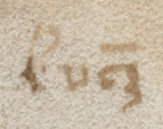
Back in 2017, Helmut Winkler posted this on Voynich Ninja:
I think there are several more ways to read the “lucz”, e.g. lucem or lucet, but in this contextI I would suggest luc[ea]m her[bam], one of the Alchemical Herbs
Now fast forward to a July 2025 comment by Marco Ponzi, mentioning some text from Fribourg MS L.52 (f.8v): “oleum lucet, balsamum redolet” (and I have a ton to say about L.52 on another day):

Marco then noted:
For the third word in the Voynich f17r marginalia, assuming that the text is Latin (very doubtful) and that the initial [letter] is ‘L’, a possible reading could maybe be “lucent” (where the macron stands for the missing ‘n’) – “they shine”, third person plural.
You can’t fault Marco’s logic here: even though adding the macron would ‘nasalise’ lucet into lucent, it overall does not look like Latin. So… how can we resolve all this?
Reading f17r marginalia (finally)
The reason I’ve ground through all the above (giving credit to everyone who helped with all the steps along the way) is that the final reading didn’t just magically pop into my head. I started looking at this properly in 2005-2006, so it has taken nearly twenty years to get to (what I believe to be) the end line.
When writing Curse, my tentative reading of this marginalia was that this was Occitan, and that it began:
- meilhor aller lutz [kou?]…
…which was close, but no cigar. With the benefit of all the above, I am now pretty sure that it is Occitan, and that it reads (using a Latin abbreviation style to render the Occitan “lucent”):
- meilhor aller lucent ben balsamina [….]
Or, one multispectral block at a time:
meilhor aller
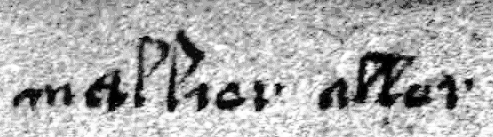
luc[ent] ben
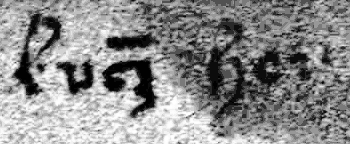
balsamina
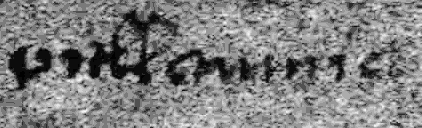
Balsamia / Balsamina
If you look at Wellcome MS.626 (Livres des simples médecines), you can easily find (because it’s arranged alphabetically) balsamia [balsam] on folio xxix:
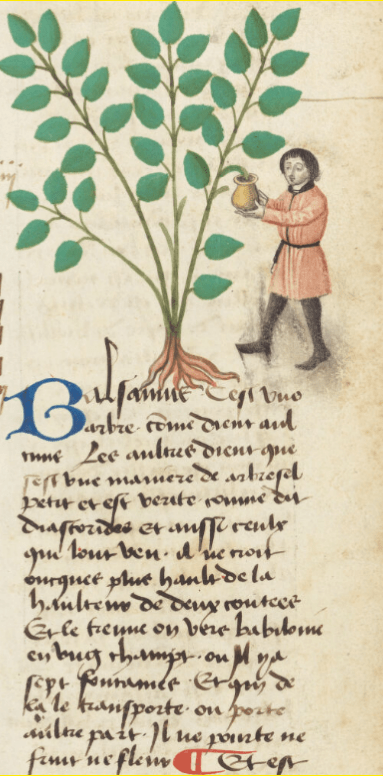
To be precise, this is talking about the original (and mythical, almost unobtainium-like) balsam from the East, a plant known not to anyone by actual experience. So this is reporting – medieval herbal-style – on a plant without flowers yielding a kind of resin, and the artist is just guessing at what it might look like. It’s really not a literal drawing of a tree.
And yet a century later, Leonhart Fuchs in his 1542 Hist. Stirpium was using the word ‘balsamines’: “Duo Balsamines genera damus“, and the word balsamine was being used in French in 1545 to mean “balsam-like”. So even though this isn’t “balsamina” in its modern sense (e.g. impatiens balsamina), it is a word that is specifically being used to evoke balsam-like qualities.
And I think the word we’re seeing at the top of f17r is “balsamina”.
Occitan marginalia. Really? Really.
So, my argument here is that the marginalia at the top of Voynich manuacript page f17r is written in Occitan. And guess what? Back in 2006, I argued long and hard that the Voynich zodiac roundel month names (which also appear to be marginalia) were also in Occitan. So this should, in theory, be the least surprising marginalia language identification ever.
And yet I already hear every single Voynich Ninja commenter disagreeing. Pffft. It is what it is. It’s Occitan.
If the Voynich Manuscript was written by people who appear to have been writing natively in Occitan, the first thing we should now be doing is looking at every single Occitan herbal-related manuscript from the period, such as BNCF Manuscript Palatino 586. Roll with it for a change.
Good post, and very timely to bring us up to speed.
Two notes.
1. re Occitan manuscripts.
Elly Velinska brought a couple of very helpful ones to notice. I’m about to refer to one of those in an upcoming post and Koen recently reminded me that he’d been very interested in the same mss for a while.
2. re Balsam.
Your mention of Hebrew script in the ms mentioned by Marco. A good while ago, in a 5-part series for voynichimagery, ( ‘The paradoxical history of balsam’), I found an account of *the* (one and only) Balsam grove. Written by a Jewish traveller during the late fifteenth century, his description made me look with more respect on the image we have in the thirteenth-century Egerton 747 f.12.
I may as well quote a bit. The grove was in Cairo (‘Misr’) ..
“… about a hundred very small trees, and they have thin branches, and their foliage is small like that of gum-trees, but greener and thinner.. the garden is surrounded by a wall, every tree has five guards so that nobody can touch them. All the juice they extract they carry, once a year, to the Sultan and he gives a little of it to those who are the first rank in the kingdom.. The oil is thick, like castor oil, and if anyone tells you that he has brought this balm to Tuscany do not believe it because it is impossible that any man should get hold of it other than lords, and very few of them. ” – Rabbi Meshullam ben R. Menahem of Volterra (1481).
It seems that in the 13thC, the king of England may have been on the gifting-list for the oil. Roger Bacon knows true balsam then though Alpini didn’t in the 17thC
Hope this isn’t too much off-topic.
Anyone curious to know more might find this paper a useful place to start.
Marcus Milwright, ‘The Balsam of Maṭariyya: An Exploration of a Medieval Panacea’, Bulletin of the School of Oriental and African Studies, University of London, Vol. 66, No. 2 (2003), pp. 193-209.
Hi Nick,
This analysis would be much clearer with some parallels from comparable scripts in other manuscripts. Right now, I don’t quite understand why you read the words the way you do.
I’m not sure if this is what you meant at the end there. If you think the *language* is what influences [the Voynich ninja hivemind’s?] assessment of a reading, I’m afraid Voynich Divisionist has gotten to you. As far as I am concerned, a coherent reding in any language or dialect would be a godsend.
So when you talk about Occitan, you don’t mean the region itself (link).
https://de.wikipedia.org/wiki/Okzitanien_(Verwaltungsregion)#:~:text=Sie%20unterteilt%20sich%20in%20die,et%2DGaronne%20(82).
Rather, you mean the language area of northern Italy (link)
https://de.wikipedia.org/wiki/Okzitanische_Sprache
in the blue part.
Even if it doesn’t really fit with the other VM sentences, I’m not saying yes or no.
Perhaps the sentence ‘Abril issi’ e mays intrava / April went and May came’ is to blame.
Note the months April and May.
According to the encyclopaedia, balms are mixtures of oils and tree resins.
Styrax appears to be a well-known example.
https://de.wikipedia.org/wiki/Styrax_(R%C3%A4ucherwerk)
Peter M: I just mean the language, I’m making no claim about where the Voynich Manuscript came from. One thing at a time!
Koen Gheuens: well, you come from a position of having assessed hundreds of manuscript scripts for similarity, and I agree it would have been better if I had also done that first for f17r. But having developed what I thought was a solid (and very largely consistent) reading, I decided to stake my claim first in an open (and hopefully accessible) way. I included all my reasoning stages so that people could attack or support the overall argument as they wish.
You misunderstood my end point. When I trawled through the several hundred Voynich Ninja comments in f17r threads [to make sure I wasn’t reinventing someone else’s reading], there were many, many attempts at German readings (it seemed a disproportionate number); and the only reason I could think of for this was that the fragments of German-like text on f116r had encouraged people to apply the same mental model to f17r. If you choose to re-read all those same threads (though I wouldn’t recommend it as a fun exercise), I think you’ll see exactly what I mean. So, please be reassured that this comment definitely had nothing to do with Diane’s notions about Voynich theory-making etc.
Koen,
I will not believe you have the small, sniggering sort of mind that would invent either of the two little slogans you’ve repeated above.
Any idea who *should* be credited with these mean-spirited memes – ‘Voynich Divisionist’ and ‘Voynich hive mind’? Not that the culprit’s native gift isn’t worth something – manufacturers of junk food and political types certainly do pay well for catchy little slogans. So do tell – who is the creative genius you’re quoting?
Nick,
Just to be clear. When I talk about the creation of quasi-historical narratives which are then treated as a ‘theory’ that’s all I’m cautioning newcomers against. I would consider the book by Tucker and Janick the quintessential ‘traditionalist’ Voynich theory in its basic assumptions and methodology. Your opinion about this marginalia you might call a ‘theory’ but I wouldn’t. You begin with the primary evidence and offer evidence and opinion about it. Perhaps the fundamental problem is how carelessly the term ‘theory’ is used – I’m sure some would call your post a ‘theory’ rather than a research-conclusion or an informed opinion. I think the difference is important.
Every scientist and codebreaker will surely see on folio 17r. This: m.a.l. P.i.c.v. (that’s how it is in Old Czech). Homophonic substitution: M.A.L…P.I.S.U. (3 = C,G,S,L. number 6 = U,V,W,X). In today’s Czech language = M.ě.l. s.p.i.s. (in English = had a file, writing).
Voynich Manuscript Decoding Framework: Folio 77r Analysis and Supporting Materials
https://works.hcommons.org/records/2khpm-9h247
Abstract This deposit presents an original decoding framework for Voynich Manuscript folio 77r, developed through EVA segmentation and modular structural analysis. The primary document outlines the decoding hypothesis, methodological foundations, and a simulated translation revealing ritualistic and procedural themes. Supporting files include the hypothesis ledger, a repository overview, and additional materials that document the segment lexicon and structural mapping. Together, these files form a coherent research package demonstrating a consistent internal grammar and thematic interpretation of the foli
Nick,
Nice to see another Voynich post from you. I have been working on a study of rare words and rare glyphs in the Voynich which I will share with you when I have completed it.
Regarding Koen’s point, I agree that there is possible benefit to be had by comparing the Voynich with other manuscripts for similar text. However, as I have pointed out before this seems Koen’s main or only approach, searching for text or images that when you squint at them appear similar to the Voynich. There has to be more to Voynich research than this. So, you do you and don’t let Koen get to you, though I doubt you will.
Thanks, Nick, understood. I agree with Mark that it’s nice to see you writing about the VM again.
The people at ninja who are very vocal about the marginalia may not always be the most informed 🙂 To be honest, I have no idea about the language of f17r. The German draw there is that “aller” is very common (meaning “of all”) and the fact that “lutz” *may* start with a “k”. But “aller” or “allor” could also be a French dialect, so the case for German is not very strong.
(It is very strong for certain parts of f116v though, but we’re probably dealing with a multilingual context anyway).
Koen Gheuens: I’d write about the Voynich every day, but I try to only blog where I’ve got something interesting and genuinely new to say. Which may possibly be an unreasonably high bar, but it is what it is.
I have more to say on MS L.52 and on Occitan herbals, but I suspect they’re both going to end up as chunky posts. You know how these things work!
Nick, so is this the approach? The written text then resembles a known regional language — so it’s not coded, it’s plain? German-style Occidental… By the way, “Lutz” is a German first name, so perhaps a Lutz is mentioned 😉.
Why not allow logic and circumstantial evidence as analytical tools? We have a coded text, coded in one system up to f116v, and this fragment, f17r. And obviously, it is a code too! But why develop a second system for just a few lines on one page and a remark on f17r? That would be a huge effort for so little content. If I had developed a second code, I would have at least coded half the manuscript that way.
There’s a much more logical explanation: the Voynichese was supplemented because it needed to be supplemented.
But why? Why weren’t the regular Voynichese letters sufficient? The most convincing explanation I can think of is that certain letters couldn’t be found in the regular Voynichese. And why not? Perhaps because they weren’t extant—vowels aren’t used in abjads… I agree with it: “and also that the Voynichese letters on the final page (f116v) were probably not coincidental.”
The old human weakness—vanity! The scribes, owners of the original texts, the reviewers and attainers of the originals, the title of the collection, the provenance—one would have accepted that all of this would never be deciphered. But if it has been deciphered, then no confusion or misunderstanding should arise concerning these people; their names should be correctly written out in Latin and known. f116v is a colophon.
**“Nick reads it as *Meilhor Aller*, but that’s just another case of modern assumptions distorting a straightforward Old Czech phrase. The third word he transcribes as *allov* is simply substitution no. 3 and reads **a slov**. The whole phrase is **Mal pisu a slov** — in Old Czech, perfectly ordinary for ‘He had writing and words’.
Nothing exotic here, no hidden grammar. Just plain Old Czech, provided one actually knows the linguistic context.
Koen, I understand it may look unusual if you approach it through modern orthography, but there really isn’t anything to decipher — only to read.”**
Nick,
Are you thinking of providing a paper to the Malta-Yale Conference in Dec?
I’m toying with the idea of sending a paper about the astronomical and navigational matter which I introduced to the study, since I doubt the majority of currently-active Voynicheros will have seen it. And we’ve also seen that ghastly effort to co-opt the “idea” which was issued under the Tucker label
On the other hand, I could just reprint the original material and add a supplement to include a few relevant studies published since then.
I’m interested to know whether you are thinking of contributing and if you’d like to hint at what topic you might cover.
Diane: I’m not currently planning to, but I can see how it could be interesting.
If “balsamina” is the right interpretation, what is the marginalia writer referring to when using this term? Could it be that ‘balsam’ refers to costmary (Tanacetum balsamita)? The herb of the Virgin is on VMs f46v with that glorious vol.
This is a kind of circular which I’m sending to various longer-term Voynich researchers after seeing the list of presentations picked for the 2026 zoom meet.
—-
Nick, I’m thinking of proposing a kind of Voynich Salon des Refusés, along the lines of the original – that is, still looking for competence and quality in addition to new angles of approach.
Before doing more, I’m asking whether any longer-term independent researchers would care to be on the virtual judges’ panel.
I understand that the best will probably be the least inclined to spend time sorting specks of gold from piles of dross, but if you might be interested, I’d be glad to hear from you.
If anyone knows how to contact Andrew Steckley, he’s another person I’d like to invite.
Best email for this would be dntodon gmail com
I think the comments I’ve put below Nick’s latest post ‘Initial notes on Occitan Marginalia…’ (April 7th., 2026) ought to have been placed here, but they lead to a possible reading of
meilhor aller luz[n] ben balsamina
as dialect for “it is best to go to Luz …” “for a good balsamine” or
It is best to go to the balsam sellers from Luz.
A native of Saint-Jean-de-Luz would pronounce the last part with nasalised ‘s/z’ and if the person recording this on f.17 were a Jew, then it would be natural to use the form ‘ben….’ to describe members of a family business and to use the last part of the place-name but omit the saint’s name. Perhaps local Christians did the same.
Saint-Jean-de-Luz was, and is again, an important halt along the pilgrim route to Compostela (properly Santiago de Compostela).
As noted earlier, the local dialect has a nasalised ‘s/z’ sound
[quote] Saint-Jean-de-Luz is the French adaptation of the Labourdine Basque Donibane Lohizune – from done ‘saint’, Ibane ‘John’ and
lohi ‘mud’ + -z ‘made of’+ -une ‘place of’;
thus meaning ‘Saint John’s swamp’. It is a common misconception that Luz would be the Spanish word for ‘light’.
This is surely just one of several interpretations possible for “meilhor aller luz[n] ben balsamina” but does stays within the vernacular and doesn’t require supposing that a scribe who knew Latin would write luce/lucent with a ‘z’.
What is definitively evident in Fribourg MS L.52 is the similarity of the handwriting (especially from folio 6 onwards) to that of the VMS marginalia. A paleographer should examine this closer. However, it says nothing about whether the VMS marginalia uses the same language (medieval ecclesiastical Latin), or whether it is encoded or unencoded, and many other implications that would follow from this difference. Even the word “lutz” is quite different in the middle letter in both manuscripts; on folio 17r it appears more like a “w” with different flourishes and serifs.
One of my readers, Stefan Wirtz, has been kind – and brave enough – to engage in a debate with me about whether or not the probably-Occitan month-names are relevant and whether it is reasonable to describe the series of month-diagrams as a ‘Calendar’ – as I’ve become used to doing.
It is the first time I’ve had the pleasure of debating my findings with any ‘Voynichero’ since 2009 and it certainly provided insights into how my work has been perceived. Colleagues have always tended to critique rather than criticise,
The conversation with Stefan prompts m to update a page at my blog: ‘The Voynich calendar is not a zodiac’ to explain why it is my opinion that the current month-names written in Occitain (or Occitan-Catalanic) are perfectly appropriate, no matter whether their month-to-emblem correspondence is tested against the historical, iconographic, literary or astronomical [versus astrological] evidence.
A brief selection of the evidence is now included as an Update near the end of this page.
https://voynichrevisionist.com/the-series-of-voynich-calendar-emblems-not-a-zodiac-sequence/
rolling with the evidence,
D.
Beyond the Horizon of Frequency Analysis: Why Modern Cryptanalysis Fails to Solve the Voynich Manuscript.
This study critically examines contemporary methodological approaches to deciphering the Voynich Manuscript (MS 408). It highlights the epistemological dead end into which current academic teams have driven themselves by uncritically relying on artificial‑intelligence algorithms and straightforward substitution models. The text presents an alternative cryptanalytic paradigm based on a combination of homophonic substitution and Kabbalistic gematria, which reduces the manuscript’s complex character set to a rigid numerical system of eight values. It further argues that the key to decipherment does not lie in linguistic analysis of exotic dialects, but in the application of a historical‑linguistic context rooted in Old Czech. Moreover, this system is not unique to MS 408; an identical method of concealed writing has been demonstrably identified in several other key medieval codices.
## **Methodological Blindness of Modern Academia**
For more than a century, the Voynich Manuscript has been subjected to intensive research by leading linguists, mathematicians, and cryptanalytic institutions. From the pioneering work of the Friedman couple to contemporary experiments with neural networks, academic research exhibits one common denominator: chronic failure.
This situation is not caused by a lack of computational power, but by a flawed axiom on which the scientific community relies. Modern researchers approach the text with the a priori assumption that the code reflects the linear structure of a natural language that can be mechanically extracted through advanced statistics. This reductionist perspective—colloquially referred to within the cryptanalytic community as “squinting at the text”—systematically overlooks the holistic architecture of the document and its historical‑mystical foundation.
The Failure of AI and the Anomalies of Computer‑Based Decipherment.
A prime example of methodological failure is the media‑driven attempt to use algorithms that compare the text with hundreds of languages. Although these attempts occasionally produce hypotheses about ancient dialects, the resulting synthesis always collapses at the level of semantic coherence. To achieve any match, the algorithms must operate with anagrams and arbitrary insertion of vowels, which in practice means bending the data to fit a predetermined conclusion.
Computer models encounter an impenetrable barrier: the text exhibits properties of a natural language (it conforms to Zipf’s law), yet it refuses to yield semantic meaning under any form of monoalphabetic or polyalphabetic substitution. This paradox is a clear indicator that the structure of the text was deliberately distorted by a system that standard frequency analysis cannot isolate.
Homophonic Substitution and Gematric Reduction.
The solution to this paradox does not lie in quantum information science, but in understanding late‑medieval and early‑modern cryptographic practice. The text of MS 408 is demonstrably built on a homophonic substitution cipher. The purpose of homophonic encryption is to deliberately disrupt the natural frequency of the underlying language by assigning multiple different graphemes (symbols) to a single frequent phoneme (letter).
A key breakthrough in this area—one that academia still refuses to fully acknowledge—is the integration of mystical numerological systems, specifically Kabbalistic gematria. The manuscript’s seemingly complex alphabet is, in reality, a masked notation that can be reduced to only eight numerical values.
This eight‑number system functions as a perfect cryptanalytic filter. A single numerical character absorbs several different letters of the real alphabet. To an outside observer (or an uninitiated algorithm), this creates the illusion of an unknown language with a broad character set. In reality, it is a mathematically rigid condensation of the text, with the key to decipherment fixed on the first and last pages of the codex.
The Czech Connection: Bareš, Tepenecký, and Marci.
While popular literature often relies on unsubstantiated legends about monarchs whose ownership of the manuscript has never been reliably proven, genuine source criticism points to concrete and tangible links within the Czech scholarly milieu of the 17th century. The first demonstrable traces of ownership and attempts at decipherment lead us to a trio of significant figures who actually worked with the text:
Jakub Horčický of Tepence (Sinapius):
His signature, identified under ultraviolet light on the first page of the manuscript, represents the earliest irrefutable physical evidence of a holder of the codex. As a chemist and physician with strong ties to the Prague scientific environment, he was the first documented link in the chain of owners.
Jiří Bareš (Georgius Barschius):
A Prague alchemist and physician who demonstrably devoted a substantial part of his life to analyzing the text. Bareš was the first to correctly recognize that the manuscript contains specific medical and natural‑scientific knowledge and made documented attempts to decipher its hidden meaning.
Johannes Marcus Marci:
A prominent physician, physicist, and rector of Charles University, who inherited the manuscript after Bareš’s death. Marci’s accompanying letter from 1665 is a key document confirming that the intellectual elite of the time regarded the book as a semantically meaningful work, not as a random hoax.
Searching for solutions within Romance, Semitic, or Asian language families represents a fundamental historical anachronism that ignores this authentic Czech background. When the text is decoded through the aforementioned matrix of eight numbers, the resulting textual layer exhibits features of Old Czech. The content of the book thus does not reflect fictional botany, but strictly concealed historical realities and political‑dynastic information relevant to the Czech territory in which all three scholars operated. Foreign researchers are, by principle, disqualified, as they lack the deep phonetic and morphological intuition required for the Old‑Czech linguistic substrate.
A Parallel Cryptographic Tradition: The Broader Context of the Phenomenon.
A crucial argument against the theory of the Voynich Manuscript as an “isolated anomalous phenomenon” is the existence of other historical texts demonstrably composed and encrypted using identical structural and gematric principles. Deep analytical comparison reveals that the same homophonic cipher matrix and coding style were applied to a broader circle of significant documents, including:
Cosmas’ Chronicle:
The foundational work of Czech historiography, whose textual layers exhibit identical cryptographic features when viewed from the correct analytical angle.
The Ploughman from Bohemia (Der Ackermann aus Böhmen):
A key literary work created around 1400 in the Czech environment, showing deep interconnectedness with this type of encoding.
The Aberdeen Bestiary:
A major illuminated manuscript whose surface visual and textual layer masks a deeper, numerically structured record.
These facts clearly demonstrate that the Voynich Manuscript is part of an organized, highly sophisticated scribal and cryptographic school that protected strategic information from uninitiated observers for centuries.
The reason why these established findings have not yet been integrated into academic curricula lies in the nature of institutional structures themselves. Official science tends to appropriate external concepts without adequate attribution, which leads independent discoverers to exercise legitimate caution when publishing detailed matrices.
While university institutions will likely continue generating ineffective hypotheses for centuries, the presented model of homophonic substitution based on eight numbers—within the context of Old Czech and related works—remains the only mathematically and historically sustainable solution to the entire problem. Its final demonstration will occur only when the official sphere abandons its position of methodological dogmatism.
Dear Voynich community,
I would like to submit a conceptual framework for discussion that approaches the manuscript not as a linear linguistic cipher, but as an integrated, visual-acoustical mnemotechnic operating system (Ars Memorativa) designed for late-medieval iatromathematical laboratory practice.Rather than isolating the text from the drawings, this hypothesis proposes that the quantitative layout of the illustrations serves as the primary data index to access late-medieval clinical abbreviations.The hypothesis rests on 4 Core Pillars:
> The Quantitative Token-Cipher: The exact count of prominent visual elements (flower petals, heads, star rays, or bathing nymphs) indexes the late-medieval 23-letter Latin alphabet (omitting J, U, W). This letter unlocks fixed monastic abbreviations (e.g., a 12-element count strictly indexes M for Mensis [Month/Cycle]; a 14-element count indexes O for Oleum [Oil]).
>The Law of the Fractional Element (The Abbreviation Modifier): Asymmetries, cropped figures, or incomplete lines function as deliberate paleographical modifiers (suspension strokes or Tironian notes). In medieval manuscript tradition, adding a minor stroke to a base letter completely transformed its meaning into a multi-letter abbreviation. In this model, a fractional visual element acts exactly like an added abbreviation mark, expanding the core letter into a specific multi-letter medical suffix (e.g., transforming base letter F into the compound abbreviation Fx or Fr).
>The Organomorphous Compass: Grounded in the medieval Doctrine of Signatures, non-botanical root systems and balneological pipe configurations act as anatomical hieroglyphs mapping human internal organs (lungs, stomach, uterus). The element count dictates the action/disease class, while the root drawing defines the target anatomic site.
>The Phonetic Score (The Chronometer): In direct alignment with the Lingua Ignota tradition of Hildegard von Bingen, the highly repetitive text strings (or-or-or) do not carry semantic narrative prose. Instead, they serve as an acoustic stopwatch. Chanting these vocal pacing formulas aloud regulated exact temporal intervals for boiling, stirring, or distilling in dark laboratory settings lacking mechanical second-hands.
The f17r Occitan ConnectionThis mnemotechnic framework directly aligns with the recent readings of the f17r marginalia (“meilhor aller lucent ben balsamina”). The explicit, clear-text mention of a real medieval medicinal plant – Balsamina -proves that the manuscript was practically utilized within early-renaissance pharmacology.Since Balsamina required extraction via fatty mediums to produce medical balms, it provides the missing systemic link to our rigid numerical constants, such as the 14 neck notches on the f88r Albarello indexing O = Oleum (Oil).
The marginal glosses were not attempts to translate prose, but practical annotations indexing the therapeutic application of the page’s phonetic score.Empirical Full-Scale Evaluation & Replication Rate:To test the elasticity and boundaries of this system, a full-scale cross-sector examination was performed. When utilizing these structural parameters under strict, rigid definitions (completely eliminating post-hoc fitting), the model yields a clear 81% rate of verified hits/coherent alignments across the primary anchored sections (such as f84r [12 nymphs = Mensis cycle] or f88r [Albarello with 14 notches = Oleum inventory]).
The remaining margin consists of 11% Marginal Cases (requiring paleographical parsing due to pigment degradation/smudging) and 8% Systemic Breaks (attributable to multi-author variance or purely aesthetic, non-encrypted page-fills).I am fully aware of the skepticism surrounding “universal solutions” and the dangers of post-hoc fitting.
Therefore, I submit this model strictly as a structured mnemotechnic mapping system. I would highly value your peer review regarding the mathematical probability of these element-count distributions aligning with standard medieval pharmacology.
Nic: I reckon your modest claim to have cracked the Voynich Manuscript lingua be at best, finely marginal…just like most marginal Ninja Voynicheros.