
Some historical researchers like to track the known ownership of things, e.g. they follow the Voynich Manuscript’s ownership trail from Sinapius to Kircher all the way through to the Beinecke. For me, I couldn’t think of anything worse – I want to know about the prehistory of an artifact, its uneasy secret life long before it ever became shelfmarked, catalogued, pigeonholed, and memed.
Similarly, for the Roswell Incident, I want to know what did (and didn’t) happen right at the start, before people started weaving so many sophisticated stories around it. Anyway, I thought it would be helpful to post my reconstruction of the initial timeline of the Roswell Incident, because I think this differs in a number of places from other researchers. The sources I found particularly useful for doing this were:
- Carey and Schmitt’s 1999 IUR article “Mack Brazel RECONSIDERED“
- Schmitt and Randle’s “Roswell, July 9, 1947” in IUR Vol. 14 No. 6 (November/December 1989).
- Carey and Schmitt’s “Witness To Roswell” (revised edition 2009)
I’ve divided my account into three separate parts, because… well, you’ll see why.
Part 1: What ~Did~ Happen
30 June 1947 (Monday)
- Ranch foreman Mack Brazel is living in a shack without electricity or lighting on the J.B Foster ranch. His family live in Tularosa: they have not visited the ranch all month.
- Brazel rides out to a particular field to check on the sheep. He sees nothing unusual. (S&R p.4)
3 July 1947 (Thursday)
- Brazel, accompanied by 7-year-old neighbour Dee Proctor, returns to the same field. There he finds a load of thin metallic debris, lightweight beams, a circular burn mark and a big set of scrape marks.
- The sheep don’t like it, and won’t go through the debris, making Brazel’s life difficult
- Then, on another site a few miles to the east, Brazel finds “something” else (but nobody knows exactly what that was, even now).
6 July 1947 (Sunday)
- Mack Brazel goes into Roswell to visit Chaves County Sheriff Wilcox, specifically to complain about what he found in the field.
- While Brazel was there, journalist Frank Joyce (of KGFL) happened to call Sheriff Wilcox for any news (Joyce used to do this regularly)
- Wilcox gives Brazel the phone
- According to Joyce, Brazel tells them both about the “debris”, the “stench” and the “dead bodies” (S&R)
- Joyce: “Well, you know, the military is always firing rockets and experimenting with monkeys and things. So, maybe…“. Brazel: “God dammit! They’re not monkeys, and they’re not human!“
- Wilcox doesn’t believe Brazel.
- Brazel asks Joyce for advice, and Joyce tells him to call the air base.
- Brazel phones the US Army Air Force base and tells them about it
- Capt. Sheridan Cavitt and Bill Ricketts get sent out: they follow Brazel back to the site
- Cavitt and Ricketts return to the US Army base with debris
7 July 1947 (Monday)
- Bill Ricketts and Maj. Jesse Marcel go to the debris site
- They fill their respective vehicles with debris and go back to the US Army air base
- Marcel is bemused by what he think is curious geometric writing on the stick-like debris
- Joyce tells radio station KGFL owner Walt Whitmore, Sr. about Brazel
- Whitmore drives to the Foster Ranch, picks up Brazel, and brings him back to his own house in Roswell. There he records an interview with Brazel. Brazel then spends Monday night there.
8 July 1947 (Tuesday) – first part
- At 11am Mountain Time (MT), Roswell Army Air Field commanding officer Colonel William Blanchard announced the recovery of a flying disk. (WTR, p.40)
- Roswell Daily Record, July 8 1947, p.1, col. 6
- The intelligence office of the 509th Bombardment group at Roswell Army Air Field announced at noon today, that the field has come into possession of a flying saucer.
- According to information released by the department, over authority of Maj. J. A. Marcel, intelligence officer, the disk was recovered on a ranch in the Roswell vicinity, after an unidentified rancher had notified Sheriff Geo. Wilcox, here, that he had found the instrument on his premises.
- Major Marcel and a detail from his department went to the ranch and recovered the disk, it was stated.
- After the intelligence office here had inspected the instrument it was flown to “higher headquarters.”
- The intelligence office stated that no details of the saucer’s construction or its appearance had been revealed.
- p.1, col.1
- Reactions [from a a number of local citizens] ran the gamut from scoffs at the whole idea to serious thoughts that they represented experiments by the government. No one interviewed thought they came from sources outside the United States.
- p.1, col 7
- The Oregonian said today that Maj. Gen. Nathan F. Twining, chief of the AAF material command, told it flatly that the “flying saucers” are not the results of experiments by the armed services.
- Sacramento Bee, July 8 1947:
- ROSWELL (N.M.. July 8. – (AP) – The army air forces here today announced a flying disc has been found a ranch near Roswell and is in possession of the army. Lieutenant Warren Haught [sic], public information officer of the Roswell Army Air Field, announced the find had bee[n] made “sometime last week” and had been turned over to the air field through cooperation of the sheriff’s office.
- Higher Headquarters
- “It was inspected at the Roswell Army Air Field and subsequently loaned” by Major Jess. A. Marcell [sic] of the 409th Bomb Group Intelligence office in Roswell “to higher headquarters.”
- The army gave no other details.
- Haught’s [sic] statement:
- “The many rumors regarding the flying discs became a reality yesterday when the Intelligence office of the 409th (atomic) Bomb Group of the 8th Air Force, Roswell Army Air Field, was fortunate enough to gain possession of a disc through the cooperation of one of the local ranchers and the sheriff’s office of Chaves County.
- “The flying object landed on a ranch near Roswell some time last week. Not having phone facilities, the rancher stored the disc until such timas he was able to contact the sheriff’s officem who in turn notified Major Jesse A. Marcel, of the 509th Bomb Group Intelligence office.
- Inspected at Roswell
- “Action was immediately taken and the disc was picked up at the rancher’s home. It was inspected at the Roswell Army Air Field and subsequently loaned by Major Marcel to higher headquarters.
- The rancher’s name and the location of his place were withheld.
- George Walsh of radio station KSWS which provided first news of the announcement said only Major Marcel, Colonel W. H. Blanchard, commanding officer at Roswell, and the rancher had seen the object here.
- The sheriff, Walsh reported, upon receiving word from the rancher went immediately to the intelligence officer at Roswell Field.


Part 2: The US Army Takes Control (of the Narrative)
8 July 1947 (Tuesday) – second part
- Mack Brazel is brought in by the US Army, and interviewed at length
- Brazel (accompanied by MPs) gets marched round for a second interview with Frank Joyce.
- Brazel now tells Joyce a completely different story about what happened (S&R):
- Joyce: “The story is different, especially about the little green men.” Brazel: “Only they weren’t green.“
- Brazel is detained by the US Army for several days, and given an Army physical (WTR p.41)
- The US Army takes possession of the tape recording made by Walt Whitmore
- At ~4.30pm Central Standard Time (CST), General Roger Ramey (the Eighth Air Force commander and Blanchard’s supervising officer) gives his own press release. (WTR pp.40-41)
- This lays out the basic Roswell ‘narrative’ that the Army will use going forward
9 July 1947 (Wednesday)
- Roswell Daily Record, July 9 1947, “Gen. Ramey Empties Roswell Saucer”
- Ramey Says Excitement is Not Justified
- General Ramey Says Disk is Weather Balloon
- Fort Worth, Texas, July 9 (AP) — An examination by the army revealed last night that mysterious objects found on a lonely New Mexico ranch was a harmless high-altitude weather balloon — not a grounded flying disk. Excitement was high until Brig. Gen. Roger M. Ramey, commander of the Eighth air forces with headquarters here cleared up the mystery.
- The bundle of tinfoil, broken wood beams and rubber remnants of a balloon were sent here yesterday by army air transport in the wake of reports that it was a flying disk.
- But the general said the objects were the crushed remains of a ray wind [sic, Rawin] target used to determine the direction and velocity of winds at high altitudes.
- Warrant Officer Irving Newton, forecaster at the army air forces weather station here said, “we use them because they go much higher than the eye can see.”
- The weather balloon was found several days ago near the center of New Mexico by Rancher W. W. Brazel. He said he didn’t think much about it until he went into Corona, N. M., last Saturday and heard the flying disk reports.
- He returned to his ranch, 85 miles northwest of Roswell, and recovered the wreckage of the balloon, which he had placed under some brush.
- Then Brazel hurried back to Roswell, where he reported his find to the sheriff’s office.
- The sheriff called the Roswell air field and Maj. Jesse A. Marcel, 509th bomb group intelligence officer was assigned to the case.
- Col. William H. Blanchard, commanding officer of the bomb group, reported the find to General Ramey and the object was flown immediately to the army air field here.
- Ramey went on the air here last night to announce the New Mexico discovery was not a flying disk.
- Newton said that when rigged up, the instrument “looks like a six-pointed star, is silvery in appearance and rises in the air like a kite.”
- In Roswell, the discovery set off a flurry of excitement.
- Sheriff George Wilcox’s telephone lines were jammed. Three calls came from England, one of them from The London Daily Mail, he said.
- A public relations officer here said the balloon was in his office “and it’ll probably stay right there.”
- Newton, who made the examination, said some 80 weather stations in the U.S. were using that type of balloon and that it could have come from any of them.
- He said he had sent up identical balloons during the invasion of Okinawa to determine ballistics information for heavy guns.
- Roswell Daily Record Chronicle, July 9 1947
- W.W. Brazel, 48, Lincoln county rancher living 30 miles south east of Corona, today told his story of finding what the army at first described as a flying disk, but the publicity which attended his find caused him to add that if he ever found anything short of a bomb he sure wasn’t going to say anything about it.
- Brazel was brought here late yesterday by W.E. Whitmore, of radio station KGFL, had his picture taken and gave an interview to the Record and Jason Kellahin, sent here from the Albuquerque bureau of the Associated Press to cover the story. The picture he posed for was sent out over the AP telephoto wire sending machine specially set up in the Record office by R. D. Adair, AP wire chief sent here for the sole purpose of getting out the picture and that of sheriff George Wilcox, to whom Brazel originally gave the information of his find.
- Brazel related that on June 14 he and 8-year-old son, Vernon were about 7 or 8 miles from the ranch house of the J.B. Foster ranch, which he operates, when they came upon a large area of bright wreckage made up on rubber strips, tinfoil, a rather tough paper and sticks.
- At the time Brazel was in a hurry to get his round made and he did not pay much attention to it. But he did remark about what he had seen and on July 4 he, his wife, Vernon, and a daughter Betty, age 14, went back to the spot and gathered up quite a bit of the debris.
- The next day he first heard about the flying disks, and he wondered if what he had found might be the remnants of one of these.
- Monday he came to town to sell some wool and while here he went to see sheriff George Wilcox and “whispered kinda confidential like” that he might have found a flying disk.
- Wilcox got in touch with the Roswell Army Air Field and Maj. Jesse A. Marcel and a man in plain clothes accompanied him home, where they picked up the rest of the pieces of the “disk” and went to his home to try to reconstruct it.
- According to Brazel they simply could not reconstruct it at all. They tried to make a kite out of it, but could not do that and could not find any way to put it back together so that it would fit.
- Then Major Marcel brought it to Roswell and that was the last he heard of it until the story broke that he had found a flying disk.
- Brazel said that he did not see it fall from the sky and did not see it before it was torn up, so he did not know the size or shape it might have been, but he thought it might have been about as large as a table top. The balloon which held it up, if that was how it worked, must have been about 12 feet long, he felt, measuring the distance by the size of the room in which he sat. The rubber was smoky gray in color and scattered over an area about 200 yards in diameter.
- When the debris was gathered up the tinfoil, paper, tape, and sticks made a bundle about three feet long and 7 or 8 inches thick, while the rubber made a bundle about 18 or 20 inches long and about 8 inches thick. In all, he estimated, the entire lot would have weighed maybe five pounds.
- There was no sign of any metal in the area which might have been used for an engine and no sign of any propellers of any kind, although at least one paper fin had been glued onto some of the tinfoil.
- There were no words to be found anywhere on the instrument, although there were letters on some of the parts. Considerable scotch tape and some tape with flowers printed upon it had been used in the construction.
- No strings or wire were to be found but there were some eyelets in the paper to indicate that some sort of attachment may have been used.
- Brazel said that he had previously found two weather balloons on the ranch, but that what he found this time did not in any way resemble either of these.
- “I am sure what I found was not any weather observation balloon,” he said. “But if I find anything else besides a bomb they are going to have a hard time getting me to say anything about it.”
Part 3: What ~Didn’t~ Happen
Schmitt and Randle‘s (1989) “Roswell, July 9, 1947” lays out numerous ways in which the US Army’s (Part 2) account was not only different from the (Part 1) account, but also manifestly false. They point out:
- The suggested date of the incident (14th June 1947) was wrong
- Brazel was alone at the ranch
- Brazel did not go to the site with his son Vernon
- The description of the debris changed
- The lettering on the debris did not look like English letters at all
- New details (such as the “flowered paper tape […] bearing the initials D.P.“) got added
- Brazel did not go to Roswell to sell wool on the Sunday
- Brazel did not try to make a kite from the debris
For an event which the US Army clearly wanted to downplay, it seems as though an awful lot of things they wanted people to think did happen didn’t happen.
In fact, I’d contend that S&R’s assessment that the US Army replaced the Part 1 narrative with its own (entirely false) Part 2 narrative has become an axiom of modern Roswell Incident research. And yet all subsequent US Army and US Air Force accounts rely completely on the Part 2 account.
One Event, Multiple Cover Stories
S&R think that “the [July 9th] article is the result of a cover story in the making. It is filled with lies that first hand testimony has recently exposed.” (p.23) And while I think this is essentially correct, I’d add that there actually appear to be not just one but multiple cover stories at play here.
Firstly, S&R describe (p.6) a superficially-similar story from Circleville OH: “On July 5, 1947, Sherman Campbell found a strange object on his farm in Circleville, Ohio. The local sheriff identified it immediately as a weather balloon, and on July 6 there were pictures printed in papers around the country of Mrs. Campbell holding the kitelike structure.” Here’s a picture from Patrick Gross’s useful site, printed in the The Columbus Citizen, Columbus, Ohio, USA, on July 6, 1947:
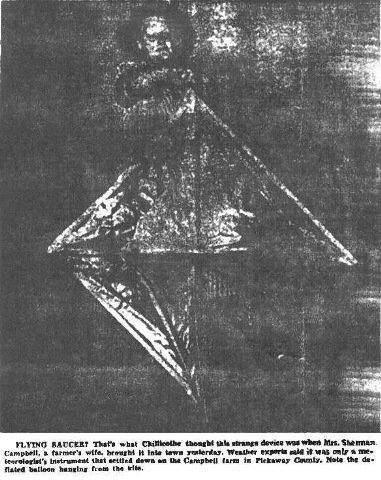
So, the first cover story would simply appear to be: ‘it was a kite-like weather balloon, like the ones in Circleville that had been in the news in the previous few days‘. (They didn’t mention Rawin at first, but that is what this first cover story seems to have evolved into.)
But if you accept that, there must also have been a second cover story, one consistent with sliding the date backwards by more than a fortnight, and with the “flowered paper tape” that was added to the narrative. Neither of these was consistent with the first cover story, so why complicate things?
My own belief is that one of the first things the US Army people did was check to see if the debris in the field found by Mack Brazel might have been from (their own) Project Mogul. And then when they found it wasn’t, I believe that they planted details to make it look as though it might have been. Either way, I think it’s clear that they spoke with someone on the Project Mogul team (perhaps even Charlie Moore, why not?), and that was where the flowered paper tape and the earlier date came from.
If that’s right, then the second cover story in the US Army’s evolving smorgasbord of cover stories was: ‘it was a Project Mogul high-altitude balloon‘. Of course, it wasn’t that at all, but here we are.
So, years later, when Charlie Moore is looking at the US Army’s Part 2 version of events, he can say – hand on heart – that it looks like a Project Mogul balloon (because of the planted flower tape detail) and the timing is kind of consistent with one of the missing Project Mogul balloons (because of the planted date shift). But this is, of course, fake logic, because the whole lot is built not on the (real) Part 1 narrative but instead on the (fake) Part 2 narrative.