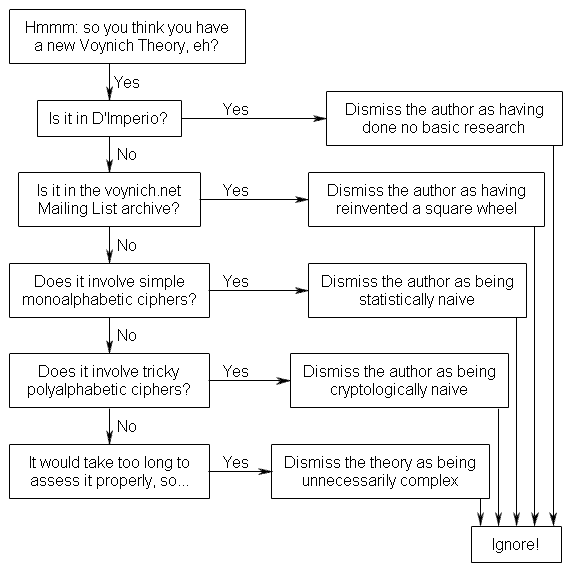
Peter Marshall’s (2006) “The Mercurial Emperor: The Magic Circle of Rudolf II in Renaissance Prague” takes a sideways look at everyone’s favourite mad Holy Roman Emperor, by using those around him as a kind of slightly wonky mirror. The choice of who makes the cut is a bit arbitrary in places: John Dee (who never came close to gaining Rudolf’s favour) gets rather more coverage than I think justified, however much some Voynicheros happen to like him. 😉

By using the Imperial court to cast light on the man in the middle, it is reminiscent (and perhaps consciously so?) of John Christanson’s “On Tycho’s Island”, which does much the same thing for Tycho Brahe (who features here too, of course).

Even though Marshall does sometimes feel compelled to thicken up his text with Wikipedificatory asides, overall you can’t help but enjoy the ride – it’s a basically good book. What you end up with is a feeling for Rudolf’s overall character arc, from his ultra-stiff Spanish upbringing, through the alchemical / astronomical / allegorical golden years, to the slow-motion showdown with his bluff soldier brother Matthias (which Rudolf lost, if you didn’t already know).

For me, the biggest takeaway I got from the book came from the raking light it cast onto Rudolf’s relationship with art. His collection of paintings was not, as Warburgian historians formerly liked to believe, imbued with Neoplatonist symbolic power, their artists digging deep into the cultural psyche to tease out deeper archetypes from myth and legend, which only heroic modern ‘symbologists’ (*ack* *spit*) could ever decode. Oh, no: it’s far worse than that; and perhaps worse even than Charles Hope’s art historical cynicism would put it. I think Rudolf’s all-star proto-Mannerist painters spent their time constructing his Imperial Internet pr0n browser: the vision that is conjured up for me is of them feverishly thumbing through their emblem books (etc) finding stories that prominently featured young women, and then ‘artfully’ arranging them on the canvas for maximum fleshly exposure. Shame on me for even thinking it, but ultimately Rudolf’s gallery reeks more of “Beavis and Butthead Win The Lotto” than anything else. Uh huh, huh. *sigh*

But I digress. 🙂

Marshall’s book did have one complete laugh-out-loud moment for me, which made my wife chuckle too (no mean feat). The engraving on p.151 depicts Nostradamus in a magic circle, conjuring up a procession of future kings of France for Catherine de Medicis in a “magic mirror” (not much to do with Rudolf II, but a fun picture all the same). I looked at it and thought – that’s not a mirror, that’s a bloody big plasma TV he’s got there. But perhaps you disagree?
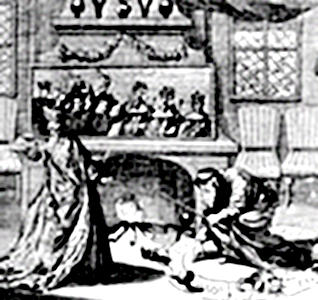
Nostradamus showing off his widescreen TV to the Queen of France

Enjoy! 😉

As I mentioned recently, I’m working my way through James E. Morrison’s book “The Astrolabe”: seeing so many astrolabes at the Museum of the History of Science in Oxford was good fun, but I still want to get all the maths and celestial mechanics straight in my head – I’m never really happy until I get Art and Science in some kind of balance. Curiously, I worked for a camera company (/*you know who you are*/) not so long ago where stereographic projection (as used in astrolabes) is central to its business: isn’t it strange by how little maths has changed over the millennia?

But before the astrolabe, there was a set of objects known as anaphoric clocks (as mentioned by Vitruvius, De Architectura, Book IX, Chap. 8, 8-15): the Tower of the Winds in Athens is generally believed to have had one of these. These are deceptively simple objects, comprising a wire framework top layer (known as a “spider”) to represent the hours of the day, and a backlayer containing both a stereographic projection of the night sky and a circle of peg holes marking the sun’s position as it moves through the zodiacal year.  (All basically as per Morrison, “The Astrolabe”, pp. 33-34).

And now Kansas City is host to a brand new (and really quite funky) anaphoric clock, thanks to local artist Laura DeAngelis (with help from Peregrine Honig), as well as the advice and calculations of Jim “Mr Astrolabe” Morrison himself. If you happen to be in Kansas City unexpectedly (for example, if you click your heels, Dorothy), why not have a look for yourself? The anaphoric clock is in the Oppenstein Brothers Memorial Park, and I think it’s just fabulous (but I would, wouldn’t I?)

Cover for Christopher Harris\' forthcoming Voynich-themed novel \I’ve had a nice email from Chris Harris, whose upcoming Voynich Manuscript-themed novel “Mappamundi” (which I mentioned here in June) is due for publication on 29th January 2009. Published by Dedalus, it’s a non-Byzantine sequel to his earlier Byzantine trilogy (if that makes sense): a teeny weeny version of the cover is on the right here.

Which reminds me… an article at the back of this month’s History Today (yes, that issue) made a rather striking claim: that historical fiction steps in to fill the gap left by historians, who have become unable to answer the basic question “What happened?” because they are so hogtied by postmodern notions of relative truth. Hmmm… as with all great lies, there’s a kernel of truth in there. My own take is that there are now so many types of history – archival, social, urban, intellectual, cultural, moral, religious, Marxist, propagandist, technological, political, codicological, forensic, etc – each with their own types of problematic, enquiry, methodology and even truth, that it can be hard to blend them together to tell a complete story. And while it is true that historical fiction offers the hope of a reconstructed holistic history, so too does the best historical scholarship.

Ultimately, I think that history is like a shattered cup, whose shards offer historians multiple ways of piecing them back together: and that once in a while, with just a little luck, we might by doing so glimpse a hitherto unseen Grail, tentatively reconstructed through our persistence and industry. Perhaps this is the romance of History (whichever subfield of it you happen to subscribe to), where novelists dramatize not just the texture of historical events, but the process of historical discovery too – is the romance in the history, or in the historian?

Do you fancy a little personal journal with a front cover loosely inspired by the VMs (the plant at the top of page f18r, to be precise)? If you do, someone called “Black Pepper” has put her design on CafePress… just in case you have $14 to burn. Alternatively, here’s a Voynich Manuscript-themed screensaver from Amaranth Publishing for a mere $2.

And here’s Thomas Maska’s Avallaen font, inspired by Voynichese lettering: he made it for his conlang [constructed language], also called Avallaen, supposedly “spoken by approximately 35 million people on the northern end of Escerna, a massive volcanic continent in the N’ra Teoi (Great North Sea).” I quite like the way the digits are formed from gallows with different numbers of bars. Oh, and don’t forget, ägloinniyüvoih pōvlen üevs erüs.

Onwards to the fine arts: and I’d have liked to show you an image of Danielle Rante’s mixed-media drawing called “Voynich Secret History” here (this won the 2008 Ohio Arts Council Professional Award), but she didn’t return my email. Oh well!

And there was a 2005 piece similarly called “Voynich Secret History” (though this was a 4-5 minute film by artist Katherine Parker). Her interests include:” the redemption of kitsch, archetypes, and Märchen (German fairytales)“. Yes, I’d say most of the stuff that’s written on the VMs does read like almost-unredeemably-kitsch German fairytales, so perhaps she’s touching on a deeper truth here. 🙂  Her description of the film is that “Dormant plants, winter snow, steam, and drawings based on the Voynich Manuscript are metaphors for latent, hidden and lost knowledge“. All of which sounds rather pleasant, & perhaps one day I’ll see that too…

Enjoy! 🙂

Word just in from my friend Peter Nockolds, concerning some John Dee Anniversary events…

Magus John Dee died 400 years ago, either this year or next, and to mark this there are a series of events in Mortlake Parish Church where he was buried (although the grave isn’t marked). These begin with a talk tomorrow evening, Tuesday 23rd, at 8 by Benjamin Woolley. Author of ‘The Queen’s Conjourer, the Art and Magic of Dr Dee’. The talk is entitled ‘Cosmos in a Cottage’, and is an attempt to reconstruct something [like] Dee’s house in Mortlake, drawing on a variety of sources.  […]

The Church, St Mary the Virgin, is in Mortlake High Street, about five minutes walk from Mortlake Station (Network South East) and is on the 209 bus route from Hammersmith. Admission is £7 with proceeds to the Mortlake Tower Appeal

And according to http://www.wherecanwego.com/Search/ViewEvent.aspx?e=215740 , there are three more Dee-themed lectures on the Tuesdays following:-

  • Sept 30th – Elizabeth Callingham Garton – The man who invented the British Empire
  • Oct 7th – Robin Cousins – In the Footsteps of John Dee
  • Oct 14th – Nicholas Dakin – The Confidential Life of Doctor Dee

“Tickets are £7 or £25 for 4 in advance – ring Anne Reeves 020 8876 6616”

TVE, the Spanish national TV company, wanted to interview me about my History Today telescope article. For visual props, they requested a 17th century telescope and a copy of Girolamo Sirtori’s book – fair enough. A quick search of COPAC revealed eight copies across the UK: but what jumped out at me from the list was that there was a copy at the Museum of the History of Science (“the MHS”) in Oxford, which I knew had a fair few telescopes – and so I suggested the interview be carried out there. Plus, I’d wanted to go there for years and years. 🙂

All of which is how I ended up having a nice day out in Oxford. Though the MHS has all kinds of historical scientific gubbins (particularly the basement, which vividly brought to mind Thomas Dolby and Magnus Pyke singing “all my tubes and wires and careful notes / and antiquated notions“), you can’t help but notice its collection is dominated by astrolabes, astrolabes, and more astrolabes. Did I mention they have a beautiful spherical astrolabe too? You get the basic idea: it’s Astrolabe City.

After the interview, I went downstairs to the MHS library to look at their copy of Sirtori’s book for myself (I’d only ever seen scans of it). I also played “I’ll show you mine if you show me yours” with Gemma Wright, the Head Librarian: I showed her my copy of Jim Morrison’s very cool book “The Astrolabe”, while she showed me the MHS’ copy of John Lamprey’s 2007 English edition of Stoeffler’s Elucidatio (also very neat, a snip at $50 + S&H). Errrm… I’m not quite sure why I’m making myself look like “ubergeek of the week” here, so perhaps I ought to stop…

As an aside: though the steak & ale pie in The White Horse (the pub opposite the MHS) was OK, their Dark Star “Sunburst” was epic – just like being in a beer festival (only without a covers band playing “Mustang Sally” too loud, thank goodness). Just in case you ever happen to be thirsty in Oxford! 😉

A few years ago, people Googling for “Voynich” started to see a sponsored “AdWord” link on the right hand side provocatively posing the question of whether there might be some link between the Voynich Manuscript and Leonardo da Vinci, and pointing them to www.edithsherwood.com.

Naturally, I pointed out that this hypothesis was a load of rubbish, primarily because Leonardo was left-handed, and the VMs was written by someone right-handed – a pretty good prima facie reason to dismiss the claim. Edith also relied on a particularly partial reading of the month names in the zodiac section (one of them when mirrored looks a bit like “lionardo”): but failed to notice not only that they all read like Occitan month names (which there is absolutely no reason to think that a young Florentine like Leonardo would have used), but also that they were plainly written by someone else.

Still, unlike the majority of Voynich theory proponents out there, she is at least looking in the right century and (I believe) in the right physical milieu (and possibly even the right town, in a roundabout kind of way): and for that I am grateful. No, don’t be like that: I really am. honestly.

Since then, Edith’s website has had some ups and downs (of which being hacked by some kind of Russan spam harvester and having its mail inboxes overflow were probably some of the downs). But over the last month, she has returned to it and begun to fill it with many additional pages detailing her and her daughter’s thoughts on actual plants apparently matching the drawings in the VMs. They refer to some of Mr Dana Scott’s botanical identifications (but repeatedly refer to him as a her, which Dana doubtless finds irritating), though largely propose their own matches.

Unfortunately, at such a large historical distance, finding botanical equivalents is a hugely hazardous way of trying to move forward: and the secondary claim to have localized the VMs’ production to Italy and/or the Mediterranean from the resulting set of highly contentious / non-obvious plants is simply not methodologically sound, however they try to spin it.

Though many people have taken this same tack over the years, that doesn’t make it a sound methodology: in fact, the consistent lack of progress achieved by it is very probably a clear indicator that doing so is in fact brutally unsound.

What is going on? I think that what we see expressed in the herbal drawings is not metaphor (a symbolic equivalent to or conceptual parallel of an original object) so much as metonymy (where component parts stand in for the whole). One classic example linguists give of this is the way Cockney geezers call a car a motor (or, in its gloriously glottal-stopperish glory, a “mo’er”), where a key component (“the motor”) is sufficient to stand in for the whole (“the car”). You may also recall this from Alexei Sayle’s “‘‘allo John go’ a new mo’er… / I keep tropical fish / in my underpants” [etc etc]).

Despite all that, the possibility remains that Edith and Erica might have managed to make some good observations. As I’m not a botanist, all I can say is that I think their reading of colours in the VMs is once again codicologically naive (because there seem to be plenty of reasons to conclude that most of the strong “heavy” colours in the VMs were not added by the original author): which would unfortunately seem to point in the opposite direction.

After a summer break full of dull-as-ditchwater technical woes, I’ve finally managed to restart my rusty old “Voynich News” blog (on Blogger) as the shiny new “Cipher Mysteries” blog (on WordPress). Although I’m most of the way through migrating the 200-ish old posts over *sigh*, what you’re reading now should (fingers crossed) be the first new post.

Incidentally, I’ve got a busy week coming up, with my big telescope article finally coming out in History Today – there’s plenty of media interest in it going on behind the scenes, so should be “interesting times”. I also have six book reviews on their way here (including Adam Mosley’s “Bearing the Heavens” and Richard Belfield’s “Six Unsolved Ciphers”), as well as a whole heap of meaty historical cipher stuff to cover: but please bear with me while I get this new site straight – getting it all ship-shape again will take a few days…

In the meantime, you might enjoy the funny picture I put up on the Cipher Mysteries ‘about’ page… Enjoy! 🙂

Here’s a quicky news story from the Mysterytopia mystery news-clipping website.

Medieval bones from six different Danish cemeteries reveal that monks who
wrote Biblical texts and other religious materials may have been exposed to
toxic mercury, which was used to formulate just one of their ink colors:
red.

So, if you do happen to get a chance to look at the VMs at the Beinecke, remember not to lick your fingers after handling pages with red paint on…

You may possibly remember a similar monks-dying-with-black-tongues-and-a-black-finger schtick from Umberto Eco’s “Name of the Rose”. Doubtless our erudite semiotics professor friend lifted the idea from a nameless footnote somewhere in his personal Borgesian library: but all the same, it’s nice to read about it for real, right?