My recently-started hunt for the authentic source of the “Anthony z Florencie” manuscript (which popped up at the Rudolphine court) continues. Only one person claims to be a disciple of Antonio of Florence: the early (if not the very first!) Czech alchemist Jan z Lazu / Johann von Laaz / Ioannis Lasnioro / Laznioro / Lassnior. This claim is in the last two sentences of his short book on the Philosopher’s Stone as it appeared in print in 1614, on pages 579 to 584 of the snappily-titled “Theatrum chemicum, praecipuos selectorum auctorum tractatus de chemiae et lapidis philosoplici antiquitate, veritate, jure, praestantia, & operationibus” Volume 4:-
Explicit via universalis Joannis de Lasnioro Lazon. sub Anno millesimo quadringentesimo quadragesimo octavo. Feria Sexta in Vigilia Viti. Ego vero Joannes Lucianus exemplavi diligentia magna anno quadringentesimo. Sit laus almae trinitati & individuae unitati sine fine. Amen.
Hic Joannes superius subscriptus de Lazionoro fuit discipulus apsius Antonij Itali de Florentia oriundi, qui hic in Bohemia propter eam artem Chymicam ab hominibus impiis est trucidatus, prout in Bohemico de lapide Philosophorum scripto testatus ita accidisse.
Basically, it claims that it was Jan z Lazu who wrote this down in 1448, after Antonio of Florence himself had been murdered in Bohemia (as a result of his alchemy).
Bohuslav Balbin in Tractatus II of his Bohemia Docta (Manuscriptorium shelfmark I C 21), claimed to have seen the original 1611 document, “de philosophico Ioannis Lassniori Bohemi opusculum“: and this discussion which in turn was picked up by Jungmann (1825). According to John Ferguson, Jan z Lazu was also discussed both by Schmieder and by Petraeus: while A. E. Waite’s “Lives of Alchemystical Philosophers” (p.291) lists the first date for Lasnioro’s “Tractatus Aureus” as 1612.
However, there are four things I’d say about this:-
The 1448 date is earlier than the 1457 date actually given in the “True Path of Alchemy“
The 1611 / 1612 / 1614 date is almost exactly the same time (or perhaps slightly after) when the “Observationes quaedam…” were written, which is hugely coincidental
To my eye, there appear to be very few obvious similarities between the alchemy presented in this document and the alchemy presented in the “True Path of Alchemy“
None of it, sadly, rings particularly true.
There are plenty (if not actually a majority) of old alchemy texts that appeal to authority by linking themselves to an older (but unconnected) writer on alchemy – and I suspect that this is precisely the case here, i.e. that Jan z Lazu (if such a person even existed) was entirely unconnected to Antonio of Florence.
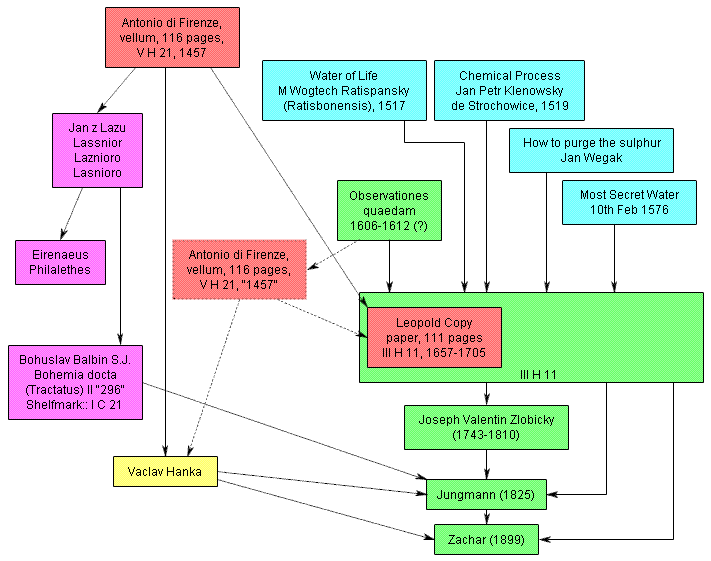
Anyway, now that I’ve started to separate all the different documents into historiographical strands, the formerly rather marky picture is beginning to clear. The connection with Vaclav Hanka seems to be a red herring; and similarly for the supposed connection with Jan z Lazu. What we have left appears to be a single issue: whether the “True Path of Alchemy” (marked in red in the following diagram) was the same document that is described in the “Observationes quaedam…”, or whether the versions we now have derive from a version that was concocted between 1606 and whatever date that the Leopold copy (shelfmark III H 11) was made.
As yet, I’m still unclear where all this is headed – but I think we’re making good progress towards getting there. More as it happens… 🙂
Today’s Cipher Mysteries post comes from long-time Voynich researcher Jan Hurych, who very kindly agreed to go through Otakar Zachar’s (1899) monograph on the “Cesta spravedliva v alchymii” (“The True Path of Alchemy”) manuscript by Antonio of Florence dated 1457. Here’s what Jan found…
* * * * * * *
While Otakar Zachar’s name is now generally unknown, he appears to have been connected with various Czech National Museum archivists who he mentions in his book, and so was probably a known historical scholar.
His book is basically a commentary on (and a modern Czech translation of) the manuscript “Cesta spravedliva v alchymii” dated 1457, and which was written in the old Czech medieval language. Though its title translates as “The Right [or righteous, or just, or correct] Way in Alchemy” , it is not about travel 🙂 but rather about the alchemical methods and recipes written therein.
Zachar claims he saw the Czech original (or rather a copy, as explained below) in the National Museum (and which should today be in the National Library): however, becasue I was not able to reach that, I will describe only what is in his book, namely in his conclusion (from p.95 onwards). He also quotes some Latin text taken from Knihovna Národního muzea v Praze MS III H 11 (starting at its page 129r) that relates to this same manuscript, but which dates from around after 1606.
Zachar claims that the book was written by the Czech servant of an Italian alchemist called Antonio di Firenze (Florence) and was then hidden somewhere (in Bohemia?). In 1606 (an interesting date!) it was discovered – a hearsay, Zachar admits – by a doctor of medicine (perhaps Czech?) who recognized its value and brought the book to Jerusalem (apparently personally). After the doctor’s death, the book was hidden again (where, in Jerusalem? Or back in Bohemia?) and then rediscovered. Zachar studied the manuscript for several months and copied its text verbatim for his own book (the original text was written on parchment in black ink, with only its chapter headings in red).
The manuscript describes four methods for making gold:-
A bottle of elixir provides gold in value of 30 marks
A cheaper method, providing only gold “fluviatile”, that cannot stand fire
An improvement on method #1
Since gold above (the result of all three methods) contains sulphur, this method is a new way by which the “Veneris” [note that “Venus” is normally the alchemical codeword for “copper”] can be removed
Zachar thinks that #4 is the real secret, and that Antonio and other Italians in Bohemia were looking for a special kind of sulphur, say a “secret sulphur” as it was called in old Czech. Zachar wonders where in Bohemia they were looking… Incidentally, here he calls Antonio “Venezian” (benatcan) so was he from Venice and not from Florence as Zachar said at the beginning? Apparently this was only Zachar’s slight mistake. He also mentioned that “Czech ways” were not as advanced as Italian ones. He noted that some passages in the manuscript were erazed – these passages interested Zachar most, but the erasure was too good for him to read past – he apparently did not have Wilfrid Voynich’s dark room! 🙂
Zachar believes that the Czech manuscript is only a copy of some original – why, he does not say. Also, nothing more is known about Antonio’s servant (who wrote down this manuscript). As for “1457”, that could well be when the original was written, the copy could have been much younger [my comment, j.h.].
So the book – or its history only? – must have been known in the 17th century while the good doctor was still alive, since the book was then in Jerusalem and hidden again after his death. Of course, all this could have been merely the history of the original manuscript, while what Hanka found in Bohemia was a copy (though exactly when he did was never noted) which may never have travelled to Jerusalem and back again. 🙂
All in all, Zachar’s book does not describe the Voynich Manuscript, but another book entirely. Whether Antonio himself ever wrote any book, especially the one we now call the VMs – we cannot tell. The Czech manuscript is of course solely concerned with alchemy – no zodiacs, no stars, and no bathing beauties!
* * * * * *
To make things even more complicated, Zachar claims the book reached the National museum via Mr. Vaclav Hanka, who was (in)famous for the discovery of two historical Czech manuscripts (Zelenohorsky, disc. 1817 and Kralodvorsky, 1818). Both of them are today generally considered as fakes, written from nationalistic motives – even though Hanka was an expert on Medieval Czech langauge, he apparently made a number of linguistic mistakes there. 🙂 Zachar confirms he saw the manuscript being first mentioned in 1825 (Jungman’s book History of Czech Literature) but he also quotes some of the above history, from the copies of some alchemical works dating from the 1600’s. He unfortunately omits to say how he found out (or worked out) that they described exactly the same manuscript. 😮
Hanka himself lived from 1791 till 1861 and from 1819 onwards he was an archivist in a Czech museum. After his discovery of those two manuscripts, they became the subject of the largely popularized nationalistic “Battle Of The Manuscripts” which lasted right up until the end of the 20th century. The quarrel split the Czech nation (which back then was under the control of the Austrian Empire) into two groups: passionate defenders and passionate rejectors. The battle later subsided and while it never fully stopped, today most people think both manuscripts were just frauds. That is not to say the old “Cesta spravedliva” definitely comes from the workshop of Hanka (and his friend Linda), but the almost-perfect medieval Czech language might just be a gentle giveway…
A big tip of the hat to Rafal Prinke: thanks to a swift reply from him last night, I can now say definitively that “The True Path of Alchemy” is not the VMs (confirming Rene’s suspicion), because both still exist independently. And the romanticized 1904 mention of the former by Henry Carrington Bolton that quickened my historical pulse yesterday with its uncanny resemblance to the VMs was, shall we say, rather less than 100% accurate. All the same, the affair is not completely closed just yet…
The manuscript of “The True Path of Alchemy” currently lives in the National Museum Library in Prague (though it doesn’t appear in any of their online catalogues). The first person to write about it in any detail was Otakar Zachar, whose 112-page 1899 monograph “Mistra Antonia z Florencie Cesta spravedlivá v alchymii” is available online (you can download it as a set of six 20-page PDFs). As an aside, “Otakar” was the name of Rudolph II’s pet lion, whose death in 1612 was (reputedly) seen as a portent of Rudolph’s own death later that year. Just so you know! 🙂
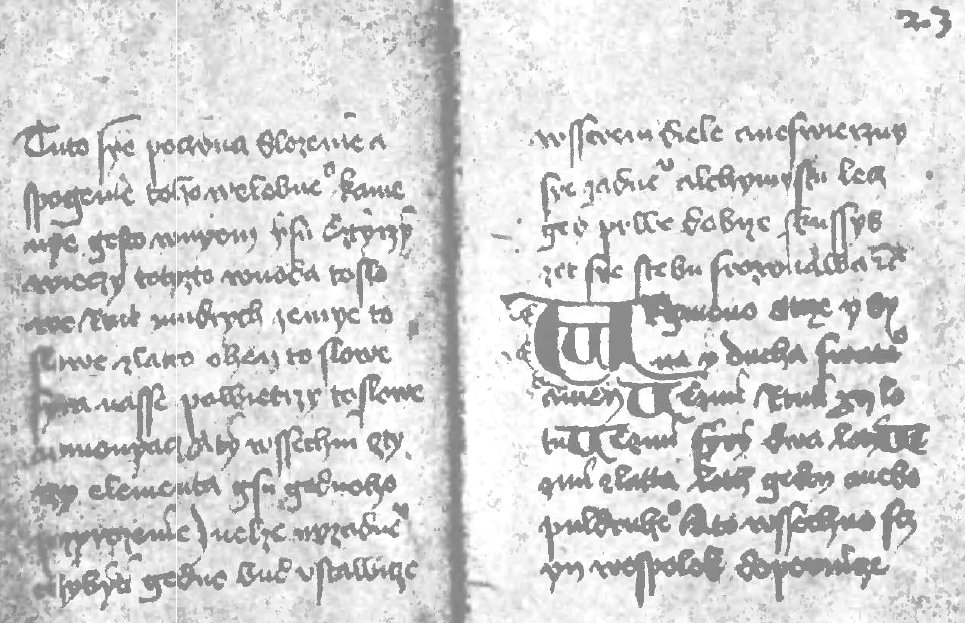
Zachar’s monograph contains (facing p.47) only one rather underwhelming scan of the original manuscript’s text: click on the following cropped & enhanced thumbnail to see a larger version:-
“The True Path of Alchemy” f22v and f23r
Unless I’m hugely mistaken (no laughing at the back), the True Path appears to be written not in Italian or Latin but in Czech / Bohemian in an apparently 15th century hand, with the folio numbering in a standard 16th century hand.
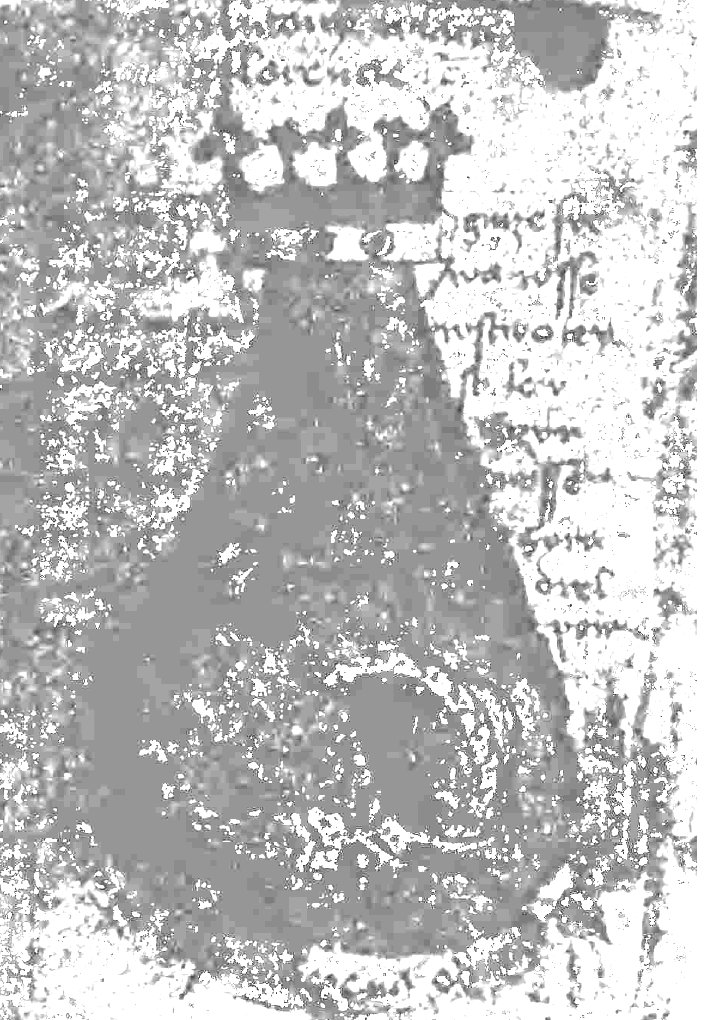
Zachar also includes (facing his page 24) an image of a flask with a crown, which unfortunately appears as a near-black page in the scan (though you can just about resurrect it using fairly heavy image enhancement):-
“The True Path of Alchemy”, flask with a crown
According to note 43 on this webpage, a more up-to-date article on the Ms by V Karpenko appeared in Ambix 37, 61 (1990), which I shall try to read. Karpenko mentions that the ms contains 13 questions for telling whether an alchemist is false. Presumably #1 is: “does he/she claim to be an alchemist?” 🙂
As to attribution, one webpage I found seems to claim that the manuscript was actually written by Jan z Lazu (A.K.A. “Laznioro”, reputedly the first Czech alchemist) [the claim appears here as well]: but as my Czech extends no further than occasional words such as “rukopisu” (manuscript), I couldn’t say whether that relates to authorship, translation, or adaptation. Perhaps my Czech mate Hurychnioro will have a look and tell me how badly I’ve got it wrong. 🙂
I then went hunting for the MS reference in the scans of the National Museum Library’s card index, where Zachar’s book merits five cards (is that five copies? or five cross-references?): the card annotations mention “86 J 121”, “Schiller 294”, and “Zeyer 1977”. However, even though “86 J …” appears to be a plausible-looking shelfmark for the Knihovna národního muzea v Praze, searching for “86 J 121” in the Manuscriptorium returned no hits. Oh well!
Rene Zandbergen also very kindly sent over the GIFs absent from the voynich.nu site: unfortunately, there doesn’t seem to be any obvious mention of the “True Path” there. Really, to identify any manuscript in the Kunstkammer inventory (whether the True Path or even the Voynich Manuscript!), you’d need to know how it was bound (i.e. whether the cover was red or white leather etc) and what else was bound in with it. Zachar and/or Karpenko may well have included this information, of course, but I’ve yet to get quite that far. 🙁
And so… back to Bolton, where this all started.
If you compare the basic factuality with Bolton’s floridity, I think you’d have to conclude that the two don’t quite gel:-
“1475” – should have been 1457 (d’oh!)
“beautifully illuminated” – though there are some pictures and illuminated letters, from the poor quality of the handwriting I’d be fairly surprised if they were “beautiful” per se
“rare” – given that it’s the only extant copy, perhaps we’ll give Bolton the benefit of the doubt on this one 🙂
“couched in exceedingly obscure and mystical language” – the jury’s out, as Karpenko seems to gives the impression that the text is a touch more rational than most alchemical texts. All the same, an alchemy text that’s not exceedingly obscure is probably a fake, so perhaps this is just Bolton being tautologous. 🙂
“library of Wresowitz” – Rafal Prinke highlights a good-sized 1855 article on Czech alchemy by Ferdinand Mikovec in the periodical “Lumir”, which says that Vaclav Vresovec z Vresovic (d. 1583) bequeathed his library (containing various alchemical mss) to the town council of Mala Strana in Prague. However, even though linking “The True Path” to this collection would be a good guess, I saw no mention at all of Counsellor VVzV in Zachar’s monograph, so I’m a little skeptical…
“high price” – without any textual source, this may well be another Boltonian ’embellishment’, let’s say. 🙂
Despite my obvious disappointment that the True Path hasn’t turned out to be an early sighting of the Voynich Manuscript, I remain optimistic that it might yet turn out to be linked with Filarete. For example, 1457 is a perfect match for when the Florentine claimed to have been collecting and writing his little books of secrets in his (ample) spare time. It may well be that nobody to date has thought to examine “The True Path of Alchemy” specifically with a Filarete hypothesis in mind – might there be some textual ‘tell’ hidden in there? There’s only one way to find out…
Finally, Zachar includes (pp.91-95) a decent chunk of Latin taken from Knihovna Národního muzea v Praze MS III H 11 that relates to this manuscript. Thanks to the online magic of Manuscriptorium, I can see that these Observationes quaedam circa suprascriptum processum Bohemicum appear on pages 129r to 153r, and that they were written at the beginning of the 17th century (the text specifically mentions “1606”). Later on I’ll ask Philip Neal if there’s anything hugely interesting there – though the chances are quite small, you never know until you look!
A vast constellation of curious books revolves around the hazily uncertain core of the Voynich Manuscript: as with most things, some are outright good, some are just plain bad, while most live in a mixed-up zone in the middle.
Henry Carrington Bolton’s (1904) ” The Follies of Science at the Court of Rudolph II” is a poster-child for that mixed-up zone – equal parts fact and fiction, Bolton’s oeuvre contains more than a dash of both historical sense and hysterical nonsense. Though it does go on to cover many varied aspects of Rudolph’s court, the first half of it amounts to a greatest-hits compilation of the credulous alchemical mythology surrounding John Dee’s Bohemian adventure – “Now That’s What I Call Bohemian Alchemy #1“, if you like. 🙂
However, for all the hallucinogenic tableaux he conjures up via the shewstone of his historical imagination (and for all the brazen liberties he takes with the facts), Bolton clearly did go to a great deal of trouble to fabricate his Ikea mansion out a lot of, well, basically good stuff. Hence the reader (though often deeply suspicious) finds hundreds of genuine factual nuggets embedded into the walls of the proto-scientific passageway Bolton has tunnelled through the Rudolfine era.
So, my question to you is this: is the following particularly shiny nugget (pp.37-38) gold or lead?
[...] when conversation was interrupted by the
entrance of Martin de Rutzke, bringing with him a beautifully
illuminated and rare manuscript rescued at the dispersal of
the library of Wresowitz, who was reputed to have been a
successful experimenter. The work was entitled "The True

Path of Alchemy," and was written by Antonio of Florence
in the year 1475; being couched in exceedingly obscure and
mystical language, hinting only at the secrets of the black
art, it was particularly admired by Rudolph who ordered his
treasurer to pay the high price demanded for it, and instructed
his librarian to add it to his valuable collection.
For a start, this “beautifully illuminated and rare manuscript… couched in exceedingly obscure and mystical language, hinting only at the secrets of the black art” bought by Rudolph for a “high price” does sounds terrifically like the Voynich Manuscript as described by Dr Raphael Mnishovsky (according to Johannes Marcus Marci in 1665).
Furthermore, even if I just happened to have a time machine in my shed I could barely have engineered a more blatant archival link between Rudolph II and a mid-Quattrocento Florentine called “Antonio”. (Note that Antonio Averlino is reported by Giorgio Vasari to have died in Rome around 1469, but given that there is no documentation to support or refute this, 1475 is entirely possible.)
As far as the book’s 16th century provenance goes, Wolfgang von Wresowitz died on 21st March 1569, while Bernhard Wresowitz died in 1571, and presumably the alchemical “library of Wresowitz” Bolton mentions was dispersed not long after: Rudolph moved his court to Prague in 1583, but it would probably take someone like Rafal Prinke to trace the Wresowitz alchemical library connection any further.
All in all, the big research question then becomes: did Bolton just make up this whole thing (the document name, author name, date, price, and provenance), or was he reporting something he found while trawling relevant books for intriguing-sounding alchemical stories? He comments elsewhere that he made use of the books by Czech historian Josef Svatek (1835-1897), so perhaps that’s one place to start.
Normally, the first proper place one would look for this would be the 1607-1611 Kunstkammer inventory drawn up by miniaturist Daniel Fröschl, as described in detail in Rotraud Bauer and Herbert Haupt’s (1976), “Die Kunstkammer Rudolfs II“. Unfortunately, the relevant gifs have long disappeared from the voynich.nu Bauer-Haupt page, so doing this will probably require someone (i.e. probably me) to spend a day at the library. However, I should also caution that, because Rudolph II may well have presented the same book to Sinapius around 1608 when he gave him the “de Tepenecz” title (i.e. while Fröschl was drawing up the inventory), it is entirely possible that it may not appear there – so, absence of evidence there would (as ever) not be evidence of absence.
However, the problem with this is that Fröschl’s inventory was completely unknown to historians until the middle of the twentieth century, and hence was unknown to Bolton: so, whatever Bolton’s source for this story, the one place we can be sure it didn’t (directly) come from is that inventory.
But all the same: if not there, where on earth did Bolton happen to read about “The True Path of Alchemy“? If we could answer that question, we might well be able to find out about the Voynich Manuscript’s very early history… definitely worth a closer look, I’d say… 🙂
PPS: thanks to a high-speed reply from Rafal Prinke, it now looks as though this is not (after all) the Voynich Manuscript (which is a shame, but what do you expect if you rely on Bolton?) – and possibly closer to a chicken nugget than to a gold nugget. Even so, expect a further post on this shortly! 😮
Following six years of arduous research, an unnamed 44-year-old German industrial technician has been trying (unsuccessfully) since 2005 to get his/her Voynich theory “De Aqua” published, either as a book or as an article. Frustrated by the lack of progress, last month he/she placed thirty-three sizeable chunks of it onto YouTube.
Of course, I fully understand that a busy person like you can’t really spare the time to trawl through several hours of German-text video presentation. So, to save you the bother, I’ve compiled a great big list of all highlights as seen from my chair [though here’s the final part (#33), which is a visual montage of all the interesting claims from the first 32 parts].
(1) Part #1 sets off with the basic format we’ll see throughout – endless pages of (almost entirely) German text fading in and out on a coloured background. Firstly, the top-level description of the theory gets presented: that the Voynich is actually entitled “De Aqua” (i.e. “concerning water“) and that the EVA transcription “otork” somehow translates as “aqua”. It then lists page after page of late-medieval things related to water. Part #2 asserts the author’s historical conclusions – that the VMs was written between 1525 and 1608 by four authors (in four writing systems), and that the underlying plaintext is German & Italian – before outlining the VMs’ known provenance since then.
(2) Part #3 is a bit of a scattergun attack on the 16th and early 17th centuries, with Kepler, Dee, Kelly, Paracelsus, Sir Francis Drake, Nostradamus, Isabella Cortese (who probably didn’t exist, incidentally), German mathematician Adam Ries, the Church’s Index of Forbidden Books, etc etc all name-dropped in quick succession. Part #4 (only three minutes long, most of the others are closer to ten minutes each) links the three red shapes on f1r to (a) “Astrologie / Astronomie“, (b) “Fauna / Flora“, and (c) “Medizin“. No proof, no evidence, just presented as fact.
(3) Part #5 begins a lengthy discussion of medieval herbals, concluding that f2r depicts Lactuca virosa, f3r depicts a Spanish pepper, that f4v depicts an aubergine (i.e. that the VMs must post-date 1500). Part #6 continues in the same vein, while Part #7 argues that f33v depicts maize (which is where the claimed earliest date of 1525 comes in). Part #8 is broadly similar, lots more of the same.
(4) Part #9 has some nice pictures of things resembling the jars in the pharmacological section (though I couldn’t see references or dates for these?), as well as lots of parallels for details, including a nice little dragon (was this from the same Paris manuscript Sergio Toresella once mentioned?). Part #10 has many more parallels (including the famous “armadillo” [hah!] and the Novara coat of arms, etc), as does Part #11 which again returns to the VMs’ f25v dragon.
(5) Part #12 goes off the rails a bit, with claimed resemblances to body parts; Part #13 covers menstruation and the spongum somniferum (for which Caterina Sforza included a recipe, as I recall), though I can’t make out the yellow annotations to the marginalia on f66r (2:41 into the video); while Part #14 reads f77r as depicting the four elements.
(6) Part #15 gets back on track with astronomical parallels; Part #16 looks closely at the rather strange page f67v2 and proposes that the corner shapes are actually constellations (such as Pegasus); Part #17 goes off on a fairly pointless Giordano Bruno tangent; Part #18 looks at the zodiac pages (including a little discussion on the month names); Part #19 focuses mainly on the month names such as the Leo page (because of its Germanic-looking “augst” month name), though it beats me what Al Pacino is doing in there (4:02). 😮
(7) Part #20 looks at crowns and golden fleeces; Part #21 goes back to the zodiac nymphs, looking more at the structure of the pages, before moving on to discuss the 15th century “De Sphaera” by the deaf Milanese illustrator Cristoforo de Predis, who worked for the Sforza family (ah, them again).
(8) Part #22 (are you still reading this? Just checking!) compares the drawings in Quire 13 with Roman aqueducts and similar water structures; while Part #23 looks at Leonardo da Vinci’s take on water, compares (at 1:21) a detail on f79r with a sextant (Rich SantaColoma recently blogged that the same detail reminded him of early “swimming girdles”, though I suspect neither have it right), and discusses rainbows too. Part #24 discusses water nymph details (poses, rings, cross, horseshoe, spinning top, nail, etc).
(9) Part #25 focuses (rather unsatisfactorily, it has to be said) on various tenuous links with alchemy, with the only high point being the comparison between the balneo section’s “giant grapes” page (f83v) and a page in Das Buch der waren Kunst zu distillieren (1512).
(10) Part #26 is pretty thin apart from a fascinating parallel (0:53) between a detail of f76v and a drawing of Mercurius in Liber II of Giordano Bruno’s (1591) De Imaginum Compositione; Part #27 is even thinner; while Part #28 proposes that the nine-rosette page is a map of Italy with Venice in the middle (yes, I’d say) and Pompeii in the top left (no, as it was only rediscovered in 1748). [I’m not convinced by Valdarno and the Wasserturm, either.]
(11) Part #29 (Perfume and Plague) didn’t really work for me at all; while Part #30 (Hidden Characters in the Manuscript) only briefly gets interesting when looking (1:53) at similarities between our beloved MS408 and Medeltidshandskrift 47 (at Lund University in Sweden) – the discussion of the f17r and f116v marginalia seems superficial and unconvincing to me.
(12) Finally, in Part #31, our anonymous author gets to the point of his whole book – that (unless I’ve misunderstood him/her, which is always possible) some clever computer programmer out there should be able to make use of all the clever cribs he/she has amassed as a result of his/her long journey into the heart of the VMs’ pictures. Part #32 has his/her (fairly diffuse, it has to be said) bibliography; and Part #33, as mentioned above, is a sequential montage of all the visual identifications proposed in parts 1 to 32.
Quite why neither of the German Voynich E-bloggers (hi Elmar, hi Elias) has yet blogged about this I don’t know (perhaps they’re on holiday?): but from where I’m sitting in the UK, there’s plenty to say about it.
Firstly, it is pretty clear that the author has for some years sustained an intense (and independent-minded) assault on the VMs’ pictures – yet at the same time he/she seems quite unaware of many long-running problematic debates, such as the whole “heavy painter” issue. Had the plant on f4v not been overpainted blue, would his/her identification with “aubergine” have been so clear-cut?
In addition, while it’s fantastic to see someone wise to hidden details (such as the concealed people in f86v4, even though this is mislabelled as f68v4 in Part#7), overall I just don’t accept the idea that the VMs’ plants can be identified as solidly as he/she thinks – we’ve now had three or four generations of herbal researchers look at it, with each finding it bewildering in a new way. Furthermore, comparing drawings with modern plants (or even with interpretative drawings of modern plants) is of little use, as virtually every plant you can name has been extensively adapted and altered over the centuries by, ummm, cunning breeders.
While I’m sympathetic to the author’s project and research programme (it is, after all, more or less identical in intention to what I was trying to do with my own “The Curse of the Voynich”), where it falls down is in historical methodology: in this instance, you just can’t get the level of proof you would like from visual similarities, however many of them you try to amass. Has our unnamed author provided coherent and powerful evidence supporting the identification of MS408 as “De Aqua“? I don’t really think so – plants aside, the overwhelming bulk of the discussion is fairly lightweight, and does not gain any real traction on the real history of the manuscript despite the sheer mass of intertextual references.
All the same, there’s plenty of food for thought here (though I wish many of the manuscripts where so many of the nice illustrations were taken from had MS and page references to back them up) – but for all “WilfridVoynich“‘s hard work, the end result simply fails to produce the set of cribs he/she was aiming for. Sorry, but it’s not “De Aqua” as claimed (though, to be honest, I would be hugely unsurprised if the vertical column of letters on f76r does indeed somehow encipher “de aqua”).
The end result, though, is plainly a great personal achievement – and I would be delighted if some of the intriguing and bold visual connections he/she has drawn in it ultimately lead onwards to genuinely productive and useful future research within the overall VMs community. For all its faults and limitations, this is definitely the (virtual) Voynich book of the year for 2009! 😉
The day: Sunday 30th August 2009
The time: 5pm (or thereabouts)
The place: The Seven Stars, 53-54 Carey Street, Holborn, London WC2A 2JB
Nearest Tubes: Temple, Chancery Lane, Holborn The purpose: convivial cipher history / mystery chat over a pint or two.
Please leave a comment if you’re planning to come! Looking forward to seeing you there…
PS: if it turns out to be too small or too dark, Plan B is to decamp to the Wetherspoons down the road. 🙂
PPS: please say if you happen to know Middlesex-based Voynich researcher Peter Mason’s phone number – he hoped to come along but I’ve managed to, ummm, tidy away his contact details. 😮 Thanks!
One of Google’s more interesting experimental engines is Google Trends: this aggregates data on keyword searches, to let you compare the relative popularity of different keywords over time: for example, “Paris Hilton” and “Star Wars” are (Google-wise) just about as popular as each other. From the graph, you can see that interest in Star Wars spiked up in May 2005, which Google guesses (correctly) was from the Star Wars film opening: while the Paris Hilton volume spiked somewhat when she left jail in June 2007. This reveals other non-obvious search aspects, such as the apparent cargo cult worship of Ms Hilton in Indonesia and Mexico. 🙂
But I digress.
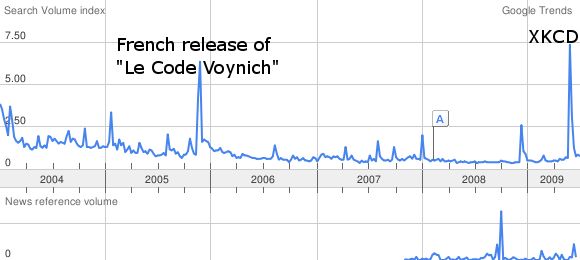
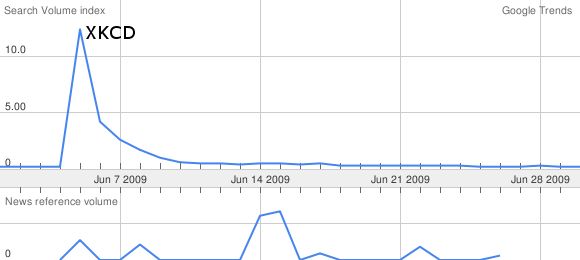
For the graph for “Voynich”, Google Trends’ algorithms gamely suggest to the SciAm 2008 online re-release of Gordon Rugg’s 2004 article (marked “[A]”) as a possible cause of Voynich interest (but this is plainly wrong). The twin peaks actually correspond (a) to a surge in Voynich interest in France caused by Jean-Claude Gawsewitch’s (2005) “Le Code Voynich”, and (b) to the (2009) Voynich gag in webcomic XKCD.
If we look solely at the June 2009 numbers, the scale of the XKCD peak is even clearer: Google search traffic for “Voynich” apparently spiked by more than 50x over baseline traffic levels. Whoosh.
This massive XKCD spike is what lies behind the battle raging in the Wikipedia Voynich Manuscript Talk page. On the one hand, you have Wikipedia editors who think the Voynich page is basically OK (yes, there used to be a section on VMs in popular culture, but it got culled over a year ago) – and on the other, you have an army of vociferous XKCD fans who think that there should be at least some mention of XKCD squeezed in there, surely?
I think it’s important to point out that neither side is entirely blameless in this dispute. Wikipedia editors deliberately use its neutral voice and juxtaposing header templates as a way of fusing (achingly) high and (shudderingly) low cultural references together under a banner of supposed universality: though this syncretism helps to differentiate it (as a project) from traditional encyclopaedias, nobody involved is quite sure whether ultimately to privilege high or low culture – both are important at different times and for different reasons.
Similarly, the XKCD fanbase (which seems centred on Seattle, according to Google Trends?) has done itself no favours by the large number of inane troll-like edits attempted on the Voynich page. And none of them has so far really explained (in the Discussion page) why it is they collectively feel the urge to stitch XKCD’s web of cultural referentiality into Wikipedia’s fabric. From the outside, it certainly looks like a kind of drive-past L337 grafitti being daubed on Wikipedia’s walls: if there is a genuine point to the whole activity, I’ve yet to find it.
Ultimately, I suspect that the basic problem is that there is no consistently useful dividing line between high and low culture: when you have Wikipedia pages on Immanuel Kant and Brian Cant (and every silly cant inbetween), who’s to say where to draw it?
Finally, a brief Wikipedia aside. A fair while ago, someone (I’m pretty sure it was “Syzygy”, Elmar Vogt’s Wikipedia editor nom-de-plume) very kindly added a mention of my ‘Averlino’ theory to the Wikipedia Voynich page. I’m pleased that it is mentioned there, because – unlike a lot of theories – I did try hard to produce a working hypothesis consistent with the facts, rather than blatantly defying them (which seems to be the norm some days, sadly). Even if you happen to disagree with it, it does at least have the merit of pointing towards a sensible template: I’m quite sure that, if not Averlino, the real author will turn out to be remarkably similar.
Yet Elmar’s description of my theory wasn’t hugely accurate: and so I thought I ought to take the opportunity to correct and update the final two sentences. Just in case anyone is tempted to revert the changes, here are links to the research I’ve published since “The Curse of the Voynich” to back it up:-
If Pelling is right, then the manuscript is enciphered with an extremely convoluted cascade of methods, mixed together to make the resulting cipher textappear to have the properties of an unknown medieval language (such as consonant-vowel pairing, folio references, etc).
I discussed this archaic language covertext in more detail in this recent blog post. And also:-
He claimsmost of the non-zodiac marginalia were originally added by the document’s author(s), but have ended up unreadable because of incorrectly-guessed alterations superimposed by multiple later owners.
Recent posts on the mystery of the VMs’ unreadable marginalia (for why should they be unreadable, given that marginalia are normally added to explain or remind?) are here and here: but most of the discussion is still relatively unchanged since The Curse.
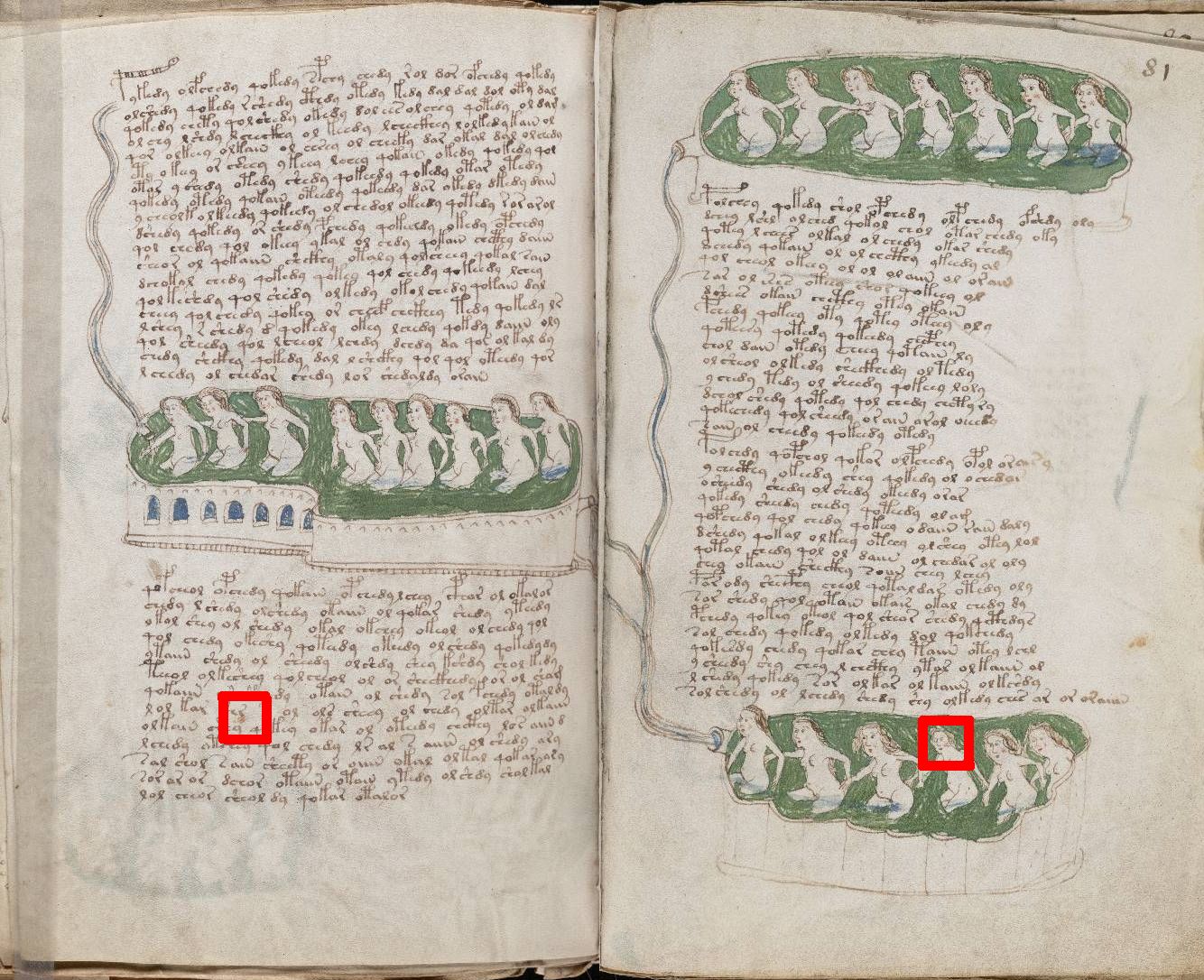
One of the (frustratingly small) number of art history leads the Voynich Manuscript’s author dangles before our eyes is the balneology part of Q13 (“quire 13”). Specifically, there are two bifolios that depict baths and pools, where the pictures helpfully allow us to reconstruct what the page layout originally was:
84r/84v – contains Q13’s quire number (which should be at the back for binding)
78r/78v – contains left half of a two-page bath picture (should be centrefold)
81r/81v – contains right half of a two-page bath picture (should be centrefold)
75r/75v
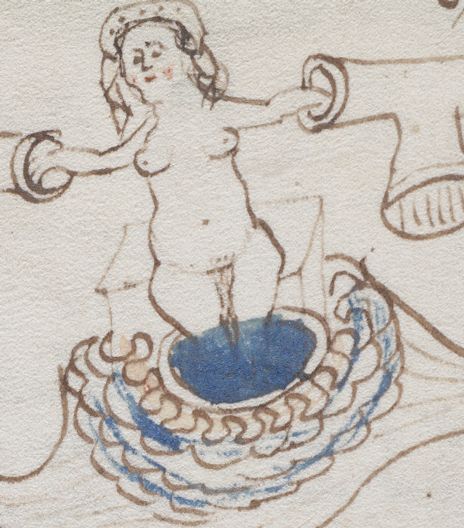
The centrefold originally looked like this (my red boxes highlight a paint transfer):-
This codicological nuance demonstrates that Q13’s quire number was added after the bifolios had been scrambled, because the page it was written (f84v) on was originally inside the quire, on a bifolio that ended up both flipped and in the wrong position. In “Thc Curse” (pp.62-65), I tried to follow this through to reconstruct the original page order for the whole of Q13.
Fascinatingly, Glen Claston has now raised this whole idea up to a whole different level – he proposes that Q13 was originally two separate (smaller) quires which have been subsequently merged together. According to his reading, the four folios listed above originally formed a free-standing balneological quire (which he calls “Q13b“), while the remaining bifolios form a free-standing medicinal / Galenic quire all on its own (which he calls “Q13a“).
Even though Glen and I disagree on the likely page order of Q13a (apart from the fact that the text-only f76r was very probably the first page, and hence its bifolio was the outer bifolio for the quire) and on its probable content, I have to say that I’m completely sold on his proposed Q13a / Q13b layout (basically, I wish I’d thought of it first – but I didn’t, Glen did). We also agree that because there is no indication at all that f84r was the front page of the quire, there was probably an additional (but now lost) outer bifolio to Q13b in its original state.
Glen also infers (from the apparent evolution of the language between the two parts) that Q13b was made first, with Q13a coming later. Having mulled over this for a few weeks now, I have to say I find this particularly intriguing because of what I believe is a subtle change in quality between the drawings in Q13b and Q13a that strangely parallels the change in drawings between Herbal-A pages and Herbal-B pages.
My key observation here is that whereas Q13b’s drawings appear to be straightforward representations of baths and pools, Q13a’s drawings appear to have layers of rendering and meaning beneath the representational surface: that is, while Q13b is a small treatise on baths, Q13a is a small treatise on something else, rendered in the style of a small treatise on baths. As an example, on f77v you can see something literally hiding behind the central nymph at the top – but what is it?
This closely mirrors what I see in the herbal A & B sections: while Herbal-A pages (from the earliest phase of construction) appear to be representing plants (if sometimes in an obscure way), Herbal-B pages (which were made rather later) appear to be something else entirely made to resemble a treatise on plants.
My current working hypothesis, therefore, is that the representational (if progressively more distorted) Herbal-A pages and the representational Q13b balneological section preceded both the non-representational Herbal-B pages and the non-representational Q13a pages, both of which are disguised to look like their respective predecessor, while actually containing something quite different.
(As an aside, the same kind of mechanism might be at play in the pharma section: there, too, you can see ‘jars’ that seem to be purely representational, together with other things that seem to be disguising themselves as ornate jars. Very curious!)
This has a strong parallel with the way that recent art historians (such as Valentina Vulpi) decomposes Antonio Averlino’s libro architettonico into multiple writing phases: In “The Curse” (pp.106-107), I proposed a slightly more radical version of Valentina’s thesis – that Averlino (Filarete) targeted Phase 1 at Francesco Sforza, Phase 2 at Galeazzo Maria Sforza, and Phase 3 at both Francesco Sforza & Lorenzo de’ Medici. In the case of the VMs, I suspect that some of the difficulties we face arise from broadly similar changes in need / intention / strategy over the lifetime of the construction – that is, that the style of the cipher and drawings probably evolved in response to the author’s life changes.
As far as art history goes, though, Q13b appears to give us a purely representational (if enciphered!) connection with baths and pools – places associated in the Middle Ages and Renaissance with healing. Bathhouses were usually situated in the centre of towns and were used by urban folk: while natural spas and pools were thought to have specific healing powers based on their particular mineral content, were usually in fairly inaccessible places, and tended to be frequented by the well-off at times of ill-health (for you needed resources to be able to fund a party to trek halfway up a mountain).
So… might there be an existing textual source where this (presumably secret) information on baths and spas could have come from?
The main source for medieval balneological information was Peter of Eboli’s much-copied De Balneis Puteo (which was hardly a secret): when I wrote “The Curse”, the two main Quattrocento balneological discussions I knew of were by Antonio Averlino and by the doctor Michele Savonarola. I also pointed out that that the (now misbound) Q13 centrefold (f78v and f81r) resembles “the three thermal baths at the Bagno di Romana. Of these, the ‘della Torre’ bath was used for showers, the ‘in-between bath’ was used to treat various illnesses and skin complaints; while the third one was more like a women’s spa.” (p.63)
However, I recently found a nice 1916 article online called “Balneology in the Middle Ages” by Arnold C. Klebs. Klebs notes (which I didn’t know) that the fashion for balneology died around 1500, fueled by a widespread belief that baths and spas were one of the causes of the spread of syphilis. Errrm… that would depend on what you happened to be doing in the baths (and with whom), I suppose. Here are some other fragments from the last few pages of Klebs’ article which might well open some doors:
In Giovanni de Dondis we usually hail the early apostle of exact balneology. Whatever his right to such honour may be, it must be mentioned that it rests on his attempt to extract the salts of the thermal of Abano.
Gentile da Foligno (died 1348), […] a great money-maker and promoter of the logical against the empirical method in medicine. He wrote a little treatise on the waters of Porreta, the chief interest of which may be found in the fact that it was the first to appear in print (1473).
Ugolino Caccino, of Montecatini (died 1425). He came from that thermal district not far from Florence, in the Valdinievole, which has still preserved its ancient reputation as a spa. Evidently he was a man of broad and open-minded scholarship, who in his treatise on all the Italian spas, the first thorough one of the kind, gives the results of his own personal observations, stating clearly when he is reporting from the information of others.
Matteo Bendinelli (1489) sums up for them all, in his treatise on the baths of Lucca and Corsenna,…
Michele Savonarola, representing Padua and the new school of Ferrara. To him European balneologrv owes the most ambitious work on the mineral springs of all the countries.
De Balneis omnia quae extant,” Venice, Giunta, 1553, fol., 447 leaves. This fine collection, the first text-book on balneology, offers to the interested student a mine of information.
Before I post properly on the Barcelonan archives, here are some random musings, make of them what you will…
Believe me, I really wanted to enjoy walking around Barcelona – but perhaps I’m too much of an Early Modern kind of guy, because for all my efforts, I just couldn’t get into the town’s whole Gothic Modernist thing. For all the feverish & fluid imagination in Gaudí’s works, for all his epic & enigmatic symbolism, I instead walked away with an overwhelming impression of hallucinatory parochialism, as if I had somehow seen Leo Lionni’s “Parallel Botany” (or the Codex Seraphinianus, for that matter) writ large in stone and in shattered tiles.
I even took along a copy of “The Gaudí Key” (a recent novel based around hidden messages supposedly left by Gaudí in his buildings, and according to which novelistic conceit the architect’s 1926 death in a tram accident was engineered by a Satanic conspiracy etc etc) to read. But that left me cold too.
Sitting on the plane home, what struck me was a eery sense of how Gaudí’s mesmeric farmboy Catholicism echoed Joseph Smith Jr’s theophanic farmboy Methodism – and an uneasy feeling of how Gaudí’s death (in 1926) segued into Opus Dei’s founding (in 1928). Perhaps the brashly naïve self-confidence required to found a religion is something denied to big-city dwellers: and hence “humble origins” are not a handicap in this respect so much as a significant asset.
To my eyes, Barcelona comes across as a sprawling temple to its own unique brand of modernity, whose underlying religion / subtext is neither Progressive Science (think of the Italian Futurists for that) nor even Commerce (think of the City of London for that), but something else entirely – Pragmatic Nostalgia, perhaps? I don’t know.
Here’s something a bit different that Cipher Mysteries buffs with an interest in the history of the Knights Templar might well enjoy: a 20MB PDF scan of a 1908 article on Temple Bruer, one of the few Knights Templar buildings in the UK still standing.
You see, one summer nearly a decade ago I had a picnic with my friend Charles Cecil and his family at a Lincolnshire local history open day at Temple Bruer, complete with a swordfight between a Templar and an Hospitaller (I think it was a draw). Just for a bit of historian fun, I decided to buy the copy of Archaeologia that contained the definitive article on the site to bring along. Fast forward to 2009… and a few days ago I thought that I really ought to get round to scanning it in, for the benefit of anyone else out there with an interest in Templar history in the UK. (Well, Charles will like it, anyway.)
One is sorely tempted in writing upon matters connected with the Knights Templars to say something about the monstrous persecution and terrible sufferings which the unhappy brethren of the Order endured, during the opening years of the fourteenth century, at the hands of an infamous King of France, a more wicked Pope, and even of a King of England, as an excuse for bringing about their suppresssion.
But the subject has already received the attention of abler hands than mine, and the purpose of this paper is not to lay before the Society any new facts about the Order, but some notes upon a curious church of the Knights Templars at Temple Bruer which I have lately had an opportunity of investigating.
It’s an easy read, and includes some nice plates, plans, maps and photos (most of which I scanned at 600dpi). If you ever find yourself between Lincoln and Sleaford and fancy having a look for yourself, here’s Rod Collins’ nice page which tells you how to find Temple Bruer (though remember that it’s on private property, so you must ask before you go in). Enjoy!