At the heart of the founding mythology of the Mormon Church sits a small fragmentary document called the Anthon Transcript. The claim linked with it is that it was copied from gold plates revealed by angels to the 18-year-old Mormon prophet Joseph Smith Jr in 1823, and that its “Caractors” were written in the “reformed Egyptian” of the (otherwise unknown) “Nephite” people, who had (allegedly) emigrated to America from Jerusalem two and a half millennia earlier.

Of course, extraordinary claims need at least some kind of evidence – and so the key historical question is whether or not the Transcript provides that. The other pages of the transcript (if they existed at all) have long disappeared, while the eponymous Professor Anthon (who had originally been said to have somehow verified Smith’s translation) later reported “that the marks in the paper appeared to be merely an imitation of various alphabetical characters, and had, in my opinion, no meaning at all connected with them“. After the Transcript had been shown to Charles Anthon, its “translation” was carried out by Joseph Smith who acted as a “seer” to channel it: to do this, Smith used either a giant pair of golden spectacles (that had been found with the golden plates), or one or two stones placed in the bottom of an upturned tall hat, the latter a scrying technique he used before and after 1823 when searching for buried treasure.

Regardless of all that, my particular interest in the Anthon Transcript is as a cipher historian looking at a single contentious document. Back in 2004, I exchanged a number of emails with Richard Stout, who has researched extensively on this subject to build up his own (very specific) claims. However, what follows below relates to my own opinion of what we can learn about the Transcript purely from its alphabet, and is competely independent of Richard’s ideas and interpretations. (And no, I’m neither a Christian, a Mormon, nor even an ex-Mormon.)
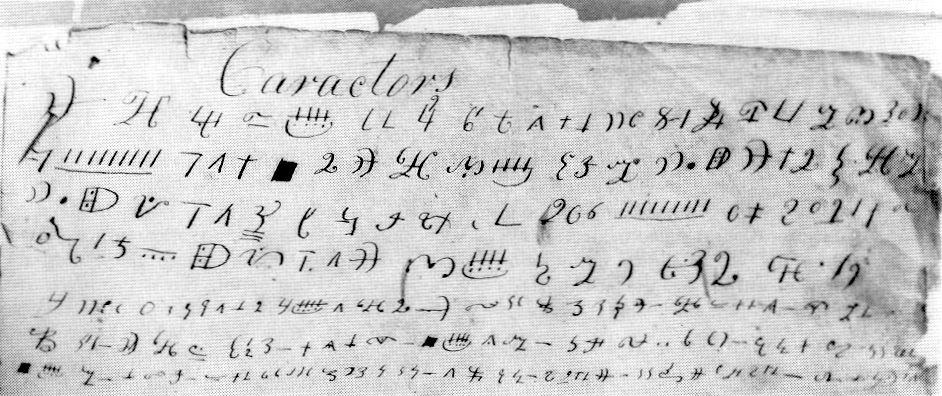
anthon-transcript-small

What kind of document is this? Much as people ask of the Voynich Manuscript, is it shorthand, cipher, a lost ancient language, or some kind of deception? Furthermore, is it an original document, a copy of a document, a copy of some letter-shapes from a real document, or a purely made-up thing? The hope here is that we can use its alphabet to help resolve any of these open questions: so let’s see what we find…

Are the letters shorthand? Just about anyone who has grasped the history of shorthand would quickly conclude that it is not a tachygraphic (“fast writing”) system, insofar as it is (as can be seen from the many fussy and overflourished letter-shapes) clearly not optimized for writing speed. Because it appears neither concise, memorizable, speedy, nor unambiguous, it’s a pretty poor match for the whole idea of shorthand.

It should be clear, then, that the Transcript itself was not written in a shorthand system: yet I do hear what Richard Stout says when he suggests links between individual Anthon Transcript letters and letters taken from a whole range of shorthand systems (apparently including many Tironian notae).

Yet I must caution that even an apparently well-defined character can trace out multiple independent paths through time. As a prime example, Stout notes that the filled-in box shape (which appears three times in the Anthon Transcript) appears in William Addy’s (1618-1695) shorthand system, where it denotes the word “altogether“. Addy’s system (first printed in 1684) was based on Jeremiah Rich’s earlier system: curiously, Addy later published a shorthand version of the Bible (1687), though this was perhaps stenographic oneupmanship to trump Rich’s shorthand version of the New Testament (1673-1676). The problem we have is that, as we saw here only a few days ago, Cod. Pal. Germ. 597 also includes a solid square in its first alchemical cipher alphabet… some 250 years before Addy. So, what was the actual source for the Transcript’s filled square shape – 15th century alchemy, or late 17th century stenography?

All the same, Isaac Pitman’s “History of Shorthand” (I own a copy of the 3rd edition) describes Jeremiah Rich’s system as being “encumbered with long lists of arbitrary characters to represent words which could not be written in any moderate space of time by their respective letters” (p.22), an “absurdity” whose “practice seems to have been at its height in the days of Rich” (p.23), with its 300 “arbitraries“. To Pitman’s roving historical eye, Rich’s follower Addy merits only a single paragraph (p.26). But helpfully, Pitman continues with a long list of people who produced related systems: Nathaniel Stringer (1680), William Addy (1695), Dr Doddridge (published in Oxford in 1805!), Farthing (1654), George Delgarno (1656), Everardt (1658), Noah Bridges (1659), William Facy (1672), William Mason (1672), John West (1690), Thomas Gurney (1751) [though Gurney finally dropped the arbitraries!]… and notes that Rich’s system (and/or its many variants and descendants) were still being taught early in the 19th century.

So it would seem that Stout is broadly on target with comparisons with the over-complex systems initially devised by Rich and Addy. I think it would be fair to say that if the Anthon Transcript’s alphabet can at all be said to have a parentage, it lies in the family of overcomplex shorthand systems deriving from Jeremiah Rich, and specifically in the ornate (and occasionally impractical) arbitrary signs added to them.

There must have been more than a hundred subtly different (usually plagiarised) shorthand systems based on Jeremiah Rich’s original, with many of them still in surprisingly active use circa 1823: and so I would predict that finding the closest match to the source of (or the inspiration for) the Anthon Transcript would likely be a perfectly possible (if painstaking) job, given a copy of Pitman’s book as a starting point.

Are the letters Tironian notae? Stout suggest comparisons between various individual Transcript letter-shapes and the sprawling array of Tironian notae accumulated over the centuries. However, my judgment is that you could construct visual correlations between just about any non-pictographic alphabet and Tironian notae: and so I’m very far from convinced that there is any immediate causality implicit in the choice of letter shapes.

Are the letters “reformed hieroglyphics”? Given that I place the Anthon Transcript’s alphabet firmly within the visual & stylistic tradition of arbitrary-loaded shorthands (which themselves all ultimately derive from Jeremiah Rich’s mid-seventeenth century shorthand system, even if the Anthon Transcript’s text is apparently not written in a shorthand system), I have to say that I am at a loss to see any conceivable connection with hieroglyphics (or even with Demotic, for that matter).

Are the letters written in an Old Irish shorthand? Richard Stout points to one shape in particular (you can see an example on line 2 of the Anthon Transcript, two glyphs to the right of the filled square) comprising two left-curving lines joined by a horizontal line: he points to a resemblance with an Irish glyph used on “page 311” of the late fourteenth century Book of Ballymote, and continues by pointing to resemblances between rows of dots elsewhere in the same manuscript and in the Anthon Transcript.

Yet dots were used by medieval monks across Europe to encipher vowels: so I’m far from sold on the idea that rows of dots (which, in any case, were used a quite different way in the Transcript) link this to the Book of Ballymote at all.

Stout’s proposed Irish manuscript connection seems to be an apologium for other Mormon cipher claim, in which the other main source document was allegedly written in some kind of old Irish writing. But I don’t really see that connection here at all: before I get too excited about a single letter-shape, I’d want to have trawled through the relevant shorthand archives first.

Are the letters a cipher alphabet? The Anthon Transcript seems quite ill-judged for this, too: what on earth would any cipher alphabet be doing with a nine-vertical-strokes-plus underline shape (line 2)? This seems to be unnecessarily showy – and in fact, I would suggest that this sort of “prison-cell counting” shape is more the kind of thing you would see in a child’s made-up cipher to denote ’10’ (or possibly ‘X’).

Regardless, the whole document could possibly be written in a cipher: and so I think it would be a good idea to subject a transcription of the Transcript to some statistical tests. It would be more credible were this to be done by someone outside of the Mormon Church (in contrast to previous attempts, according to Wikipedia). It’s true that there are some repeated patterns inside the Transcript, sure: but might these amount to complete words, phrases, or even sentences? Right now, I’m not sure: it looks fairly fragmentary to me.

Are the letter-shapes all fake? I don’t think so: to my eyes, they do give the impression of forming a moderately coherent set of “characters” copied from one or more existing shorthand documents, but with child-like cipher shapes added, very probably to give the whole thing slightly more of an ‘exotic’ feel. More than anything else, I think it is this awkward blend of the nuanced and the naive that makes it seem unconvincing as a real piece of text.

Because the ratio of arbitraries to simple strokes also seems quite high to my eyes, I would also be unsurprised if the author had cherry-picked the interesting-looking letter-shapes from a shorthand source.

In summary, probably the least controversial inference you can draw from the lettershapes is their post-1650 dating: the embellished “H” shape and the probable links with Rich-family shorthand letter-shapes indicate that this is in no way ancient.

In the absence of any other credible information, the most likely story I can reconstruct is that the “caractors” in the Anthon Transcript were copied in no particular order from a shorthand Bible (or possibly a shorthand diary), with various other letter-shapes added to make the overall alphabet look more ‘exotic’, or even “hieroglyphic” (even though, to our modern eyes, these singularly fail to have the desired effect). I would also be fairly unsurprised if the same shorthand Bible itself was subsequently used as a prop to convince skeptics – in short, that this was the Detroit Manuscript itself (but which, like the rest of the Anthon Transcript, subsequently disappeared from sight).

Of course, a single good piece of evidence could well refute all of this… but I haven’t seen it yet.

What do you think?


Post update: a very big thank you! to Richard Stout for suggesting corrections to the first two paragraphs – much appreciated! 🙂
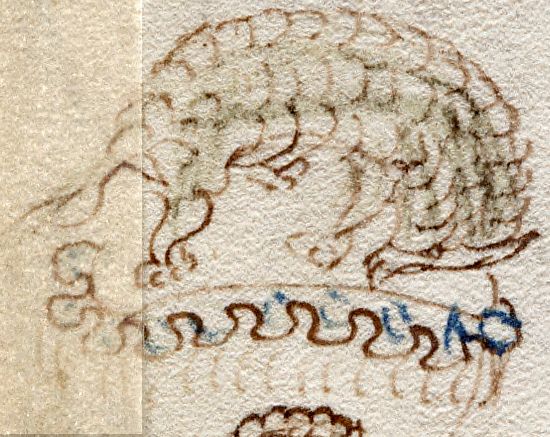
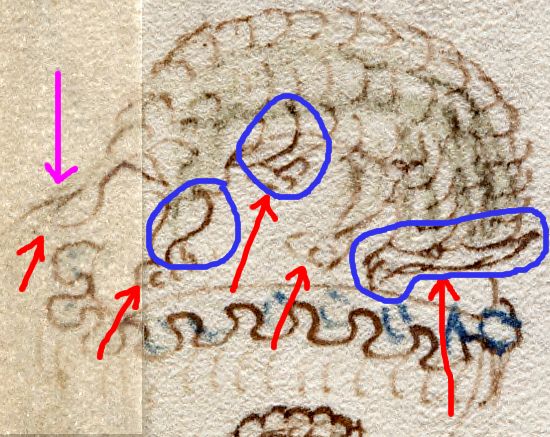
Here’s a vogue-ish detail from the Voynich Manuscript – the (claimed) “armadillo” in the middle-left margin on page f80v. Of course, if this can be proven to be intentionally depicting an animal from the New World, then a lot of other dating evidence becomes secondary. But of course, this kind of controversy is nothing new: you only have to think of the decades-long hoo-ha over the (claimed) New World sunflowers.

catoblepas-enhanced

Armadillo proponents “read” this image as having a tail (on the left), three legs (with the left foreleg therefore tucked behind the head on the right), and a kind of upside-down armoured armadillo head facing backwards (with a sort of smiley cartoon mouth). Fair enough.

By way of contrast, I argue that because everything else in Quire 13 appears to be water-related (plumbing, baths, steam, rainbow, pools, etc), this is probably a depiction of a catoblepas – a fearsome creature Leonardo da Vinci (and doubtless many of his contemporaries) believed lived at the source of the Niger river, and whose bull-like head was so heavy that it permanently hung down to near the ground.

Specifically: what appears to the pro-armadillo contingent to be a tail (purple arrow), I read as a left rear leg, making all four legs visible – and what they read as an armoured armadillo head, I read as a pair of bull-like flat horns at the back of a down-turned head.

catoblepas-enhanced-annotated

All the same, it’s not like I can’t ‘see’ the armadillo: it’s a lot like one of those optical illusions (such as the famous old lady / young girl drawing) where you can flip between two parallel readings almost at will.

But the odd thing here is that both the armadillo and the catoblepas might be equally correct. It doesn’t take a great deal of sophisticated codicology to look at the line strengths (in the areas ringed blue above) and note that a few key lines are in a darker ink, quite different from the ink used for the wolkenband-like decoration just below it. Could it simply be that some 17th century owner (for whom the catoblepas was probably never part of their conceptual landscape) thought this picture somehow resembled an armadillo, and emended it to strengthen that resemblance? I think that this is very probably precisely what happened here.

Now, this is precisely the kind of contingent, layered, conjectural historical explanation (basically, an intellectual history of art) that Richard SantaColoma has long enjoyed lambasting. Specifically, he sees any explanation that appeals to layered codicology as fully worthy of his scorn – as though it’s merely constructed as an apologium to keep the faith with the existing ‘mainstream’ dating evidence.

But actually, layered codicology hypotheses are among the most brutally (and easily) testable of historical ideas – unless two layers of ink added many decades apart just happened to use exactly the same raw materials (and in the same proportions), we will ultimately be able to differentiate them… or not.

However, unless people explicitly propose such layering hypotheses, nobody would think to do such tests – they’d perhaps spend all their codicological efforts on f116v (a valid investment, to be sure, but it’s only one of many possible areas of the Voynich Manuscript that should be tested for revealing information).

Indeed, the whole point of such historical hypotheses is not to prove historical narratives in and of themselves, but rather to lay the underlying ideas open to physical mechanisms of disproof. Bluntly put, any given hypothesis is usually of little or no value if it cannot be specifically disproved (because direct causative proof is as rare as hen’s teeth in history).

In the absence of any suitable tests on f80v, however, both viewpoints (and indeed all other fairly sensible viewpoints) remain in a suspended state of vague possibility, hypothetical kites floated carelessly into an unthreatening breeze.

Hmmm… how I long for such tests!

(1) A big hello to Rich SantaColoma as he emerges from the VMs “List Closet” into the bright(-ish) light of the blogosphere. His “New Atlantis Voynich Theory” blog sets out his basic stall – which is that, thanks to his “Nagging Sense of Newness” about the Voynich Manuscript, he harbours strong doubts that it is anywhere near as old as mainstream Voynich researchers (such as, errrm, me, apparently) think it is.

The truth is that historians have basically frittered the last century away on foolish conceits (such as the Roger Bacon thing, the Dee-and-Kelley thing, or the it’s-a-hoax-because-the-NSA-can’t-break-it thing), and so until such time as a single proper codicological and palaeographical analysis comes along to define the research problem properly, we’ll remain in the same old evidential free-fall.

As for me, I’m sticking with John Manly’s assessment (that the quire numbers were added in the 15th century) as a basic starting point for the dating: and if that turns out to be wrong, then so be it. That doesn’t make me “mainstream”, just… old-fashioned, I guess. 🙂

Incidentally, it’s a little-known fact that the Beinecke’s catalogue originally listed MS 408 as fifteenth century, but that in the 1970s (perhaps as a result of Brumbaugh’s wobbly claims?) this got extended forwards to the sixteenth century… I suspect they got it right the first time round.

PS: Rich, given that I think Q13 has a water theme, I’m sticking with the catoblepas (with its heavy head hanging down) rather than the armadillo – given that even Leonardo wrote that the catoblepas was found at the Nigricapo [the source of the Niger river], it was very much part of the mental landscape of the Florentine Quattrocento.

(2) And another big hello to (the apparently email-address-less?) “acevoynich” and [his/her] eponymic “acevoynich’s blog“. Though given [his/her] apparent inability to find Cipher Mysteries, the Voynich Manuscript Mailing List, The Journal of Voynich Studies, voynich.nu, the Voynich Wikipedia site, the Voynich dmoz entry, etc (let alone D’Imperio or The Curse) I have to say I’m somewhat dubious that [he/she] is, as [he/she] claims, actually writing a “thesis”. Does [he/she] really have a research question in mind, or is [he/she] just a [troll/trollette]? Hmmm…

Still, acevoynich feels confident to ask the five key W-questions of the big V-manuscript: who, what, where, when, why. Again, I refer the honourable member to my previous answer: and add that until such time as we have the forensic side (the “What happened?” question) considerably more locked down than it is at the present, I suspect that these W’s are (sad as it is) actually more harmful than helpful. Oh well! 🙁

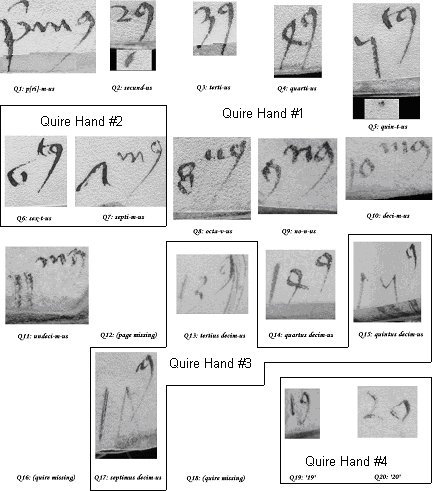
For ages, I’ve been planning to devote a day at the British Library solely to the task of looking for matches for the Voynich Manuscript’s unusual quire numbers. There’s a long description of these quire numbers elsewhere on this website, but the short version is that they are “abbreviated longhand Latin ordinals in a fifteenth century hand”, and are one of the key things that point directly to a 15th century date:-

If we could find any other manuscripts with this same numbering scheme (or possibly even the same handwriting!), it would be an extraordinarily specific way of pinning down the likely provenance of our elusive manuscript, more than a century before its next mention (circa 1610). It would also give an enormous hint as to the archive resources we should really be looking in to find textual references to it.

But let’s not get too carried away – how should we go about finding a match, bearing in mind we haven’t even got one so far?

To achieve this, my (fairly shallow, I have to say) research strategy is to trawl through the following early modern palaeography source books, as kindly suggested by UCL’s Marigold Norbye:-

  • F. Steffens, Lateinische Paläographie (Berlin and Leipzig, 1929)
  • New Palaeographical Society   Facsimiles of Manuscripts &c., ed. E.M. Thompson, G.F. Warner, F.G. Kenyon and J.P. Gilson, 1st er. (London, 1903-12);  2nd ser.  (London, 1913-30)
  • Palaeographical Society   Facsimiles of Manuscripts and Inscriptions, ed. E.A. Bond, E.M. Thompson and G.F. Warner, 1st ser. (London, 1873-83);  2nd ser. (London, 1884-94)
  • S.H. Thomson, Latin Bookhands of the Later Middle Ages (Cambridge, 1969)
  • G.F. Hill, The Development of Arabic Numerals in Europe exhibited in sixty-four Tables  (Oxford, 1915)
  • Catalogue des manuscrits en écriture latine portant des indications de date, de lieu ou de copiste, by Charles Samaran and Robert Marichal. etc.

To which I would add (seeing as it was written by Michelle Brown, who was for many years the Curator of Medieval and Illuminated Manuscripts at the British Library, so it seems a little ungracious not to include it)…

  • Brown, Michelle. A Guide to Western Historical Scripts: From Antiquity to 1600. London : British Library, 1990.

…as well as the Italian equivalent of Samaran and Marichal’s work…

  • Catalogo dei manoscritti in scrittura latina datati o databili per indicazione di anno, di luogo o di copista. Torino, Bottega d’Erasmo, 1971 Bird-Special Collections Z6605.L3 C38 f

…and a more general bibliographical reference work…

  • Boyle, Leonard E. Medieval Latin Palaeography: A Bibliographical Introduction. Toronto: University of Toronto Press, 1984.

Even though this might seem like a very large set of source books to get through in a day, no more than 5-10% of each is likely to be acutely relevant to the 15th century, so it should all be (just about) do-able. And I think that several of them may well be on open shelves in the Rare Books & Manuscripts Room at the BL, which should help speed things along.

Yet all the same, do I stand any significant chance of uncovering anything? Well… no, not really, I’d have to say. But that’s no reason not to try! And the bibliographic side of the trawl may well yield a more specific lead to follow in future, you never know.

All I need to do, then, is to free up an entire day from my diary… oh well, maybe next year, then. =:-o

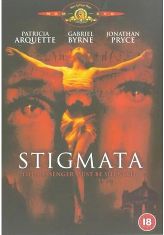
The film Stigmata (1999) presses a whole lot of my buttons. At the time it was originally released, I had been researching my own novel built on broadly the same premise:  a globetrotting protagonist hunting down miraculous statues and people claiming to have duplicates of Christ’s stigmata (though that’s basically where the similarities ended). And so I was fascinated to see how the film-makers went about bringing this to life.

stigmata-small

Even though the story and script (by Tom Lazarus, the not-quite-so-famous brother of Paul Lazarus III, director of Westworld & Capricorn One) didn’t itself think far out of the [confession] box, something magical happened in the art direction and cinematography: the use of colour, focus, light, time, sets, costume, and even make-up were all exemplary. For me, watching Stigmata was at times like being artfully collaged to death, machine-gunned with photographically (and geometrically) perfect moments: a tick on a piece of paper, Patricia Arquette lying underwater, a blood drop in a pool, blood being drawn, a blood centrifuge – all elegant, spare, swift, and focused. I highly recommend the film to anyone purely to enjoy its five-star visual treatment.

As a writer myself, however, I think the film’s problems stemmed right from the initial plotting – basically, having a priest-scientist (Gabriel Byrne) investigate the stigmata being suffered by a young atheist-hairdresser (Patricia Arquette) beneath a Vatican conspiracy managed by his control-freak boss (Jonathan Pryce) never worked as a setup for me… all too staged / stagey. The walls between the characters stopped the emotional side of the film from developing in a satisfactory way: I also didn’t much like the St Francis of Assisi (arguably the most famous stigmatic?) resolution, but you’d have to see that for yourself to see if you agree or disagree.

Watching this film a decade on, it feels a bit dated: could it be that the Da Vinci Code (and its flood of [make]-me-[rich]-too ripoffs) made the whole notion of devastating-secrets-that-would-topple-the-Church-were-they-to-be-made-public seem lightweight? And I kept wondering: was Holy Blood Holy Grail ultimately to blame?

Regardless, the film set me thinking about the kind of ur-story towards which Tom Lazarus was reaching, with his ancient Aramaic codex (based loosely on the Coptic Nag Hammadi Gospel of Thomas) triggering high-stakes factional infighting within the Vatican, with the supernatural subtext that The Truth Will Out (even beyond death).

Yes, it’s undoubtedly a cliché: and the overarching literary / cultural template at play is pretty easy to sketch out:-

  • concealed message left by an ancient (implicitly perfected) person, that requires…
  • deciphering and translation by (extremely proficient) domain experts, to expose…
  • long-held lies behind contemporary doctrinal messages, which are supported by…
  • powerful present-day conspiracies trying to maintain the (morally untenable) status quo.

Historically, does this sound familiar? After all, it is not vastly different to the entire back-story of the Renaissance (particularly during the Quattrocento). There, you had people scouring the known world for lost or concealed messages left by the Greco-Roman civilizations, to be deciphered by humanist scholars for their presumed wise (and frequently contrarian) messages.

And so I would argue that HBHG-style searches for enciphered traces of a ‘real Jesus’ are arguably little more than back-projecting our present-day cultural insecurities onto early Renaissance cultural insecurities – their search for lost classical wisdom was no different. One irony, though, is that things like the Turin Shroud (which I blogged about here and here) offer us glimpses of an entirely parallel kind of lost Christian history, far beyond the conceptual reaches of most contemporary conspiracy theorists.

What I personally fail to understand, though, is how this whole wonky ‘enciphered anti-doctrinal message’ meme has managed to endure the centuries as a literary conceit. Even my new best friend François Rabelais satirized this none too subtly in Chapter 1 of Book 1 of his alcohol-obsessed Gargantua and Pantagruel:

The diggers struck with their picks against a great tomb of bronze… Opening the tomb at a certain place which was sealed on the top with the sign of a goblet, around which was inscribed in Etruscan letters, HIC BIBITUR, they found nine flagons, arranged after the fashion of skittles in Gascony; and beneath the middle flagon lay a great, greasy, grand, pretty, little, mouldy book, which smelt more strongly but not more sweetly than roses.

Rabelais goes on to offer (“with much help from my spectacles“) his translation of the “Corrective Conundrums” found in that stinky little tome, all of them nonsensical and presumably meant to resemble some kind of vaguely prophetic quatrain-based literary genre popular in France at the time (Nostradamus fans, take note):-

The year will come, marked with a Turkish bow,
And spindles five and the bottoms of three pots, […]
This age of hocus-pocus shall go on
Until the time when Mars is put in chains

So… even though this concealed-text plot pattern was a hoary old chestnut by 1530, can anyone really explain to me how come it continues to drive a low-brow literary industry nearly five centuries later? For me, the big mystery here centres on the apparent lack of cultural progress: does Dan Brown’s success actually prove that we have learnt practically nothing in half a millennium?

Consider that your cipher mystery for the day… 🙂

It’s not really my historical bag, capice?, but some early American ciphers popped their heads over my virtual parapet in the last few days, and I thought I ought to pass them on…

(1) On Christmas Day 1801, Thomas Jefferson received a cipher challenge from “Pennsylvania mathematician Robert Patterson”, that remained unbroken for two centuries. Here’s the cipher itself: according to a comment and example given by “A nonny bunny” on Bruce Schneier’s blog, for “helloworld”, the plaintext would first becomes columnar-transposed to “lrhweollod”, which secondly gets shifted into positions 3 and 2 (the “3” and “2” of the key), and padded with nonsense, before finally being read off in the same c0lumnar-transposed kind of way

1 hw 3 lr 32 ablr
2 eo 1 hw 11 khwl
3 lr 2 eo 20 eoyu
1 ll 1 ll 11 llty
2 od 2 od 20 odtr

I’ve underlined the plaintext (“helloworld”), the key sequence (32,11,20) and the ciphertext (akelobholdlwyttrluyr) to make it a little clearer what’s going on (the original comment lost the formatting). But it’s nice to see a relatively pure transposition cipher out in the wild. 🙂

(2) Here’s a ciphered letter from John Adams  to John Jay dating from 1783-1785. There are a fair few web pages on John Jay’s codes and ciphers, as well as on Thomas Jefferson’s own codes and ciphers. John Jay and the agent Silas Deane also used invisible ink-style trickery (according to this CIA page, followed by more on the various ciphers used).

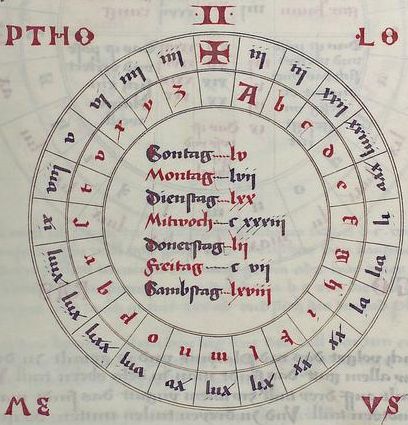
Following my recent post on modern per-degree astrology, Rene Zandbergen very kindly left a comment here pointing to online scans of a 15th century German translation of some of Pietro d’Abano’s works on astrology. While idly flicking through that, I noticed (starting on folio 132r) a short book by Johannes Hartlieb on ‘Namenmantik’ (onomancy, using names to tell fortunes). Dating right to the middle of the 15th century, this shows circular volvelle-like things that remind my eye of Alberti’s speculum (his rotating code wheel):-

hartlieb_132r_cropped

Cod. Pal. germ. 832 Heidelberger Schicksalsbuch, folio 132r

Given that this kind of thing was in the air round that time, was it mere chance that Alberti happened to devise it first? It’s true that Hartlieb’s ones (like the one for Ptolemy above) probably didn’t rotate at all… but all the same, I do honestly think it wouldn’t have involved a vast leap of mid-Quattrocento imagination to make them do so.

But the mention of Hartlieb reminded me of another research strand I’ve been meaning to blog about – flying potions. You see, it was Hartlieb who first wrote (in 1456) about witches’ flying potions, in his puch aller verpoten kunst, ungelaubens und der zaubrey, i.e. on “forbidden arts, superstition and sorcery”.

Reading up again on this subject just now, I was somewhat disappointed to discover that Ioan Couliano’s colourful account of how the handles of broomsticks were used to administer the hallucinogenic unguent turns out to be only supported by a single (and fairly unreliable) source. Mainly, the ointment seems more likely to have been administered to the armpits and absorbed into the bloodstream from there. Still, it probably beats flying cattle class on a charter flight, right?

To me, the bizarre thing about the historical sequence is that in the early Middle Ages it was heretical to believe witches’ descriptions of flight (because they were clearly delusional), while during the Early Modern period it became heretical to disbelieve witches’ descriptions of flight (because they were clearly possessed by the Devil). So much for the continual march forward of knowledge! 😮

For much, much more on this fascinating subject, I heartily recommend Shantell Powell’s set of pages on flying potions. Enjoy!

For years, it has been suggested that the structure of the Voynich Manuscript’s “zodiac” section (where each 30-degree sign has 30 nymphs / 30 stars linked to it) might be encoding some kind of per-degree astrology information. Famously, Steve Ekwall claimed that an “Excitant Spirit” had told him the types of star here denoted the outcome of conception (i.e. a male birth or female birth). This would have been either from the precise degree that the moon was passing through at the time of conception, or from the precise time when the question was asked of the astrologer.

libra-small
Voynich Manuscript page f72v1 – Libra (contrast-enhanced)

Interestingly, there is also a substantial modern literature on per-degree astrology, usually known as “Sabian Symbols”. The best-known set of these was drawn up by Marc Edmund Jones in San Diego in 1925 (you can see it on pp.10-26 of this Italian PDF): this was later refined and popularized by Dane Rudhyar (and others).

Yet Jones was building (to a certain degree, one might say) on the work of two nineteenth century astrologers / psychics: Charubel [John Thomas] (1828-1908) and the colourful Theosophist Sephariel [Dr Walter Gorn Old] (1864-1929). There’s a 1998 biography of the latter by Kim Farnell called “Astral Tramp” (Blavatsky’s nickname for Walter Old). [Review] Charubel & Sephariel’s 1898 “The Degrees of The Zodiac Symbolized” contains two 360-degree lists that are, it has to be said, wildly different.

On the surface, this would appear to be two completely parallel, relatively modern, and entirely unconnected re-inventions of the sort of (probably originally Arabic) per-degree astrology described by Pietro d’Abano – and so something Voynich researchers should perhaps strive to walk around rather than to engage with.

Certainly, Charubel’s list was specifically described as having been channeled:  yet Sephariel claimed that he had actually translated the symbols from a very old book called “La Volasfera”, by Antonio Borelli (or Bonelli) – and so there is, right at the core of the whole modern Sabian Symbol tradition, a very specific claim to a lost Renaissance parentage. Unfortunately, nobody has (as far as I can tell) since tracked down this lost author or this lost book, so Sephariel’s claim might… just… possibly… not be entirely truthful. Really, it’s hard to say, particularly as Sephariel was so, well, unreliable. Oh well!

If you want to read more about Sabian Symbols, there is a surprisingly large amount of literature: the Astrological Center of America maintains a pair of webpages (here and here) listing numerous books on Sabian Symbols and on other per-degree systems (respectively).

Finally, here’s an example of modern astrologers’ describing and using Sabian symbols, which might help make it clear how they are broadly intended to be used.

Twice a year, the Leiden antiquarian bookseller Burgersdijk and Niermans hold a book auction – the one coming up shortly is on 19th-20th May 2009.

Flicking idly through the listings, I noticed that going for (what seems to me a very reasonable) 300-ish euros is a 1608 printed edition of the 365 letters of the philosopher / astronomer Celio Calcagnini of Ferrara (1479-1541) – his Epistolarum criticarum & familiar. There’s more on Calcagnini here and his claim to have preempted Copernicus (Thorndike even discusses him [Vol V], so he can’t be all bad). He gets a brief Wikipedia mention, and was a major influence on Rabelais (of all people). Hmmm… if I was filthy rich, this book is exactly the kind of historical frippery I’d fritter away my hard-earned money on. I might even go up to 310 euros, you never know. 🙂

(Note that a copy of the Basel 1544 edition of his letters (Opera Aliquot) is also on sale on the Internet, though 12,500USD isn’t quite such a bargain. Conrad Gessner once had a copy of it, too.)

Calcagnini wrote on many subjects: on the significantly cheaper end of the scale (i.e. free), there’s an online scan of his 1534 book “De imitatione eruditorum quorundam libelli quam eruditissimi puta” here and another of his books here, both courtesy of the Bayerische Staatsbibliothek. There’s a 2006 paper on Calcagnini by Jan Papy: and he merits a good page-and-a-half in the 2003 book Contemporaries of Erasmus (yes, he knew and corresponded with Erasmus too), which you can see on Google Books.

Alternatively, if you haven’t yet been inspired to make a mad impr0mptu telephone bid, you might possibly be more tempted to splurge an an early printed set of Libavius’ works (including Paracelsian and Rosicrucian controversies in the appendix), a B&N snip at an estimated 3800 euros! As always, your choice…

Because Google is like a jetcar with a 20-speed manual gearbox, first gear is plenty for most people. However, if you want the other 19 gears, here are some ideas to get you fired up (just make sure you’re pointing in the right direction first)…

Google’s 2nd gear – Exact-fu

Without much doubt, I think the two basic Google tricks everyone should know are:-

  1. If you want an exact word match (i.e. not a nearest sound match, or a plural/singular), precede the word with ‘+’. This is most useful when (as is often the case with historical research) you’re looking for a particularly obscure word or name, for which Google will suggestion zillions of alternatives. For example, if you want to search for Sirturi (but don’t want the 46,000 hits returned by Sireturi), search instead for +Sirturi and you’ll get the 79 hits you do want.
  2. If you want an exact phrase, wrap the phrase in double quotes. For example, searching for Nick Pelling gets 144,000 hits (any page containing the two words will do) – but searching for “Nick Pelling” will give you a mere 9,250 hits. (Lazy hack: you can usually omit the final double quotes, Google is smart enough to fill them in for you.)

Basically, if you know that a given (fairly rare) search term is correct, you’re normally better off preceding it by ‘+’, to ask Google not to get in the way. Of course, leave out the + if you’re not 100% sure!

Note that these two tricks overlap: if you Google for (the doubly-misspelt) cypher mistery, the top result is for cipher mystery (i.e. Google suggests corrections to both words) – but if you search for “cypher mistery” (i.e. the same word pair but in quotes), Google only suggests web-pages with one change to the pair of words.

Google’s 3rd gear – Success-fu

A recurring problem is how to deal with the vast number of pages returned (even with 2nd gear Google-fu): and with just the one lifetime at your disposal, how could you ever sensibly go through a million hits? Of course, you can’t: but here are some neat Google trickettes to help you when your search query has proved, errrm, too successful:-

  1. If there is some unrelated idea that is diluting your search results, add a word associated with that secondary strand to your search but precede it with ‘-‘. For example, if you want to search for Voynich but don’t want any hits related to the Broken Sword computer game (written by Charles Cecil’s company Revolution Software), you could search for Voynich -Revolution. For bonus Google-fu points, try excluding multiple things at the same time, such as Voynich -Revolution -Ethel -ufo
  2. Use “100 results per page” as your default Google preference. The “Page Down” button (or, more likely these days, “mouse scroll-wheel down”) is a quick way of browsing 10x more results than you would otherwise get. OK, it’s not ideal, but any half-decent researcher should be capable of speed-reading, surely?

In short, being able to use ‘+’, ‘-‘ and double-quotes effectively is a good practical starting point for would-be Googlers. Note: while it used to be the case that Google’s engine caused these mechanisms to interfere with each other (specifically, you used not to be able to search for quoted strings and excluding search terms at the same time), these days they seem to have sorted all that out. Just in case you run into some outdated information on the web! (As if…)

Google’s 4th gear – Refinement-fu

Let’s say you’d like to craft a search query to yield a manageable set of results – say, 50 or 100 hits. But what do you do if your ‘vanilla’ two word search gets a million hits, but an exact phrase search gets only 2 or 3 hits? How can you coax Google into returning a more useful number of hits?

  1. The OR operator (in caps) lets you merge pairs of search words. Rather than search for Sirtori telescopium and then search for Sirturi telescopium, you can search for Sirtori OR Sirturi telescopiummuch more useful. If you’re after bonus Google-fu points here, try using multiple ORs in the same search, such as Sirtori OR Sirturi telescopium OR telescope
  2. Number ranges have their own merging trick! If you separate two numbers by two dots (i.e. 2006..2008), Google will find you pages containing any number in that range (though note that this doesn’t work with negative numbers, maths fans). A nice example is that searching for Voynich “500..700 ducats” will dig up references both to 600 ducats (Marci) and to 630 ducats (Dee) – pretty neat!
  3. The ‘*’ operator lets you find documents containing a pair of words separated by one (or two) words. This can be useful when you’re searching for two words that are connected but which don’t usually appear exactly next to each other. For example, if you wanted to find my middle name, Googling for Nick * Pelling returns pages with Nicholas John Pelling – here, note that because I didn’t specify +Nick, Google silently converts it to Nicholas. Also, note that you can progressively weaken the link by adding more stars in a line, but only if you put them inside double quotes – so, “Nick ** Pelling” and “Nick * * * Pelling” will all find pages where the two words appear progressively further apart (however, “Nick * * * * Pelling” won’t work, sorry!)

Basically, once you can consistently use your refinement-fu to control Google, you’re not coping with search results any more… you’re managing them.

Google’s 5th gear – Zigzag-fu

This is a hard one to describe, but as it defines a gear change all of its own, it needs its own section.

The big takeaway from the preceding gear-fu should be that the point of searching is not to find the perfect page, but rather to find a sensible range of pages clustered around the perfect page – while Google is pretty good at getting you close, you still need to be actively exercising a fair bit of choice if you’re going to find what you want. The skill lies in crafting queries that get you reasonably close (but not too close) to where you want to go.

However… in practice, the whole process doesn’t usually work out quite as well as you would hope – you can’t always “just get closer”, shaving 1,000,000 hits to 100,000 to 10,000 etc. The noble art of “zigzag-fu” involves constructing queries that iteratively zigzag you towards your final query – too many results is bad, too few results is bad, and too spammy / too general a set of results is also bad.

Zigzag-fu is where you build up a feeling for what you’re looking for (even if you haven’t seen it before), and somehow move around it and towards it without really realizing how. People with great zigzag-fu get to where they want to without really thinking – but as this is more of a craft skill, I’m struggling a bit to explain it.

Just practise – I’m sure you’ll get there yourself (if you’re not already there, of course). 😉

Google’s 6th gear – Operator-fu

Google has a sprawling set of obscure “operators” (you can usually recognize them by their trailing colon) for refining searches according to different aspects of the pages found. Having said that, in most cases these are usually only marginally useful – the big trick is realizing when you’re in a big enough hole that only a special-purpose Google crane can hoist you out. “Operator-fu”, therefore, isn’t so much a refined sense of power as a refined sense of danger – i.e. has your search floundered?

  1. site: – this operator filters out only those pages whose website name (partially) matches the pattern. So, if you only want to find Voynich pages on US university websites, searching for site:.edu Voynich should do the job. The OR operator works on this, so searching for site:.edu OR site:.ac.uk Voynich will find Voynich pages on US and UK university webpages. You can also use this to see how many pages Google has indexed from a given site: for example, searching for site:ciphermysteries.com yields about 613 results (as of today).
  2. intitle: / inurl: / intext: / inanchor: / allintitle: / allinurl: / allintext: – these tell Google where to look (and, conversely, where not to look) for the keywords you specify. So, searching for allintitle: Voynich Decoded will list all the webpages in Google’s index that contain the words “Voynich” and “Decoded” in the title. Not very useful, but might possibly save the day.
  3. filetype: – if you are trying to find (say) a pdf containing the phrase “chilled monkey brains”, then Googling for filetype:pdf “chilled monkey brains” should work OK. There are also a load of obscure Google filetypes (such as htpasswd), but that’s a story all to itself. 🙂
  4. date: – very useful for finding things within the last N months. Not very useful otherwise. 🙂
  5. daterange: – very useful for finding things within a range of dates. Sometimes a big help!
  6. The tilde (‘~‘) operator forces Google to look for synonyms, even when it doesn’t itself think the word is ambiguous. However, this isn’t really very useful as (by and large) Google guesses right.

For more on these (and other mad Google operators), there’s a nice guide on the Google Guide site.

Google’s higher gears – Ninja-fu

(OK, OK, I know it’s mashing Japanese and Chinese words together, but I wanted to evoke a feeling of mastery over many worlds – just so you know!) Ascended Google Ninja-fu masters come up with a constant stream of tricks that make just as much use of Google’s sprawling array of secondary search apps (half of which the GooglePlex’s Borg mind has probably forgotten about) and its business model. There’s also a 2003 O’Reilly book called Google Hacks, most of which is now out of date, but which should arguably be given to ten-year-olds with their first proper laptop. 🙂

But to such a 33rd Scottish Rite Googler as yourself, it should be clear by now that everything Google does and has is fair game. Here are just a handful of things to consider, from an insanely long list:-

  1. Google lets you search for ampersand and underscore characters (maybe it’ll help one day).
  2. Google doesn’t match search phrases over paragraph boundaries (that’s just the way it works).
  3. Google knows about C++ and C# (helpful for programming searches)
  4. You can search for stopwords (such as ‘the’, that Google normally discards) by preceding them with a ‘+’. Though some searches (such as for The Who) do automatically include them!
  5. PageRank dominates short query strings, context dominates long query strings. If you can decide whether PageRank is helpful or unhelpful for your query, you can adjust your query length accordingly.
  6. Google API-based tricks – too many to list
  7. Google Trends-based tricks – too trendy to list
  8. Google Widget-based tricks – too new to list
  9. Google’s cache, calculator, weather, currency, recipe, flight information… you get the idea!

Of course, if I disclosed these kinds of secrets, I would be hauled in chains before the New World Order’s special blogging oversight committee and thoroughly excoriated (and I like my corium just the way it is, thank you very much). Besides, because Google changes all the time, so does the array of useful higher-gear tricks – and so you’ll be unsurprised to find out that the real art of being an Ascended Master of Google-fu is… making up your own tricks.

Enjoy! 🙂