
If you’ve followed parts one and two, you’ll know that I’m pretty sure that
(a) that The Unknown Man had worked on a ship (probably as a Third Officer), but was unemployed & nearly destitute;
(b) that Jestyn had probably first met him in the hospital where she worked, and – as with Alfred Boxall – had given him a copy of the Rubaiyat of Omar Khayyam, as well as her new phone number; and
(c) that he had recently been acutely ill, possibly even hospitalized following a bad virus.

Some other facts that strike me as relevant:
(d) the Somerton Man, Alfred Boxall, and Jestyn’s husband were all much the same age
(e) the Rubaiyat is a collection of love poetry

The first issue is why the Unknown Man travelled far across Australia to see a nurse who had once treated him, carrying a book of love poetry she had apparently given him, despite being unemployed and outrageously poor. Personally, I suspect the answer to this lies in the question: love. A number of people have speculated that the unknown Man had fathered the nurse’s son (some based on the observation that their earlobes apparently shared the same rare structure): travelling long-distance to see your own young son would be a perfectly consistent scenario.

But Jestyn now had a new partner, whom she consistently referred to as her “husband” (though it was to be several years before his divorce came through and they were able to marry). Given that she had already refused Alf Boxall’s request after the war to meet up with her, it seems odd that she allowed the Unknown Man to visit: why one and not the other? I believe this points to a different dynamic between her and the Unknown Man: indeed, if the Unknown Man were her young son’s father, I believe Jestyn wouldn’t comfortably have been able to turn him away, even if she did now have a partner she intended to marry.

All in all, I’m perfectly comfortable with the idea that this is what connected them together, and that rather than conspiracy or subterfuge, it was love that had bound him to her (even if it was not necessarily reciprocated): but what then are we to make of his mysterious enciphered note? After all, this is a cipher mystery, right?

MRGOABABD
MLIAOI
MTBIMPANETP
MLIABO AIAQC
ITTMTSAMSTGAB

For all the speculative and hallucinatory code-breaking efforts that have gone into cracking these few short lines, there’s no doubt in my mind what it actually is: nothing more than a performance aide-memoire, the first letters of a poem dedicated to Jestyn that the Unknown Man had himself written, perhaps composed on the train on his way over to Glenelg. In his mind, I suspect he was aspiring to something close to:-

“The Moving Finger writes: and, having writ,
Moves on: nor all thy Piety nor Wit
Shall lure it back to cancel half a Line,
Nor all thy Tears wash out a Word of it.”

Of course, few poets reach such sublimity and subtlety of expression, and I have little doubt that the Unknown Man’s own poetry fell well short of that league. But if it is a love poem, it seems a reasonably safe bet to me that each line has only four feet (there seem to be too few initials there for it to reach FitzGerald’s five feet per line), and so the lines probably also divide into four sets of two halves:-
MRGOA
— BABD
MTBIM
— PANETP
MLIABO
— AIAQC
ITTMTS
— AMSTGAB

Given that there’s a high chance that the letter [L] (which only appears once) probably stands for ‘[L]OVE’, I’d expect that [MLIABO] will turn out to be something not far off from “My Love Is Almost Boiling Over”. Intensely felt no doubt, but probably far from sublime.

Perhaps a retired crossword enthusiast with plenty of time on their hands might care to try to reconstruct this poem? There are plenty of reasonable clues to be had: [ITT] could well be not too far from “I Think That”; the last word of [BABD] probably rhymes with the last word of [PANETP], and similarly for [AIAQC] and [AMSTGAB]; the lines beginning [A-] could well be “AND…”, while [M-] could be “MY…”; the [Q] strongly constrains the [AIAQC] line; etc.

To sum up, I’m completely comfortable with the idea that the Unknown Man travelled to Glenelg not long after coming out of hospital to see Jestyn and their son, and that it was there he died, possibly poisoned by digitalis, but more likely from an allergic reaction to something in the pasty he’d had for lunch. But none of that really touches on the question of where he came from: really, what happened before the curtain rose on his relationship with Jestyn?

People don’t tend to speculate on this much, which is a shame because in many ways I think we do now have enough information to to give it a go. Perhaps the chewing gum he was carrying was the clue: for, as Diane O’Donovan thoughtfully pointed out in her comments to Part Two,

Well, I’d say that one thing is quite sure; he wasn’t Australian.

Gum-chewing was considered an exclusively American habit in the forties, and even into the sixties, positively loathed by most adults and by middle class teenagers too.

And if you tenaciously follow that idea through to the end…

So how about this? Mystery man is American, contracts malaria in the tropics and is sent to a hospital in Australia, as was usual. This first time, in Sydney. But then he gets orders to return to the front, prefers to go AWOL, gets caught and is put into an internment camp [perhaps already in Victoria; Melbourne Hospital was one of the internment camps. While there, he gets plenty of sun and exercise, but little really hard work. Fortunately, war ends. He’s finally tried for AWOL, but only sentenced to 12 months in prison (or gets sick again) so no sun for the final year.

Now released, he asks to be accepted as a new migrant, claiming to be a sign writer. He’s accepted, and buys the tools of the trade intending to start a new life and find Jestyn. Suitcase and clothes were given from a refugee/charity organisation, as part of a routine de-mob and welcome to Aus. etc.
BUT – While at Melbourne Hospital .. and so forth.

With my only proviso being that the Unknown Man was arguably more likely to be in the US Navy than the US Army, I think this is pretty much the best scenario currently going. Might the answer to the Somerton Man mystery therefore lie not in Australian hospital archives, but in US Navy files? As Diane muses, perhaps the most telling clue of all here might turn out to be the smallest: the pack of Juicy Fruit. Something to chew on! 😉
A quick update on Part One: I note in the Taman Shud Case Wikipedia page that:

Initially, the clothes were traced to a local sailor, Tom Keane. As Keane could not be located, some of his shipmates viewed the body at the morgue, and stated categorically that the corpse was not that of Keane, nor did the clothes belong to the missing sailor.

This does make me wonder if Tom Keane the sailor had given some older clothes away to a Mission to Seafarer’s branch. Did anyone ever try to follow up Tom Keane? An interesting thought…

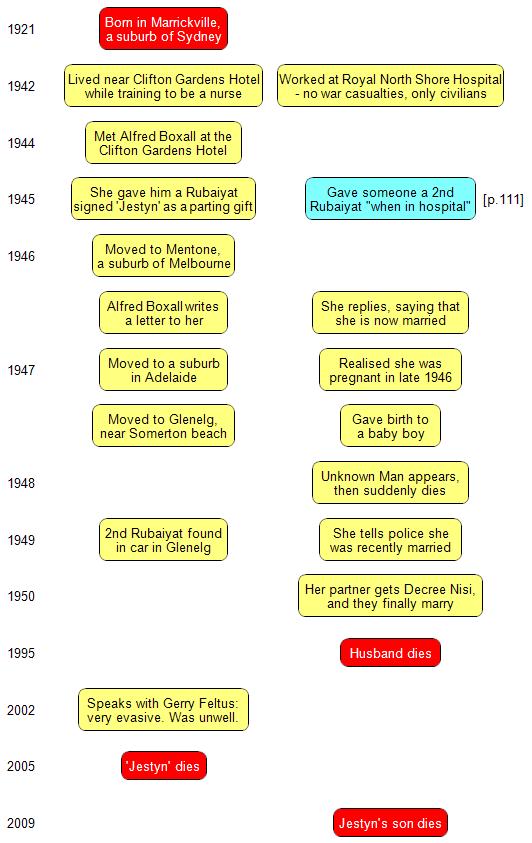
Anyway, before I carry on discussing the Unknown Man’s life, death, and cipher, I need to post about the timeline for ‘Jestyn’, the unnamed nurse whose phone number was in the back of the 2nd Rubaiyat (i.e. not Alf Boxall’s copy) found thrown in a car in Glenelg’s Jetty Road, and from a page of which the words “Taman Shud” had been torn and put in one of the Unknown Man’s pockets.

The diagram below summarizes pretty much all the top-level details of the nurse’s timeline, but with one addition from me. Gerry Feltus quotes [p.111] Adelaide’s “The News” of 28th July 1949 as saying that the nurse had “told police that about three years ago she had given the man, Lieut. Alfred Boxall, a copy of Omar Khayyam’s ‘Rubaiyat’ when he was in hospital“. Except, of course, Boxall never was in hospital: they met at the Clifton Gardens Hotel (which was demolished in 1966, just in case you accidentally try to go looking for it).

Was this just lazy journalism [Gerry Feltus says “possibly”], or a slip of the tongue from the nurse? I suspect the latter, for this would tie together many elements very neatly: and will continue discussing this in Part Three…

More to come… 🙂

The news of the moment is that Australian Attorney-General John Rau has refused Professor Derek Abbott’s request that the Somerton man’s body be exhumed for DNA / autosome testing, commenting that Abbott’s application wasn’t “compelling”. Well, I guess that means we’re going to have to do it the hard way, then… 🙂

So here (as long-promised) is Part One of my thoughts on the Unknown Man and his mysterious cipher note, perhaps they’ll open up some new research avenues. Overall, while I’m pretty sure my reasoning is basically sound, please feel free to disagree! (PS: I’ve included a few page references to Gerry Feltus’ book for Klaus Schmeh and other hardcore cipher mystery buffs).

[For background on the Somerton Man / Unknown Man / Taman Shud / Tamam Shud case, here’s a pair of links that should get you started]

(1) Why was the Unknown Man in Somerton? As with pretty much all historical mysteries, it is ‘within the realms of possibility’ that all the evidence that the police were (eventually) able to assemble had been consciously constructed and arranged to give a certain impression, and that the real story behind them all was entirely different. Yet while we should acknowledge that each individual piece of evidence might well have been influenced, finessed, modified or even faked, we should be trying to look through them to the overall narrative. So, I view as basically reliable the link between the Unknown Man and the copy of Taman Shud subsequently found nearby – and hence between the Unknown Man and the nurse ‘Jestyn’, whose private phone number was written in the back, and who lived close to Somerton Beach in Glenelg.

Given that a man was seen knocking at Jestyn’s door during the day before the Unknown Man’s appearance on the beach, it seems to me a wholly unremarkable conclusion that the Unknown Man almost certainly came to Glenelg specifically to visit her. Moreover, Jestyn had not long lived in Glenelg, so had had that phone number for only a short time: and must therefore have given the Unknown Man her phone number relatively recently.

(2) Where did the Unknown Man die? I think the answer – without a shadow of a doubt – is “not on the beach“. He was found propped up on Somerton beach yet with “lividity above the neck and ears” [p.204] – i.e blood pooled at the back of his head after death. If he had quietly died in the position in which he was subsequently found, gravity would have pushed his blood to his feet: hence I conclude that he died somewhere else entirely, where in fact his body was left for a while with his head below the rest of his body, before being carried to the beach and arranged in that oddly casual pose.

Moreover, Somerton Beach is sandy – so if the Unknown Man had lain on that beach for any period of time with his head at its lowest point before being physically rearranged by a random passer-by, there would surely have been sand in his hair… but there was none. As such, I disagree with the Coroner T.E.Erskine who concluded that “He died on the shore at Somerton on the 1st December, 1948.” [p.205] – rather, though the man was found dead there, I find it highly unlikely that it was the scene of his death.

No: to my mind, the only realistic scenario is the Unknown Man died somewhere else entirely and was carried to the beach – probably, from his weight, by a man. The report mentioned by Gerry Feltus [pp.143-144] of someone seen apparently doing exactly this around 10pm on the previous evening would seem to be entirely consistent with this scenario.

(3) How did the Unknown Man die? The first pathologist noted that the man was in good physical shape, and that his “heart was of normal size, and normal in every way”. There was blood in his stomach along with the remains of a pasty eaten roughly three hours before his death.

Though his spleen was significantly enlarged (3x times normal size) AKA splenomegaly, note that this is most likely a symptom of a different problem rather than the problem itself. As I understand it, your spleen can’t suddenly enlarge in a matter of a day: and given that the Unknown Man was apparently only in Somerton for less than a day, he must have arrived there with his spleen already enlarged. The lack of any obvious signs of another problem points to a problem that had just receded, quite probably a recent viral infection. So to me, the presence of an enlarged spleen implies that the Unknown Man had only just recovered from an significant illness, and that he was perhaps still in quite a fragile state. He would very probably have also had some lingering discomfort or back pain from his enlarged spleen.

(4) What was the cause of the Unknown Man’s death? It’s important to remember that coroners and pathologists repeatedly examined his body and screened his blood, looking for any faint clue that might help to narrow down the cause of his death, but with no success. Given the healthy state of his heart, the two best theories left standing (in my opinion) are (a) a deviously hard-to-pin-down poison deliberately administered either by himself or by someone else but which quickly disappeared from his system after death; or (b) an unexpectedly strong allergic reaction to something he had ingested, with the most notable candidate being excess sulphur dioxide used as a preservative in the pasty, which in 1948 was yet to be controlled [pp.202-203].

For me, I have to say that there is only one likely scenario I’m at all comfortable with: that while at Jestyn’s house late that afternoon, he had an unexpectedly strong allergic reaction to something in the pasty he had had for lunch (for why else would there be blood in his stomach?) In my mind, he must have laid down on a bed suffering from acute stomach cramps; but because he was so weakened by his recent illness, he unfortunately died as a result of his reaction, slumping with his head falling backwards over the edge of the bed – not upside down, but with his neck supported at an angle by the edge of the bed, leading to the distinctive lividity observed by the pathologist.

Even though Jestyn had worked as a nurse (and more on that later), I suspect she was not physically strong enough to move him from that position, so left him just as he was until her husband arrived home in the evening. I believe the Unknown Man remained on the bed until later that evening, when they carried him to the beach to pose him there, to be found in the morning.

(5) What was the Unknown Man’s personal situation? In his modest suitcase, there were stencilling tools for making signs such as Third Officers use on ships to mark baggage and crates, along with the princely sum of sixpence. It was December (the middle of the Australian summer), and his body had the remains of the kind of outdoor tan you’d expect from someone who had worked outside the previous summer, but not that summer. His clothes came from a variety of places, and in a variety of sizes (his slippers were smaller than his shoes), and most had their labels removed. The items that did have a label were marked “T. Kean” or “T. Keane”.

This has led to a lot of spy theories (“an international man of mystery who didn’t want to be identified“, etc) and conspiracy theories (“his killers removed the labels from his clothes in order to conceal his identity“, etc), none of which rings true at all to me. For me, however, the simplest explanation by a mile was simply that he was poor (if not actually destitute), and had been given these clothes by a charity. The original owners’ name tags would have been removed by the charity before being given to the needy.

Furthermore, given the probable connection with sea-faring implied by the stencilling tools in his case, my prediction is that he was given these clothes by a local Mission to Seafarers or Stella Maris branch.

So: as far as I can see, the most likely overall scenario is that the Unknown Man had recently had a serious viral infection, travelled to see Jestyn in Glenelg, had a pasty for lunch, was taken ill with an allergic reaction, died on her bed, but was posed on Somerton beach that night. But… why was he there at all, and what of his mysterious enciphered note? More on that in Part Two…

Though I’ve blogged about the Tamam Shud / Taman Shud case before, it’s still very far from closed. The man found on South Australia’s Somerton Beach in December 1948 remains unidentified, the nature of his death continues to be unresolved, his relationship with the nurse “Jestyn” is still not fully locked down, while as for the curious note tucked into his pocket…

MRGOABABD
MLIAOI
MTBIMPANETP
MLIABOAIAQC
ITTMTSAMSTGAB

…it’s as mysterious as ever.

Arguably the best starting point for people intrigued by this whole story is to watch a 1978 documentary on the subject from Australia’s ABC channel. Handily, it has been posted in three 10-minute sections on YouTube: 1/3, 2/3, and 3/3. Because so much of the police evidence has been destroyed over the years, the great thing about this film is that you get to actually see things in The Unknown Man’s suitcase (right at the start of part 2), which I for one found particularly interesting.

What I suspect you’d really want to leaf through next would be a dossier on the case, carefully laid out by a former policeman who had been assigned to it, and who went to some lengths to be factual, not judgmental. If my guess is even remotely close, then I’d say you simply have to get yourself a copy of G. M. Feltus’ (2010) book “The Unknown Man: A suspicious death at Somerton Beach“.

Yes, Gerry Feltus was indeed a policeman assigned between 2002 and 2004 (when he retired) to the Somerton Man cold case: and I think he does an admirable job of bringing together both the numerous strands of (often painfully thin) evidence and the various claims and theories as to the dead man’s identity.

It’s entirely true that his lengthy roll call of dud theories in the middle of the book can get very slightly wearing: but he’s clearly trying to give armchair mystery solvers everything they could reasonably need to get under the skin of this peculiar case, and so arguably couldn’t present it in any other way. Recommended!

Of course, there’s an extensive Wikipedia page for you to go through too (frankly, I’d recommend pouring yourself a nice glass of lightly-oaked Australian Chardonnay and watching the ABC documentary before you do anything so completist), though it’s not really a patch on Gerry’s 200+-page book.

Incidentally, there’s a lot of recent speculation that the Unknown Man may well have been the father of Jestyn’s son (there’s now even talk of exhuming bodies and performing DNA tests). Though my own belief is that this is – for entirely separate reasons – most likely true, I also think that this is missing the point. The right first step would be to do much more to explore the Somerton’s Man’s life before his death: thanks to Gerry Feltus, I think we can tell a great deal about him, and make some well-educated hunches.

In a few days’ time, I’ll post about what I think the odd cipher message contains, as well as my thoughts on the Unknown Man’s life, his travels in Australia after the Second World War, and his premature death (yes, I’m quite sure he was poisoned). But that’s by the by: for now all that’s important is that I think anyone with an interest in this enduring cipher mystery should buy themselves a copy of Gerry’s book from his Australian website and try to make up their own mind!

Here’s a historical cipher mystery from 1948 that I found out about yesterday (apologies for being so slow on the uptake). It’s a thoroughly perplexing affair from Australia, with an anonymous corpse that ended up embalmed, lots of red herrings (all deliberate, it would seem), a fragment from the Rubaiyat of Omar Khayyam (“Tamam Shud”, after which the whole case is known) hidden in a secret pocket, and a short piece of apparently ciphered text:-

MRGOABABD
MLIAOI
MTBIMPANETP
MLIABOAIAQC
ITTMTSAMSTGAB

As is clearly visible from the hi-res scan of the note, the second line is crossed through: to me, this makes it look as though the fourth line [MLIABO…] is a corrected version of the deleted second line [MLIAOI], perhaps where the “B” was omitted.

Any passing pen-and-paper code-breakers (particularly the hairier ones, naming no names *cough* Tony Gaffney) would immediately note a number of stand-out features:

  • The “AB” letter-pair appears four times in the message
  • IA appears at least twice
  • “(I)TT(M)T” occurs in the last line (suggesting that ciphertext T <=> plaintext E, hmmm?)
  • Several reversed letter-pairs (ST/TS, AI/IA, TM/MT) appear in the message
  • The quality of writing appears semi-literate rather than hyper-literate

I suspect that these largely rule out any sophisticated cipher system: so what we are looking at here is probably a simple monoalphabetic cipher, and one probably executed by a fairly inept code-maker (i.e. with errors).

Since March 2009, a team from the University of Adelaide led by Professor Derek Abbott (who presumably felt compelled to try to work out whether or not to add the affair to his list of “imponderable” questions) has apparently set out to solve this whole mystery. But should the cipher get cracked, the sorry rationale behind it all would probably become painfully obvious. (For what it’s worth, my guess is that it’s some kind of botched suicide note to a lover, that would need to be both private and public at the same time.)

So, all you historical code-breakers out there, what are you waiting for? Get cracking! 🙂