Ever since Prescott Currier first pointed out that letters and words in Voynich Manuscript lines appear to prefer (or to avoid) certain line-positions within lines, pages, and paragraphs, Voynich researchers have been on the lookout for more of these unusual LAAFU (“Line As A Functional Unit”) features. This is simply because (a) they’re a bit weird, (b) they pretty much disprove any Voynich theory that claims that Voynichese is a simple language, and (c) they might possibly be hinting at what’s going on inside the ‘engine’.
So here’s a new LAAFU feature that Claude managed to dig up for me, that I certainly didn’t know before.
The Word 2 sh-initial boost
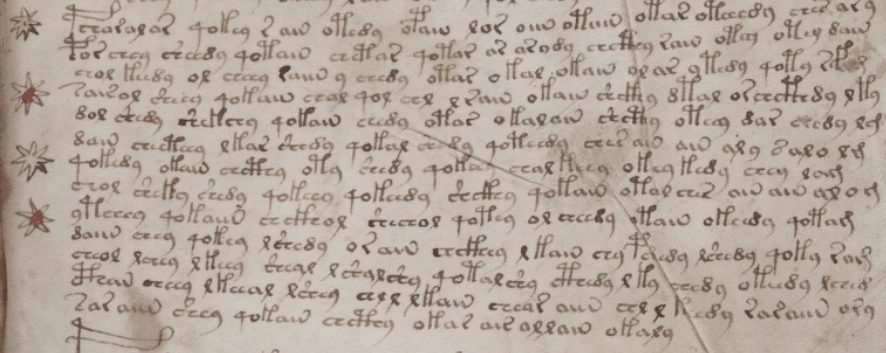
I have recently been restricting my analyses to Quire 20, because I believe that Currier B ‘evolved’ between the various sections, and I don’t want to accidentally miss features by searching too widely. (I also posted about Neal Keys.) And what emerged from all this is that the second word of a line is unusually often sh-initial.
How strong is this preference? On Tiltman lines (the top line of a paragraph) in Q20, the second word is about 2.14x as likely to be an sh-initial word (21.2% vs 9.9%) than in mid-line: on non-Tiltman lines in Q20, the second word is about 2.46x as likely to be an sh-initial word (16.7% vs 6.8%) than in mid-line. [All values from the Takahashi transcription.]
Also, sh-initial words trail off as you get closer to the line-end. Once you’ve got past the Word 2 spike, the probability of a word being sh-initial stays quite flat (~8%), before sharply dropping off in the last two (~3%).
Finally, sh-non-initial words are generally flat (2-3%) with a slight peak at Word 3 (3.4%), but trail slowly off to ~1% at line-end. Which makes sh-initial words appear to have a noticeably different positional distribution from sh-non-initial words.
As with other LAAFU features, this feels quite unlike the way you’d expect any natural language to work. But what is going on?
Contextual Factors
We might sensibly look at nearby text behaviours, to see if any of them are correlated with this. There are many weak correlations, but none explains or predicts the spike. For example:
- It isn’t driven by the first word. After words such as daiin and dar, the second word’s sh-initial share is high at the start of a line (0.44) but low after the same words in mid-line (0.11).
- It isn’t a page or leaf setting. Pages differ a lot in how much sh they have, but the Word 2 boost sits on top of that at about the same size everywhere.
- Nothing carries over from the end of the previous line.
- It occurs broadly the same in sections that seem to be recipes as in sections that seem to be non-recipes.
- There are no specialised sh-initial words that appear at Word 2: it’s the same vocabulary, just more often sh-initial.
Claude also points out:
- At Word 2, the ch- rate is roughly normal, so sh- is being added rather than ch- being suppressed. The openings that become rarer at Word 2 are gallows-initial and qo-initial words (and a-, ol/or- and o-initial words become commoner).
- Something similar appears in Q13, though it fades less sharply after Word 2. In Currier A pages, Word 2 favours ch- and sh- alike, rather than sh- over ch-.
So this remains a mysterious feature.
Line-Initial Correlations
So I pushed Claude to look for any correlations between this Word 2 sh-initial spike and the first glyph of each line. Overall, the first glyph made no significant difference. The figures for individual glyphs bounce around, and even rank differently in the two transcriptions. (These are odds ratios on sh-‘s share of ch-/sh-initial words, so they aren’t directly comparable with the 2.14x and 2.46x figures above.)
The one exception was lines starting o- or qo-, where the spike seems to disappear (1.13x, against 2.46x for all other lines). Because I only spotted that grouping after seeing the numbers, I asked Claude to test it in Q13. The same thing happens there: no boost on o-/qo-initial lines (1.15x), and a normal one on other lines (2.32x).
What Is Going On Here?
It might be that an o-initial or qo-initial line-initial word is simply an ordinary mid-line word (okaiin, qokeedy, ol…), whereas most other Q20 lines open with one of the distinctive set of line-initial glyphs.
If this is right, the Word 2 spike may be triggered by (or may be a component part of) some kind of artificial or scribal line-start construction mechanism. That would seem to be a new angle on LAAFU, though that’s still not much use in moving us forward. But it’s interesting, right?