For decades, Roswell researchers have tried to gain access to Project Mogul documents. Most famously, UFO skeptic Robert Todd submitted numerous FOIA requests during the 1980s and 1990s to try to access some of them. According to the McAndrew US Air Force report, it was Todd’s efforts that ultimately led to the Project Mogul account of the Roswell Incident emerging (or ‘being constructed’, depending on your point of view), mostly by… looking at his FOIA requests. And if that sounds a bit useless, it’s because it is.

Still, where are all the Project Mogul documents?

The Roswell Report

The Roswell Report contained large sections of Project Mogul-related text (albeit carefully curated):

  • New York University, Constant Level Balloons, Final Report, March 1, 1951
  • New York University, Constant Level Balloons, Section 1, General, November 15, 1949
  • New York University, Constant Level Balloons, Section 2, Operations, January 31, 1949
  • New York University, Constant Level Balloons, Section 3 , Summary of Flights, July 15, 1949
  • New York University, Progress Report No. 6, Constant Level Balloon, Section 11, June 1947
  • New York University, Special Report No. 1, Constant Level Balloon, May 1947
  • New York University, Progress Report [No. 7], Constant Level Balloon, Section 11, July 1947
  • New York University, Progress Report No. 4, Radio Transmitting, Receiving and Recording Systemfor Constant Level Balloon, [Section I], April 2, 1947

To be clear, these were taken from reports on the contract portion of the project that was carried out by the group at New York University. And there’s no obvious sign to me that those reports themselves have ever been made public, or indeed any document relating to the project (as opposed to just the contract), which was top secret.

Request for Lt. H. F. Smith (USNR)

Incidentally, while once again grinding my way through these sections of the Roswell Report, I noticed a short report of a meeting on p. 807 that I’d previously overlooked re. Harris F. Smith:

  • 6/25/47
  • Mr. Gordon Vaeth, Commander G. W. Hoover, J. R. Smith, C. B. Moore
  • Sands Point Office of Naval Research, Port Washington, L. I., N. Y.
  • Request for clearance on General Mills Balloons. Request for Lt. H. F. Smith (USNR) to accompany project to Alamogordo.
  • Granted.

References in a Holloman AFB document

I found a separate (non-classified) https://apps.dtic.mil/sti/tr/pdf/ADA323109.pdf Holloman AFB balloon history document that referred to the NYU project reports, along with monthly Guided Missile group progress reports (which were from Holloman AFB itself):

  • Research Division, College of Engineering, New York University, Technical Report No. 1 (New York, 1 April 1948)
  • Research Division, College of Engineering, New York University, Technical Report No, 93.03. Constant Level Balloons Final Report (New York, 1 March 1951)
  • Progress Summary Report on U.S.A.F Guided Missile Test Activities (HAFB, published monthly 1 November 1947-1 June 1950)
    • Progress Summary Report, 1 August 1948
    • Progress Summary Report, 1 October 1948
    • Progress Summary Report, 1 March 1949
    • Progress Summary Report, 1 May 1949
    • Progress Summary Report, 1 May 1950

According to DTIC document ADA375116, Maxwell AFB apparently has at least some of the HAFB monthly Progress Summary Reports on microfilm. So I submitted a request to the Air Force Historical Research Agency at Maxwell AFB to ask them what they have, and whether it is declassified / accessible etc.

Robert Todd’s “Cowflop Quarterly”

Back in 1995-1997, UFO skeptic Robert Todd (who died in 2007) published parts of his research via a newsletter he called “The Cowflop Quarterly” (“Reporting on Ufological Frauds and Fantasies“). I’m guessing the one time he called it “KowPflop Quarterly” was some kind of not-very-subtle dig at Roswell researcher Karl Pflock.

Very helpfully, though, Todd explained (on p.3 of The Cowflop Quarterly No.4) how Project Mogul connected to other projects:

A search using the code name “Mogul” would be worthless, especially since the name was later changed to “Rockfish”. For reasons too complicated to explain here, Project Mogul also was known as, or became a part of, Project MX-968, which itself was a part of the much larger Project “Whitesmith”, which was later changed to Project “Bequeath”, which was later changed to Project “Centering”, which was still later changed to Project “Cottonseed”. During the Operation “Sandstone” A-bomb tests in the Pacific in 1948, Operation “Fitzwilliam” was formed to test various methods of detecting nuclear explosions at long range. The Project Mogul portion of Operation “Fitzwilliam” was known as Project “Blackheart”.

I bet you’re glad that’s clear now!

Yet Todd also cautions that “[he] spent five years looking for the Project Mogul project files, without success” (on p.4 of The Cowflop Quarterly No. 4).

Additionally, in The Cowflop Quarterly No. 5, Todd mentions (pp. 2-3) two interesting sounding files of AMC correspondence out of a 36-box-large load of files retired to the National Archives:

  • 000- Flying Discs- “Sign”, “Grudge”
    • 1947-1950
  • MX-1011 – “ROCKFISH”, “MOGUL” Projects
    • Acoustical Research (1946 thru 1950)

These files were supposed to be retained, but (p.3) “[were] destroyed during [a] disastrous fire in July 1973” at the National Personnel Records Center, St Louis, Missouri. But all the same, that suggests another AMC project number (MX-1011).

Some quick thoughts…

The Project Mogul documents seem to be caught in a peculiarly American tangle. The reports produced under the NYU contract (which I think was confidential rather than secret) have been indirectly released via the Air Force’s “Roswell Report” but not declassified. So, unless you know better, these documents don’t appear in DTIC or anywhere else, apart from the Roswell Report excerpts. Similarly, even though Project Mogul itself was an Air Materiel Command project, it doesn’t appear to have been declassified at all.

All the same, the two MX- references that Robert Todd dug up (MX-968 and MX-1011) can be cross-referenced using modern search engines, with surprising results…

Project MX-968 and Project MX-1011

First, the easy one. MX-1011 was (according to this site) “Aerojet General X-8 Aerobee research rocket”. The Aerojet General X-8 rocket was ordered by the US Army Air Force for high-altitude research as part of Project MX-1011: this was used at Holloman AFB for many of the space biology launches I discussed a few days ago. So it seems as though the reference on the outside of the AMC correspondence file may not have been correct.

We’re onto more solid ground with MX-968, though. According to this MX designation website, MX-968 was “[Project] “Cottonseed” (unidentified project; Power Plant Lab requirement)“, which is – according to Robert Todd – the name that Project Mogul ultimately morphed into. Note that “Power Plant Lab” was the section of Wright Air Development Center at Wright-Patterson AFB that designed engines specifically for planes, so this is probably a sign more of what the project later became than what it originally was.

A much more direct reference describing what MX-968 actually was appears in this DTIC file, pp. 45-46:

Although this approach [Project Mogul] did not prove fruitful, the newly-established Geophysics Research Directorate at Watson Laboratories started a follow up program, MSX-968 [sic], early in 1948 to explore radiological, acoustic, and seismic techniques for long-range detection. Work on the radiological technique, originating under a Watson Labs contract with Tracerlab, Inc. in Cambridge, MA, developed airborne measurements of post-nuclear particles that diffused through the atmosphere. It led to a successful identification of the first Russian nuclear explosion in 1949.

Footnote 89 (pp. 70-71) is also very revealing:

Memo from Capt Albert Trakowski to AFOAT-1, subj: Mogul and MSX-968, 10 December 1948, Geophysics Directorate History File, Hanscom AFB, MA. For these programs, which originally were classified Top Secret, see Charles A. Ziegler and David Jacobson, Spying without Spies: Origins of America’s Secret Nuclear Surveillance System (Westport, CO: Praeger, 1995), esp. chs. 3-7. Also Bates, Gaskell, and Rice, Geophysics. 87-88. As the memo above indicates, the Tracerlab contract was transferred from Watson Labs to AFOAT-1 later in 1948.

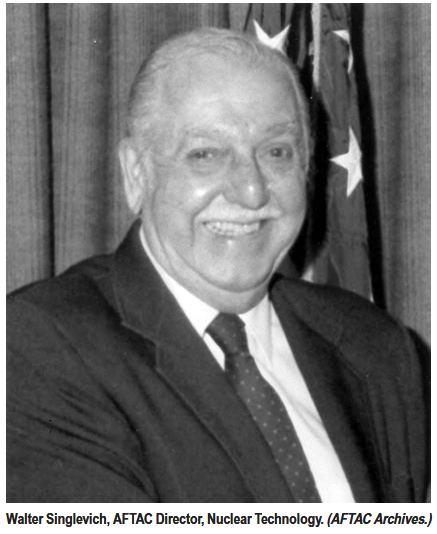
(In case you’ve forgotten my post from a few days ago, AFOAT-1 was where Walt Singlevich worked: the Air Force Office of the Assistant Deputy Chief of Staff for Atomic Energy, Section 1. This was later renamed the Air Force Technical Applications Centre (AFTAC). There’s also an excellent CIA history of AFOAT-1 and the detection of JOE-1 online.)

Unfortunately, Ziegler’s “Spying without Spies” is currently £70+ on bookfinder (ouch), so I guess I’ll have to park that purchase for the moment. But it seems like it could be a helpful book: Trakowski did say (Roswell Report, p.198, and then much the same on p.258):

Charles Ziegler was working on the history of nuclear weapons detection capability. He had some letters/papers that I did not have such as the letters the Gen Spaatz directed the establishment of project Mogul.

Putting all these pieces together (finally)

All in all, I think this helps us read the few references in the Roswell Report reasonably well. For example, Roswell Report p.198, Albert Trakowski witness statement:

  • “Through 1949, I [Trakowski] was the director of both MX968 and Mogul.”

Roswell Report p.224, interview with Charles Moore:

  • A: [Moore] At [Tracerlab], have you come across Charlie Ziegler at Brandeis?
  • Q: No.
  • A: [Moore] He worked for [Tracerlab, Inc] and is just bringing out a book on the early detection system.
  • Q: That was Project Center. MX-968.
  • A: [Moore] There was another one that followed on this to measure krypton. It was called Grab Bag in our lexicon.
  • Q: Did you ever hear of the project Bequeath?
  • A: [Moore] No. Being a civilian and outside, I was more knowledgeable, essentially, of the intent and what was required rather than the project names.

Roswell Report p. 260, interview with Col Trakowski:

  • Q: Until ’49, were you still on Project MOGUL?
  • A: [Trakowski] Yes, indeed. And Project MX-968.

So the big picture seems to be that Project MX-968 was actually Project Center (which might be a McAndrew transcription mishearing for “Project Centering”, as per Robert Todd), which was the follow-on project launched in 1948 to achieve by different means what Project Mogul had proved unable to do.

Even though I still don’t know what Project Bequeath or Project Whitesmith was (though web scraped data implies that the latter is discussed in “Spying without Spies”), I think it’s likely that Mogul became Rockfish, and in turn became Cottonseed.

I keep mentioning Project NEPA here, but it’s not exactly well known. So, for a bit of fun I thought I’d draw out the lines connecting it with the Fallout game series’ Vault Boy mascot.

As you might guess, this whole story arc hasn’t really got a happy ending.

From the Manhattan Project to the AEC

The Manhattan Project was the top secret WWII US programme to develop nuclear weapons of war. Even though the work was spread across a large number of geographically dispersed sites, the technology goal was achieved using a tightly managed, highly compartmentalised wartime secrecy culture. Ideologically-driven administrators (in particular Major-General Leslie Groves) did what it took – and in an often direct and unaccountable way – to get the job done.

The period 1945-1947 saw (as I’ve discussed elsewhere) the US transition from this wartime secrecy silo state to a peacetime secrecy silo state. The National Security Act of 1947 took the set of practices that had evolved out of wartime secrecy silos and embodied them both in legislation and in bodies such as the CIA. So… where did all that Manhattan Project know-how go next?

The Manhattan Project’s civilian successor body was the Atomic Energy Commission, which had a chairman and five commissioners. Right from the start, AEC Commissioner Lewis Strauss often acted as a dissenting voice (e.g. being outvoted 4-1 on information security matters). Strauss believed completely that a Cold War had already started, and that the US should actively try to detect Soviet nuclear blasts (which led to Project Mogul and its successor projects).

Strauss was what you might call an “atomic maximalist”: he vigorously backed a large number of ambitious nuclear-based programmes, albeit typically by kicking the feasibility can far, far down the road. He believed that electricity generated by nuclear energy would become “too cheap to meter” (he actively backed the first US nuclear power station in Pennsylvania in 1957), and that nuclear ships and aircraft were not just possible but desirable. At the same time, he largely dismissed talk of nuclear contamination, such as after the 1954 Castle Bravo nuclear test.

But hold on… nuclear aircraft, really?

Project NEPA

Initiated on 28th May 1946, Project NEPA was bold and audacious, if somewhat hallucinatory: it was like a post-war hi-tech programme designed by ChatGPT. Yet despite being one of the most massive tech efforts of the period, it has been somewhat airbrushed out of history: on Wikipedia, it gets no more than half a paragraph in the page devoted to its successor project ANP.

Militarily, Project NEPA was initially driven by the US Army’s Air Materiel Command, and framed by the emerging Cold War. The plan was to build nuclear-powered bombers capable of flying across continents (or even circling high over enemy continents for days or weeks) without ever refueling, all the while keeping the crew safe from radiation. The planners believed that this would give the US a permanent nuclear advantage.

But where did it come from? Surprisingly, Bernard J. Snyder’s (1996) bibliography traces the core idea right back to H. G. Wells’ (1914) “The World Set Free – A Story of Mankind“, where the author describes the (future) skies of 1943 as being filled by thousands of atomic-powered planes “humming softly”.

Back in the real world, a 1945 study (“Where We Stand”) by renowned aeronautical engineer and physicist Theodore von Kármán (commissioned by Air Materiel Command) was upbeat about nuclear aircraft. This was used by AMC to pressure Major-General Leslie Groves into creating Project NEPA. Brant Sponberg’s (1995) “Means Without an End” article noted that this got approved even though Vannevar Bush, James Conant and Robert Oppenheimer were all skeptical about the idea of nuclear aircraft.

And so Project NEPA started with a feasibility study carried out by Fairchild Engine and Airplane Corp., in space provided by the AEC at the Oak Ridge National Laboratory (ORNL) in Tennessee, and with the first project funding in May 1947. A 1948 project review (the Lexington Report) concluded that it was basically sound, but would require 10-15 years and a billion dollars. And so a billion dollars was indeed spent on the dream, before it was finally cancelled in 1961 by President Kennedy.

In reality, NEPA was a ‘triumph’ of secrecy over realism, of ambition over accountability, and futurism over physics. Classified reports circulated without scrutiny, technical hurdles were treated as footnotes, and the engineers tasked with shielding, propulsion, and crash safety were constantly outflanked by administrative optimism. The program consumed massive sums of money, intellectual energy, and political capital, all in service of a vision that, by its own physics, was doomed from the start.

Honestly, Project NEPA wasn’t just big ticket technical misadventure; it was a towering monument to how not to do state-backed big science.

But what if it had succeeded?

The Fallout Universe

For the Fallout videogame series, the developers were aiming for a vibe inspired by A Canticle for Leibowitz (1959), a post-apocalyptic sci-fi story by Walter M. Miller Jr. In the book, the titular Isaac Edward Leibowitz creates a monastic order in New Mexico to preserve human knowledge following the “Flame Deluge” (nuclear war). Six centuries later, Leibowitz’s 20th century notes are found in a fallout shelter, where they are considered ‘holy relics’: and so forth.

For me, though, Fallout’s “Vault Boy” who grins at you bright-eyed from a pip-boy screen is like the cheerful ghost of Project NEPA. He embodies all the hubris, spin, technological impossibility, madness, lies, and deception: he embodies the stupid political dream of 1945-1947 that, somehow, physics was wrong and their whole anticommunist Cold War ideology was right. He is AEC Commissioner Lewis Strauss’ poster boy for the nuclear reactor in every home, the cheerily polished technological turd.

I mean, thousands of nuclear reactors “humming softly” in the sky, what could possibly go wrong?

As per my last post, I’ve been trying to dig up all the Project Mogul reports to get a more detailed (and less curated) look not only at how it worked, but also at how it interworked (e.g. with Project Helios, etc). These appear to be in the unhelpful state where they have been declassified but not digitised or indexed. Anyway, I at least now have a long list of reports that I know I don’t have, so maybe this is progress.

Holloman AFB

I did find a helpful cache of documents on the Defense Technical Information Center (DTIC). For researchers with a suitable clearance (including “select [but unnamed] academic institutions“), this provides close to five million records, of which a million or so are accessible to the rest of us.

As far as balloon-related documents go, there are a good number from Holloman SFB there, many written by (or with sections written by) Duke Gildenberg. For example, “Contributions of balloon operations to Research and Development at the Air Force Missile Development Center Holloman Air Force Base, N. Mex 1947 – 1958” covers the early development of balloon launches at Holloman AFB. This mentions (on p.108) that “After visiting Holloman Air Force Base for the first time with a New York University balloon team in 1948, [Duke Gildenberg] joined the Balloon Branch itself on a permanent basis in 1951.” This confirmed my suspicion that Gildenberg wasn’t with the NYU team in New Mexico in 1947.

But the most interesting document I’ve found so far is this: “The beginnings of research in space biology at the Air Force Missile Development Center Holloman Air Force Base, New Mexico 1946 – 1952“. This gives a history of the first various space biology experiments they tried to carry out using balloons, which I haven’t seen covered in other space biology references. So I thought I’d summarise them here.

Early Space Biology at Holloman AFB

  • 17 December 1946 – National Institute of Health
    • Fungus spores (though the lucite containers containing them were never recovered)
  • 1947
    • Fruit flies carried up to 106 miles (was this a typo?)
  • 18 June 1948 – Albert(I) Project – Wright-Patterson Aero Medical Lab
    • Anaesthetised rhesus monkey (“Albert”)
    • Probably died before V-2 launch
  • 14 June 1949 – Albert(II) Project – Wright-Patterson Aero Medical Lab
    • Anaesthetised rhesus monkey carried up to ~83 miles
    • Died on impact (on return to earth), after parachute failure
  • ???? – Albert(III) – Wright-Patterson Aero Medical Lab
    • Anaesthetised rhesus monkey
    • Early V-2 rocket failure
  • 1950
    • Unanaesthetised mouse on a V-2
    • Died on impact
  • 29 August 1950 – Wright-Patterson Aero Medical Lab
    • “1st of the balloon flights for the Aero Medical Lab” (Wikipedia)
  • 28 September 1950 – Project MX-1450R, “Physiology of Rocket Flight”
    • Eight white mice carried to 97,000 feet on a balloon
    • “[This and] other balloon experiments in the same series were primarily intended to determine the effects of cosmic rays upon biological specimens“
  • 18 April 1951
    • Rhesus monkey in an Aerobee rocket
    • Died on impact (after parachute failure)
  • 20 September 1951
    • Rhesus monkey, nine mice, plus two other mice in a drum
    • Even though the parachute worked OK, the monkey and two mice died two hours after impact (probably from the heat of the midday New Mexico sun, after the retrieval was delayed slightly)
  • 21 May 1951
    • Two monkeys and two mice, carried up to 36 miles on an Aerobee rocket
    • All animals survived, both monkeys were then given to the National Zoological Park of the Smithsonian Institution in Washington D.C.

Holloman – Frontier of the Future

Incidentally, film of the “two mice in a drum” from the 20th September 1951 flight can be seen edited into the following film at 2:43, which also includes reasonably well-made footage of a lot of things I’ve been describing here – balloons, Project Manhigh, etc – along with a detailed description of Holloman AFB:

Introducing Project MX-1450

As Cipher Mysteries readers probably know (or at least those few who read my Roswell-related posts), I’ve been searching for a while for a human physiology project from 1945-1950 focused on the effects of cosmic rays on human physiology. So, what then of the Project “MX-1450R” mentioned above?

MX stood for “Materiel, Experimental” (an early R&D project numbering system used by the U.S. Army Air Corps, then U.S. Army Air Forces, and early U.S. Air Force), where “Materiel” referred to Air Materiel Command. For example, Project Moby Dick (that Duke Gildenberg worked on) was actually “Project MX-1498”. There’s a list of MX projects here, that says MX-1450 was from Wright Field AeroMedical Laboratory, and involved “Research into the physiology of rocket flight (high-altitude animal experiments using ballons and rockets)”. Similarly, another MX project listing describes it as: “Wright Field, high altitude balloon and rocket tests with animals on board“.

A balloon launch listing (presumably supplied to Project Blue Book by Holloman AFB) shows lots of MX-1450 flights from 29th August 1950 onwards. These are interleaved with MX-1277 (“Fundamental properties of the atmosphere”), MX-1011 (“Aerojet”), MX-1498 (“Project Moby Dick”), MX-1594 (“Project Gopher”), and “AFCRC” (which I expect was Air Force Cambridge Research Center, i.e. Cambridge Massachusetts).

Furthermore, while MX-1450 was the name of the overall funded project, it seems that the “-R” suffix would have indicated a specific subpart of the project. The first “MX-1450-R” balloon launch in the Holloman Blue Book listing is 12th February 1953, but flights before that were just marked up as “MX-1450”. These start right after Holloman AFB began keeping systematic records in summer 1950, so were probably flying General Mills and Winzen Research polyethylene balloons even before then.

So… might MX-1450 be the missing cosmic ray biophysiology programme I’ve been hoping to find?

MX-1450B in the Roswell Report

“The Roswell Report” mentioned “MX-1450B” in three places, but only in respect of the much later (anthropomorphic test dummies) Roswell cover story. Firstly the footnote 44 on p.129:

High Altitude Balloon Dummy Drops Part I, and High Altitude Balloon Dummy Drops Part II, and Holloman Air Development Center, Weekly Test Status Reports, Project MX-1450B (Manned Balloon), National Archives and Records Administration, National Personnel Records Center, St. Louis, MO, Accession No. 342-62A-A-641, box 115/248, folder; R-695-61D, “High Altitude Escape Studies, Gen B-l, Manned Balloon Flights.”

Footnote 152 on p. 136 says:

Memorandum, subject: Balloon Tracking and Recovery Equipment, ad., National Archives and Records Administration, National Personnel Records Center, St. Louis, Mo., Accession No. 342-67B-2133, box 65/249, file 2, “Biophysics Branch-Escape Section, High Altitude Escape Studies, 7218-71719,” and High Altitude Balloon Dummy Drops, Part 1,17, and “Weekly Test Status Report on Project 7218, Manned Balloon Flights, (MX-1450B)”, for Week Ending 28 February 1955, National Archives and Records Administration, National Personnel Records Center, St. Louis, Mo., Accession No. 342-66A-181, Box 14/18.

And finally, the bibliography on p.223:

Holloman Air Development Center, Weekly Test Status Reports, Project MX-1450B/7218 (HIGH DIVE), June 1954 to January 1956. ADA323823

The Missing Project

Of course, you have to ask the basic question: if Project MX-1450 ran from at least as early as 1950 and to much later in the decade, and was an Air Materiel Command Experimental R&D project, why do my searches of DTIC and NARA for it all return, ummm, nada?

With DTIC, it’s entirely possible that MX-1450 hasn’t been declassified: and so I can only ask any Cipher Mysteries readers who just happen to have access to the full (five million document) DTIC archive to – please! – search there for MX-1450 on my behalf. There may be tons of files or nothing, I don’t know.

But really: when did Project MX-1450 start? Who funded it? Has it been declassified? Where are all its documents? Who were its principals? Was it run out of Wright Field’s Aero Medical Labs? Even though I have a lot of questions, hopefully they will prove specific enough to answer…

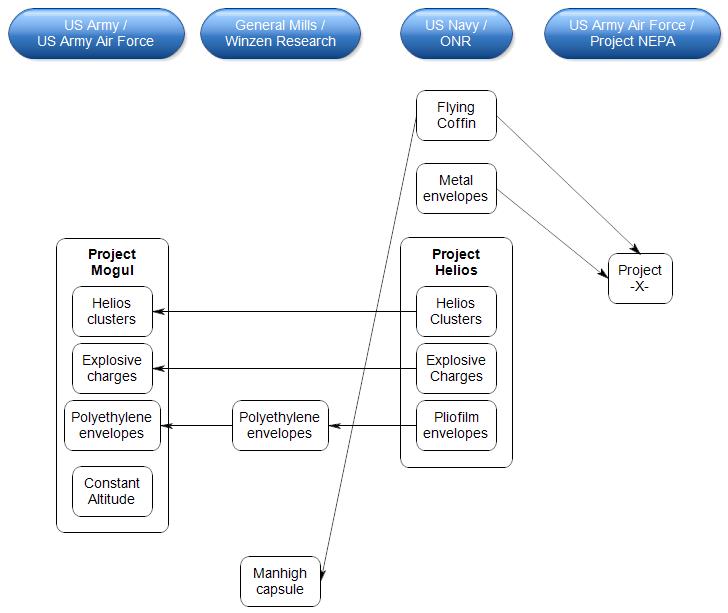
I put the following diagram together to make it easy to see how I think the various pieces of balloon technology fitted together. The “Project -X-” is, of course, a placeholder for the (still unnamed) project or operation that ended up (thanks to the magic of plausible deniability) at Roswell in 1947.

There are numerous links between Project Helios and Project Mogul:

  • Albert Crary’s journal in February mentions that the Mogul administrators were interested in Project Helios’ June launch (Project Helios planned to make its first manned balloon long on 21st June 1947)
  • We see Lt. Harris F. Smith arriving with the NYU team at the launch site as part of the project’s Alamogordo Phase II (28th June 1947 – 8th July 1947)
  • Some of the Project Mogul balloons used a Helios cluster balloon configuration
  • According to Stratocat’s list of 1947 stratospheric balloons, there was a Project Mogul balloon launch on 5th August 1947 from NAS Lakehurst (which landed in Smyrna, Delaware)

One of the things I’m therefore now trying to get a hold of is all the Project Mogul technical reports and progress reports, which I believe have all been declassified. The McAndrew report presented a curated summary of those reports, but I would expect that many of the things that particularly interest me would have flown over McAndrew’s head (if you’ll forgive the pun).

Here’s a nice story about Walt Singlevich, that I found in “The U.S. Air Force’s Long Range Detection Program and Project MOGUL” by James Michael Young in Air Power History (2020 winter).

Walt Singlevich

Young writes: “During the Second World War, Singlevich worked for DuPont but was assigned to the Manhattan Project at Oak Ridge“; and then in 1952 became head of Technical Directorate 4 (TD-4), Radiometrics, at AFOAT-1, which was the part of the US Air Force that was trying to detect [Soviet] nuclear explosions from afar.

By 1952, AFOAT-1 had given up trying to listen for the sound of nuclear explosions (which is basically what Project Mogul had tried [but failed] to do), and so instead were sending planes and balloons up to ‘scoop up’ high-altitude air. This was then taken back to the lab and tested for radioactive residue. But to make sure this worked, AFOAT-1 had to conduct its own (small-scale) nuclear tests and then sample the cloud downwind. Young continues:

During one nuclear test, as the prevailing winds pushed the nuclear cloud southeast towards Texas, the contaminated balloon landed close to a ranch in the Roswell area. Singlevich flew out to recover the debris, and his pilot landed the helicopter in a small, adjacent valley out of sight of the ranch. Both donned their protective gear that included a suit, hood, and respirator. As luck would have it, the two neared the debris just as a woman from the ranch arrived on the scene. According to Walt, she took one look at the two, gasped, and then fainted. They both ensured she was OK, then gathered the debris and ran for the helicopter. Singlevich surmised that with his height, approximately five feet two inches, and outfitted in his strange protective gear, he must have appeared to her as an alien being.

Over the decades, Singlevich received numerous accolades for his work at AFOAT-1: he received the Air Force Exceptional Service Award (twice), along with the Presidential Award for Meritorious Executive and the Presidential rank of Distinguished Executive. But perhaps he felt his greatest achievement was being mistaken for a Roswell alien. For how on earth (literally) can you top that?

In his later years, Walt found the encounter with the woman from the ranch humorous and would joke that he was one of the Roswell aliens. Given his remarkable expertise in nuclear materials, and his vast knowledge and innovations that advanced the LRD program and the AEDS, perhaps he was.

While writing up my last post on Roswell meteorology, I noticed that Duke Gildenberg – who presented himself as a UFO arch-skeptic more and more as he got older – appeared to make some assertions about the very first big UFO incident of the 1947 ‘flap’: the Kenneth Arnold UFO sighting. Firstly, Gildenberg’s “Roswell Requiem” article in Skeptic magazine [Vol. 10, number 1, 2003] has this right at the start of his claimed Roswell timeline:

June-July [1947]—UFO reports generated by Mogul balloons from Alamogordo AAF, NM, and balloon clusters out of Colorado.

To which you might reasonably respond (as I did), “Colorado, wtf?” No, it clearly wasn’t a typo, because Gildenberg then goes on to say (also on p.62):

Throughout June and July of 1947, Professor Moore’s NYU team launched Mogul balloons from Alamogordo AAF, while another NYU group launched similar balloon clusters out of Colorado (generating more UFO reports).

So, it’s a “another NYU group” who were launching “similar balloon clusters out of Colorado”. He then, in 2004, repeated basically the same claim in his Skeptical Inquirer article, but with a very obvious difference:

There were also sightings in the summer of 1947 in the western and northwestern United States. A 1949 Air Force investigation (Trakowski 1949) could not correlate those sightings with Project Mogul, but the Air Force was unaware of a Navy program launching cluster balloons in Colorado that same summer. Coordination between branches of the military was limited in the years just following World War II. Accordingly, the dilemma of that 1949 report added fuel to a developing UFO mythology.

So… now Gildenberg is saying it’s “a Navy program launching cluster balloons in Colorado that same summer”. So it’s an NYU group (as per his 2003 article) and a Navy program (as per his 2004 article), right? But he concludes his whole thought (in his 2004 article) to reprise the same thing he put at the top of his claimed Roswell timeline, but slightly stronger this time round:

Clusters of weather balloons launched from both New Mexico and Colorado triggered reports of flying saucers sighted in formations throughout the West.

I think the keyword “formations” is the clincher here: Gildenberg’s not just trying to use cluster balloons to explain away Roswell, he’s also trying to use them to explain away Kenneth Arnold’s UFO sighting – arguably the start of the whole 1947 UFO ‘flap’.

Charles Moore on Colorado

In the witness interview with Charles Moore in the Roswell Report, he talks with not a little confusion about an article that appeared in Alamogordo News on the 10th July 1947 (transcribed here on Patrick Gross’ very useful site). This was where Captain Lawrenz (“Larry”) Dyvad and various others pretended that it was they who were doing the Project Mogul launches (and not NYU). Moore specifically mentions that he thought this was a US Army cover-up to try to protect Project Mogul:

This is a coverup right here because they talk about our operations, they talk about our balloons we thought went to Colorado, and they all claim it to be part of Pritchard’s radar operation.

Moore was also bemused because Dyvad and the others seemed to know all his balloon-launching tricks (including his balloon-boiling trick, and his step-ladder trick), which he didn’t think anyone else knew.

If this is correct, the summer 1947 Project Mogul timeline would appear to be something closer to this:

  • 28th June 1947 – NYU and AMS people arrive (the “Alamogordo II” project phase)
    • This includes the US Navy’s Lt. Harris F. Smith
    • Lt. Smith appears to have brought Helios balloon cluster tie-plates with him
  • 8th July 1947 – Most of the NYU / AMS project people leave
  • 9th July 1947 – Capt Dyvad give a fake interview with the Alamogordo News
  • Subsequently, cluster balloons would have been shipped to Colorado
  • More cluster balloon tests would have been done in Colorado

As an aside, the McAndrew report transcribes Moore as saying: “There’s Newt Goldenberg, you mentioned him earlier in one of our conversations. That’s one of our altitude controls.” Which I can only really interpret as a mishearing / misreading of “Duke Gildenberg”.

Alamogordo News details…

Incidentally, the Alamogordo News article included some interesting details, such as optimal launch time:

“[…] showed the early morning hours of from five to six to be the most successful to gain the 30 to 40-thousand feet altitudes attained by the device”

Also, it’s probably not hugely relevant but I thought I ought to relay the single mention of Colorado:

“The radar has been successful, he explained, up to 40 miles, while some of the balloon-towed groups have gone as far as Colorado.”

The people listed in the article were:

  • Major C. M. Mangnum
  • Lt. S. W. Seigel
  • Major W. D. Pritchard
  • Capt. L. H. Dyvad

Charles Moore admitted to knowing Captain Larry Dyvad (a pilot who worked for the Army’s Air Materiel Command, and who was based at Alamogordo), but claimed not to have heard of the others. Yet Albert Crary’s journal mentions meeting Pritchard twelve times betwen December 1946 and April 1947, e.g. the entry for 7th April 1947:

“Talked to [Major W. D.] Pritchard re 3rd car for tomorrow. Gave him memo of progress report for MOGUL project to date…”

“Major C. M. Mangum” would appear to be Cledous Mathew Mangum, who I found a reference to as the 1951 author of “Paperclip or Project 63 Personnel” at the Environmental Division, White Sands Missile Range, New Mexico. He was Deputy for Operations at Holloman in 1952, and retired in 1959.

Kenneth Arnold’s 1947 UFO sighting

Where was I going with all this? My point was that I can’t help but conclude that Duke Gildenberg set out to shovel a bit of skeptical dirt at Kenneth Arnold’s famous 24th June 1947 UFO sighting.

Arnold’s sighting was of “a diagonally stepped-down echelon formation” of nine shiny things, that he thought were moving terrifically fast. Intriguingly, similar light formations were reported by other people close to the same location: L. G. Bernier of Richland, WA; Ethel Wheelhouse of Yakima, WA; a member of the Washington State forest service; and Sidney B. Gallagher.

What Gildenberg appears to have tried to do was dismiss these as early cluster balloon sightings. Yet it’s not so easy to make these phenomena historically line up. The first documented actual Project Helios balloon flight was from September 1947; while for Project Mogul, there were very few Helios-configuration balloons – #7, #8, #9 according to Charles Moore, but only #7 according to the table in the McAndrew report.

To be fair, I can see how the lifter cluster (the top part) could possibly fly away, let loose by the 35,000 feet detonator, never to be seen again. But that would surely only be for polyethylene balloons? A neoprene balloon lifter cluster would surely have burst relatively quickly?

Finally, it seems likely to me (from Charles Moore’s description) that the NYU group did launch more cluster balloon tests from Colorado later in the year. But these could only have been much later than the Kenneth Arnold sighting, so it’s extraordinarily unlikely to have been the cause of that.

So, all in all, I’d say that it appears Gildenberg may have been trying a bit too hard to play to the skeptical gallery here.

The starting point here is my personal belief that the Roswell Incident was a (horribly unethical) post-WWII stratospheric-balloon biophysics experiment that went horribly wrong.

However, there is a competing balloon account to consider: B. D. “Duke” Gildenberg told Craig Ryan (reported in pp. 20-21 of the latter’s book “The Pre-Astronauts”) that:

One of the first postwar manned balloon flights sponsored by the military was launched from the Tularosa Basin in 1947 with the intent of crossing the Rockies and landing somewhere along the Eastern Seaboard. Unfortunately, the entire flight’s supply of ballast was expended in the crossing of the Sacramento range to the east of Alamogordo and the balloon’s journey ended just short of Roswell. A potential embarrassment, the aborted continental crossing was kept quiet and the pilot’s name never released. “We were naive as hell,” explained one of the NYU scientists.

Gildenberg worked on Project Mogul (though not yet in summer 1947, I believe) and then on Moby Dick, Gopher, Project 7218, Project 7222, Project Manhigh, Project Stargazer and Project Excelsior, which were all stratospheric balloon projects (see here, here, and here). He was also a friend of Charlie Moore. As the civilian meteorologist, engineer, and physical science administrator at AFB Holloman from 1951-1981, his special skill was predicting where a balloon would come down (“Gildenberg Never Brought a Balloon Down More than 1/4 Mile from its Target“). And note that Gildenberg also wrote “Roswell Requiem“, and a guide to how many of the Skyhook balloon missions were mistaken for UFOs. So we shouldn’t take his account lightly.

In the end, though, because balloons are unpowered, meteorology is king. So, what does meteorology have to say about all this? Can it help us choose which of these two balloon accounts is more likely?

The Meteorology of Stratospheric Balloons

There are essentially two key phases to a stratospheric balloon launch. Once you’ve managed to get away from near-earth wind patterns (and note that a proper sized balloon should get you to the stratosphere in half an hour or so), you’re in the realm of very much simpler wind patterns.

Yet, to avoid most of those low-level wind turbulence (most noticeable in the afternoons and near mountains), there’s actually quite a simple hack: launch just before dawn, when the air is densest (and so your balloon’s relative lift is maximised).

As far as the high-altitude weather goes: if you want to go up and not really get blown far away, the place you want to be is right on top of a broad high pressure feature. Conversely, if you want to hitch a fast ride from the Tularosa Basin all the way to the Eastern Seaboard, you’d be looking for bunched up isobars (for speed) going in the direction you want, and well away from a high pressure feature.

Duke Gildenberg also offered the following generalisation in his McAndrew Report witness statement, which I’d note also runs somewhat counter to his Roswell balloon account:

Balloon trajectories in New Mexico below the tropopause, are predominantly towards the east-northeast, when launched from Holloman AFB with the exception of July and August when balloons remained over the Holloman area. At high altitude, above the tropopause, trajectories are generally westerly during the summer and easterly during the spring, fall, and winter.

So I think that gives us a straightforward test as to whether Duke Gildenberg’s balloon account was correct: on 3rd-4th July 1947, where was the nearest high pressure feature?

The Meteorology of Roswell

As an aside, Project Helios had planned to do its first stratospheric balloon launch on 21st June 1947. However, I’m sure that would have been contingent on the launch site being near the middle of a big fat high pressure feature on the day. If not, the actual launch day would have been delayed until such time as the Sky Gods were smiling.

So what did the weather over Alamogordo look like on 1st-5th July 1947? Very helpfully, you can download historical synoptic weather maps from here. Let’s look at the sequence:

1st July 1947:

2nd July 1947:

3rd July 1947:

4th July 1947:

5th July 1947:

What do these tell us?

I think these are telling us that as far as a stratospheric balloon launch from the Tularosa Basin would have gone:

  • the 1st July 1947 (Tuesday) was tolerably good
  • the 2nd July 1947 (Wednesday) was much better
  • the 3rd July 1947 (Thursday) was pretty much optimal
  • the 4th July 1947 (Friday) was a little worse
  • the 5th July 1947 (Saturday) was worse again

Really, though, all five days seem to have been pretty good candidates for stratospheric balloon launches (with the 3rd July 1947 being the best of the bunch). Conversely, none of the days would have been even remotely good for “crossing the Rockies and landing somewhere along the Eastern Seaboard“. So it seems that, if the dates are correct for Roswell, Duke Gildenberg’s account of the balloon flight was a bit of a busted flush, sorry. Against it sit both the meteorology maps and his own McAndrew witness account (pp. 166-168).

All of which is a bit of a mystery in itself, because there’s no doubt in my mind that Duke Gildenberg genuinely did know his stuff. So why did he get this so diametrically wrong? He claimed in 1992 to Berliner and Friedman that he had been “part of the launch crew” for Project Mogul, but it’s not clear to me that he was there in the summer of 1947. So I think there’s a high chance that his statement to Craig Ryan was based on something reported to him by someone else who was there, probably the same “NYU scientist” who said that “[they] were naive as hell“. Regardless, the balloon part of it seems to have been false.

But then… who was that NYU scientist? And why did they tell Gildenberg a fake / cover story? Really, you might also ask the question of what Project Helios got in return for providing Project Mogul with all the cluster technology.

“A man is found dead in the desert, next to an open package. How did he die?”

Many will immediately recognise this puzzle format, which became popular for a few years thanks to the 1967 publication of Edward de Bono’s “The Use of Lateral Thinking”. Nowadays, de Bono’s whole “Lateral Thinking” fad is long forgotten, because – in truth – all it really claimed was that not all puzzles yield to linear analysis, so sometimes to get to an answer you’ve got to shake the tree a bit.

Fast-forward now to Peter Senge’s (1990) “The Fifth Discipline: The Art & Practice of The Learning Organization”, which introduced holistic problem-solving to many. This is the idea that reducing complex systems to individual components can make some problems impossible to solve, because you’re not looking at the big picture. I should also point out that this is oddly reminiscent of Douglas Adams’ book “Dirk Gently’s Holistic Detective Agency” (1987) and its sequels, where seemingly unrelated events turn out to be connected in surprising ways.

But if you’re looking for a funkier, 2020s take on problem-solving under uncertainty that somehow reboots and refreshes these angles, I suspect your search will be in vain. (Perhaps that’s a book I should write?) All in all, the best advice currently on offer for genuinely hard problems would seem to be:

  1. Shake the tree a bit;
  2. Make sure you see the full picture; and (if all else fails)
  3. Ask Dirk Gently.

Roswell as a Lateral Thinking Puzzle

Let’s now lean hard into the witness-centred version of Roswell that appears in Carey & Schmitt’s book “Roswell: The Ultimate Cold Case”, and present that in the same puzzle format:

“A round-ended metal capsule with no engine or life support system is found in the arroyo. It contains three small alien-looking people, two of whom are dead, while the third cannot speak. Two other sites are found a few miles away, one with many shards of paper-thin metal debris, plus fragments of lightweight I-beams with unknown writing on.”

This, I believe, is an (only very slightly) stripped-down version of the puzzle the US Army was faced with in 1947. I further believe that the US Army:

  1. Latched onto a false solution (i.e. that it was an alien spacecraft);
  2. Covered that up as an issue of national security;
  3. Terrorised witnesses and concealed evidence as far as possible; and
  4. Has, ever since then, kept covering up the messes left by its previous coverups.

Why on earth did the US Army act like this? And, moreover, why does it continue to act like this even now? What kind of mad confuddlery is going on here?

The birth of the “Secrecy Silo State”

To me, Roswell is a symptom of something much, much bigger, which in 1947 had only really just begun: the modern US security state. Though this was made official by the National Security Act (enacted 26th July 1947), the ideas behind it – to create a peacetime security state based on the wartime security state – had already started to be put into practice by President Truman, Oppenheimer, Groves, Conant et al.

This took the set of wartime management practices used by the Manhattan Project and similar tech projects, and codified them into a peacetime management toolkit. The heart of this involved using secrecy not as a choice, but as a de facto starting point for everything. The default position was to disclose nothing, and (later) refuse to confirm or deny anything: and, as per the CIA, use plausible deniability. The state gave no transparency, no accountability, no access: the media were controlled, licensed, sanctioned, and quickly leash-yanked back into line if they started to dig in a ‘wrong’ place.

We can see this with Operation Crossroads in 1946: despite being planned very much as nuclear success theatre, many things went wrong (for example, the first test’s [“Able”] bomb [“Gilda”] missed its target by 649m; decontamination was almost impossible; and so on) and journalists proved much harder to force into line than expected. David Bradley subsequently wrote that “the accounts of the actual explosions, however well intended, were liberally seasoned with fantasy and superstition, and the results of the tests have remained buried in the vaults of military security“.

So, secrecy and accountability were immediate casualties of the new security state. But another wartime management practice accompanied secrecy: silos. Secrets were actively held and managed in small local silos – groups, teams, committees, even individuals. There was no global secrecy, just lots of local secrecy.

And this is, I think, what people often fail to grasp about America since WWII: it’s not that it’s a state that is built on secrets, but it’s a state that is built on lots of silos of secrets, all jealously owned and gatekeeped (gatekept?) by different groups and interests. And which rarely fit together.

The Problem With Silos

You’ve probably already worked out the rest of the arc here, but I’ll be explicit: as Peter Senge highlighted, you really need to see the big picture in order to solve particularly complex problems. And silos full of secrets make that almost impossible to achieve.

Because secrecy silos often isolate problem-solvers from conflicting information and opinions, they can often act as what we now call “echo chambers”, amplifying bad ideas and interpretations, which then (thanks to the way the silo is isolated) can get locked in. My belief is that this is precisely what happened with Roswell: a bad conclusion (about aliens who weren’t aliens) became a gospel truth, one so dangerous that it had to be immediately covered up (and then kept covered up).

Many people have written about the practical issues of secrecy, including Timothy Melley (whose book “Covert Spheres” on this subject I’m currently waiting for). A Professor of English Literature, Melley argues that literature becomes a way that people use to help imagine what the state is “getting up to” inside a secrecy state.

However, I think there’s a big difference between a secrecy state (i.e. one where the state monolithically holds secrets, so that you can talk meaningfully about a ‘government conspiracy’) and a secrecy silo state (i.e. one where lots of silos hold secrets, but not in a joined-up kind of way). For example, The X-Files told stories not only about The Syndicate (an archetypical silo of secrets) but also about lots of other groups holding secrets: yet unless you’re carefully tracking the overall story arc, people often think it’s about a single monolithic government conspiracy, jumpscare lolz, and whether Mulder and Scully are going to finally have sex. So maybe it’s all a bit more complex than the way Melley presents it.

But local silos also lead to disjointed management decisions based on partial (and often incorrect) knowledge, and leadership being forced to make macro decisions based on conflicting reports and opinions. You don’t have to look far into the history of the CIA to to see how this plays out geopolitically – Bay of Pigs, U2 spy plane, etc. I further suspect that bad decision-making built on the culture of secrecy silos played out on even bigger geopolitical stages – weakening Russia so much that it empowered the rise of Putin. But that’s another story.

Roswell 1947

So for me, because Operation Crossroads was in the Pacific, the Roswell Incident seems to have been the very first time that the modern US secrecy silo state was properly tested on US soil, with ordinary people caught in the middle of it all. And the US Army failed every test – they abused human rights in the service of controlling the narrative, covering up something that they didn’t even remotely understand (then or now), simply because that was how the whole modern state apparatus now ‘rolled’.

And as far as I can tell, it is still failing every test to do with Roswell. And you don’t need to be Dirk Gently to figure that one out.

“And you’re 100% sure this won’t be traced back to me?”, the sweaty man asked a little nervously. “I mean, my wife Mandyleen thought I shouldn’t meet you, but tonight’s her Krav Maga club night. Yeah, if you came at her with a knife, you’d get a broken wrist [he snapped his fingers proudly] like that.”

I laughed. “I’ll just pretend it’s fiction. We never really met, did we? And especially not just around the corner from SAPOL? Of course not! That would be far too… fantastical.”

Previously I’d had to endure forty minutes of relentless Ashes sledging from this Les Patterson-styled forensic sararyman, until I finally ‘admitted’ that, yes, the 2025 Aussie bowlers had left me as sad as Joe Root’s mum. And then after that, he’d told me about how he always wanted a son called Hurtle, but had ended up with twins (Hayley and Dayley) at medical school, and that they had creepy-looking doppelganger Japanese boyfriends, both called Ken. He’d shown me the WhatsApps. Which was nice.

To be honest, I had more than a fleeting suspicion that my nervous insider had downed a couple in the arvo before we met up. But I didn’t mind, because the drunker he got, the more it felt as though he was preparing to spill his filthy guts. The floodgates were trembling: I signalled for two more schooners.

“And I expect you want to know all about the Somerton Man? Now, what a shitshow and a half that was.”

The floodgates had opened.

= = = = = = = = = = = =

“Me, I like West Terrace, I’ve got a couple of great-aunts resting eternally there. But the whole exhumation thing? I didn’t care for it, it seemed like a giant barbie for a tiny prawn. But once that Professor guy got politicians on-side, they all wanted a bit of our cold case DNA magic.”

“So, did you do the familial DNA for the Suzanne Poll cold case? And for the North Adelaide rapist?”

“My team did”, he crowed. “Clever buggers, I love ’em all. But…” – he looked down at his empty glass – “that was before ‘Summy M’ came along, and wrecked the show. Wrecked my bloody show.”

I passed him his next schooner of Coopers Pale. “So, what happened? I mean, the exhumation was in May 2021, that seems a long time ago.”

“It was! Everyone else in the office thought it would be a stroll in the park: swab ‘im, stick it in the machines, bonza job, off to the Power at the weekend. I wasn’t so confident, but even I was surprised when nothing – and I mean nothing – went to plan. We’d have had more luck sequencing a Fritz Bung.”

“So what was the problem?”

He took a healthy glug, nearly draining the oddly small glass, and sat back with a wry smile. “It took me a while – probably longer than it should have – to figure it all out, but I reckon you might know already.”

“Nope, no idea.”

He looked across the table, narrowing his eyes. “So tell me: what’s the difference between an onion and a pickled onion?”

I again shook my head.

“One stings your eyes, the other stings your arse.” He laughed, then quickly looked uncomfortable. “Only in this case, the joke was on us. We were the arse. And jeez, it stung like hell.”

= = = = = = = = = = = =

“I’m sorry, I still don’t get it.”

“Look: what do you taste when you bite into a pickled onion?”

“Regret?”

He rolled his eyes. “I wasn’t asking for a punchline. You taste pickle – vinegar. And that not only masks pretty much all the funky sulfury onion-tasting stuff, it also denatures all the proteins. It’s a lot less of an onion after it’s been pickled.”

I frowned. “So, the formaldehyde SAPOL injected into the Somerton Man’s veins, that pickled him too?”

“Actually, formaldehyde fragments DNA, it cross‑links to it and it degrades it. What starts as DNA ends up as nasty, sticky goo. We all knew about this beforehand, but thought: yeah, yeah, we’ll find a way around it. But we never did. The poor bugger was worse than pickled. His closest DNA match was to a gherkin.”

“And that was basically your DNA report that took two years to do?”

“Yup”. He shook his head glumly. “So our bosses now think we’re a bunch of idiots.”

“But what about hair analysis? Nail analysis? Teeth enamel analysis? All that clever stuff you promised at the start?”

“Mate, this is South Australia, not M.I.T. The money was for DNA, and that’s where it went. In the end, we had a bit of cash left over for a forensic odontology report, but that was basically how it all panned out.”

“Hmmm”, I said. “Not heaps good”.

“Yeah”, he said. “Heaps not good at all. Another schooner? I could murder a pickled onion.”