I’ve got a lot of time for Dominic Selwood: his 1999 (non-fiction) book Knights of the Cloister: Templars and Hospitallers in Central-Southern Occitania, c.1100-c.1300 painted a detailed, evidence-based picture of the Knights Templars across a properly historical and social background. It is not, as he points out, “light relaxing reading”: but remains a fine counterpoint to the more militaristic / political / conspiratorial accounts of the two Orders, well worth looking at.

Just so you know: back in 2001, I went to a lecture of his at the (now long-slumbering) Canonbury Masonic Research Institute, and later asked him by email about Templar artificial alphabets that were used for signing their proto-‘cheques’. Unfortunately, he replied that “All my notes from my research were thrown away by accident by the staff where I used to work“, (though he may still have some images on slides).

At that time, he had just completed a PhD at Oxford (and occasionally played in a band called The Binmen!) and was then starting the work as a barrister that would occupy him for the next five years: and so I was intrigued to discover a few weeks ago that he had just published a novel called The Sword of Moses (the Kindle version is currently only 62p, which is a steal).
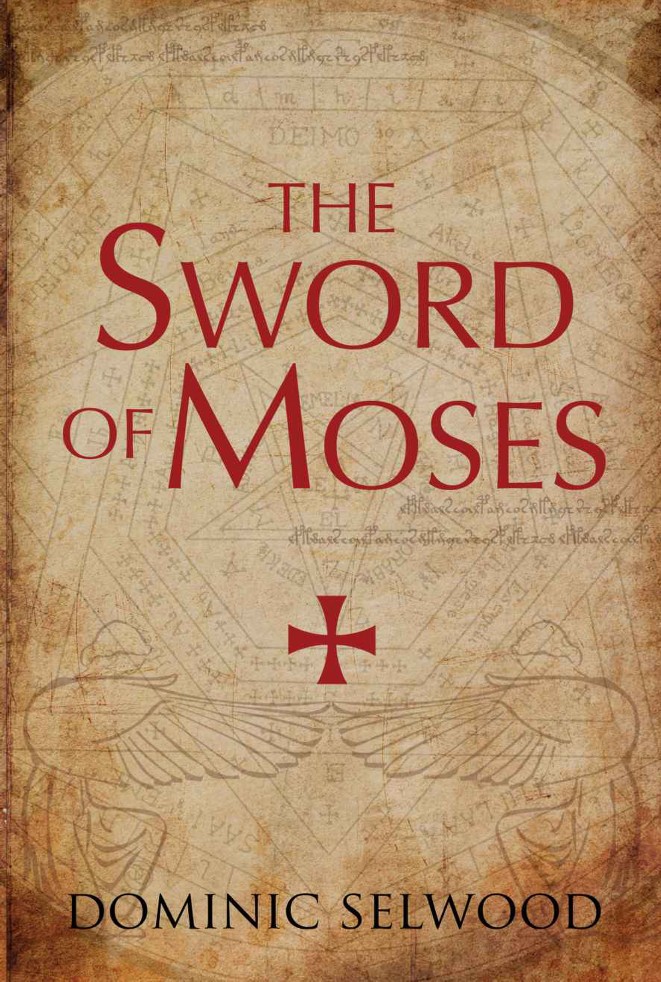
the-sword-of-moses-cover

Oddly, this also seems to have necessitated drinking some Johnny Depp-stylee potion, as can be seen from the dramatic physical transformation he has undergone:-


Dominic-Selwood-as-was

Dominic-Selwood-as-is-or-perhaps-his-evil-twin

Either that or the novel was written by his evil twin, it’s hard to tell. 😉

Anyway, if you even remotely know how books in the historical-artefact/modern-threat/sassy-hero genre run, you’ll be at home immediately (think Ark of the Covenant, international mercenaries, bombs, assault weapons, etc): and the main character (Dr Ava Curzon) is a kind of passive-aggressive ‘Jane Bond’ / Lara Croft ex-spook-now-sassy-archaeologist hybrid, probably with half an eye towards Angelina Jolie in the film version (as per normal). And if you can find a genuinely empathetic or believable character anywhere in the mix, you’re far more observant than I am: but that’s hardly much of a criticism, as it is industry standard fare for the genre.

The most obviously notable feature, though, is the sheer scale of the book. Not just the chunky page count (792 pages!), but it is very much as though Selwood has collided two or three already biggish novels together, and welded the wreckage together into a fatter, lumpier composite: Ethiopian churches, Iraq, Knights Templar (who, it seems, are still going strong, bless ’em), Masons, MI6, Russian gangsters, Israeli spies, London/Kent Neo-Nazis, necromancy, John Dee, etc all play their respective part (though the Voynich Manuscript only gets a cameo, it has to be said): and even dear old Aleister Crowley gets more than a nod.

Really, this all comes across to me as though Selwood’s Writing Ambition was in a gladiatorial fight to the death against Editorial Control, where only the former was wielding a sword. By which I mean that even though he writes pretty well, whenever his story’s fire starts to flicker a little, he anxiously hurls yet more geopolitics and history onto its flames: but that rich burning smell ultimately comes across as one of insecurity, not of confidence.

For me, though, the most interesting feature of “The Sword of Moses” was the history – the book clearly sits atop the heaped spoils of Selwood’s lifetime’s connoisseurship of alt.history strands. And what I think transforms the whole enterprise into something epic is something that I think emerges from the text only indirectly: his personal micro-crusade against junk history.

Honestly, he seems to be saying, why do novelists invest so much time filling their genre books with historical nonsense, when the real deal is even more excruciatingly complex and intriguing, if you just bother to get your stupid superficial noses out of Wikipedia? And so he goes out of his way to get the history properly right, again and again: mightily impressive, densely entertaining, heavily intertextual stuff.

And so when it comes to the idea that forms the historical backbone of his novel, it’s his idea of a proper shocker: that the Old Testament has polytheism and even ritual sacrifice embedded in it (which is indeed entirely true). But… but… but… this is also where it all goes a bit Pete Tong.

The horrible, dull truth is that exposing the ritualistic layers codicologically embedded in plain sight within The Bible (and having a super-evil necromancer to bring them to some kind of twisted life) just isn’t much of a surprise any more. The Dan Brown sincere flattery crowd (as in “imitation is…”) of novelists have kind of strip-mined the genre: and for all their dodgy historical faults, in the list of their crimes against readers Bad History comes a distant third behind Empty Characterization and Mile-Wide Plot Faults.

So… while I like Dominic and have terrific admiration for his historical sensibilities and indeed writing ambition, I finished his book feeling that he set out on his novel-writing quest to solve the wrong problem. Having myself read far too many books in this genre over recent years than is properly healthy, I’d agree that he really isn’t tilting at windmills – that Bad History is an endemic problem in fiction in general. But he’ll have to work somewhat harder with his next novel to help readers care whether Dr Ava Curzon lives or dies, because frankly I never quite managed that piece of reading magic, sorry. 🙁

Online webcomic “What Don’t You Understand” by Hong Jac Ga (“A pretty strange story about a hitman, a hermit writer, and a boy who loses his memory”, translated by Rachel Ahn) has recently put up a nice Voynich-inspired episode (#24 here).

what-dont-you-understand

It’s not often you have a story with a talking cat and dog trying to train a somewhat unwilling young dark magician: for the purposes of the narrative, the Voynich Manuscript is a kind of repository of impressions, able only to be ‘read’ (or rather ‘sensed’) by someone able to tune in to the original magician’s wavelength.

And I can affirm that there are plenty of people in the real world who truly believe that they can read the Voynich Manuscript in precisely this way, i.e. purely by affinity and/or sense. So perhaps the modern world is just as magical / irrational as it ever was, lurking beneath what is no more than a thin veneer of 21st century logico-positivist supposed hyper-rationality.

Then again, maybe dogs and cats will indeed converse enigmatically long before anyone has cracked the Voynich Manuscript in this kind of way. 😉

Jeremy Robinson’s and Sean Ellis’s latest Jack Sigler novel “Prime” (2013) reveals the origins of the “Chess Team” (their super-secret Delta-of-Deltas best-of-the-best elite US army team, that’s hopefully fictional, or else I’m a dead man in the next 10 minutes 🙂) that rattles along in the other novels in the same series. Here, though, the goodies-vs-superbaddies story plays out against the backdrop of the Voynich Manuscript’s secrets, the origins of the Black Plague, and indeed the ultimate origins of Life on Earth. But with lots of guns.

Thankfully, Robinson gets one over on most of his Voynich fiction competition by finding ways of not inserting too many cut-and-pasted slabs of cod Wikipedia-esque history into his brisk narrative: while another near-first is that the manuscript stays centre-stage throughout the whole book, which is also a nice change from what has become the norm.

Yet… despite all the knowingly-contemporary ironic macho posturing and ultra-weaponry fetishism of the genre, the language of “Prime” used still feels to me like it has been written for 17- or 18-year-olds. You know: relentlessly soul-less super-soldier hyper-gun pr0n, coupled with the run-at-the-camera poisoned-sugar rush of 3d zombie films and the moral one-dimensionality of young adult fiction. And as for the crypto girl’s inner maths-geek monologues… well, best not get me started on something that badly lame.

“Prime” was certainly a quick read, and perhaps if I had previously trawled through the rest of the Chess Team series, I might just have viewed many of the sequences in a different, possibly more nuanced light. But in the end, I’m pretty sure that it is what it is: a Voynich novel that treats the manuscript with reasonable respect (mostly), yet fetishizes and objectifies just about everything else it touches. And with lots of guns.

Basically, if your secret inner you is an 18-year-old kid who thinks that big guns and heroes that are described as looking like “Hugh Jackman[‘s]… film portrayal of the comic book superhero Wolverine” (p.26) are all like totally kewl, while also being a tiny bit of a cipher mystery history geek, then maybe this is the hot book of the year for you. But for the rest of us… maybe not.

If you know a bit about the history of cryptography, then you’ll probably know that the first well-known modern story about ciphers was Edgar Allan Poe’s (1843) “The Gold-Bug“. Poe explicitly built his narrative around the legend of Captain Kidd’s treasure, so in many ways it forms a kind of literary bridge between the worlds of buried treasure and ciphers. Of course, he was writing some 80 years before the Kidd-Palmer treasure maps and La Buse cryptograms surfaced (and long before “Treasure Island”, which appeared in 1881), so his story is unaffected by any of these.

Just so you know, the (simple substitution) cipher he devised looks a lot like this:-

53‡‡†305))6*;4826)4‡.)4‡);806*;48†8
¶60))85;1‡(;:‡*8†83(88)5*†;46(;88*96
*?;8)*‡(;485);5*†2:*‡(;4956*2(5*—4)8
¶8*;4069285);)6†8)4‡‡;1(‡9;48081;8:8‡
1;48†85;4)485†528806*81(‡9;48;(88;4
(‡?34;48)4‡;161;:188;‡?;

Previously (in 1840), Poe had challenged readers of “Alexander’s Weekly Messenger” to send in simple substitution ciphers for him to crack in print, and so had for some time been aware of a widespread public interest in cryptography. “The Gold-Bug”, then, was written to capitalize on this interest: and won a $100 prize. Later, many readers were inspired by “The Gold Bug” to develop an interest in codebreaking, most notably a young William Friedman of whom you may have heard…

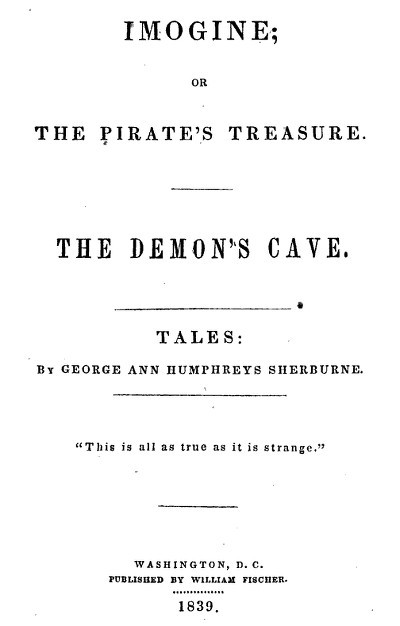
However, when reading about “The Gold-Bug” the other day, my eye was drawn to one aspect to the whole affair that I found intriguing. At the time, newspaper editor John Du Solle made the suggestion (though one he quickly retracted) that Poe may have drawn inspiration from the 1839 “Imogine; or the Pirate’s Treasure“, written by 13-year-old girl George Ann Humphreys Sherburne.

It’s true that the two tales do share key elements: but as is so often the case, those ideas were without doubt very much ‘in the air’ at the time. Rather, the two stories seem related in the same way that Robert Louis Stevenson’s “Treasure Island” drew ideas from numerous earlier books, but had an entirely new style of presenting them that made it feel fresh and appealing. Basically, in both cases I’m quite sure that Poe or Stevenson weren’t (literary) pirates, but simply well-read writers with a zingy contemporary geometry to add shape and style to the narrative building blocks that they found around them.

But ever since Du Solle’s speedily retracted comparison, it seemed to me that hardly anybody had actually bothered to read Sherburne’s story (mainly because almost everyone mis-spells its protagonist’s name, *sigh*). I did, though: and I found something a little unexpected…

imogine-cover

Having trawled past all the girlish swooning chapters and then the unexpected (but unconvincing) chapter with a death, in Chapter VIII the reader finally gets to the climax of the piece where (to almost nobody’s great surprise) the pirate treasure is finally found along with a skeleton…

“Yes”, said Imogine, “and just as you came up, I was about turning over that piece of old iron near the bones.”

“Ah! I see it,” replied her father, “and it looks to me like the top of a ship’s iron pot;” and turning it over with his cane, saw under it white sea sand, [in] which, on stirring about, gold and silver pieces were seen sparkling, which caused an exclamation from all.

“What a great discovery is this!” said Mr Belmont, turning and looking with surprise at Imogine and Cornelia;

[…]

After placing the skeleton in a box, and interring it, they removed the treasure, and in doing so, discovered another similar pot to the first under it, but more valuable, which was all moved safely to the house.”

What’s so unusual about this? Well… according to near-legendary metal-detectorist Charles Garrett, it has often been the case that a large treasure cache is buried immediately below a small treasure cache. Garrett post-rationalizes / explains this as a kind of ‘trap’ for treasure hunters, i.e. for them to be satisfied with robbing out the (small) topmost treasure, while leaving the (big) treasure underneath intact for the original owner. (Though personally, I suspect it’s just as likely that they couldn’t be bothered to dig a bigger hole.)

The big question, then, is this: how would a 13-year-old girl writing in 1839 know to describe such an arrangement… except if she had been party to the ins and outs of an actual treasure dig? I’m not suggesting that recovered pirate treasure is the true secret of the Astor family fortune (mainly because that particular joke’s already been done to death)… but maybe there’s a touch more truth in Sherburne’s story than might at first be thought.

Perhaps the real giveaway in the whole thing is the curious tag-line on “Imogine”‘s cover: “This is all as true as it is strange“. What do you think?

PS: another mystery to ponder is who “George Ann Humphreys Sherburne” was? Apart from her presumed birth in 1825, there appears to be no other information on her anywhere at all. Unless you happen to know better, of course… please leave a comment if you do! 🙂

Part I
It was a dark and stormy night. The world-famous WW2 codebreaker furiously twiddled his moustache. Suddenly, a shout – “I’ve solved the Voynich!” It was the television! A small boy and his beagle were smiling at the camera, holding a book up. They had “proved it was a hoax”. This meant one thing: war! The codebreaker slammed the door and drove to the library.

Part II
Seven hundred years earlier, Knights Templar pounded the monastery door. Roger Bacon answered. “We’ll taketh that”, said the knights, grabbing the mysterious book from his hands. “My secrets are safe with you idiots”, sneered the codemaker monk.

Part III
The security guard approached. The codebreaker was in his pyjamas, waiting at the library’s front gate. “You’ll have to wait till morning, sir”, said the guard. A shot rang out. The guard slumped. The codebreaker hid the body in a snowdrift. The history graduate walked warily past the man in bloodstained pyjamas on her way home. The boy on TV carried on smiling.

Part IV
The Knights Templar couldn’t decipher the book. “Torture him!”, the Grand Master screamed. They tried, but Bacon had a heart attack and died. Nobody would ever know. Or would they? And then the whole Templar Order was suppressed. Or was it?

Part V
The gate opened, and the codebreaker ran in past the history graduate, again. The librarian shrugged. But where was the security guard? The codebreaker sped through all the pages one last time, until – yes, there it was! A bloody fingerprint, overlooked by everyone. It wasn’t a hoax! Outside, the librarian noticed the trail of blood and called the police. The dog smiled even harder.

Part VI
Leon Battista Alberti borrowed the book from the Vatican, his oily fingerprints messing up the radiocarbon dating. Suddenly, a thud! Alberti lay unconscious in the street, mugged: the thief ran away with his prize, for his great-grandchildren to sell to the Holy Roman Emperor, and from there to Athanasius Kircher in 1665, the Jesuit archives, and then Wilfrid Voynich in 1912.

Part VII
Bang! The codebreaker lay shot, slumped by the book, his vividly red blood mingling with the ink, the paint and the blood spatter from Alberti’s head. His life ebbing away, he suddenly realized: nobody would ever know. They’d all think it simply a hoax, forever. He lifted his hands to the sky and shouted “Noooooooo!” The boy and the dog danced on top of the kennel, one last time.

THE END

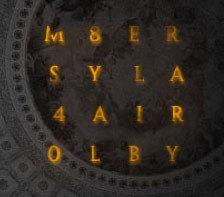
The Daily Grail has today’s hot cipher history story: that Dan Brown’s soon-to-be-released novel “Inferno” is somehow based around the Voynich Manuscript. Apparently, the proof of this particular pudding is, well, a cipher, one apparently hidden in plain sight on Brown’s website:-

dan-brown-voynich-code

In Rolf Harris’ immortal phrase, “Can you tell what it is yet?” I hope you can, because all it is is… a 4×4 transposition cipher of “MS 408 YALE LIBRARY”. Yes, that’s it. Which is in itself a fairly underwhelming starting point, considering that the Voynich Manuscript isn’t MS 408 in “Yale Library”, but in Yale University’s Beinecke Rare Book & Manuscript Library. But (of course) that wouldn’t fit in 16 letters. 🙂

So, the story of the story is that Dan Brown will once again be wheeling out his “symbologist” Robert Langdon in a Renaissance-art-history-conspiracy-somehow-impinges-on-the-present-day-with-terrible-consequences schtick, but this time in Florence with Dante’s “Inferno” right at the heart of it (hence the title), with only the poor, much-abused Voynich Manuscript for company.

One part I’m not looking forward to is what Brown will have Robert Langdon make of the Voynich: for of all the mysteries I’ve ever seen, the Voynich is surely the least obviously symbol-laden. There’s no “sacred geometry” there, no gematria, no heresy, in fact no religion at all: just about all you could do is tie in the Voynich ‘nymphs’ with the same kind of alt.history “goddess” thing that Brown tried to stripmine in The Da Vinci Code… but all the same, that looks fairly hollow to me. I guess we’ll have to see what angle he does take… at least we won’t have long to wait (14th May 2013).

For me, the central contrast between Dante’s Inferno and the Voynich Manuscript is that they are diametrically opposite in referentiality: while the Inferno (and in fact the whole Divine Comedy) reaches out to touch and even include all of human culture, the Voynich Manuscript’s author seems to have worked with the same kind of monastic intensity to ensure it appears to refer to nothing at all. So, when Dan Brown collides the everything-book with the nothing-book, what kind of po-faced bathos-fest are we in for?

As an aside, I don’t see any numerology in the (original) Inferno: and considering the amount of effort Dante put into satirizing astrologers, alchemists, politicians, liars, frauds and the like in their aptly tortured circles of hell, I’m reasonably sure he’d mete out the same kind of punishment to numerologists. And probably to symbologists, too. And (if we’re lucky) to bad novelists… though you’ll have to put your own candidates forward for that, I’m far too polite. 😉

However, the bit I dread most is when people start to realize that Dante Alighieri’s Inferno was only the first part (of three) of his Divine Comedy: and with the current Hollywood craze for trilogies (The Hobbit trilogy, really?), what are the odds Dan Brown will extend any success with this book out into his own money$pinning Dante-based series, hmmm? The “Ka’chingferno” three-parter, no less!

Update: Erni Lillie upbraids me (and rightly so) in a comment here for omitting to mention his substantial 2004 (though the Wayback Machine only has a copy from 2007) Voynich Inferno essay, where he proposed that the nine “rosettes” on the Voynich Manuscript’s nine-rosette page might well represent the nine layers of Dante’s Inferno. My own experience of working on that particular page would place it closer to Purgatory, but perhaps we’re closer than medieval theologians would have it. 🙂

Truth be told, I did remember that I had forgotten something to do with Dante and the Voynich, but couldn’t for the life of me remember what it was I’d forgotten. And now that I’ve found it again, I was delighted to read it all over again, Renaissance warts and all. So, hoping that it’s OK with Erni to bring his work to a new generation of interested readers, here’s a link to a copy of his paper The Voynich Manuscript as an Illustrated Commentary of Dante’s Divine Comedy. Maybe it will turn out to be what Dan Brown’s new book plagiarizes was amply inspired by this time round, who knows? 😉

Personally, I suspect the smart money is indeed on Brown’s having the Voynich’s nine-rosette map turn out to be a map: with the devastating twist *yawn* that it actually represents a physical map of Dante-related locations in Florence, which Robert Langdon is then able to decode at speed thanks to his encyclopaedic knowledge of all things symbolic and Florentine, which ultimately leads him to the dark secret at the heart of a centuries-old conspiracy which he and his unexpected accomplice must choose whether to reveal to the horror of the world.

You know, basically the same as all his other books. 😉

Anyway, looking forward to the launch party at the Duomo, darling. Of course I’d like more olives, thanks for asking, and isn’t the San Giovese simply, errrm, Divine? 🙂

I read Robin Wasserman’s Voynich-themed young adult novel ages ago but never got round to reviewing it here…

Curiously, though, it has to be said that the Voynich Manuscript itself only ends up playing a relatively small part in the overall story: ultimately, most of the action revolves around the discovery & translation of a series of (fictional) letters to or from (the very real) Elizabeth Weston, Edward Kelley’s literary poetess stepdaughter, each of which gradually reveals details that move the teen gothic plot towards its nicely horrific conclusion.

In the modern novelistic style, Wasserman has the various ancient artefacts protected and sought (respectively) by a Conspiracy of Basically-Good and a Conspiracy of Basically-Evil: the teen novel conceit is that despite the ridiculously amplified level of peril surrounding the main character, she tends to trust wholeheartedly pretty much any drop-dead-gorgeous young hunk (from either conspiracy) who asks her to do anything.

From a Voynich researcher’s point of view, the good stuff about this novel is that it foregrounds a lot of the gritty historical stuff that people tend not to think about much – transcription, translation, cross-referencing, etc. Yet the bad stuff about it is that the way it mythologizes Europe and romanticizes Latin translation makes it feel like it was written for Lisa Simpson – several times I imagined Lisa clutching the book to her heart and exclaiming “She didn’t dumb it down for me!” (not unlike the “Mother Simpson” episode with Glenn Close).

The book was clearly not written with me in mind, so I don’t really want to dwell too much on its nitty gritty: but even so, I get the impression it would make a very much better teen film than a book. In short: one to option rather than to read! 😉

Does the world need yet more Voynich Manuscript-themes novels? Errrrm… obviously it does, or else why would so many of them be parachuting down out of a clear blue sky?

First up in today’s list is H. L. Dennis’ “Secret Breakers: The Power of Three”. Even though this is a kid’s book, between you and me it’s actually a jolly good read, with lots of Bletchley-Park-Station-X and mint-imperial-crunching-British-code-breaker stuff threaded throughout it, like so much Csjhiupo Spdl. My 8-year-old son enjoyed it so much that he’ll be posting a review of it here soon. All you need to know for now is that the ending sets up book two with Edward Elgar: so, Dorabella here we come! 😉

Next up is Linda Lafferty’s “The Bloodletter’s Daughter” – this 480-page heft weaves the Voynich Manuscript’s threads in with the even more obscure (and, actually, far bloodier) story of Holy Roman Emperor Rudolf II’s mad son Don Julius. There’s a copy right beside my desk waiting to be read… I just wish I didn’t have so much actual cipher research to do at the moment. But I promise I’ll get there (eventually)… oh well!

Finally, R. J. Scott’s “Book Of Secrets – Oracle 2” is due for release at the end of the month, though I get the feeling that it may not make a lot of sense unless you’ve already read the first book (“Oracle”).

Enjoy! @-) <--- belated Wenlock smiley ;-)

While accidentally reading John Grisham’s “Theodore Boone” the other day, what struck me the most was the sheer laziness of the characterization. In particular, Boone’s uncle came across to me a paint-by-numbers Donald Sutherland part – the whole failed-lawyer-looking-for-redemption-through-a-younger-man’s-action thing, if you remember Time To Kill. Kind of set my teeth on edge right from near the start: not good, not good at all.

Similarly, the moment that the female lead in Russell Blake’s The Voynich Cypher appears wearing a “skin-tight black jumpsuit crafted from suede that left little to the imagination and calf-height black leather boots boasting four-inch heels” was the precise moment that the author left me behind. It’s not exaggerated, it’s not comic, it’s just lame, big-stylee. It’s not even Angelina Jolie (who would be too tall for the part).

Don’t get me wrong, I like independent writing and independent publishing: but there’s only so heavy a storm of genre clichés I can weather before I just want to shut the door on the lot of them. And on those terms, this was a perfect storm.

Yet even though other writers seem hugely comfortable with The Good Conspiracy Vs The Bad Conspiracy plot structure virtually all such modern cipher thrillers seem to roll out, here it’s handled without much finesse. In fact, if I were to say that it came across to me as a kind of Poundland remake of The Da Vinci Code with the Voynich Manuscript spliced in awkwardly, rest assured that that wouldn’t be giving away the plot.

As far as the writing goes, only one line stands out in the whole book (a bakery-related semi-gag on p.230, *sigh*), which quickly turns out to be no more than a clumsy artifice for introducing the young-sexy-woman-gets-it-on-with-the-older-man-despite-their-daunting-age-gap cliché. How many times have I read that? More to the point, how many more times will I have to endure it?

Sure, you might possibly like The Voynich Cypher, it’s certainly a quick’n’easy read… but personally, I just didn’t get it. Then again, I thought Fifty Shades of Whatever was, ummm, pants, so what do I know? 🙂

Greetings, most dearly beloved [insert-name-here],

I bring you a message of great urgency and yet colossal financial benefit. My name is Seko Mugu Alberti, and thanks to ancestry.com I have discovered that I am the sole descendant of Renaissance polymath genius Leon Battista Alberti. This means I am in line to inherit the architectural and consulting fortune he deposited at the Medici Bank long ago. Yes, I do believe I was indeed just as surprised to find this out as you are now.

Through close reading of my ancestor’s published works, I have discovered that he kept a copy of his bank account details hidden in plain sight. All I now need to do is present the proper authentication to the modern successors of the Medici Bank (the Rothschilds, of course) and they will be compelled to give me my rightful inheritance of (with compound interest) 48.9 billion US dollars.

As a result I have been looking for an exceptional historian and code-breaker to assist me – for a modest 15% finder’s fee – in deciphering Alberti’s greatest work, the Voynich Manuscript. (I wasted a lot of time on the disgusting and perverted Hypnerotomachia Poliphilii, and the less said about that monstrosity the better). The nice gentleman at Cipher Mysteries sold me a list of mugus cipher researchers for a thousand US dollars “to put behind the bar in Frascati” (whatever that means), which is how I now find myself with your most excellent contact details.

The ridiculous Voynich Manuscript is, as I am sure you have already worked out, 240 pages of nonsense constructed with the sole purpose of concealing and disguising Alberti’s bank account details. Sadly, when I contacted Rothschilds with the important passphrase “qokedy qokedy dal qokedy qokedy” to identify myself, the teller refused to hand over even 100 dollars of my staggeringly large inheritance. I tell you, it is a shameful and degrading thing to be escorted from a bank building at gunpoint when you have committed no crime, no crime at all.

So you see, the fate of my inheritance is now in your hands. Research, research, research it! Find my ancestor’s hidden number or identification phrase, and you and I will be rich beyond all Renaissance dreams!

I remain your excellent friend and accomplice in research,
— Seko Mugu Alberti