
Too long to be a short story and too short to be a novel, some might say that The Voynich Affair by Linnet Moss suffers from both problematic elongation and improper positioning.

But given that Google (until today) yielded precisely zero hits for the phrase “Voynich erotica”, Moss is clearly reaming out a niche untouched by few (if any) previous hands.

Voynich Erotica

But has she hit the spot?

I must confess that I found reading “The Voynich Affair” on a Kindle on the bus towards Staines in the morning rush hour more than a bit unsettling. Coming to the genre for the first time (so to speak), what I found oddest was that it seems to be written by people scared to death of physical intimacy, and aimed at readers who are also scared to death of physical intimacy. No, really.

I don’t know, it’s like it was typed by someone wearing gloves: chic, distantly-perfumed Italian leather gloves, sure, but gloves nonetheless. And for all the shudderingly implausible physical encounters described in the text, the whole endeavour came across as being locked within a resolutely lonely world, sans any flicker of Sartrean authenticity.

As a result, I can’t claim to have liked (or even mildly empathised with) any of the protagonists: but given that there are plenty of Internationally Acclaimed Bestsellers which failed that same test even more dramatically (Digital Fortress, anyone? *sigh*), that hardly amounts to a serious criticism. And anyway, that’s probably not the point of erotica, right?

At this point, a traditional review would tell you about how the story is based around extra missing pages of the manuscript in a French chateau, and involves various broodingly mysterious (and sociopathic) Voynich researchers: but frankly that’s a bit pointless. By now, you’ve almost certainly decided whether or not you’re interested, so all I can usefully add is that all fifteen chapters are freely available online, starting here.

The Selfish Reason

At this point, I have to ‘fess up to the real reason I bought a copy of The Voynich Affair (which Linnet Moss published as part of “The Mind-Body Problem: Stories of Desire and Love in Academe” (2012), complete with Voynich page on the (virtual) front cover)…
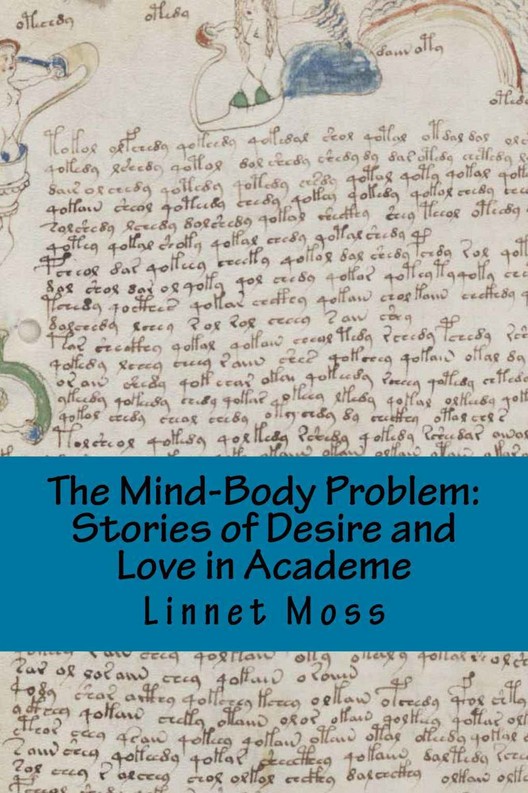
mind-body-problem

…which is that I wanted to see if the various Voynich researchers in the story were loosely based on any real-world Voynich researchers.

OK, OK: I wanted to see if I had been parodied. Not that I can’t take a joke, it’s just that I’d rather know about the joke than find out about it a decade later. 🙂

Happily, though, I can exclusively reveal that no Voynich researcher seems to have been openly parodied (no Randy Zenbergen, no Donna Via-Odeon, and no sign of the infamous Len Pickling), nor were any Voynichians’ sexual proclivities (errrm, to the best of my knowledge) turned into sort-of-page-turning Voynich-themed erotic encounters.

Unless you know better, that is? 😉

But… Who Would Write Such A Thing?

Author Linnet Moss claims to be:

“a college professor who writes fiction in her spare time. She adores old books, new books, cats, frogs, miniature books, wine, Trappist ales, tea from Ceylon, vegetarian gourmet food, London, Rome, Art Deco skyscrapers, and beautiful men.”

Of course, while some (or indeed all) of this may be true, it remains just as possible that Moss is a short balding non-professor bloke from Deptford with OCD, conceptually not too far removed from “paradee man woman” Wor Cheryl, pet.

As a result, I can (just about) see how some readers might possibly see decrypting the author’s identity, age, and/or indeed gender from the text as a worthwhile challenge.

For me, though, I’m sticking with the Voynich Manuscript: that has more than enough strangely inscrutable nymphs to worry about for one lifetime. 😉
A nice set of past Voynich limericks are elsewhere on Cipher Mysteries, but I thought (six years on) I’d write a couple of new ones for you:

Might Voynichese be Nahuatl?
Or incomprehensible prattle?
We might never find
How this thing was designed
Without patronage from Seattle.

The Voynich Manuscript’s a conundrum
One that draws us away from the humdrum
It defies those who attack it
But have faith – you’ll soon crack it
Illegitimi non carborundum! 🙂

I’ve read a lot – and I really do mean a lot – of Voynich Manuscript-themed (and other genuine-historical-cipher-themed) novels over the years, and I have to say that the whole experience rarely gets any better than just-about-OK-if-there’s-nothing-much-on-TV. Yes, even with TV in the nadir-like pit it has winched itself down into these days.

Sad as it is, such novelists’ including-an-ancient-unbroken-cipher writing mechanism comes across to reflective readers as rather, I don’t know, desperate-and-wanting-to-be-loved (and doubtless someone will tell me an obscure German or Icelandic adjective to describe this more precisely). More precisely, it shouts out “please God, let importing some genuine real-world mystery be enough to distract attention from the countless plot flaws, the unconvincing characters, and the piss-poor writing“. And that’s before you’ve even got to page one.

At the same time, none of the above ever hurt Dan Brown, so why not press that button and see where it leads, eh?

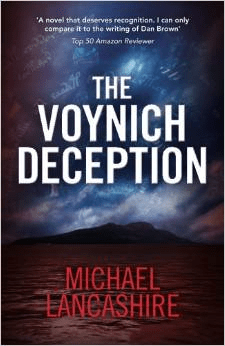
the-voynich-deception

Indeed, Michael Lancashire pressed that very button: and to his credit, his novel “The Voynich Deception” comes out of it basically an OK read. As the backdrop to his story, he has an unfeasibly clever guy (‘The Architect’) devising unfeasibly-clever-yet-still-oddly-micromanaged evil plans for ambitious crims to buy to execute. The rest of the plot involves a group of brutal, greedy and unlovable – though utterly uninvolving – Albanian gangsters following a blood-soaked trail of Voynich-linked cookie crumbs ever onwards towards a long-concealed treasure trove, where… well, that last bit would be telling, so my lips are sealed.

But at the same time, what I can say is that the structural weakness of “The Voynich Deception” is that while Lancashire’s ‘Architect’ is just an anti-Sherlock Holmesian conceit, the entire story pivots entirely on a single (admittedly fairly large) twist, one which the author flags very early on. As such, it’s more like a long short story than a novel: and for all the (occasional spatter of) blood ‘n’ gore, it does end up feeling a bit… thin.

Still, Lancashire is respectful towards the Voynich Manuscript (which is good), and he tells his story at a fair old pace, something far too many cipher novelists struggle with (hint: a fight they usually lose ignominiously).

The Kindle ebook version is only £1.99, so it’s not a huge investment or risk. And if you like The Voynich Deception, Lancashire has since written an Architect prequel novella (“Kernel Panic”) for you to move onto. All in all: not my tasse de thé, sure, but a perfectly OK read.

The Brazilian nurse adjusted the Great Poet’s line and pillows with genuine tenderness but little effect.

“Titanic deckchairs?” he mused. “Infinitesimal parameters?” Words, old friends, pain relief, they all failed him now: like the snow falling softly outside, the only way was down.

Since arriving, he had only written occasional haikus on a Post-It Note pad: but day by day even that had become impossibly long-form. His writing fingers drummed arthritically on the coverlet, empty-tanked sports cars ever impatient for races they would never finish.

On a whim, he stared past her out of the window at the snowman standing in the tiny courtyard. It lacked yesterday’s newly-made sharp definition, true, but a pinprick of its shaped vitality was still discernible, if you knew where to look. “You and me both, pal”, he wheezed ineffectively.

“Are you alright, Meester Alston?”

“Never better”, he tried to lie: but as with his pen, the words seemed too wide, the channel too narrow.

She paused, watching his struggle for breath. “I will leave the light on”, she said as she left. “You seem to have a lot on your mind tonight.”

As the ground-floor’s other temporary residents turned in and switched off, the snowman gradually found itself illuminated just by the poet’s room light, leaving it a white lighthouse in a wine-dark sea of night. And far off in the hospice, a muffled radio played the organ intro to Procol Harum’s “A Whiter Shade of Pale.”

And he was back in the ballroom, Bayswater, 1967, winter solstice. Dress code was pagan, Bohemian black for everyone except his bride, white-faced, ivory-clad Lindsay, his Mama Cass, his muse, with her sane reasoning and insane appetites.

Oddly, his resentful, drug-abusing sons were there too, their burning arrows of creativity forever condemned to sail listlessly beneath his own Laureate arc: and his daughter Caterina as well, beautiful before she was born and serene after she died.

“We skipped the light fandango…” Indeed: so what shall we dance this time, my dear? His mistresses, Tarni and Ute and Iris, eased gently out of the shadows as bridesmaids – though hardly vestal virgins – lifting him to the stage, to Lindsay, to a reconciliation they had both wanted but had never quite reached.

And everywhere he looked in the darkness around her, he saw more eyes, more faces, more everything, and with a vivid clarity that had long eluded him. And he was writing, writing now, writing his life and his love and his pain and his death, trapped and freed within a seventeen syllable prison cell of heaven and hell…

It was Nurse Celestina who found the body beside the snowman: how the Great Poet got there was a mystery. The Post-It Note in his hand was blank, though: there never was enough time to write that final haiku.

Our winter ballroom
Fills with friends anew.
My first and last dance, with you.

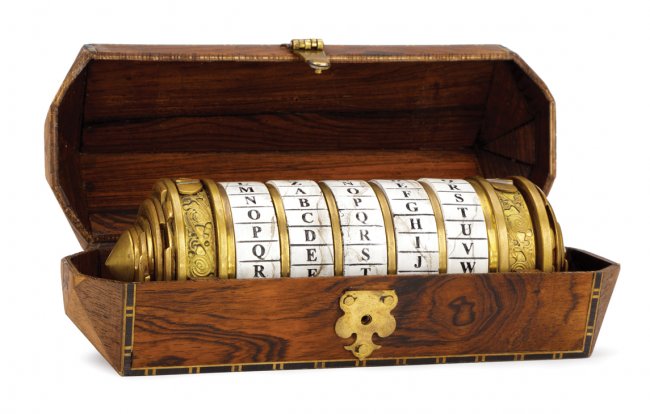
I’ve just heard about an upcoming auction for a Da Vinci Code “cryptex”. It’s allegedly one of the ones ‘potentially’ used in the film (whatever ‘potentially’ means, you’d have to ask an IP lawyer to be sure), but is believed by the auctioneers to be genuine. Which is nice.

cryptex-in-box

I should add that word on the crypto street (if your street just happens to have lots of collectors) is that movie props are widely forged and can be very hard to prove genuine, so it really is a case of caveat emptor etc.

But if neither your budget nor your appetite for risk will stretch quite that far, you can buy Authorized Cryptex Replicas on eBay (of course you can, that’s exactly what eBay is for, isn’t it?).

Here’s a nice departure from normal: a ‘Peter Crossman’ short story that just appeared on tor.com called The Devil in the Details, by Debra Doyle and James D. McDonald.

It’s a kind of high-octane (parody of / homage to) the modern-day Knights-Templar-as-God’s-Special-Ops novel genre, based around missing pages from the Voynich Manuscript being offered at a dangerously high-powered auction, at an arcane and mysterious venue with the Vatican and (possibly) Google Research also trying to bid, if they can stay alive long enough… you get the idea.

The writing sustains a quirky balance between rigid Latin medievalism and modern weapon fetishism, with tongue firmly in cheek. I hope you like it! 🙂

Having been exposed to what might reasonably be termed a ‘surfeit’ of unhealthily imaginative Voynich theories since nineteen-clickety-duck [*], I’d like to think that I’ve seen quite a lot of ‘highly unlikely scenarios’: and so pretty much anything involving Roger Bacon, time travel, and the Voynich Manuscript I should have covered, right?

Wrong! In her 2013 novel “A Highly Unlikely Scenario: Or, A Neetsa Pizza Employee’s Guide To Saving The World” Rachel Cantor straps an extra ten feet to her conceptual pole and vaults far higher than just about anyone else would try. (In fact, I’d say she tries her level best to vault out of the whole darn arena.)

Yet there’s a spark, verve and swerve to her jambalaya of story ingredients: future fast food corporations at war, a heady mix of mismatched philosophies, time-travelling conversations (with Marco Polo and family members), magical songs (“who is the king of the [clap] third ether?“, stop me if you’ve heard it before), anarchist book club members (sort of), and clothes so vividly jangling they make your inner eye hurt (toreador pants and red afros? Yes, really). And then the story properly begins…

There will be those who glibly snark that such a book is not a ‘novel’, it is simply a creative writing experiment that somehow managed to escape the labs: and that the correct cultural response to such over-hybridized monsters is a tranquilizer dart in the thigh and a discreetly dark van to clear the Frankenbody from the streets. But pshaw to such reactionary knee-jerking, I say: for all its angularity, such writing keeps language fresh and (dare I say it) exciting. Read this and enjoy it! 🙂

[*] Which is, of course, the punch-line to the wonderful old joke: “Two little old ladies playing bingo. One says to the other, ‘You know, I’ve been coming here since nineteen clickety-duck’.

Leena Krohn’s novel “Datura” has long been on my big fat list of Voynich novels: though originally released in 2001 as ‘Datura tai harha jonka jokainen näkee’ by the multi-genre Finnish writer, it has now been translated into English as Datura, or a delusion we all see.

The story follows a woman running a kind of Finnish Fortean Times, and its chapters are criss-crossed by her (fictional) encounters with oddbods holding a wide range of fringe beliefs about reality. All the while, her accidental addiction to Datura is growing, while her ability to tell fantasy from reality diminishes… it’s a slippery slope. The Voynich Manuscript is in there somewhere (but then again, so is a lot of other marginal stuff).

That’s the bare bones of the story – is it worth a read?

Unfortunately, I didn’t really enjoy it half as much as I hoped I would. Krohn launches her story from a traditional horror plotline trope (the a-little-bit-of-this-surely-won’t-hurt gag), but never really puts her foot on the accelerator: her main character’s meetings with Fortean outsiders are more tetchy and impatient than genuinely weird or mind-expanding, and only occasionally intersect with anything like the plot.

Even the book’s Fortean fare – the Voynich Manuscript included – acts merely as a backdrop to the main character’s solipsistic, dreary suburban life, in thrall to her friend Markus (who owns the magazine she edits) for no particularly good reason. Even the ridiculous practical risks involved with taking Datura – aka the moonflower, angel’s trumpets, Devil’s Weed, or Jinson weed – are breezed over.

I’m sorry to say that at the end of the book I came away wishing that Krohn had been braver, had taken more risks with the writing, had been… I don’t know, altogether more gothic.

Structurally, you can’t (I’d say with my editor hat on) genuinely hope to sustain a book around a main character whose interactions with other characters are avowedly indifferent or grudgingly accepting: it’s just not enough for readers to work with.

( Chapter 1 )

Chapter 2.

— Day Two, 9am —

“Hold the door, Max!”, Joey calls good-naturedly from just behind me, and heavily jogs up the steps into the tiny ante-room we amuse ourselves by calling a ‘foyer’. “Was that…?”

“Yes, it was indeed our purple-haired encyclopedia girl Germaine.” I reply, putting the office kettle on and corralling four coffee mugs onto a small tray. “Though she says we should call her ‘Mayne’.”

“Ah, as in The Spanish”, Joey nods conspiratorially, slowly backing his ample frame onto the less-than-entirely-new office sofa. “So… how do you think this is going to play out, young Mr Harmer?” He’s called me ‘young’ ever since college, when he was in the year above: it’s sometimes hard to believe that was fifteen years ago.

“Well…”, I muse, reaching for the coffee jar, “half of me thinks we’re completely doomed: but the other half is looking at the money our man Charlie has already wired through, and liking it a lot.”

Light taps at the door herald Mayne’s return, along with two sizeable crates of Voynich-related books she’s wheeled along on a kind of powered carrying gadget. “Charlie said that you’ll be wanting these.”

Fortuitously, this is when Parker – the third (and fittest) member of our troika – skateboards in: and so the kettle is left to boil while he and I ferry the books up the steps and onto our war table.

By the time everything’s in its proper place, Joey has – slightly unusually, it has to be said – finished making coffee and has moved on to thumb through Mary D’Imperio’s “An Elegant Enigma”, though with what looks like a slightly sour look on his face.

I catch his eye. “Not quite to your legalistic taste, J-Man?”

He winces. “If this is as good as it gets, what we’re dealing with with this Voynich Manuscript thing isn’t ‘evidence‘ but ‘stuff that people think might one day become evidence‘. Really, it’s all a bit virtual for me – and you know how much I hate that word.”

“Along with every other word coined after Shakespeare”, chimes in Parker. He’s not wrong there.

I turn to Mayne, who by now is happily sniffing the coffee fumes from her mug. “What’s the low hanging fruit?” I ask her.

“Yes. Ah.”, she stutters. “That would be ‘The most easily achieved of a set of tasks, measures, goals, etc.‘”

A silence falls on the room. Mayne looks around slightly puzzled.

“Oh, and a 2012 track by Tenacious D. ‘She wears the beekeeper suit‘. Is that the answer you wanted?”

I perhaps should have instead started the day by telling Joey and Parker about Mayne’s tendency towards extreme literalism.

“Ohhhh kayyyy…”, I interject, “let’s try asking you about the low hanging fruit of the set of Voynich theories we might reasonably consider disproving.”

“That’s also a good question”, she frowns. “Perhaps Gordon Rugg’s grille-text?”

“Hey – isn’t that the one from Scientific American way back when?” puzzled Parker.

“June 21st 2004, yes. Rugg famously claimed that, by using Cardan grilles randomly moving over a set of tables, a 16th century hoaxer could have produced a manuscript indistinguishable from the Voynich Manuscript.”

This has me puzzled. “But the Voynich’s radiocarbon dating was 15th century, right?”

“Yes, the same dating that a whole bunch of other internal evidence has.” She slurps her coffee unself-consciously. “Rugg therefore concludes that it must have been written on century-old vellum, while all those other features must similarly have been contrived by a sophisticated hoaxer to look as if they had been added in the 15th century.”

“But given that there are no 15th century books that look like it, Rugg has to be claiming that it’s a hoaxed copy of a book that never itself existed?”

“That’s correct.”

“How marvellously 1980s”, shrills Joey, “a Baudrillardian simulacrum!”

There’s an awkward, tumbleweedy silence as Parker and I stare at him blankly.

Germaine coughs politely. “Jean Baudrillard used the word ‘simulacrum’ to denote a thing which bears no relation to any reality whatsoever. Its earlier meaning was ‘an image without the substance or qualities of the original’.”

Parker, ever the mathematical logician, is shaking his head. “That’s all very well, but… come on – was Rugg actually able to prove any of this?”

We all look at Germaine. “In fact, no. Skeptical physicist Mark Perakh demonstrated that the Voynich-like text Rugg reconstructed had statistical properties much more like those of gibberish than those of the actual Voynich text.”

Parker shakes his head: “So all Rugg really proved was that a 16th century hoaxer could have produced something that superficially resembled the Voynich Manuscript, as opposed to something that actually had the same statistical properties as the Voynich Manuscript.”

“That is correct,” Germaine nods.

“As a piece of computer science, it’s probably quite interesting”, Parker muses, “but as historical research, it seems worthless. Who really cares if a 16th century hoaxer could possibly have made something that only superficially resembled the Voynich Manuscript?”

“So have I got this right?”, I ask. “Rugg has no actual evidence, an hypothesis that doesn’t do what he says it does, and has spent the last decade dining out on the headline rather than fixing the problem. Meanwhile, all the actual Voynich evidence out there he dismisses, saying that reproducing anything that trivial should be well within the range of a sophisticated 16th century forger.”

Joey dejectedly sinks back into the far end of the sofa. “If anyone’s a hoaxer in that whole sorry saga, I’d have thought it was him.”

“But guys, guys”, I say, “- and Mayne, please consider yourself an honorary guy – whatever our opinion, how do we go about trying to disprove Rugg’s theory? You know, like we’ve been paid to?”

“Do we need to?” Parker asks. “That Mark Perakh guy has already cut it down to almost nothing. And if Rugg, with all the modern computing power at his disposal, hasn’t in a decade been able to use his grilles and tables to construct a replica of his supposed simulacrum with the same statistical properties, the chances of a supposed 16th century hoaxer doing the same must surely be basically zero.”

“Yeah”, says Joey, “if Rugg thinks it’s a fake replica but can’t replicate it using the approach that he claims was originally used to make it, why should anyone else think the same? Case closed, in my opinion.”

“Great work, guys”, I concur, “I’ll email this through to boss-man Charlie straightaway. Then shall we break for an early lunch?” I look out at a roomful of eagerly nodding heads. Proof is good, but lunch is better.

Chapter 1.

— Day One —

Today, like every day, the phone rings: I answer it, but for once I’m genuinely surprised by what I hear.

What usually happens here at the Epistemological Detective Agency is that a client calls: he or she has ended up in some kind of nebulous everyone-loses train wreck scenario, surrounded by people spinning ridiculous stories to save their sorry skins. But if that’s you and you’re rich and really want to get to the truth (or, at least, to disprove the manifestly false)… well, you call us. In a world of wonky knowledge pipes, we’re the 24-hour emergency plumbers. Not so much lawyers, but rather something closer to ‘industrial logicians’.

But this afternoon’s call is playing out to quite a different script. On the other end of the line is a well-known billionaire Yale benefactor – let’s call him “Charlie” – who wants to hire our specialist services, but not necessarily in a way we’re going to be comfortable with.

“So…”, I say, trying to recap where we’ve got to, “do I take it that you want us to prove what kind of thing this manuscript actually is?”

“No, that’s not it at all.” He pauses: but even over the phone, I can hear him still trembling with anger and annoyance. “I want to hire you Epistemological detective people for some proper Popperian disproof. These crazy-ass Voynich theories are making my alma mater a laughing stock, and I want you to stop them in their ridiculous tracks.”

He’s definitely got a point: for months now the Voynich Manuscript has been all over the media and Internet, with one broken theory after another loudly trumpeting itself as supposedly irrefutable fact. They can’t all be right at the same time: but they definitely might all be wrong.

“I can see what you’re trying to do”, I muse, “but history is something of a… high-risk area for us.” And the less said about that whole sorry Vinland Map episode the better, we both think to ourselves.

“Look, sixteen thousand bucks a week says your agency will take it on. My PA says that’s double your normal rate, but I don’t care, I know you can do this thing and I want you guys on board ASAP, even if History does make your toes curl.”

After a lifetime as a captain of industry, Charlie is plainly used to getting what he wants. Right now, I haven’t really got any objections that $16K a week can’t comfortably fix. And he knows it.

“I’ll take it from your silence that you’re on board”, he beams, yet another deal won by sheer force.

“Yes, we will take it on”, I reply, “though I’m sure you already know it normally takes us about a fortnight to assemble a dossier of rock-solid premises to build out from.”

“In this instance, I have a short cut for you”, he smirks. “I’ve taken the liberty of putting Encyclopedia Girl on a plane, she’ll be at your door first thing tomorrow morning.”

“Encyclo-who?”, I hear my voice say, though a touch more incredulously than I actually intended.

“Her name’s Germaine Zayfert; she’s from Long Island, and has spent the last two months filling her capacious photographic memory with everything to do with the Voynich Manuscript. She’s on my payroll until the summer, as a kind of intern: just keep feeding her bagels and coffee and she’ll tell you everything you want to know. I’ll wire a fortnight’s money in a minute. Goodbye!”

And with that the line goes dead. Whatever made Charlie his billions, I think to myself, it certainly wasn’t his phone manner. I call Parker and Joey to let them know to clear their diaries and to be in at 9am: we’re going to be busy for a good while.

— Day Two —

When I arrive to open up our Little Italy office at 8.30am, there’s a purple-haired girl already sat on the stone steps outside. Her eyes seem distant, yet raster back and forth as if she’s counting far-off cars only she can see: she looks about fifteen, but I know she’s older.

She springs to her feet and juts out a small white hand for me to shake. “You must be Maxten Harmer?” she asks with that superfluously upwardly-inflected final syllable that everyone under twenty-five seems to, like, like so much?

“Yes, I must”, I reply, shaking her hand lightly. “But call me Max. How should I introduce you to the others?”

At that, she recoils backwards, physically withdrawing into her coat. “I… don’t see anybody else here,” she mumbles into the fabric. “Who the heck are you talking about?”

“Joseph Serrani and Parker Hitt II, the Epistemological Detective Agency’s other two principals: they’ll be here in half an hour. I expect Charlie already told you about them.”

“Oh. Yes. That’s right.” I watch in curious fascination as her body language slowly winds from scared witless back down to merely tense as hell. “Sorry about that. I have a tendency to be quite… literal, sometimes. Call me ‘Mayne’. Can’t stand that whole ‘Encyclopedia Girl’ thing.”

“Yeah, that would bug me too,” I commiserate, opening the door and disabling the alarm. “‘Mayne’ is good. Coffee?”

“Perfecto”, she answers with what can only reasonably be described a homeopathic flicker of a half-smile. “I’ll fetch my bags.” And she turns, marches down the steps and then away down the street, without once looking back.

I can’t honestly see how this is going to work.