
Nick Redfern mentioned gonzo journalist’s John A. Keel’s story in Chapter 11 of his book “The Roswell UFO Conspiracy” (his 2017 follow-up to his “Body Snatchers in the Desert”), but it’s so good that I thought it worth looking more closely at. Keel’s story was itself a follow-up to a previous piece on Fu-Go balloons in Fate magazine in 1990. Redfern also discussed the article on his (old) blog here.
John A. Keel’s “Return of the Fu-Gos”
There’s a copy of Keel’s original 1993 Fate article online here, but it was also reprinted in “The Best of Roswell”, pp.109-116. The two paragraphs that Redfern and I are most interested in are on pages 110-111:
Three different, unrelated people wrote to tell me of almost identical experiences. Each saw a low-flying balloon somewhere in the U.S. in 1945 with a gondola containing a living creature. At a distance, all three thought they were seeing a “screaming monkey”. When the balloon came closer, they realised it was really a very small man wearing some kind of headgear, probably radio headphones. The poor fellow was clearly agitated. Two of the letter writers noted that he had a very angry expression, even a hatefilled one. He appeared to be an Oriental.
Soon after the balloon bounced away, disappearing over a hill or the horizon, one or more Jeeps filled with soldiers suddenly roared onto the scene, apparently in hot pursuit. Two of the witnesses said they heard shots a few minutes later. All three reported that the Jeep(s) came back and a military officer stopped and warned them sternly to forget what they had just seen. “Don’t even discuss this with you parents,” one was told.
It’s customary to write off Keel as writing a smoky mixture of fact and fiction that is hard (if not actually impossible) to separate out reliably. But I think there’s something about the way this particular story goes nowhere (while proving nothing) that’s both endearing and perhaps telling: so I’ve long wondered whether Keel’s story might in fact be true. Of course, Keel offered no names, no evidence, no references: so it’s just a curio that may or may not be true.
Back in 2022, I contacted Doug Skinner, who has access to Keel’s ‘archives’, about this. He replied:
“[M]y access to files is limited by what John chose to keep, and what his friends were able to save. I can give you detailed info on his radio scripts for the American Forces Network, for example…”
Doug also suggested I contact UFO researcher Antonio Huneeus, which I’ve just now tried to do (I wasn’t able to find Antonio when I looked in 2022). Hopefully I’ll get through and he’ll remember something (but it was a long time ago).
Don Piccard’s balloon licence flight
Pioneering balloonist Don Piccard (son of Jean and Jeannette Piccard) recounted the story of his flight in a Fu-Go balloon in some detail in the May 2001 edition of Smithsonian Magazine. Each Japanese Fu-Go balloon was (Piccard says) “[t]hirty feet in diameter, weighing 150 pounds, and with a volume of 19,000 cubic feet”.
Ross Coen says [in “Fu-Go: The Curious History of Japan’s Balloon Bomb Attack on America”] it was 10 metres in diameter and weighing 152 pounds : and that the 19,000 cubic feet volume “balloon had a lifting capacity of 1000 pounds at sea-level and approximately 300 pounds at altitude”. Though Piccard said that his Fu-Go balloon had originally landed in Flint, Michigan, Coen’s book mentions only one balloon reaching Michigan, and that was in Farmington (p. 159): “when a man found a single incendiary device, what [sic] he first believed to be a tin can, in his backyard garden. Fortunately for the Michigander, the bomb did not detonate when he picked it up with a shovel and tossed it aside.” On the table on Coen’s p. 236, we can see that that the Farmington Fu-Go was reported on 25th March 1945, and an “incendiary bomb” was recovered.
However, a 2017 news story by Ian Harvey recounted that Don Piccard’s balloon had actually landed in North Dorr, Michigan on 23rd February 1945, and had been seen (and then retrieved) by “Bob and Ken Fein (brothers) and their friend Larry “Buzz” Bailey [as they] were playing outside“. The balloon was then “sent to the Naval Technical Air Intelligence Center in Anacostia, District of Columbia“, and from there to NAS Lakehurst, where Don Piccard eventually took possession of it (“Not bad for an old, used, patched, $220 device”).
The only line that intrigued me from Piccard’s Smithsonian account was this: “I was cozy in my fur lined flight suit (also a captured Japanese war souvenir, worn in honor of the balloon’s own heritage).” I found a photo of him in this fur-lined flight suit (Don Piccard is on the left) in July 1997 Balloon Life, p.32:
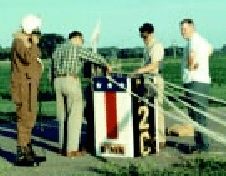
I wonder where that fur-lined flight suit came from? I wasn’t able to dig up any details in any of Piccard’s interviews (maybe he didn’t know). But… maybe there’s an answer out there.
The historical plausibility of Keel’s story
On the one hand, Don Piccard successfully flew a Fu-Go balloon for more than two hours, so Keel’s suggested flight itself was – as long as you don’t try to go too high – entirely plausible. You certainly wouldn’t have needed a balloon bigger than the ones that were already being launched. And I can certainly imagine it being launched from one of the larger Japanese submarines.
It’s also true that from August 1944, Japanese pilots were being trained specifically for one-way kamikaze missions. (The first documented kamikaze mission was late October 1944.) So, a kamikaze manned balloon attack would fit the historical timeline from about October/November 1944 onwards.
On the other hand, there are many reasons why the story feels like a bit of a stretch:
- Keel never named his witnesses (nor even which US state they were in)
- There’s no mention in the Japanese archives of a sea-launched manned balloon
- There’s no mention in the US archives of the incident
- By 1945, Japanese ships and submarines weren’t going anywhere near America’s West Coast
The last – and admittedly very slim – whisper of plausibility remaining is that in late 1944, Japan launched a single large aircraft carrier submarine: Submarine I-13 was launched on 30th November 1943 and commissioned on 16th Dec 1944. This certainly had the range and the size to launch a manned kamikaze balloon attack off the coast of America, albeit in a very narrow historical window.
The cipher history angle
However, there’s also a cipher history angle that makes this (already shaky) timeline even less plausible. By mid-1944, American cryptanalysts had comprehensively broken the Japanese naval code JN-25, so that they essentially knew where every Japanese ship and submarine was, and where they were headed to next. And there’s not a sniff of any mission that came close to the West Coast in 1944 or 1945.
It’s true that there were some Japanese attacks on American mainland targets in late 1941 to 1942 (such as the 1942 attack on the Ellwood refinery near Santa Barbara, that caused minor damage). The closest incident was when a floatplane was launched from Japanese submarine I-25 off the coast of Oregon on 9th September 1942 and tried to start some forest fires (though it failed). But after 1942, American anti-submarine efforts caused Japan to focus their submarine attention elsewhere in the Pacific.
Even though there’s still a (faint) possibility that Keel’s claimed kamikaze balloon attack on the West Coast was done as a need-to-know rogue operation (Japan certainly had a few of those late in the war), I’d have to say that the probability this happened currently seems wafer-thin-if-not-actually-zero. But I’ll keep my ears open for any updates, ‘absence of evidence’ etc.