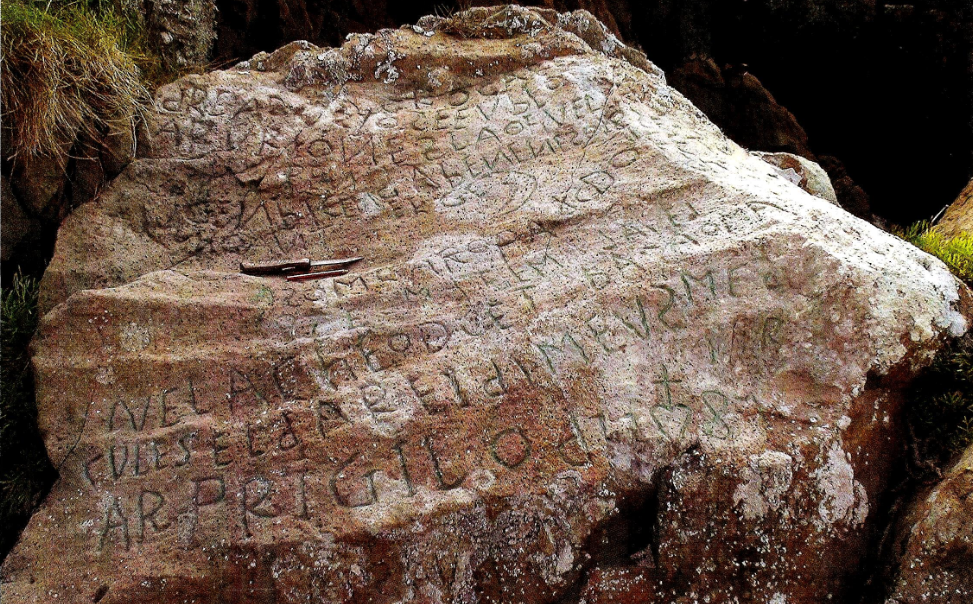
I mentioned this mysterious stone here a few days ago, since when the story has been picked up by many more news outlets, largely justifying the mairie‘s decision to put a 2000 euro price on its head, it would seem.
And so I, like probably many others, emailed through a filled-out form to say I’d like more information: and received a link to a 12MB PDF, which
contained mainly photos of the rock in question.
Société Archéologique du Finistère
It also contained a copy of what may well be the only time this stone has been discussed in some kind of journal or book. This was (as I suspected) the Bulletin of the Société Archéologique du Finistère, which has a long-running kind of ‘mop-up’ feature entitled “Monuments et objets d’art du Finistère. Études, découvertes, restaurations“, for small items that don’t quite merit a full article. I don’t know precisely which Bulletin this is, but from the page numbers visible in the copy (pp. 332 and 333), I’d guess it was the 1979 Bulletin (it certainly can’t be any earlier).
Here’s what it says:
PLOUGASTEL-DAOULAS
Anse du Caro
Une inscription énigmatique du XVIIIe siècleAprès bien des hésitations, nous livrons le relevé d’une longue inscription gravée en creux sur des rochers au nord de l’anse du Caro, dans la presqu’île de Plougastel-Daoulas. Elle nous a été signalée en 1979 par Bernard Tanguy. Nous communiquons ce que nous avons pu en relever, dans l’espoir que quelque membre de la Société y exerce sa sagacité, afin que l’on puisse obtenir des éclaircissements, comme cela a été le cas pour l’inscription de Guengat (cf. supra).
Les coordonnées de l’inscription du Caro, selon la carte I.G.N. au 1/25000, sont les suivantes : X : 098 00, Y : 094 15, soit à 500m, à vol d’oiseau, à l’ouest de village d’Illien-an-Traon. On peut, à marée basse, suivre la côte vers le nord en partant de l’anse du Caro, et repérer les rochers entre la pointe qui s’avance dans la mer et la falaise.
Sommairement gravée en caractères dont la majorité est en capitales, il ne fait pas de doute q’elle est en langue bretonne. Vieille de deux siècles, le rocher sur laquelle on la lit s’est débité sous l’action des marées, plusieurs signes sont érodés et la surface de la pierre est éclatée par endroits.
My rough-and-ready translation:
An enigmatic inscription from the eighteenth century
After much hesitation on our part, here is a record of a long[-ish] carved inscription found on the rocks in the Plougastel-Daoulas peninsula, north of Anse du Caro. This was first reported to us by Bernard Tanguy in 1979. We hope that, by publishing here what we have been able to discover, some member of the Société will apply his or her sagacity to it, so that we can gain greater clarity, as indeed happened for the Guengat inscription (cf. supra).The coordinates of the inscription du Caro, according to the 1/25000 scale I.G.N. [Institut Géographique National] map, are as follows: X: 098 00, Y: 094 15; this is 500m west of the village of Illien-an-Traon as the crow flies. If, at low tide, you follow the coast northwards along from Anse du Caro, you should be able to locate the rock between the tide-line and the cliff.
Looking at the lightly engraved in characters (of which the majority are capitals), there is surely no doubt that this is written in the Breton language. Two centuries on, however, the rock on which it was carved has been damaged by the action of the tides, several of its glyphs have been eroded away, while in places the surface of the stone is smashed up.
The First Transcription
We have two basic sources for the inscription: the version that appeared in the Bulletin (just after the above-translated text), and the hand-written version that appears in the mairie‘s PDF. Firstly, here’s the SAF version:
ROC AR B…
DRE AR GRIO SE EVELOH
AR VIRIONES BAOAVEL… R I
… GENBICEN DA BEN ESOA… S E
DIASBOANT…
…EKGES…
BO…FET
DAR
ASOMGAROPA
VARLAEOERIATQDAO
NELACIEOD – ET… F… AOMA
CVLESEDAREIDIMEVSMES
ARPRIGILOD1787
(coeur et croix) OBIIE: BRISBVILAR… FROIK… AL
…ALVOA ARBORSINET
CARCLONEPR ES (SAKI) ASONRES E I BEL
(ANNDDIN) VMS
… (ABAN) SDARANDOC (SAOU) ADREIRIO
(FAN) 1786 NEIS
… CL…
… DOS…
SARMIS – UT
177IMESO
EMGAR
DALOTOGREC
TRE: C-ND’une autre main, la date de 1920…
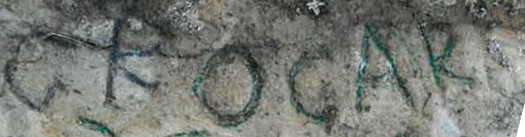
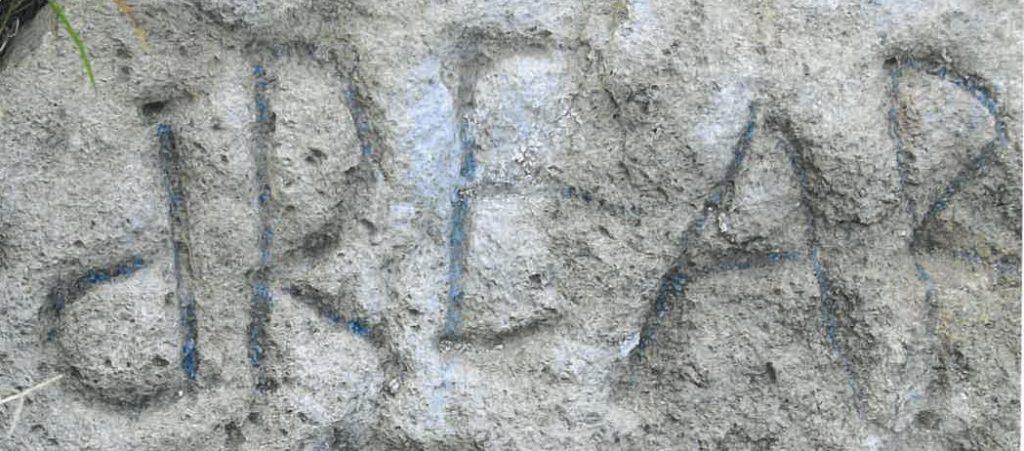
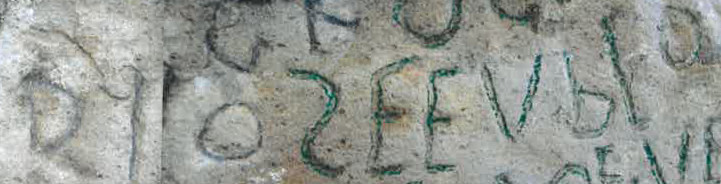
All the same, I have to point that this SAF transcription isn’t really doing justice to the lettering on the rock. For a start, the first letter resembles a lower case ‘d’ more than a ‘D’; several of the letters seem to have backwards ‘N’ shapes; and so forth.
Even so, this first transcription was (without much doubt) done in good faith some years ago, and we must be aware that the process of cleaning it up and preparing it for public view in 2017-2019 may possibly have added a layer of interpretation to these carvings that wasn’t originally there.
As an aside, Bernard Tanguy is without doubt the Brittany historian who was for many years president of the SAF, so it is hardly a surprise that he chose to pass his discovery on to its members. He may well have also photographed this mysterious rock when he first encountered it, but I don’t know if this particular angle has been pursued by anyone.
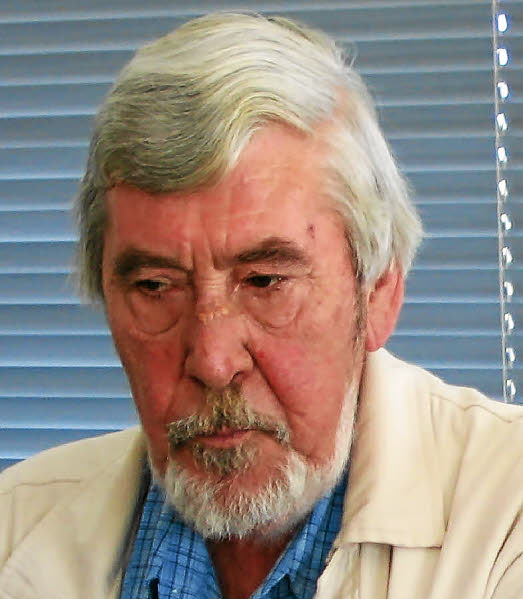
Bernard Tanguy, (1940-2015) – photograph fromLe Telegramme, 2015
The Second Transcription
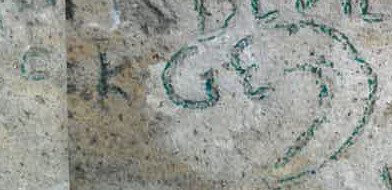
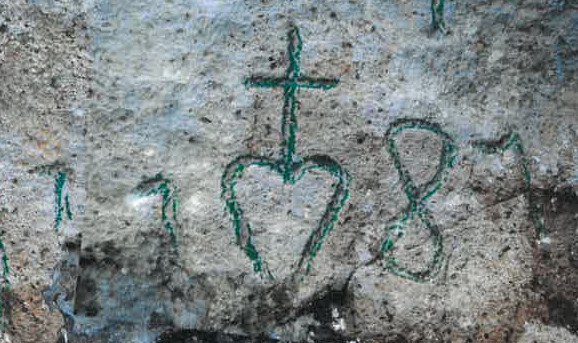
In the following version of the hand-transcription released by the mairie, I have rendered the back-to-front ‘N’ as the Cyrillic capital I (i.e. ‘И’), and the back-to-front ‘S’ as ‘Ƨ ‘ (the Unicode character 01A7), etc. All of which is not perfect, sure, but it’s perhaps tolerably close:
GROCAR
dREAR DIOƧEEVbIO
ARVRFOИEƧLAΘENEL
PEИ AbEИEИEƧΘ182E
GEИbICEИG
EKGE (left-facing crescent moon shape)
AZOMOARΘ PA ꙋCDOFET
dAROA
AIELAChEODCET DA AOMA
CVLESELDdA RE IdIMEVƧMEƧ
ARPRIGILOd17(cross on top of a heart)87
ObIIE bRIƧbVILA
ALVQ4AKbORSIV . T
OSCARCLOIVEPRE 2 . T
ZOИREZE
VAR
dARAИdOL
AdREIRI9
1786 ИE12
Scans of the Mysterious Rock
I’ll finish up by illustrating the above with some example scans cropped from the mairie‘s kindly-provided set, so you can perhaps get a better idea of what we’re up against here.


Enjoy!