Much to my surprise, my online order with the PROV (20 AUS, i.e. £12) for a copy of Carl Webb and Dorothy Jean Robertson’s 1941 marriage certificate pinged into my inbox in less than 15 minutes (and on a Sunday, no less). Luckily they got married more than 60 years ago, so this counts as an historic document that anybody can order (yes, even me). So I can now tell you exactly what it says…

The 1941 Marriage Certificate

The marriage was celebrated at St Matthews, Prahran on 4th October 1941: the Church of England “Clerk in Holy Orders” (minister) was John Burrell Montgomery.

Carl Webb is listed as a 35-year-old bachelor (no children) (occupation: instrument maker) born in Yarraville to Richard August Webb (deceased) (baker and pastrycook) and Eliza Amelia Grace.

Dorothy Jean Robertson is listed as a 21-year-old spinster (no children) (occupation: foot specialist) born in Ballarat to John Coomber [sic] Robertson (Inspector of Munitions) and Alice Stratford.

The bride and groom’s addresses are all listed as 274 Domain Rd, South Yarra. The witnesses were Doris Martin and J. C. Robertson.

Here are the bride and groom’s signatures:

Dorothy Jean Robertson’s Parents

John Comber (‘Jack’) Robertson was born in 1894 Omeo, Victoria to Robert Robertson and Mary Kate Comber (Australia Birth Index), and died on 6 Jan 1989 (“retired caretaker”). He appears on the Victoria Electoral rolls for 1919 (Beeac, Corangamite), 1922, 1925, 1927, 1928, 1931 (Brunswick West, Bourke), then a gap to 1954 (Essendon North, Lalor), 1963 (1963 St Kilda North, Isaacs), 1968, 1972, 1977 (Fawkner, Burke), and 1980.

Apart from serving in WWI (blue eyes, brown hair, 5ft 8.5in, 11st 12lb, Fourth Light Horse Regiment, etc), pretty much all else that you’ll find out about John Comber Robertson is that on 23 Jan 1924, he was in the Victoria Petty Sessions Court in Colac (ref: 301/P0/Vol 62). Complainant R Batterbury, default summons 20/12/1923, 5 shillings fee, charge “Goods sold & delivered”, struck out, no defence. (Findmypast)

Alice Stratford was born in 1896, married Jack Robertson on 2nd June 1919 in Mildura, and died in Brunswick, Victoria in 1980 (Ref: 05849). According to this rather charming Wikitree page:

Alice Stratford, daughter of Charles Stratford and Louise. Her parents had the hotel at St. Arnaud. Alice learned to drive a car among the trees in the park just before the arch in Ballarat, where they lived after their marriage. Alice married Jack Robertson on 2 June 1919 at Mildura. During WWII both Jack and Alice were in munitions. Alice died in 1980 aged 84.

Alice and Jack appeared at the same address in the Victoria Electoral rolls right up until 1977, so it seems fairly safe to assume that they spent their entire married life together.

Dorothy Jean Robertson

MyHeritage lists Dorothy Jean Robertson being born in 1920 in Ballarat, Victoria, Australia, to John Comber Robertson and Alice Robertson (nee Stratford): so I think everything ties together just about as perfectly as possible (even if all the information was behind four different paywalls, bah). According to able online genealogist Angela (thanks!), we also know that Dorothy Jean Robertson’s date of birth was 18 July 1920.

What remains is the question of when and where Dorothy Jean Robertson / Webb died. Though I’ve managed to eliminate a lot of possibilities (e.g. the Dorothy Jean Robertson born Aug 3 1920 who died in New Zealand in 2000), the one candidate I have who’s still left in play is:

Maybe this is her, maybe it isn’t: hopefully we’ll find out before too long. Still, I think that all of this is a decent enough start, and hopefully researchers with access to different databases (and/or different ways of searching them) will be able to fill in all the missing details. Good hunting!

According to https://www.abc.net.au/news/2022-07-30/somerton-man-researcher-rules-out-link-to-wife/101281666, Carl Webb and Dorothy Jean Robertson were (according to their marriage certificate) married on October 4, 1941 at St Matthews in Prahran, when Carl was 35 and Dorothy was 21: they were living on Domain Rd in South Yarra. (Note: Trove gives you far more hits with “Domain Rd” than with “Domain Road”, but I haven’t found any small ads from there.)

Yet most of the Webb-Robertson family trees that have quickly sprung up in the last few days (e.g. the one on familysearch maintained by “MichaelBennett14”) seem to think she was born in 1905 or 1907 and died in 1965 or 1996. So… what did actually happen? Who was Dorothy Jean Robertson?

The Candidates

According to findagrave.com, a Dorothy Jean Robertson died on 1 Jun 2001 aged 80–81 in Hornsby, Hornsby Shire, NSW. However, there were at least two Dorothy Jean Robertsons in NSW who first appear in the electoral rolls in 1943, one in Cargelligo, the other in Bathurst. The former was likely Dorothy Jean Robertson born 2 Aug 1921 in Ardlethan (no date of death given, but the user family tree says that she died near Lake Cargelligo). So my current guess is that the Hornsby DJR was the Bathurst DJR (and that she therefore wasn’t the DJR we’re looking for), but please feel free to correct me.

I’m 99% certain we can rule out the Dorothy Jean Robertson who was the only daughter of Mrs and Mrs A. Robertson (of 20 Perth-st, Prahran), because she was due to marry William McKerchan (only son of Mr and Mrs T H Hardwick, of 157 Moore-st, Ararat) on 12 April 1947 at St Matthews’, Prahran. Which, given that ‘our’ DJR was still married (albeit not happily) in 1947 would be tricky.

Similarly, we can rule out the Dorothy Jean Webb who died in Colac on 19 Nov 1996, because she was buried with her husband Stanley Douglas Webb (courtesy of billiongraves.com). And to support that, there’s a long series of electoral roll references to the two (plus Leslie Douglas Webb and Beatrice Mary Webb) at 413 Cooke-st, Ballarat West (e.g. 1949, 1963, 1968, 1972, 1980).

So we’re kind of left (unless you know better) with the widow called Dorothy Jean Robertson who died in 1965 in Balwyn (according to PROV), though if she was born around 1920, you’d probably think that that was quite young. And archives are almost by definition incomplete, so the notion that we’ve eliminated all other alternatives would be rather foolish. Hence we now need to take a different tack to make any progress…

A Second Marriage?

In 1952, Dorothy Jean Webb divorced Carl Webb in absentia: but did she subsequently remarry? Ancestry.com and familysearch don’t seem to have any Dorothy Jean Robertsons getting married in Australia in 1952 to 1972 (and the same for Dorothy Jean Webbs).

But I had a plan: I went into ancestry.com and brought up all the women called “Dorothy Jean” in the 1954 Electoral Roll in Victoria (the South Australia electoral rolls only really go up to 1949, so they weren’t any use for what I had in mind). Then – cunningly, I thought – I’d be able to search the list for any chiropodist.

Except… if you put anything in the Keyword field (e.g. hoping to pick up, say, “machinist” or “teacher”), Ancestry doesn’t have them in the index. So (unless you know better) it seems that you can’t actually search for occupation in these Australian electoral roll. Which, as we say in the UK, is a bit ‘pants’.

Regardless, I decided to soldier on: how bad could manually searching through 1392 Dorothy Jeans in the 1954 Victoria Electoral Rolls be? Let’s just say that after 350 non-chiropodists, I gave up with eyestrain and headache. Maybe I’ll continue another day (or maybe I won’t).

So: while it’s possible she remarried in 1952 or later, I haven’t yet seen any evidence that supports this.

The Bute Connection?

According to Derek Abbott, by 1951 Dorothy Jean Webb had moved to Bute in South Australia. However, the South Australian electoral rolls only really go up to 1949 (and even then only patchily): and there seem to be only two Dorothy Jeans listed in Bute (Dorothy Jean White and Dorothy Jean Snodgrass, both in 1939 and 1941). And even if you search for “Robertson” in Bute’s electoral rolls, you get zero results.

So while it’s entirely possible that Dorothy Jean Webb did indeed move to Bute, it seems that the electoral rolls are so sketchy around there for that time period that we can’t use them to try to track her.

What else might we try to use a connection between Bute and the Robertsons? Searching findagrave.com (and billiongraves) for anyone with the surname Robertson buried in Bute yielded only two people:

  • David Martin Robertson, 1932-2002 (at Ashford Hospital, according to the ‘Tiser)
  • Lynette Ruth Robertson, 1930-2012 (at Moonta Hospital, according to the ‘Tiser)

A MyHeritage family tree says that David Martin Robertson’s parents were Thomas Robertson and Mary Robertson (nee Spence), and that Lynette Ruth Robertson (nee Hocking) was his wife.

Ancestry.com also had:

  • Lily Robertson, d. 25 Aug 1910

OK, it’s clear I’m making heavy weather of this, so I’m guessing that Derek Abbott has some specific information here that I’m not aware of. Perhaps all this stuff will come out over the next few days.

*** Update ***

Retrying the same keyword search for “Dorothy Jean” and “chiropodist” via the FindMyPast search interface was much more successful. Even though the keyword match triggers if “chiropodist” is anywhere on the same page, this was enough to reduce the number of hits to manually go through to a mere 7 (down from 1392).

Alas, the only actual Dorothy Jean who was listed as a chiropodist anywhere in the electoral rolls was Dorothy Jean Webb, for the year we already knew about. So this was a nice idea that didn’t actually work out.

Once I found (from the Victoria electoral rolls) that Carl and Dorothy Jean Webb‘s address in 1942 was 63 Bromby street, the blindingly obvious next step was to look for any small ads at that address. So, in the spirit of keeping up with the Abbotts, here’s what I found (it’s not a massive haul, but it is what it is)…

The Small Ads

16 Feb 1942 – The Argus (same in The Age)

MORRIS 8 40 Roadster 1937 only two private owners mechanically splendid. Inspection after 6. £110 Cash only. C Webb 63 Bromby-st, South Yarra (behind Kellow’s)

15 May 1943 – The Argus

ELECTRIC Shave Master. £4/10/; Golf Clubs. £4. Saturday afternoon, Webb, 2/63 Bromby st.. South Yarra.

5 Jan 1946 – The Argus

BILLIARD Cue and Case. Joe Davis: also almost new flat-top Tennis Racket. Flat 2. 63 Bromby st.. S. Yarra. Sat, afternoon.

31 May 1947 – The Argus

TOOLS. Hand, Engineer’s, Carpenter’s chance. Before 11. Flat 2, 63 Bromby st..South Yarra.

D George

According to Derek Abbott, Carl Webb and Dorothy Jean Webb separated around April 1947. However, someone at the same address (apparently “D George”) then carried on selling cars through the Melbourne small ads for the next few years:

10 Jul 1948 – The Age

Jaguar, 2.5-litre 1937 Saloon; 2205: PP £450; exch. D George, Flat 2 Bromby-st. S Yarra.

17 Jul 1948 – The Age

Rover, 1938, identical with current mod, faultless in all detail; PP £444, exch, D George 63 Bromby-st, S Yarra

13 Nov 1948 – The Age

Lancia, 16 or 17 hp Farina, convertable coupe, 1931, brand new tyres, immaculate car. George, 63 Bromby-st, S Yarra. Sat afternoon.

  • 28 Apr 1951: Austin A/90, convertible, fully automatic…
  • 02 Jun 1951: Chevrolet 48 Stylemaster, completely overhauled, capped tyres…
  • 16 Jun 1951: Panel Van, Austin A/40, brand new; £825…
  • 15 Sep 1951: Panel Van, Ford 10/10 appearance and tyres good, low mileage…
  • 1 Mar 1952: Consul, new, beige and blue, £50 over list…

Might there be some kind of car dealer connection? Or is all that just a normal Somerton Man coincidence?

The big news of the day (which I first saw on CNN) is that Professor Derek Abbott and Colleen Fitzpatrick have used DNA from the hair embedded in the plaster cast of the Somerton Man’s head to identify the Somerton Man. And it’s… Carl Webb, a 43-year-old electrical engineer / instrument maker from Melbourne.

Oh, and no, nobody else had heard of him either.

Derek Abbott got the final confirmation via a DNA test from some close relatives that arrived on 23rd July, which capped several years of fairly painstaking genealogical research by him and Fitzpatrick.

The downside is that nobody has any photo of Webb, or indeed any record relating to him (apart from his birth). Which means that for the moment, even though the Somerton Man has been identified, the Somerton Man mystery remains pretty much wide open.

I thought I’d start the research ball rolling by posting some of Carl Webb’s family tree and a few thoughts.

Carl Webb’s Family Tree

Carl Webb’s paternal grandparents were Johannes Frederick Webb/Weber (b. 1840), and Elis Buck (b.1840 in Berkhampstead, Herts). Their son was Richard August Webb (born 1866 in Hamburg, died 2 April 1939), who married Eliza Amelia Grace in Victoria in 1892.

Richard August Webb was a baker, whose one notable appearance in Trove is a cluster of reports relating to a 1912 case where he was brought before the court for selling underweight loaves of bread:

Following his death, there’s a probate notice from April 1939:

NOTICE is hereby given that after the expiration of 14 days from the publication hereof, application will be made to the Supreme Court of the State of Victoria in its Probate Jurisdiction that LETTERS of ADMINISTRATION with the will (dated the 8th day of May 1937), annexed, of the estate of RICHARD AUGUST WEBB, formerly or Spring Vale road, Spring Vale but late of 15 Coats street, Moonee Ponds, in the said state, baker, deceased may be granted to Eliza Amelia Webb of the latter address, the sole beneficiary named in the said will.

Dated this 6th day of April 1939.

J. J. CARROLL, 440 Little Collins street, Melbourne, solicitor for the applicant.

Richard and Eliza had six children:

  • Russell Richard (registered 1893) born St. Arnaud, Victoria
  • Freda Grace Webb (born 1896, died 1964) in Dandenong. She married Gerald Thomas Keane in 1915. They had a son John Russell Keane, who was an RAF flying officer who died in a training exercise in WW2; and a daughter Gwen M. Keane.
  • Gladys May (registered 1897) born in Prahran, died 1955. Married Leslie William Scott (in 1933 or earlier). Her 1955 death notice:
    • SCOTT. — On July 3, at her residence, 9 Peterleigh grove, Essendon, Gladys May, dearly beloved wife of Leslie William, loved sister of Dot (Mrs. Martin) and Freda (Mrs. Keane).
  • Doris Maude (‘Dot’) Webb was born on 22 May 1901 in Footscray. She married Daniel William Martin: they had at least one daughter. She died in May 1956, at the age of 55.
  • Roy (registered 1904)
  • Carl born 16 Nov 1905 in Footscray
    • Married Dorothy Jean Robertson in 1941 in Victoria (16701)

This is all I’ve managed to come up with so far: but it is hard not to notice that Carl Webb seems to have been basically invisible, Trove-wise (or even NAA-wise). Abbott and Fitzpatrick reconstructed the maternal side of the Webb family (the Somerton Man’s mitochondrial DNA matched a “first cousin three times removed on his mother’s side“), but I’m sure more details will emerge from them over the next few days.

Carl Webb’s Separation

Interestingly, we also have a Trove record not of Webb’s presence but of his absence from 1951, from the Melbourne Age, Fri 5 Oct 1951, p.15 (column 10):

To CARL WEBB, formerly of Bromby-street, South Yarra, but now of parts unknown. —Take notice that your wife, DOROTHY JEAN WEBB has instituted DIVORCE proceedings against you on the ground of desertion, and that unless you enter an appearance in the Prothonotary Office of the Supreme Court at Melbourne on or before the 29th day of October, 1951, the case may proceed in your absence, and you may be ordered to pay costs.

According to Abbott and Fitzpatrick, Carl Webb had deserted his wife in April 1947: by 1951, she had moved to Bute in South Australia, some 89 miles northeast of Adelaide. They therefore speculate that Webb might possibly have travelled to Adelaide to try to see her, but… it should be clear that they really have no idea. And… I’m sorry to say it, but Derek Abbott’s track record of previous speculations seems to suggest we should perhaps have more than a pinch of salt ready to hand.

The Keane Connection!

If you were paying attention in the list of siblings above, you’d have noticed that Freda Grace Webb (1896-1964) married Gerald Thomas Keane; and also that she was still Mrs Keane in July 1955. Which actually offers us a fabulously rich connection to the (now long-lost) suitcase linked to the Somerton Man, which famously had various items of clothing (tie, jockey shorts, etc) marked with “T Kean[e]“. Or perhaps “J Keane“.

Up until now, we’ve been unable to make any genuine progress here: Tom Keane in particular is such a common name pair that there were too many avenues to explore. But now that we have (what seems to be) the specific Keane we should have been interested in, what can we find out about him?

Gerald Thomas Keane was born in 1889 in Ballarat East, Victoria, to William Thomas Alpius Keane and Emma Ann (Hawkins) Keane: he died in 1960 in Fitzroy, Victoria. From his son’s wartime records (in the NAA), we know that their address in 1940 was 226 Glenlyon Road, East Brunswick, Vic, before moving to 194 Stewart Street, East Brunswick, Vic.

The NAA has other records relating to the same wartime flying accident that killed Gerald Keane’s pilot son John Russell Keane: one record relating to Francis Aloysius Connell lists the contents of Connell’s personal effects, sent back to Australia in a tin suitcase in 1944.

So… could it possibly be that the suitcase in Adelaide Railway Station was actually John Russell Keane’s personal effects? Sadly, only a few of the documents relating to John Russell Keane have been digitised, so this is simply an open question at this point. For now, my point is more that we now have a number of specific new historical avenues to search. Regardless, the game is afoot!

As part of my search for a missing US Navy balloonist, I’ve been working my way though a long list of research leads. One of these was to find out if Thomas Greenhow William (“Tex”) Settle’s papers were left anywhere (the Settle Collection at the Smithsonian was donated by J. Gordon Vaeth in 2006, and is more like Vaeth’s shrine to his old boss). So imagine my surprise…

Tex Settle (1895-1980)

Celebrated US Navy balloonist Tex Settle was born on November 4, 1895, retired as an Admiral in 1957, and finally died on April 28, 1980. He was CNATE at NAS Lakehurst from 1946 to 1947: Admiral Charles E. ‘Rosy’ Rosendahl, Settle’s predecessor, said (in his book “SNAFU”) that Settle was basically the only person to whom he would hand NAS Lakehurst’s reins.

Settle was someone who was not only well-educated but also meticulous (if admittedly a bit terse). So it seems extraordinarily likely to me that his papers would both exist and be in a well-organised (and indeed archive-friendly state). So where are they? Perhaps his family might still have them…

Fay Brackett Settle

Fay Brackett was born in Somerville, Middlesex, Massachusetts on 14 Aug 1900 to James Frederick Brackett (1871-1937) and Alice Palmer Fay (1873-1934). She married Tex Settle around 1930, and died at Arlington, 6 Oct 1989: the only relation of hers I’ve found was her brother Frederick Brackett (who, in 1934, the Boston Globe said lived in “the Heights”).

She and Tex Settle had one son…

Thomas Brackett Settle (1930-2020)

For telescope historians (such as myself), the name Tom Settle should ring a very loud bell indeed. Tom Settle wrote extensively on the early modern history of science, with a particular focus on Galileo. As I understand it, after being a Professor Emeritus at Polytechnic University, Brooklyn (now part of NYU) he retired to Florence, and was closely associated with the IMSS (now the Museo Galileo).

In fact, if you have searched for topics in and around the history of science, there’s a high chance you will have encountered “The History and Philosophy of Science, Technology and Medicine” website he curated for some years.

What was even more surprising for me was that, following my 2008 Juan Roget popular article (I wouldn’t really call it a ‘paper’) on the possible Catalonian history of the telescope, Settle wrote a paper on the exact same topic:

‘The invention of the telescope. The studies of dr. Josep M. Simon de Guilleuma’, Actes de la III Jornada d’Historia de l’Astronomia i de la Meteorologia, Vic, 17 d’octubre de 2009.

(Note that this is available on academia.edu via Google Scholar – I read it just now, it’s a nice article.)

I haven’t so far managed to trace any living family member for Tom Settle, but if anyone is able to dig anything up, please let me know!

Tex Settle’s Estate

I did manage to find a July 2020 auction listing for a “Collection of books relating to Admiral Thomas ‘Tex’ Settle’s flights as a balloonist” (which didn’t sell), along with another for three watercolours of Istanbul by Nikolai Saraphanoff (which did sell), where both listing mentioned that they were from Tex Settle’s estate, and then another, another, some ducks, a horse, some bookends, some books, etc.

The implication would seem to be that these were items from a house clearance put up for auction following (Tex Settle’s son) Tom Settle’s death (also in 2020), and hence that the rest of Tex Settle’s papers may possibly now be on the move too. So: where are they, and who has them? Or… have they all just been thrown away as having no obvious value at auction?

Not much news here, though I have finally managed to make contact with Charles Hansford Kendall’s family, who very kindly answered my questions about him. From what they told me, it now seems highly unlikely to me that Kendall was the Navy balloonist I’ve been seeking, so my search continues.

Robert Henry (“Bob”) Howe USNR

Kendall aside, the only other NAS Lakehurst Navy man I’ve found who died around the period of interest was Robert Henry Howe. The Princeton Alumni Weekly reported:

ROBERT H. HOWE ’23

It seems almost unbelievable that we are reporting the death of Bob Howe who was killed in an automobile crash August 24 [1947]. The accident happened near Utica, N.Y. while Bob with his wife and son, Richard, were on the way to the Adirondacks for their vacation.

Bob was commissioned in the Naval Air Corps in June 1942 as a lieutenant. He had served as a navigation instructor in Norfolk and at the time of his death was a Lt. Comdr. at Lakehurst, where he was instructing.

Prior to his entry into the service, he was in the jewelry and wholesale silver business. During the war his son, Robert H., Jr. died in the service when his Marine Corps plane crashed at Jacksonville, Florida.

Bob could be found at all reunions and those who were back last June will always remember his ready smile. Reunions just won’t seem the same without Bob and the class has lost a most loyal classmate.

He is survived by his widow, Priscilla M.; two sons, Charles M. and Richard B.; his father, Charles H.; a sister, Mrs Carol H. Newell; and his maternal grandmother, Mrs. Carrie W. Ostrander.

The class extends its sincere sympathy to the family in their great sorrow.

For the Class of 1923

H. GATES LLOYD, President

JOHN E. SPENCE, Secretary

If anyone has paywalled access to old newspaper sites, can I please ask if you would have a quick look to see if Howe’s death on 24th August 1947 was reported there? I looked on NYS Historic Newspapers (one of my favourite free newspaper sites), but it seemed to have nothing from Oneida County for that month, alas.

Dennis Gilliam, pressure suit historian

I’ve also found myself stymied looking for contact details for the pressure suit historian Dennis Gilliam. He used to work for “Orbital Outfitters” (surely a play on Urban Outfitters, right?), the spacesuit company whose contract with Elon Musk famously specified that the space suits should look “badass”.

I’d like to talk with Gilliam about the US Navy’s Strato Model 7 full pressure suit (designed by John D. Akerman at his Strato Equipment Company in Minneapolis). There’s a load of stuff in the John D. Akerman Collection at the University of Minneapolis, which I’m sure Gilliam will have gone through.

However, now that OO is defunct, Dennis Gilliam also seems to have disappeared from view. Can I please ask anyone with better online sleuthing skills than me to please try to find his contact details and pass them to me? Thanks!

I’ve been going through yet more of the (digitised) papers in the Smithsonian’s Captain George Henry Mills Collection, and have more to share about Captain Charles Kendall and NAS Lakehurst history.

The CNATE Succession

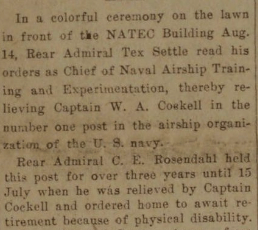
At the start of the period in question (1945-1950), the base commander at NAS Lakehurst was Vice Admiral Charles (‘Rosey’) Rosendahl. However, when ill health forced Rosendahl to retire early, the base was temporarily run by Captain William Arthur (‘Art’) Cockell, who then handed over to Rear Admiral Thomas (‘Tex’) Settle. Settle was in turn replaced by George (‘Shorty’) Mills, who held the post of CNATE to mid-1949.

We can see much of this from a clipping from “The Bag Vet” (Number 1, Vol 1, 1st September 1946, p.1), an airship “News Sheet For All Vets of Blimpron 14”, which, along with all its where-are-they-now and would-you-like-a-job-flying-a-Howard-Hughes-blimp articles, also included airship-related news from various NAS bases such as Lakehurst:

(By way of explanation: a “blimpron” was a “blimp squadron”, Blimpron 14 was also known as “ZP-14”).

Captain Kendall updates

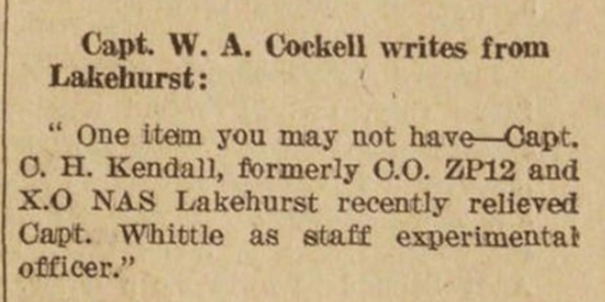
Even though Charles Kendall seems (unlike Rosendahl and Mills) not to have subscribed to The Bag Vet, a few news items relating to him do appear there. For example, in The Bag Vet, Jan 15th 1947:

Decoding the Navy acronyms, “C.O. ZP12” was “Commanding Officer of Blimpron ZP-12”: this was the blimp squadron that covering the Atlantic during WWII. “X.O” was “Executive Officer”, who was normally the Number Two on a given base. So it seems from this that Kendall started as Executive Officer under Tex Settle, but then became Experimental Officer at the start of 1947.

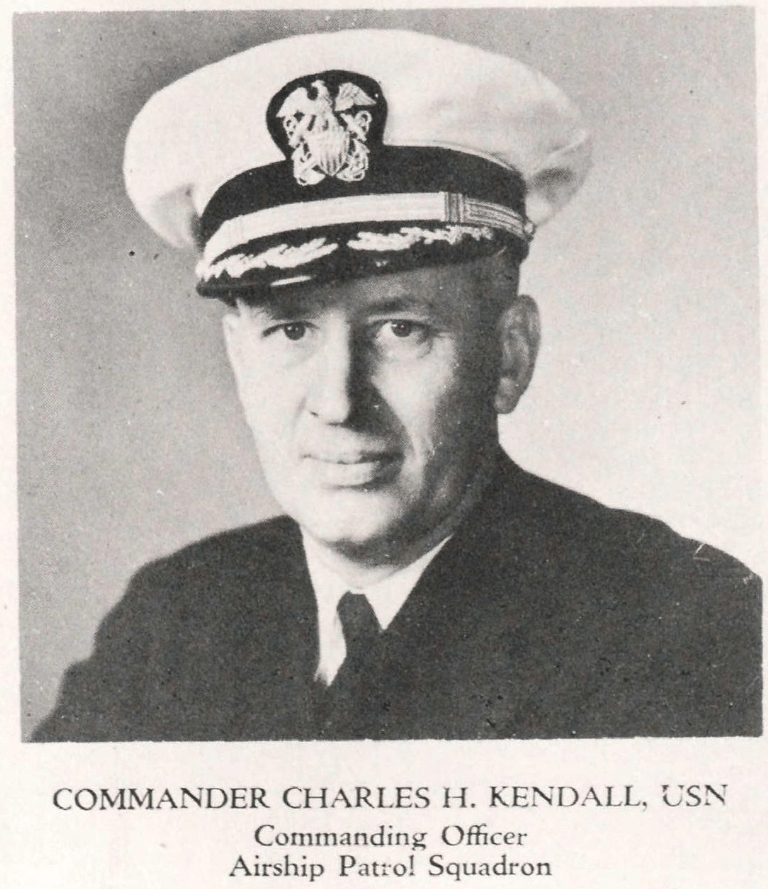
Incidentally, there’s a nice picture of Kendall as C.O. ZP-12 in “United States Naval Air Station Lakehurst New Jersey – A Photographic Essay”, a copy of which is in the George Mills Collection:

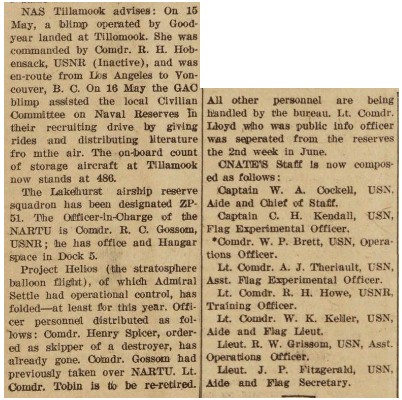
The Bag Vet (Vol. 1, Number 5, 1st Nov 1947) mentions the demise of Project Helios (note that Commander Henry Calvin Spicer Jr was for a while the designated pilot for Project Helios):

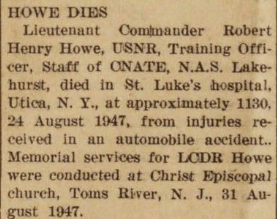
So, at some point in 1947, Captain Art Cockell was SDO NAS Lakehurst, Captain Charles Kendall was Experimental Officer, and Lt. Commander Alcide Theriault was Assistant Experimental Officer beneath Kendall. However, we can date this organisational change to before 24th August 1947, because that sadly was when Lt. Commander Howe (“Training Officer” above) died in an automobile accident:

Incidentally, in a US Navy context, a “Flag Officer” means a commissioned officer senior enough that they are entitled to fly a flag at the place they exercise their command. While this normally applies to rear admirals or higher, it can also apply to someone who has commanded a squadron of vessels. Yet in such cases, this normally only applies for up to a couple of years until a suitable promotion (normally to rear admiral) can be put in place.

So it would seem that in 1947, Captain Charles Hansford Kendall was very close to becoming an Admiral in the US Navy, a rank his older brother Henry Samuel Kendall had previously reached. It therefore seems likely to me that Kendall would have taken on the role of Experimental Officer at NAS Lakehurst only on a temporary basis: at that time, he was surely headed for a bigger role within the Navy before too long.

Where next in the archives?

While it has been helpful going through the (fully-digitised) George Mills Collection at the Smithsonian, and frustrating looking at the finding aid for its (entirely undigitised) J. Gordon Vaeth Collection (boo), it left me wondering if I was even looking in the right place.

I think it fair to say that George Mills was more of an administrator who liked LTA, while Vaeth was an airship enthusiast (if not actually a bit of an LTA history obsessive). But both of them were left firmly in the shade by Vice Admiral Charles Rosendahl: following his early retirement, Rosendahl seems to have spent the next 30-odd years writing constantly about airships – from the archives, there seem to be few newspapers or magazines or journals to which he didn’t submit pieces or articles concerning LTA.

And so it is that Charles Emery Rosendahl’s voluminous collection of LTA material at the Special Collections Department, Eugene McDermott Library (at the University of Texas at Dallas) has ended up, without much doubt, as the best place to look for answers to historical questions about airships and US Navy LTA history in general. This contains over 330 boxes of material: there’s a finding aid here.

Why is this so good? For example, whereas the George Mills Collection has a few cherry-picked issues of “The Airship” from NAS Lakehurst, the Rosendahl Collection holds (I believe) every issue from 1944 right through to 1958. Similarly, Rosendahl has Vol. 2 Number 6 of The Bag Vet (Mills only goes up to Number 5), along with a whole load of rare LTA newsletters that it would seem nobody else has ever heard of.

Even though I think I have already unpicked much of the raw history I was hoping to find, the answer to the thorny question of what actually happened to Charles Kendall still evades me. Yet there seems a good chance that the answer will be found in the Charles Rosendahl Collection, either in “The Airship” or The Bag Vet (Vol. 2 Number 6), if only I could find a way to look there…

A few days ago, I wondered whether I might find any clues to what happened to Captain Charles Hansford Kendall not when Rear Admiral Tex Settle was base commander of NAS Lakehurst (1946 – September 1947), but when Captain George Henry Mills was (October 1947 to June 1949). Helpfully, Captain Mills’ family made a substantial donation of his papers and notes to the Smithsonian Archives not too long ago: and – amazingly – almost all of the George H. Mills Collection is digitised and available online. So there is plenty to work with…

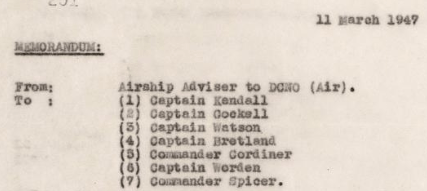
11th March 1947

There’s a brief mention of Captain Kendall here, in a memorandum from Tex Settle (it’s in one of the files holding correspondence between Mills and Settle):

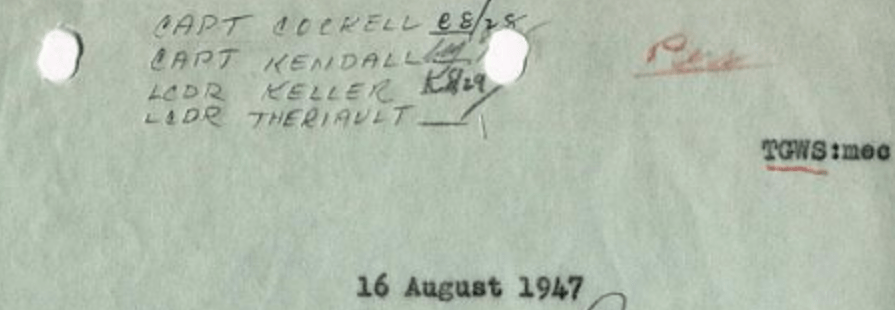
16th August 1947

Close to the end of his time at NAS Lakehurst, Tex Settle sent out a fairly robust letter summarising the difficulties he had experienced as base commander. Kendall’s name was on a list of addressees, but unfortunately it’s not clear (to my eyes, at least) what was marked against his name:

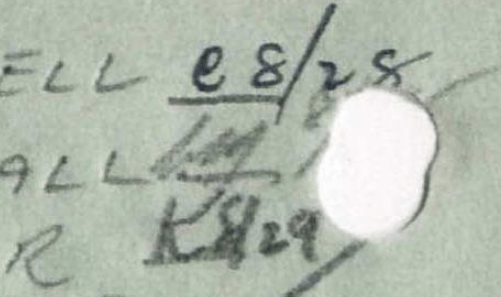
I tried zooming in but it’s no clearer, the punched holes went straight through the interesting bit, alas:

10th October 1947 – Lakehurst Org Chart

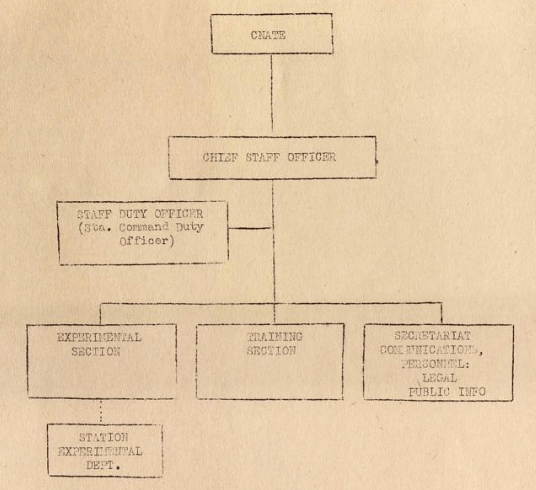
This organisational chart of the base dated 10th October 1947 was something I found interesting: this was in Memos – Naval Airship Training and Experimental Command (CNATE) personnel, 1947-1949. You can see that the Chief Staff Officer position (immediately below CNATE, the base commander) was a hugely important position (page 4):

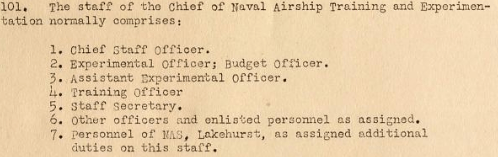
Page 2 includes a list of the major roles under CNATE at Lakehurst, including the Experimental Officer role (which was essentially head of the Experimental Section):

Oddly, Charles Kendall’s newspaper obituaries gave conflicting accounts of his position at Lakehurst: the Associated Press version was that he was Chief of Staff (CSO) to the base commander, while the reporter who talked to his widow noted that he was NAS Lakehurst’s Experimental Officer.

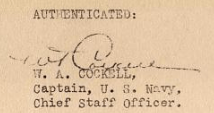
However, page 1 of the same document shows that it was Captain William Arthur (“Art”) Cockell who was the CSO as of October 1947:

November 1947 – List of Lakehurst Personnel

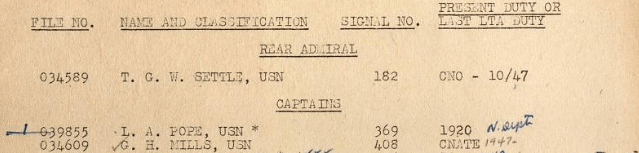
The following document gives a list of NAS Lakehurst personnel as of November 1947. This starts with RADM Tex Settle (who had just left), and you can see Captain George Mills as CNATE just below:

At the end of the section listing all the Captains, we see Captain Art Cockell and Captain Charles Kendall, who were both noted as being base Staff:

And yes, you can see that Captain Kendall’s entry was clearly marked as “SICK”.

January 1948 – Visitors to Base

A different series of document give CNATE News Memoranda, which are a lot like cut-down versions of NAS Lakehurst’s “The Airship” newsletter, but much more tightly focused on the NATEC part of Lakehurst, rather than its (numerically larger) training section.

Here we can see visitors such as airship designer C. P. Burgess coming over from BuAer visiting the base:

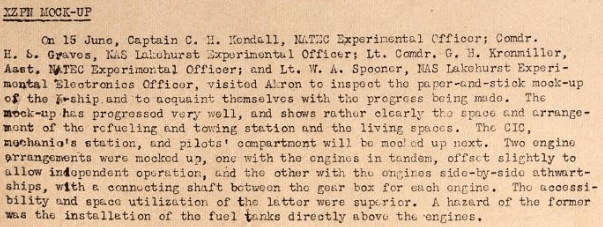
15th June 1948 – XZPN Design Visit

Here we get to see the first active mention of Charles Kendall I found from George Mills’ time as CNATE:

Hence it would seem that Associated Press (later) got it wrong: Kendall was not Lakehurst’s CSO, but NATEC’s Experimental Officer.

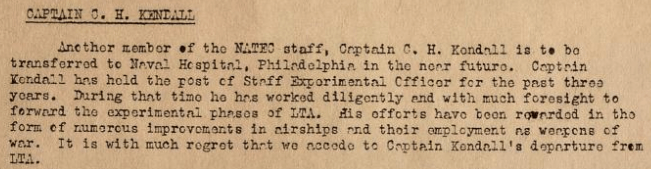
25th April 1949 – Naval Hospital, Philadelphia

This, alas, is the last mention I was able to find of Charles Kendall in the George Mills Collection, and signals Kendall’s impending transfer to the Naval Hospital in Philadelphia:

Because Captain George Mills left Lakehurst (and indeed retired from the Navy) in June 1949, the series of CNATE memoranda the Smithsonian has finishes just before Captain Kendall’s death (in the Naval Hospital) in August 1949. Hence – unless further CNATE memoranda appear – this report may also prove to be the end of the line for this particular archival trawl.

I’ve got a historical material science / metallurgy / applied physics itch I’d really like to scratch, but it falls far beyond my (relatively meagre) physics skillz. I’ll describe the challenge as best I can, (hopefully) enough for one or more potential physicist collaborators to step forward to help me move the whole narrative forward. Thanks!

The Alloy Challenge

The scenario: the year is 1937, and you are a highly-skilled metallurgist. You have just been handed an ingot of a little-known (and incredibly expensive) shiny new alloy.

The challenge you have been set by your bosses:

  1. How would you fashion this into a foil? (You can do this however you like)
  2. How would you predict (and then measure) that foil’s tensile strength?
  3. How would you join pieces of that foil together (e.g. brazing or riveting) so that the lap tensile strength isn’t significantly weaker than the foil’s tensile strength.

To help you, you can assume you have a copy of the First Edition of Hansen’s (German, later translated into English) “Constitution of Binary Alloys”, along with a state-of-the-art-for-1937 laboratory / technical library. 😉

Email me (nickpelling at nickpelling dot com) and I’ll tell you the alloy! Thanks!

French artist Guy de Cointet (1934–1983) once made a series of enciphered artworks, one of which found itself uploaded to imgur (by user “drpoopandpee”, *sigh*) in 2020, triggering a brief flurry of interest on Reddit from user Doc_Skeef.

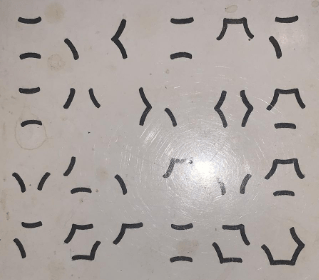
Once Klaus Schmeh posted about it, it didn’t take his readers long to realise that it was (in part) a simple substitution cipher. For example, the ciphertext at the centre of the cover image looks like this:

This can be transcribed as:

     A CAPT
     AIN FR
     OM POR
     TUGAL. 

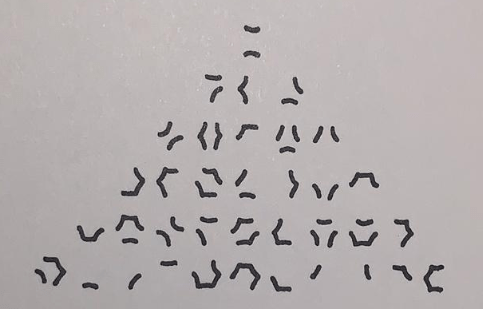
How can you tell this? The cipher alphabet used for the above appears on a different page:

Here you can see the “=” glyph at the top (for plaintext ‘A’), with the ‘<‘ glyph immediately below it (for plaintext ‘C’), etc, which should get you started reading “A CAPTAIN…” on the cover page. A nice piece of work by Klaus’ commenter Armin!

“Bands of pigmentation”

But one of the other pages, once correctly decrypted (by commenters ShadowWolf and Matthew Brown) offered up a mysterious plaintext for which nobody had an explanation:

like bands of pigmentation in the zebra, the ridged elevations formed on the shell of the argonaut and on the giant cactus of the west present …

I can now actually reveal that this text came from “Finger Prints, Palms and Soles: An Introduction to Dermatoglyphics“, a 1943 book by Harold Cummins Ph.D., and Charles Midlo M.D. I’ll transcribe the full section (“Other Patternings In Nature”, pp.34-36), simply because the OCR of the original book is so bad (which may possibly explain why nobody found it before).

There are numerous parallelisms in nature of dermatoglyphic configurations and of minutiae of individual ridges. The analysis of what might be termed the geometry of biology is a field in itself.

One of the most striking illustrations of dermatoglyphic parallelism is the form and arrangement of stripes in some animals, the zebra being a familiar instance (Fig. 32). The bands of pigmentation in the zebra, and in a negative fashion the light stripes separating them, show remarkable resemblance to the configurations and minutiae of epidermal ridges. The stripes have ends and forkings which simulate minutiae and there are triangular consolidations of stripes which resembled triradii. The several areas presenting unlike directions of stripes might be likened to configurational areas in a palm or sole. In some zebras there are regional organizations of strips that may be likened to dermatoglyphic patterns and vestiges.

Hair arrangement also is suggestively similar to dermatoglyphic configurations. Hairs are projected at a slant from the skin. In a restricted region of the body the hairs slant in a common direction (fig 33) but adjoining regions may present quite different slants as exemplified by the parting of the hair of the scalp and the occurrence of one or two whorls on the crown. Other regions of the body likewise present local [p.35] distinctions of hair arrangement, and though that arrangement accords with a common general topography, there are individual differences. The areas in which the hairs point uniformly in one direction may be compared to open fields of the dermatoglyphics. The crown whorl and similar configurations elsewhere are patterns, and the irregularities localized at the points of juncture of three or four areas of different hair slants correspond to triradii.

Like bands of pigmentation in the zebra, the ridged elevations formed on the shell of the argonaut and on the giant cactus of the West present bifurcations and ends resembling the minutiae of eipdermal ridges. Inanimate nature is not lacking in similar illustrations. Sand whipped by wind or waves, may show ridges conforming with surprising exactness to the characteristic of epidermal ridges, with forkings, enclosures and ends (Fig. 34). Similarly, some cloud formations exhibit bands with ends and [p.36] forkings. Periodic precipitates (Liesegang rings) resulting from diffusion into a gel of a substance reactive with another substance contained in the gel, behave under some conditions like the lines of cellular proliferation which produce epidermal ridges. If the gel is contained in a capillary tube of uniform bore and no disturbing factors modify the reaction, the passage of the diffusing solution is marked by a succession of regularly spaced discs of precipitate which on edge view are seen to be perfectly plane. Variations in caliber of the tube or sudden changes in temperature produce warping and other irregularities of these discs which as shown in figure 35 are in edge view curiously like the irregularities of epidermal ridges.

The physical principles responsible for the configuration of wind swept sand, banded clouds or of periodic precipitates are probably simpler in their operation than the factors which underlie the production of dermatoglyphic configurations and ridge minutiae. Nevertheless, the forces concerned may prove to have more in common than mere outward resemblance of their effects.

But What Does It All Mean?

OK, I’ll cheerfully admit that I have no idea. But Cummins and Midlo’s book is all about fingerprinting, so I went off a-hunting to see if I could find a Portuguese captain who was historically connected with fingerprinting in some way. Though I found nothing even slightly of interest, perhaps others will have more luck than me. But it’s a start!