As should be pretty clear from my posts over the years, I’m a big fan of René Zandbergen: he’s one of the very few Voynich researchers that have managed to keep a consistently clear head over the years, and it is his generally even-handed approach that casts a pleasantly affable shadow over voynich.nu, the website he put together many years ago and still one of the few genuinely useful general-purpose Voynich research resources in Internetland. (Please don’t get me started on the uselessness of the Wikipedia page, I want to keep this under 1000 words).

And so in many ways the news that René has now taken back control of voynich.nu (he stopped updating it in 2004, and then handed it over to Dana Scott to look after for a few years) and begun an HTML makeover on it comes as a very pleasant surprise. It’s already looking much better, and no doubt it will carry on improving for a while yet.

I suppose the key question, though, boils down to this: really, what have we learnt about the VMs in the last six years? And how does the whole voynich.nu programme fit in with where we are now?

It’s important to remember that René’s website, for all its substance, is not some kind of “Encyclopaedia Voynichiana“, trying to compile every comment ever made on every feature, drawing, paragraph, line, word, letter. Rather, it concerns itself at least as much with the historiography of the VMs as with the VMs itself. For some people, that is a strength: yet for me, that remains its central weakness. The basic historiographic problem is that the VMs’ provenance shudders to an awkward halt circa 1608, even though it is (demonstrably, I believe) significantly older than this – in fact, if the recent radiocarbon dating is broadly reliable, the VMs probably predates its appearance at the Rudolfine court by more than 150 years. Which is a bit like trying to use Twitter to grasp the dynamics of Queen Victoria’s court.

What, then, should a 2010 voynich.nu look like? In many important ways, we’ve lost all the major archival battles: Marci pointed us to Kircher and Kircher pointed us to Baresch (and that was the end of that), while Rudolph II and WMV jointly got us to Sinapius (and that was the end of that). All of which formed a pleasant historical pear tree to climb, but ultimately one with no fruit, low-hanging or otherwise. We have all the pathology of a history, but none of the substance: for all the patient research fun trawling the archives can be, this approach has not helped us.

And from where I’m sitting, the minute we start defocussing to allow the tsunami of historical possibilities and dead-end theories to wash over us (Wikipedia, anyone?), we’ve basically lost the epistemological fight too. The annoying thing about the VMs is that even though it really is, as I once noted, like a million piece jigsaw, it would probably only take 20 or 30 carefully chosen observations about Voynichese to unlock its cipher. But which 20 or 30 would be the key? We’ll only know in retrospect, I guess. 🙂

Perhaps a revised voynich.nu circa 2010 should focus not on its (let’s face it, fairly damaged and unhelpful) historiography, but rather on what we’ve genuinely learnt about the VMs in and of itself: by which I mean things like…

  • the difference between Currier A and Currier B (and all the shades inbetween)
  • reconstructing the original page order
  • places where the cipher breaks down and/or is hacked (such as space insertion ciphers)
  • apparent copying errors
  • letter stroke construction and variations
  • document constructional details, gatherings vs quires
  • marginalia
  • internal layering
  • the various painters
  • handwriting differences and evolution

All of which is very “Voynich 2.0”, but there you go. Really, we do now know a great deal about the VMs that isn’t to do with Marci, Newbold, Brumbaugh, etc: in fact, we have plenty of reasons to be optimistic if we but allow ourselves to be!
A couple of days ago, an entrepreneurial Scot put out a call on Gumtree for…

“…a Scottish historian, cryptographer or world class crossword puzzle solver. If you can do the Times Crossword in less than 10 minutes I want to speak to you. If Charles Babbage interests you, if you hang out at Rosslyn Chapel. Know who Fibonacci was or if you have heard of the Voynich manuscript, I would like to speak to you.”

Actually, it turns out that what Jamie Renton is hoping to find is a puzzle setter rather than a puzzle solver, i.e. someone combining, ummm, ellipticity with historicity in a broadly Kit-Williams-meets-Dan-Brown kind of vein. Feel free to email him here if this might interest you, as I’m sure Jamie will be happy to tell you more about what he’s setting up.

Just a quick heads-up (thanks to Paul F!) to any Cipher Mysteries readers planning to be in Jersey in May 2010, because there’s a cipher talk planned for then which you might well rather enjoy:-

Dr Mark Baldwin has made a detailed study of the Enigma machine, the code-breaking work at Bletchley Park, and U-boats and has built up a unique collection of slides which illustrate the main features of those important facts of the Second World War. The show is divided into two parts. It is followed by an opportunity for questions, then a hands-on demonstration of one of the very few surviving Enigma machines.

Spin those rubber wheels! 🙂

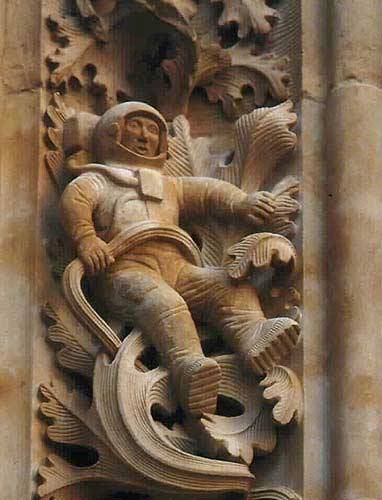
I love this picture from the Porco Cane blog:-

During 1992 restoration work on the Cathedral of Salamanca, this astronaut ensnared by vines was added by Jeronimo Garcia, along with “a dragon eating ice cream, a lynx, a bull, and a crayfish“, all approved by the appropriate committee etc. Perhaps this will confuse archaeologists a millennium hence? Probably not.

Doubtless more than a few of our problems with the Voynich Manuscript arise from looking at it out of its original context: perhaps it too consists of ancient visual themes peppered with humorous contemporary additions, but we are too far removed in time to see the jokes, let alone get them?

Even when I’ve shown the VMs’ marginalia to some very clever, very experienced historians / palaeographers, you can see that there’s a easy stopping point tempting them: that because they are unreadable, they must necessarily be cryptographically unreadable.

But the two types of mark are manifestly not the same: they have quite different types of unreadability. That is, one seems intentionally unreadable, the other seems unintentionally unreadable. But even this overloads the word “unreadable” to breaking point, obscuring the core difference between the two which is this: that one is easy to apprehend but tricky to comprehend, while the other is easy to comprehend but tricky to apprehend. Alternatively, you can pitch this as “legible but obfuscated” vs “illegible but sensible”, if you think that helps. 🙂

What I’m clumsily trying to point out is that ‘unreadable’ is one of those words that really gets in the way of inter-domain collaboration, by offering up domain experts an easy alibi to avoid engaging with the VMs’ many problematiques. In the case of the VMs’ marginalia, the real reason an expert palaeographer should stand clear is the absence of a proper codicological analysis of the key pages supported by some state-of-the-art scans. Whereas this lacuna can be filled (in time), writing the marginalia off as necessarily cryptographic (and perhaps uncrackably so) is just crabwalking out of the way.

But perhaps I’m wrong, and the pragmatic reason historical experts feel comfortable manufacturing reasons (such as the above) not to get involved is that there is a fusty stench of unfunded academic death perceived to be lingering in the air above the VMs, by which I mean that they collectively think there is much more to lose by getting involved than there is to gain. Though in many ways such a view would be fair enough, few are brave enough to admit to it. Personally, I believe that there is an enormous amount to gain: but that the widespread (and arguably dominant?) contemporary practice of history as simply a close reading of fragments of historical texts is what gets in the way, as this does not give historians the tools to deal with a primarily non-verbal text situated outside most of the stylized art history mainstream.Creating alibis is much easier than having to face up to gaps in your core methodology.

Just as it says on the tin title, here are some nice manuscript-related links for you. 🙂

First off, I didn’t know until very recently that there was a Wikipedia entry on manuscript culture, which contains all kinds of manuscript-related bits and pieces (it puts the decline in trade for parchminers circa 1500, for example). However, I have to say that this whole account is constructed around an old-fashioned, rather brutally sequential model of how books linearly took over from manuscripts and thus caused the Renaissance, etc etc, which I don’t buy into even slightly. It seems (from the final section) that this is from the influence of historian Elizabeth Eisenstein: so, as with most things Wikipedian, “interesting, but ingest with caution“.

Secondly, here’s a EU collaborative website telling you (pretty much) everything you need to know about iron gall ink corrosion (yes, really), including chemistry, historical recipes and conservation strategies. There’s also an iron gall ink corrosion discussion list you can subscribe to… for myself, I wasn’t particularly tempted to join, but you might be. 🙂

Thirdly, here’s a nicely detailed page on vellum / parchment manufacture by SCA (Society for Creative Anachronism) member Meliora di Curci, part of “The Royal College and Confraternity of Scribes and Illuminators of the Kingdom of Lochac“. All hail King Bran and Queen Lilya!

Fourthly, courtesy of the Department of Medieval Studies at the Central European University in Budapest comes a really rather nice Medieval Manuscript Manual. Though I originally downloaded a PDF version of this from somewhere, the current version is all in HTML: there are also Italian, Russian and (unsurprisingly) Hungarian translations on the same site. What is so pleasant about this is that it floats in a sea of physical terms: brindle, piebald (from which we get “—bald eagle”), wing pinion, barbs, gall wasps, dangling weights on a sloping desk, pumice, gesso, dog’s tooth mounted on a handle, miniver / calaber tail hair clippings, dragons’ (and elephants’!) blood, tumsole, sturgeon’s air bladder… enjoy! 🙂

Following on from yesterday’s post on Elmar’s marginalia PDF, I’ve once again been looking really closely at the Voynich marginalia. I’m using the modern kind of fuzzily-overlapping codicology / palaeography / linguistic methodology that sometimes gets mentioned online (but which may be more to do with university administrators’ desire to collapse three history lecturing posts into one) to try to model the underlying hand, one careful stroke at a time.

f116v-letter-a-analysis

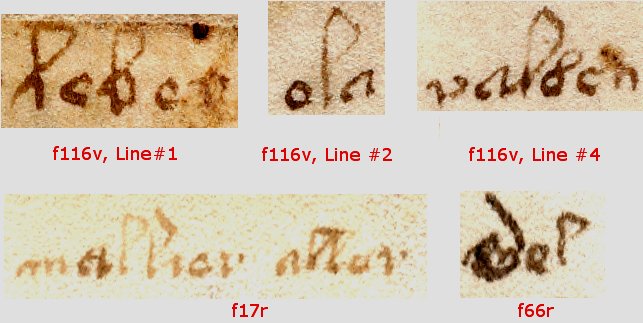
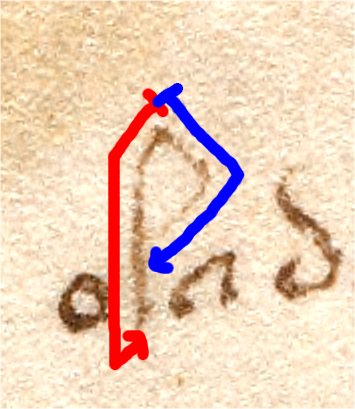
Yesterday, I decomposed the ‘a’ into what I think its constituent strokes are: a curved ‘c’-stroke (red, above) followed by a zigzaggy ‘z’-stroke (blue, above). Now here’s a collection of ‘l’ shapes (and note once again that these are consistent across the various marginalia, just as the “pre-upstroked topless p” marginalia character proved to be back here)…

voynich-marginalia-letter-l

…and the two constituent continuous strokes that I think make up the ‘l’ shape…

voynich-marginalia-letter-l-strokes

My reasoning is; that you can see where the ink pools slightly at the overlap (right at the top); that it’s always easier to do downstrokes than upstrokes with a quill; that the NE-to-SW end part of the second (blue) stroke sometimes crosses over the vertical stroke (most notably in the “por le bon” instance); and that the vertical downstroke seems evenly inked from top to bottom, consistent with a single long stroke.

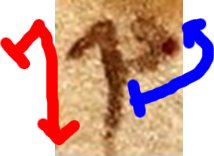
Similarly, here’s how I think the ‘topless p’ character was stroked, with the second (blue) stroke pushed upwards, which I guess accounts for why it stops short:-

voynich-marginalia-letter-p-strokes

Now, the real question is: how can we use this basic codicological and palaeographic knowledge to help us? Tentatively, I suspect we can now identify the hand as a kind of “French Secretary” hand (as shown on this page on Dianne Tillotson’s excellent site) with perhaps just a hint of Italian mercantesca (as illustrated in this paper by Irene Ceccherini). The two-stroke ‘a’ with a peak-y arch seems quite distinctive: probably the next good step would be looking for old-fashioned palaeography books in Gallica, see what kind of a literature there is on the subject.

Anyway, good luck looking for French Secretary hands with topless p-shapes (but be careful of the keywords you use on Google, you may get something of a high ranking surprise)… 😮

Self-professed Voynich skeptic Elmar Vogt has been fairly quiet of late: turns out that he has been preparing his own substantial analysis on his “Voynich Thoughts” website of the Voynich Manuscript’s teasingly hard-to-read marginalia, (with Elias Schwerdtfeger’s notes on the zodiac marginalia appended). Given that Voynich marginalia are pretty much my specialist subject, the question I’m sure you want answered is: how did the boy Vogt do?

Well… it’s immediately clear he’s thorough, insofar as he stepped sequentially through all the word-like groups of letters in the major Voynich marginalia to try to work out what each letter could feasibly be; and from that built up a kind of Brumbaugh-like matrix of combinatorial possibilities for each one for readers to shuffle to find sensible-looking readings. However, it also has to be said that for all of this careful (and obviously prolonged) effort, he managed to get… precisely nowhere at all.

You see, we’ve endured nearly a century’s worth of careful, rational people looking at these few lines of text and being unable to read them, from Newbold’s “michiton oladabas“, through Marcin Ciura’s mirrored “sa b’adalo No Tich’im“, and all the way to my own [top line] “por le bon simon sint…“. Worse still, nobody has even been able to convincingly argue the case for what the author(s) was/were trying to achieve with these confused-looking marginalia, which can easily be read as containing fragments of French, Occitan, German, Latin, Voynichese (and indeed of pretty much any other language you can think of).

And the explanation for this? Well, we Voynich researchers simply love explanations… which is why we have so many of them to choose from (even if none of them stands up to close scrutiny):-

  1. Pen trials?
  2. A joke (oh, and by the way, the joke is on us)?
  3. A hoax?
  4. A cipher key?
  5. Enciphered text?
  6. Some kind of vaguely polyglot text in an otherwise unknown language?

How can we escape this analysis paralysis? Where are those pesky intellectual historians when you actually need them?

I suspect that what is at play here is an implicit palaeographic fallacy: specifically the long-standing (but false) notion that palaeographers try to read individual words (when actually they don’t). Individual word and letter instances suffer from accidents, smudges, blurs, deletions, transfers, rubbing off, corrections, emendations: however, a person’s hand (the way that they construct letters) is surprisingly constant, and is normally able to be located within a reasonably well-defined space of historic hands – Gothic, semi-Gothic, hybrida, mercantesca, Humanist, etc. Hence, the real problem here is arguably that this palaeographic starting point has failed to be determined.

Hence, I would say that looking at individual words is arguably the last thing you should be doing: instead, you should be trying to understand (a) how individual letters are formed, and (b) which particular letter instances are most reliable. From there, you should try to categorise the hand, which should additionally give you some clue as to where it is from and what language it is: and only then should you pass the challenge off from palaeography to historical linguistics (i.e. try to read it). And so I would say that attempting to read the marginalia without first understanding the marginalia hand is like trying to do a triple-jump but omitting both the hop and the skip parts, i.e. you’ll fall well short of where you want to get to.

So let’s buck a hundred years’ worth of trend and try instead to do this properly: let’s simply concentrate on the letter ‘a’ and and see where it takes us.

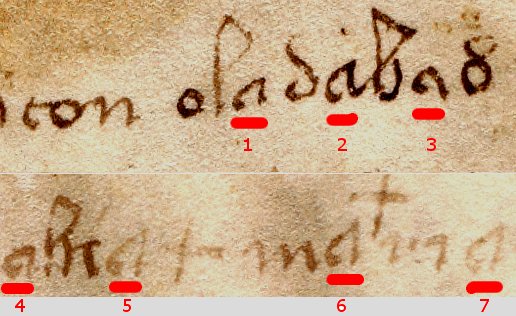
f116v-letter-a

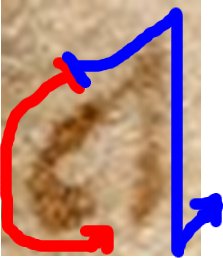
To my eyes, I think that a[5], a[6], and a[7] show no obvious signs of emendation and are also consistently formed as if by the same hand. Furthermore, it seems to me that these are each formed from two continuous strokes, both starting from the middle of the top arch of the ‘a’. That is, the writer first executes a heavy c-like down-and-around curved stroke (below, red), lifts up the pen, places it back on the starting point, and then writes a ‘Z’-like up-down-up zigzaggy stroke (below, blue) to complete the whole ‘a’ shape. You can see from the thickness and shape of the blue stroke that the writer is right-handed: while you can see from the weight discontinuity and slight pooling of ink in the middle of the top line exactly where the two strokes join up. I think this gives us a reasonable basis for believing what the writer’s core stroke technique is (and, just as importantly, what it probably isn’t).

f116v-letter-a-analysis

What this tells us (I think) is that we should be a little uncertain about a[4], (which doesn’t have an obviously well-formed “pointy head”) and very uncertain about a[1], a[2], and a[3] (none of which really rings true).

My take on all this is that I think a well-meaning VMs owner tried hard to read the (by then very faded) marginalia, but probably did not know the language it was written in, leaving the page in a worse mess than what it was before they started. Specifically: though “maria” shouts original to me, “oladaba8” shouts emendation just as strongly. Moreover, the former also looks to my eyes like “iron gall ink + quill”, while the latter looks like “carbon ink + metal nib”.

Refining this just a little bit, I’d also point out that if you also look at the two ascender loops in “oladaba8″, I would argue that the first (‘l’) loop is probably original, while the second (‘b’) loop is structured quite wrongly, and is therefore probably an emendation. And that’s within the same word!

The corollary is simply that I think it highly likely that any no amount of careful reading would untie this pervasively tangled skein if taken at face value: and hence that, for all his persistence and careful application of logic, Elmar has fallen victim to the oldest intellectual trap in the book – of pointing his powerful critical apparatus in quite the wrong direction. Sorry, Elmar my old mate, but you’ve got to be dead careful with these ancient curses, really you have. 🙂

This week is “Shakespeare Week” at my son’s school: his year have been allocated A Midsummer Night’s Dream, and so get to do their lessons in costume for a day. All of which yielded an ideal family opportunity to break out one of those tediously aspirational The-Bard-For-Kidz boxed sets and run through a heavily abridged version with him to see which character he’d like to play (i.e. which outfit we’d be rapidly constructing). And so Puck it was. 🙂

In business school terms, Oberon and Puck come across to me as an idealized (i.e. pragmatic yet dysfunctional) CEO and CTO pair, i.e. where Puck trolls around the wood trying to implement Oberon’s barking mad strategies. Specifically, Puck drops a tincture of “Love In Idleness” into the eyes of those asleep, confident in the knowledge that they will fall in love with the first person (or indeed donkey) they see when they wake up. With hilarious (and/or dramatic) consequences, etc.

Shakespeare is full of folksy herbal stuff like this: in fact, you don’t have to look very far these days to find academics who argue that the witches in Macbeth were talking about not literally about “eye of newt”, “toe of frog”, and “wool of bat”, but referentially to ‘eye’ plants (such as daisies!), buttercups, and holly leaves respectively, as a humorously winking aside to the audience. If correct, this pitches the witches closer to pantomime dames (such as Nana Knickerbocker, my son’s favourite) than to Cruella De Vil… but I digress!

gigglebiz_nanaknicker_150

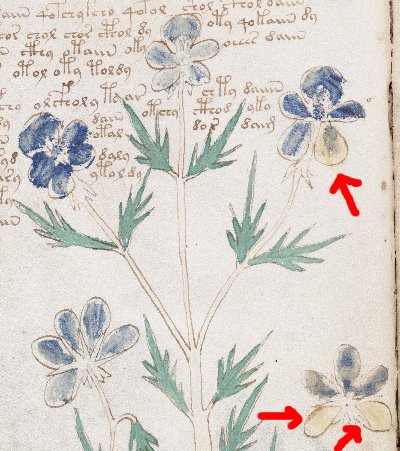
Anyway, it turns out that ‘Love In Idleness’ is actually viola tricolor, the purple wild pansy (from which modern pansies were cultivated in the 19th century), A.K.A. ‘heartsease’ and hundreds of other names. Which, of course, is the cue for a picture of the plant on Voynich Manuscript page f9v, for which numerous people have suggested viola tricolor as a good match:-

f9v-viola-detail

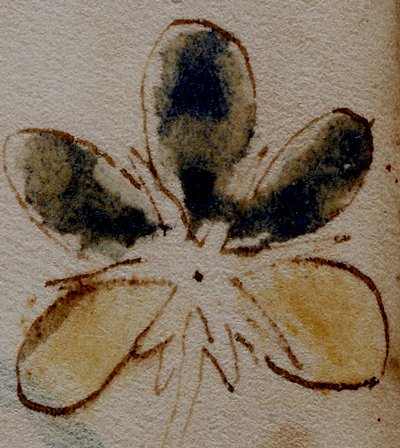
As normal, the unsympathetically-applied blue paint looks as though it was added by a later owner’s young child: yet what is strange here is why three of the leaves seems to have had yellow paint added instead (which is what my annoying red arrows are pointing at). If you contrast-enhance the bottom-right flower, you can see this quite clearly:-

f9v-viola-closeup-enhanced

Why was this so? I don’t know, but perhaps that’s not a bad question to be asking. Is that enough random digressions for one day? Probably! 🙂

Here’s something neat and slightly unexpected from long-time Voynich Manuscript researcher (and Voynich theory über-skeptic) Rene Zandbergen I think you’ll probably appreciate.

Arguably the least-discussed subject in the VMs is the set of tiny plant drawings in the two ‘pharma’ (pharmacological) sections, which somehow usually manage to fly beneath most researchers’ radars. Yet it has been known for decades that a good number of these plant drawings recapitulate or copy plant drawings in the main herbal sections (though as I recall these are more or less all Herbal A plants, please correct me if I’m wrong) – mapping these correspondences properly is an interesting challenge in its own right, but one to which nobody (as far as I can see) has really stepped up in the last decade.

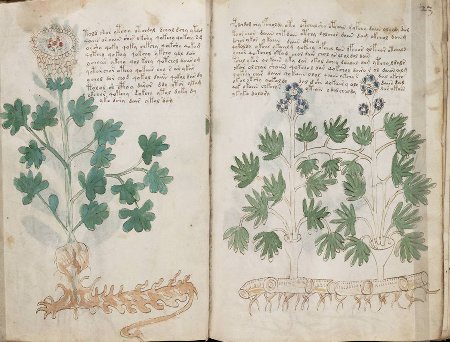
And so it is that the general indifference to the pharma section forms the backdrop to Rene’s latest observation, which is this: that the pair of roots depicted on the two (now separated) halves of the Herbal A f18v-f23r bifolio recur side-by-side at the bottom of f102r2 in the pharma section. Here’s what the f18v-f23r bifolio would look like if you took out the bifolios currently bound between them (ignore the green mark in the middle from f22v, that’s just my lazy editing):-

f18v-f23r-bifolio-small

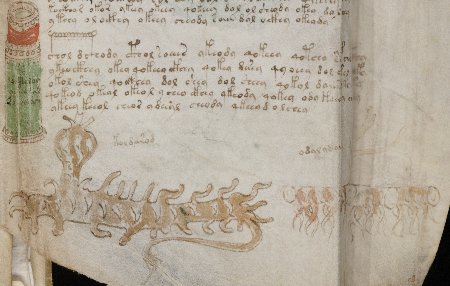
…and here’s what the pair of roots at the bottom of f102r2 look like. Somewhat familiar, eh?

f102r2-detail-small

Actually, I think it’s fair to say that this is extremely familar.

Now, it should be obvious that that you can (depending on how strong a piece of evidence you think the above amounts to, and what other observations you think are relevant) build all kinds of inferential chains on top of this. Cautious soul that he is, Rene concludes: “the colours of the two herbal pages were perhaps not applied when the bifolio was laying open like this“, basically because the two green paints are so different, which is similar to my observation in yesterday’s post about the two blues in Q9. He continues: “I don’t even think that the colours were applied by the same person who made the outline drawings, not deriving from these drawings though.

Regardless, the pretty-much-unavoidable codicological starting point would seem to be that f18v and f23r originally sat side-by-side, and hence almost certainly sat at the centre of a herbal gathering / quire. It also seems likely that the two green paints were applied after other bifolios had been inserted between f18v and f23r (though not necessarily in their final binding order, or at the same time).

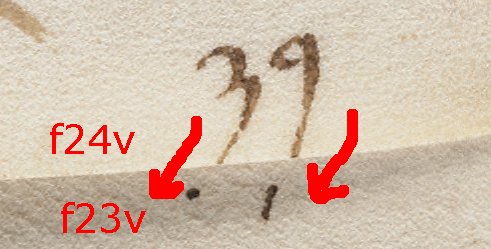
Furthermore, if you look at f23v (i.e. the verso side of f23r), you can see where the tails of the “39” quire number’s two long downstrokes have gone over from the bottom of f24v (the last page of the quire). This indicates to me that the f18v / f23r bifolio was already nested just inside the f17 / f24 bifolio when the quire numbers were added: and when combined with the new idea that f18v-f23r was probably the central bifolio of its original gathering, I think the implication is that (unless Q3 was originally composed of just two bifolios, which seems somewhat unlikely) Q3’s quire number was added after the bifolios had been reordered / scrambled / misordered. OK, it’s pretty much the same thing I argued in “The Curse” (pp.62-68): but it’s nice to see the same ideas coming out from a different angle.

q3-quire-mark

However, the range of green paints is a bit troubling. Even though I’ve just now looked at all the greens in Q3, I’m struggling to reconstruct a sensible codicological sequence: but perhaps the reason for this will turn out to be that there isn’t one to be found. Could it be that a significant amount of Herbal grouping data could be inferred simply by spectroscopically analysing the various green paints used, and looking for recto/verso matches? Glen Claston will doubtless argue otherwise, but the chances that a verso page and a recto page with precisely the same green paint were facing each other at the time they were painted must surely be pretty good, right?

So, Rene: another good find, cheers! 🙂